info@biomedres.us
+1 (502) 904-2126
One Westbrook Corporate Center, Suite 300, Westchester, IL 60154, USA
Site Map
 ISSN: 2574 -1241
Received: October 15, 2026; Published: October 26, 2026
*Corresponding author: Salvador Pérez-Mora, Undergraduate Student in Dentistry, Universidad UCAD, Mexico City 07340, Mexico, Doctoral Student in Educational Sciences, Centro de Estudios Profesionales y de Investigación (ESPI), Ciudad López Mateos 52970, State of Mexico, Postdoctoral Researcher, Molecular Biomedicine Laboratory I, Escuela Nacional de Medicina y Homeopatía (ENMyH), Instituto Politécnico Nacional (IPN), Mexico City 07320, Mexico
DOI: 10.26717/BJSTR.2026.67.010457
Periodontitis is a chronic, multifactorial inflammatory disease associated with dysbiotic dental biofilm that leads to the progressive destruction of tooth-supporting tissues and has been linked to numerous systemic diseases. However, the coexistence of two conditions does not establish a causal relationship. This study combined bibliometric analysis with a narrative synthesis to characterize the research landscape of periodontal–systemic connections and assess the strength of the supporting mechanistic evidence. A total of 3,937 Scopus-indexed publications (2000–2026) were analyzed. Annual scientific output increased from 34 publications in 2000 to 461 in 2025, with 62.5% published since 2019. Diabetes mellitus and cardiovascular diseases were the most extensively investigated conditions. However, relatively few publications explicitly addressed the pathways through which periodontal-derived signals reach distant organs. The hematogenous/systemic route was identified in 4.0% of the corpus, followed by the oral–gut axis (1.3%) and oral–lung axis (1.0%). Inflammation was the most frequently investigated mechanism (38.1%), followed by microbiome alterations/dysbiosis (17.1%), immune responses (13.6%), microbial virulence factors/lipopolysaccharide (LPS) (9.4%), oxidative stress (6.7%), and extracellular vesicles (2.2%). Based on these findings, an integrative framework comprising four modes of long-range communication was developed: direct trafficking, systemic inflammatory signaling, central immune reprogramming, and adaptive immune trafficking. Among these mechanisms, only systemic inflammatory signaling was supported by evidence from human interventional studies. Overall, the literature predominantly focuses on epidemiological associations, the detection of microbial components, and their biological activity, whereas direct evidence establishing their periodontal origin and causal involvement remains limited. Future progress in this field will require a clear distinction between detection, source attribution, viability, biological activity, and causality.
Keywords: Periodontitis; Periodontal Medicine; Bibliometric Analysis; Systemic Inflammation; Oral Microbiome; Levels of Evidence; Porphyromonas gingivalis; Hematogenous Dissemination; Oral–Gut Axis; Oral–Lung Axis
Abbreviations: LPS: Lipopolysaccharide; HSPCs: Hematopoietic Stem and Progenitor Cells; CSV: Comma-Separated Values; DOI: Digital Object Identifier; OMVs: Outer Membrane Vesicles; PPAD: Peptidylarginine Deiminase; Th17: T Helper 17; PAMPs: Pathogen-Associated Molecular Patterns; PCR: Polymerase Chain Reaction
Abstract Figure
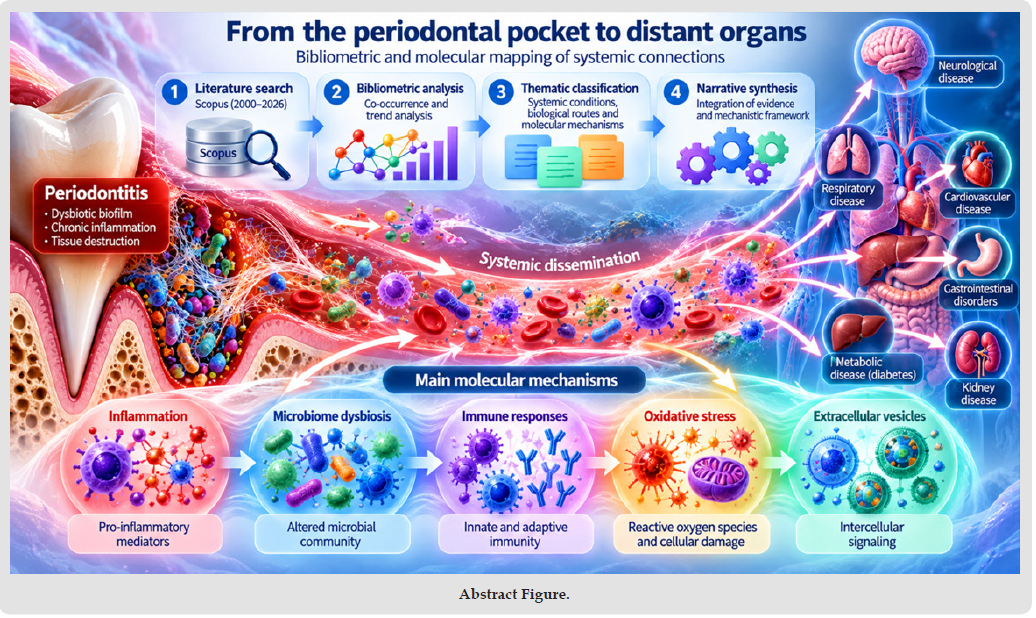
Although periodontitis is a disease localized to the periodontium, its associations extend far beyond the oral cavity. Over recent decades, periodontitis has been linked to cardiovascular diseases, diabetes mellitus, respiratory and kidney diseases, rheumatoid arthritis, gastrointestinal disorders, neurodegenerative conditions, cancer, and adverse pregnancy outcomes. These associations have positioned the connection between localized oral inflammation and distant organs as a major area of interest in contemporary periodontal medicine [1,2]. Biologically, periodontitis is characterized by subgingival biofilm dysbiosis, dysregulation of the host immune response, and progressive destruction of tooth-supporting tissues. The current challenge is not merely to recognize these associations, but to determine how a periodontal lesion may generate signals capable of reaching or affecting distant tissues and to establish the level of evidence supporting these connections [3].
The growing recognition of these associations has consolidated the concept of periodontal medicine while also highlighting a fundamental limitation: epidemiological coexistence does not, by itself, establish causality. Periodontitis and many systemic diseases share risk factors, genetic susceptibility, and metabolic and immunoinflammatory mechanisms, making it difficult to distinguish direct biological connections from associations explained, at least in part, by shared determinants [4].
Therefore, the central question is not simply whether periodontitis is associated with a given systemic condition, but whether a demonstrable biological sequence connects the periodontal lesion to distant tissues. One of the most extensively investigated explanations involves hematogenous dissemination. Periodontal inflammation and disruption of the epithelial barrier may facilitate transient episodes of bacteremia, allowing microorganisms or microbial products to enter the bloodstream, a phenomenon documented using microbiological and molecular approaches [5,6]. However, detecting microbial material in the systemic compartment represents only the initial step in establishing a mechanistic connection. The detection of a microbial signal does not necessarily establish its periodontal origin; the identification of microbial DNA does not demonstrate viability; the presence of viable microorganisms does not, by itself, confirm biologically relevant activity; and the demonstration of a functional response does not automatically establish causality. Distinguishing among these levels of evidence is essential for critically assessing the extent to which a periodontal–systemic association represents a biologically supported connection.
The complexity of these interactions has progressively shifted the conceptual framework beyond bacteremia alone. Periodontal lesions may serve as a source not only of microorganisms but also of endotoxins, virulence factors, extracellular vesicles, and host-derived mediators capable of entering the circulation or modulating systemic responses [7]. Consistent with this framework, periodontitis has been associated with measurable systemic inflammation and alterations in circulating immune responses [3,8]. Furthermore, periodontal treatment can reduce certain systemic inflammatory markers; however, changes in biomarkers or intermediate physiological functions do not necessarily translate into the prevention of clinically manifest disease in distant organs [9,10]. This broader framework also encompasses mechanisms that do not require the persistent presence of microorganisms within recipient tissues. Proposed mechanisms include the reprogramming of hematopoietic stem and progenitor cells (HSPCs), modulation of circulating immune responses, and trafficking of activated immune cells [11]. In addition, periodontal–systemic communication may occur through distinct biological routes, including hematogenous/systemic dissemination, the oral–gut axis, and the oral–lung axis, further expanding the conceptual model of communication between periodontal lesions and distant organs [7,12]. Collectively, these observations suggest that the relationship between periodontitis and systemic diseases is unlikely to be explained by a single route or mechanism.
This increasing mechanistic complexity has been accompanied by a rapid expansion of the scientific literature. The field now encompasses research ranging from epidemiological associations and systemic biomarkers to microbial translocation, dysbiosis, inflammation, immunometabolism, and immune reprogramming [3,7]. However, an increase in publication output does not necessarily reflect a corresponding advance in mechanistic understanding or causal evidence. It remains necessary to determine which systemic conditions have received the greatest scientific attention, which biological routes have been explicitly investigated, which mechanisms predominate in the literature, and, most importantly, to what extent the available evidence supports progression from statistical associations toward biologically substantiated connections. Overall, the periodontal–systemic literature has evolved from describing clinical associations toward increasingly complex models of biological communication between periodontal lesions and distant organs.
However, this expansion has also resulted in a fragmented research landscape in which epidemiological associations, proposed anatomical routes, molecular mechanisms, and different levels of evidence coexist [7,12]. Bibliometric analysis provides a means of mapping the evolution and conceptual structure of a research field [13]. In this context, integrating bibliometric approaches with mechanistic evidence assessment is particularly valuable for organizing a large and heterogeneous body of literature characterized by varying levels of inferential strength. The aim of this study was to integrate these dimensions into a unified framework to identify which systemic conditions have received the greatest scientific attention, which biological routes and molecular mechanisms have been proposed to explain their connections with periodontitis, and to what extent the available evidence supports these relationships.
Study Design
A bibliometric study complemented by a focused narrative synthesis of the literature was conducted to characterize the evolution, thematic structure, and major research trends concerning the connections between periodontitis and systemic diseases or conditions. The analysis comprised two complementary components. The first quantitatively characterized the bibliographic corpus using indicators of scientific output, citation performance, geographical distribution, publication sources, keyword co-occurrence, and thematic evolution. The second examined the representation of major systemic conditions and their co-occurrence with biological routes and molecular mechanisms potentially involved in communication between periodontal lesions and distant organs. The narrative synthesis was used to provide biological context for the patterns identified through bibliometric analysis and was not intended to constitute a systematic review or meta-analysis.
Data Source and Search Strategy
The literature search was conducted on September 5, 2026, using Scopus (Elsevier, https://www.scopus.com/pages/home), which was selected for its broad multidisciplinary coverage and availability of structured metadata suitable for bibliometric analyses [14]. Records were retrieved using the TITLE-ABS-KEY field, which searches publication titles, abstracts, and keywords.
The following search query was applied in Scopus: TITLE-ABSKEY ((periodontitis OR “periodontal disease” OR “periodontal diseases”) AND (“systemic disease” OR “systemic diseases” OR “systemic health” OR “systemic condition” OR “systemic conditions” OR “systemic effect” OR “systemic effects” OR “systemic manifestation” OR “systemic manifestations” OR “extraoral disease” OR “extraoral diseases” OR “extraoral effect” OR “extraoral effects” OR “oral-systemic” OR “oral systemic” OR “periodontal-systemic” OR “periodontal systemic”)).
The search was restricted, using the Scopus filters, to publications from 2000 to 2026, written in English, and classified as Article or Review. The search strategy was designed to provide broad thematic coverage of the periodontal–systemic research landscape without restricting retrieval a priori to specific diseases, organs, or molecular mechanisms. Because the search was conducted before the end of 2026, data for this year were considered incomplete in the temporal analyses.
Eligibility Criteria and Corpus Development
Records retrieved through the search strategy described above were included if they met the predefined criteria for publication period, document type, and language. Editorials, letters, book chapters, conference abstracts, notes, and other publication types outside the predefined eligibility criteria were excluded. Eligible records were exported in comma-separated values (CSV) format, including authors, publication title, publication year, source title, affiliations, citation counts, digital object identifier (DOI), abstract, Author Keywords, Index Keywords, and bibliographic references. Before analysis, duplicate records were screened using the DOI as the primary identifier and normalized publication titles as a secondary criterion. Records sharing an identical DOI were considered bibliographic duplicates, and only one record was retained. Publications with similar titles but different DOIs were not automatically removed to avoid inadvertently excluding independent publications or simultaneously published articles indexed as separate records.
Data Cleaning and Normalization
The Author Keywords were converted to lowercase and standardized using a thesaurus file to minimize unnecessary terminological variations. Spelling differences, singular and plural forms, hyphenation, and conceptually equivalent terms were harmonized. The main adjustments included merging periodontal disease and periodontal diseases into periodontitis, and diabetes and type 2 diabetes into diabetes mellitus. Similarly, cardiovascular diseases, oral microbiota, and biomarkers were standardized to cardiovascular disease, oral microbiome, and biomarker, respectively. Normalization was performed conservatively to avoid merging biologically distinct concepts solely on the basis of semantic similarity. Accordingly, terms such as periodontal health, oral bacteria, oral pathogens, outer membrane vesicles (OMVs), reactive oxygen species, systemic inflammation, chronic inflammation, immune response, innate immunity, and pregnancy were retained as separate terms. Likewise, preterm birth and low birth weight were maintained as independent terms in the Author Keywords analysis. Generic, methodological, or conceptually uninformative terms were excluded from the thematic characterization, including article, review, systematic review, meta-analysis, association, prevalence, risk factors, diagnosis, and treatment. The final thesaurus is available in Zenodo (https://doi.org/10.5281/zenodo.23362562). For subsequent text-based analyses, information from the Title, Abstract, Author Keywords, and Index Keywords fields was combined. Searches were performed in a case-insensitive manner, and each term or category was counted only once per document within each analysis.
Descriptive Bibliometric Indicators
Annual scientific output was determined by the number of documents published each year from 2000 to 2026. The distribution by document type (Article or Review, according to the Scopus classification) was examined across three consecutive nine-year periods: 2000–2008, 2009–2017, and 2018–2026. For each period, the total number of documents and the proportion classified as reviews were calculated. Journal productivity was assessed using the Source title field, identifying the 15 journals with the highest number of publications. Geographic research output was determined from the countries listed in author affiliations using the full counting method at the country level. Each country received one count per document when represented in at least one affiliation, regardless of the number of authors or institutions associated with that country. Consequently, internationally coauthored publications could contribute simultaneously to the publication counts of multiple countries. Country names were standardized before analysis. Citation impact was assessed using the Cited by field recorded in Scopus at the time of data retrieval. Cumulative citation counts, without normalization by publication year, were used to identify the 15 most highly cited documents in the corpus. Simultaneously published articles indexed by Scopus as independent records were retained and counted separately.
Keyword Co-Occurrence Analysis
The conceptual structure of the research field was examined using VOSviewer version 1.6.21, based exclusively on the previously standardized Author Keywords. The full counting method was applied, with a minimum threshold of 10 occurrences for term inclusion and normalization using association strength. Three complementary visualizations were generated from the same keyword dataset: network visualization, to illustrate thematic structure and connectivity; overlay visualization, to examine the temporal distribution of terms according to their average publication year; and density visualization, to identify areas with the highest concentration of terms and co-occurrence relationships. In the network, node size represented the frequency of occurrence of each term, while links indicated co-occurrence relationships between terms.
Frequency and Temporal Evolution of Author Keywords
The 15 most frequently occurring Author Keywords in the normalized corpus were identified, counting each term only once per document. To assess their temporal evolution, the study period was divided into three consecutive nine-year intervals: 2000–2008, 2009–2017, and 2018–2026. For each term, the number of documents in each interval and its proportion relative to the total number of documents with available Author Keywords in the corresponding period were calculated. This approach allowed absolute growth to be distinguished from changes in the relative representation of individual terms within the literature. Temporal evolution was visualized using an alluvial diagram. To accommodate differences in term frequencies, node and ribbon widths were scaled according to the square root of the number of documents, while labels displayed absolute document counts. The 2018–2026 interval includes incomplete data for 2026.
Thematic Classification of Systemic Conditions
The major systemic conditions were identified through a term-based thematic classification applied collectively to the Title, Abstract, Author Keywords, and Index Keywords fields. Ten categories were defined: diabetes mellitus, cardiovascular disease, cancer, obesity/metabolic disorders, adverse pregnancy outcomes, respiratory disease, rheumatoid arthritis, Alzheimer’s disease/neurodegeneration, chronic kidney disease, and inflammatory bowel disease. Each category was defined using a controlled dictionary of terms and their variants, which was reviewed beforehand to minimize terminological overlap between categories. At this classification level, clinically related terms such as preterm birth and low birth weight were grouped under adverse pregnancy outcomes, although they were retained as independent terms in the Author Keywords analysis. Each document was counted only once within each category but could contribute to more than one systemic condition when the corresponding classification criteria were met. Three indicators were calculated for each systemic condition: the total number of documents, the average publication year, and the proportion of recent publications, defined as the percentage of documents published between 2020 and 2026 relative to the total number of documents assigned to that category.
Disease–Route–Mechanism Co-Occurrence Analysis
A document-level co-occurrence analysis was performed using the Title, Abstract, Author Keywords, and Index Keywords fields collectively. Biological routes were grouped into three categories: hematogenous/systemic dissemination, oral–gut axis, and oral–lung axis. Hematogenous/systemic dissemination was defined as the entry of periodontal microorganisms, their products, or inflammatory mediators into the bloodstream; the oral–gut axis as the connection between the oral cavity and the intestine, either through ectopic microbial colonization or immune cell trafficking; and the oral–lung axis as the connection between the oral cavity and the lungs, primarily through aspiration of oral secretions. Molecular mechanisms were classified into six categories: inflammation, oxidative stress, microbiome/dysbiosis, immunity, virulence/LPS, and extracellular vesicles. Each systemic condition, biological route, and molecular mechanism was identified using controlled dictionaries of terms and their variants, available in Zenodo (https://doi.org/10.5281/zenodo.23362562). For each document, only the presence or absence of each category was recorded, ensuring that repeated occurrences of the same term within a record did not increase its count. To minimize associations arising from terminological overlap, generic terms such as gut microbiota, gut microbiome, and gut dysbiosis, as well as their intestinal equivalents, were not used independently to define the oral–gut axis. Similarly, the term inflammatory alone was not considered sufficient to classify a document under the inflammation mechanism, thereby preventing the automatic inclusion of publications mentioning inflammatory bowel disease.
Disease–route co-occurrence was recorded when both categories were identified within the same document, whereas route–mechanism co-occurrence was recorded when both appeared in the same publication. Each category pair contributed a maximum of one count per document. Disease–route and route–mechanism co-occurrences were summarized using document-level matrices. For each category pair, the number of documents in which both categories were present was calculated, together with its proportion relative to the total number of documents assigned to the corresponding row category. The complete co-occurrence matrices are available in Zenodo (https://doi.org/10.5281/zenodo.23362562). These relationships were interpreted exclusively as thematic co-occurrences within the scientific literature and not as direct evidence of biological translocation, molecular activity, directionality of effects, or clinical causality.
Narrative Synthesis and Development of Conceptual Models
The bibliometric findings were complemented by a focused narrative synthesis aimed at providing biological context for the major routes and mechanisms identified and integrating representative evidence concerning periodontal–systemic connections. References were identified through targeted searches in Scopus and examination of consensus reports, systematic reviews, and relevant primary studies. Priority was given to publications providing evidence directly related to the biological routes, molecular mechanisms, or systemic consequences under consideration, including epidemiological, experimental, microbiological, molecular, and interventional studies. Study selection was intended for contextual and interpretative purposes rather than comprehensive evidence retrieval. No formal risk-of-bias assessment or hierarchical grading of evidence quality was performed. Accordingly, this component should be interpreted as a narrative synthesis rather than a systematic review. Based on this evidence, two complementary conceptual models were developed. The first integrated periodontal sources, the three biological routes examined, the mechanistic categories identified through bibliometric analysis, and their major systemic consequences.
The n values associated with the mechanisms were derived from the bibliometric analysis, whereas specific molecular processes and systemic consequences were informed by the selected literature. The second model organized communication between periodontal lesions and distant organs into four conceptual modes: direct trafficking, systemic inflammatory signaling, central immune reprogramming, and adaptive immune trafficking. This classification was based on the nature of the transmitted signal, the biological compartment involved, and the type of available evidence. These modes were not considered mutually exclusive. Finally, the evidence was organized into five conceptual levels of inferential strength: detection, periodontal source attribution, viability or cargo integrity, biological activity, and causality. Each level was defined according to what could be established by the experimental design and analytical methods employed. These levels served as a framework for distinguishing different degrees of mechanistic demonstration, and the available evidence supporting a given association was not assumed to progress necessarily through these levels in a sequential manner. The qualitative assessment of the available evidence at each level—extensive, limited, or scarce—was based on the representative literature reviewed rather than on bibliometric counts.
Software and Data Visualization
Co-occurrence network maps, temporal overlay maps, and density maps were generated using VOSviewer version 1.6.21. Corpus processing, data cleaning, document-level counting, and frequency and co-occurrence analyses were conducted using Python 3.13.5, primarily employing pandas 2.2.3 for data processing and Matplotlib 3.10.8 for customized quantitative visualizations. The individual document was used as the fundamental unit of analysis and counting.
Analytical Considerations
All analyses were descriptive and exploratory in nature. Term frequencies, publication counts, and co-occurrence patterns were used to characterize the structure and evolution of the scientific literature and were not interpreted as direct measures of biological relevance, the magnitude of clinical associations, or causality.
No hypothesis testing or meta-analysis of effect sizes was performed, and bibliometric frequencies were not used to draw causal inferences. Furthermore, the conceptual models represent an interpretative integration of published evidence rather than experimental demonstration of a single causal pathway linking periodontitis to systemic diseases.
Bibliometric Overview and Thematic Structure
The search yielded 3,937 documents, comprising 2,677 original research articles and 1,260 review articles.
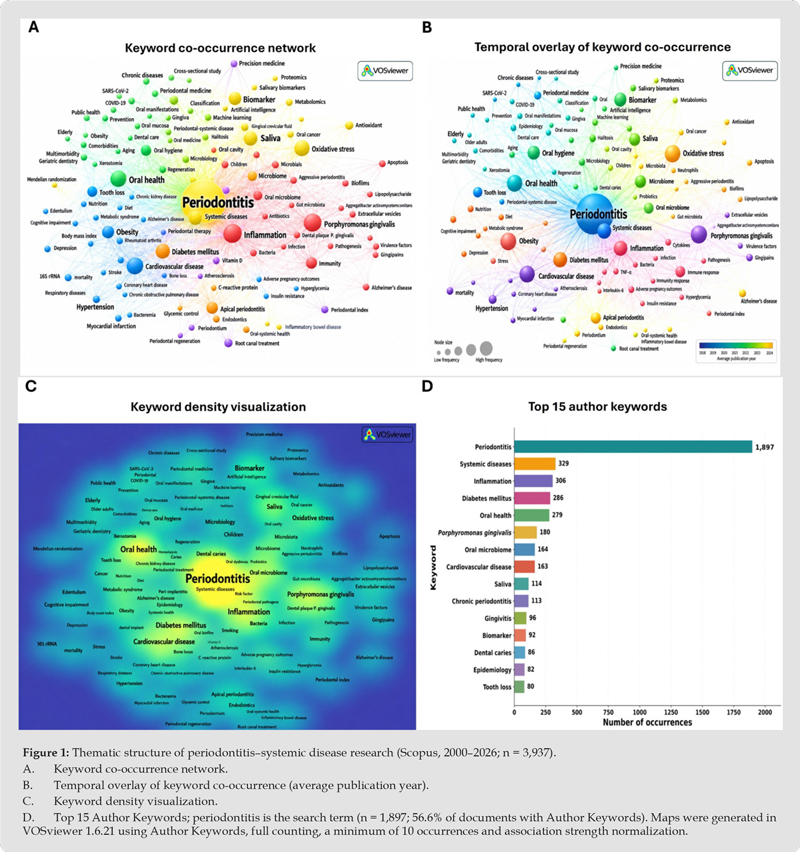
In the keyword co-occurrence network, periodontitis was the largest and most centrally positioned node, showing prominent connections with systemic diseases, inflammation, diabetes mellitus, cardiovascular disease, oral health, Porphyromonas gingivalis (P. gingivalis), and oxidative stress (Figure 1A). In the temporal overlay visualization, terms such as microbiome, biomarker, metabolomics, proteomics, precision medicine, machine learning, and artificial intelligence exhibited more recent average publication years (Figure 1B). The density visualization revealed the highest concentrations around periodontitis, inflammation, systemic diseases, diabetes mellitus, cardiovascular disease, oral health, and P. gingivalis (Figure 1C). Among the 3,354 documents with available Author Keywords, periodontitis, the central term of the search strategy, appeared in 1,897 documents (56.6%). Other frequently occurring terms included systemic diseases (n = 329), inflammation (n = 306), diabetes mellitus (n = 286), oral health (n = 279), P. gingivalis (n = 180), oral microbiome (n = 164), and cardiovascular disease (n = 163), followed by saliva (n = 114), chronic periodontitis (n = 113), gingivitis (n = 96), biomarker (n = 92), dental caries (n = 86), epidemiology (n = 82), and tooth loss (n = 80) (Figure 1D)
Figure 1
Scientific Output, Thematic Evolution, and Citation Impact
Annual scientific output increased from 34 documents in 2000 to 461 in 2025, with a marked acceleration since 2019. A total of 2,460 documents (62.5% of the corpus) were published between 2019 and 2026. The year 2026, which was still incomplete at the time of data retrieval, accounted for 372 documents (Figure 2A). Of the 3,937 documents, 2,677 (68.0%) were original research articles and 1,260 (32.0%) were reviews. Publication output increased from 389 documents in 2000–2008 to 949 in 2009–2017 and 2,599 in 2018–2026. The proportion of review articles was 33.7%, 25.4%, and 34.2%, respectively (Figure 2B). The temporal analysis of Author Keywords revealed a shift toward microbiome- and biomarker-related research topics. The frequency of oral microbiome increased from 0 documents in 2000–2008 to 156 in 2018–2026, P. gingivalis from 8 to 148, and biomarker from 1 to 76. In relative terms, oral microbiome increased from 0% to 6.5% of documents with available Author Keywords, whereas P. gingivalis increased from 3.9% to 6.1%. Conversely, the relative representation of diabetes mellitus decreased from 11.2% to 7.8%, and that of cardiovascular disease from 7.3% to 4.1%, while inflammation remained consistently represented across the three periods (9.2%, 7.3%, and 9.7%, respectively) (Figure 2C). The United States led scientific output (n = 889; 22.6% of the corpus), followed by China (n = 474), India (n = 471), Japan (n = 274), and Brazil (n = 263). Italy, the United Kingdom, Germany, Türkiye, and Saudi Arabia occupied the next positions, while Spain, South Korea, Sweden, Poland, and Romania completed the 15 most productive countries (Figure 2D). Mexico ranked 34th, outside the top 15, with 30 documents (0.8% of the corpus).
Figure 2
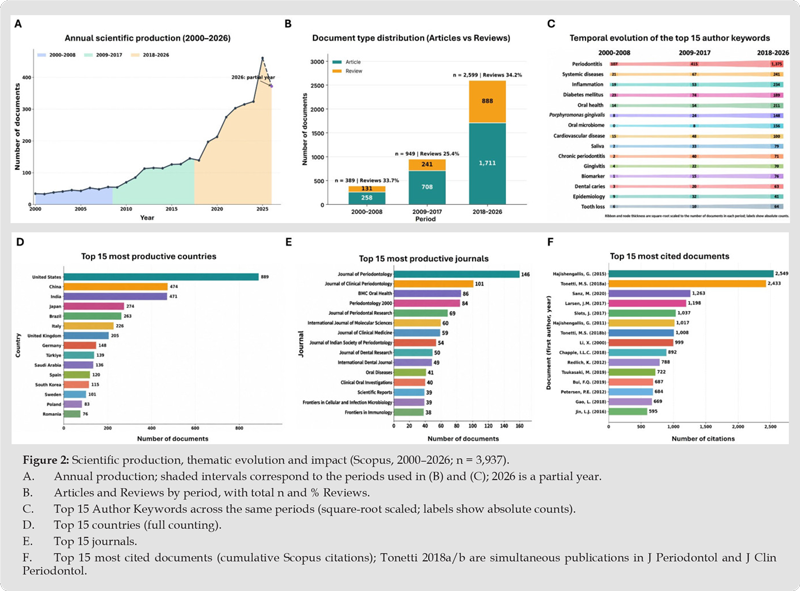
The documents were distributed across 1,212 publication sources, with the 15 most productive journals accounting for 955 publications (24.3%). Journal of Periodontology ranked first (n = 146), followed by Journal of Clinical Periodontology (n = 101), BMC Oral Health (n = 86), Periodontology 2000 (n = 84), and Journal of Periodontal Research (n = 69) (Figure 2E). The corpus accumulated 139,323 citations, with a median of 10 citations per document. The most highly cited publications were those by Hajishengallis [15] (2015; 2,549 citations), Tonetti, et al. [16] (2018a; 2,433), Sanz, et al. [17] (2020; 1,263), Larsen [18] (2017; 1,198), and Slots [19] (2017; 1,037). Other highly cited publications included Hajishengallis, et al. [20] (2011; 1,017), Tonetti, et al. [21] (2018b; 1,008), Li, et al. [22] (2000; 999), Chapple, et al. [23] (2018; 892), Redlich and Smolen [24] (2012; 788), Tsukasaki and Takayanagi [25] (2019; 722), Bui, et al. [26] (2019; 687), Petersen and Baehni [27] (2012; 684), Gao, et al. [28] (2018; 669), and Jin, et al. [29] (2016; 595). Collectively, the most highly cited literature encompassed seminal mechanistic studies, conceptual and narrative reviews, international consensus reports, and broader contributions addressing periodontal inflammation, oral microbiology, disease classification, and the relationship between oral and systemic health (Figure 2F).
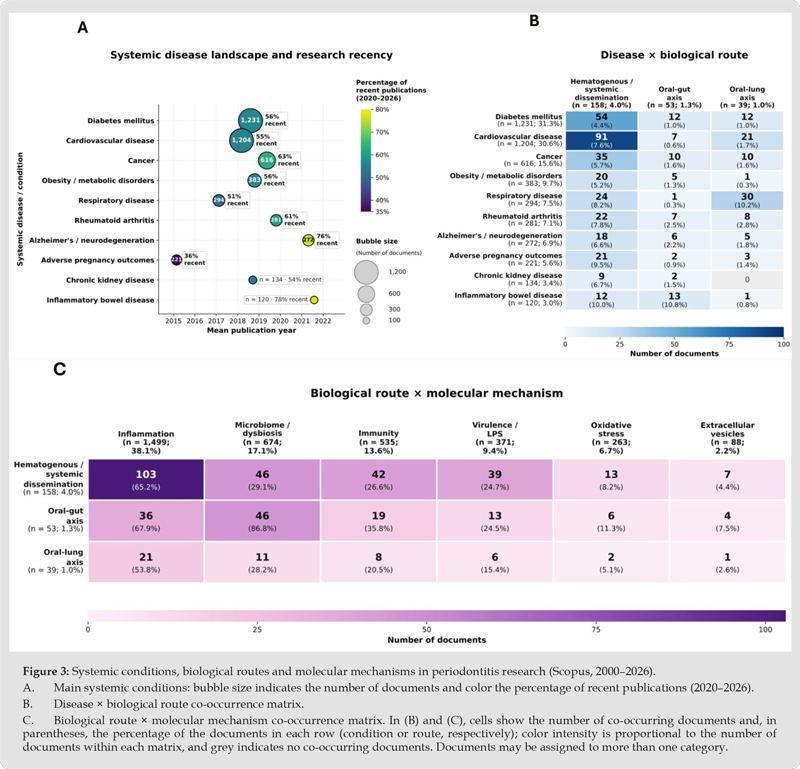
Figure 3
Systemic Conditions, Biological Routes, and Molecular Mechanisms
Diabetes mellitus was the most frequently investigated systemic condition (n = 1,231; 31.3% of the corpus), followed by cardiovascular disease (n = 1,204; 30.6%) and cancer (n = 616; 15.6%). Other conditions included obesity/metabolic disorders (n = 383; 9.7%), respiratory disease (n = 294; 7.5%), rheumatoid arthritis (n = 281; 7.1%), Alzheimer’s disease/neurodegeneration (n = 272; 6.9%), adverse pregnancy outcomes (n = 221; 5.6%), chronic kidney disease (n = 134; 3.4%), and inflammatory bowel disease (n = 120; 3.0%). The highest proportions of recent publications were observed for inflammatory bowel disease (77.5% of its documents published between 2020 and 2026; mean publication year, 2021.6), Alzheimer’s disease/neurodegeneration (75.7%; 2021.3), cancer (62.7%), and rheumatoid arthritis (60.9%). In contrast, adverse pregnancy outcomes exhibited the earliest publication profile (35.7%; mean publication year, 2015.1) (Figure 3A). Biological routes were explicitly identified in only a small proportion of the corpus: hematogenous/systemic dissemination in 158 documents (4.0%), the oral–gut axis in 53 (1.3%), and the oral–lung axis in 39 (1.0%). Because these categories were not mutually exclusive, their percentages do not sum to 100%. Together, they accounted for no more than 250 documents (6.4%), indicating that at least 3,687 documents (93.6%) did not explicitly describe any of the three routes. The most frequent disease–route co-occurrence involved cardiovascular disease and hematogenous/systemic dissemination (n = 91; 7.6% of cardiovascular disease-related documents), followed by diabetes mellitus (n = 54; 4.4%) and cancer (n = 35; 5.7%) with the same route.
For the oral–gut axis, the highest co-occurrence frequencies were observed with inflammatory bowel disease (n = 13; 10.8%) and diabetes mellitus (n = 12; 1.0%), whereas the oral–lung axis most frequently co-occurred with respiratory disease (n = 30; 10.2%) and cardiovascular disease (n = 21; 1.7%) (Figure 3B).Among the molecular mechanisms, inflammation was the most frequently represented (n = 1,499; 38.1% of the corpus), followed by microbiome/dysbiosis (n = 674; 17.1%), immunity (n = 535; 13.6%), virulence/LPS (n = 371; 9.4%), oxidative stress (n = 263; 6.7%), and extracellular vesicles (n = 88; 2.2%). Each biological route exhibited a distinct mechanistic co-occurrence profile. Hematogenous/systemic dissemination most frequently co-occurred with inflammation (n = 103; 65.2% of documents assigned to this route), followed by microbiome/dysbiosis (n = 46), immunity (n = 42), and virulence/LPS (n = 39). The oral–gut axis predominantly co-occurred with microbiome/dysbiosis (n = 46; 86.8%) and inflammation (n = 36; 67.9%), whereas the oral–lung axis most frequently co-occurred with inflammation (n = 21; 53.8%) and microbiome/dysbiosis (n = 11; 28.2%). Extracellular vesicles, the least represented mechanistic category, co-occurred with hematogenous/systemic dissemination in seven documents and with the oral–gut axis in four documents. Percentages in the co-occurrence matrices represent the proportion of documents within each systemic condition (Figure 3B) or biological route (Figure 3C) exhibiting the corresponding co-occurrence. Individual documents could be assigned to multiple systemic conditions, biological routes, or molecular mechanisms. Accordingly, co-occurrence patterns reflect how frequently these topics were addressed together in the literature rather than establishing causal relationships (Figure 3C).
Synthesis of Representative Evidence
Table 1 summarizes representative evidence for ten systemic conditions, integrating the reported biological routes, major mechanisms involved, associated periodontal-derived factors, and documented systemic consequences. Biological routes were assigned to each condition according to the communication pathways proposed in the representative references and grouped into the three categories used in the bibliometric analysis: hematogenous/systemic dissemination, involving the entry of periodontal microorganisms or their products (such as LPS, vesicles, and inflammatory mediators) into the bloodstream and their subsequent transport to distant organs; the oral–gut axis, encompassing ectopic intestinal colonization by oral microorganisms and the migration of immune cells from the oral cavity to the intestine; and the oral–lung axis, involving aspiration of oral secretions into the lower respiratory tract. A given systemic condition could involve more than one biological route. Hematogenous/systemic dissemination was the most frequently described route, identified in nine of the ten systemic conditions, with inflammatory bowel disease being the only exception, for which only the oral–gut axis was described. The oral–gut axis was also identified in obesity/metabolic disorders and cancer, whereas the oral–lung axis was described exclusively in respiratory disease. Inflammation was the common mechanism across all ten conditions, frequently accompanied by oxidative stress and immune activation.
Table 1: Major systemic conditions associated with periodontitis: proposed biological routes, mechanisms, and representative evidence.
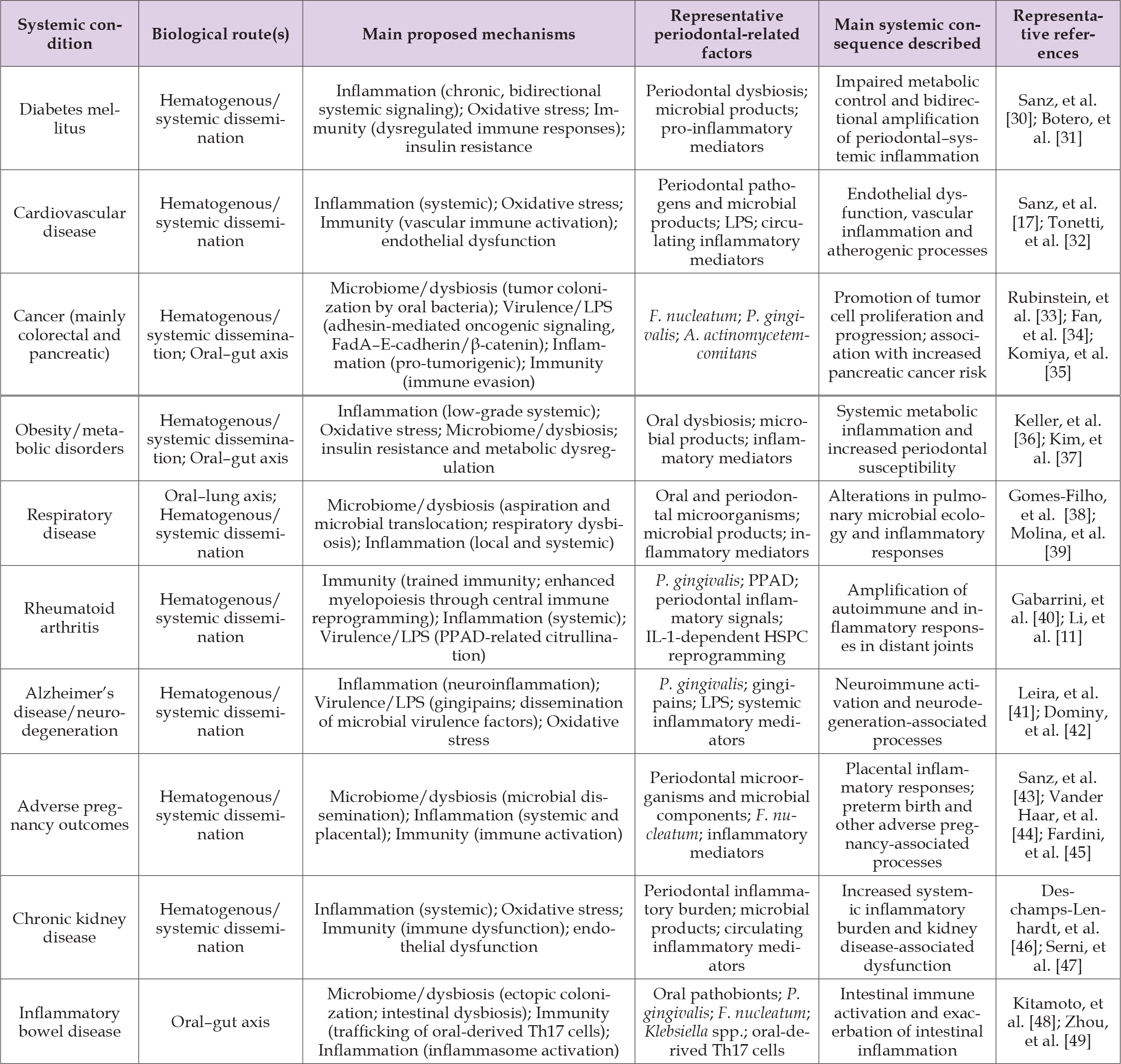
Note: Conditions are ordered as in Figure 3. Biological routes correspond to the three categories of Figure 3B, and the mechanisms named first in each entry correspond to the six categories of Figure 3C; additional mechanistic details are given in parentheses or in lowercase. Abbreviations: A. actinomycetemcomitans, Aggregatibacter actinomycetemcomitans; F. nucleatum, Fusobacterium nucleatum; FadA, Fusobacterium adhesin A; HSPC, hematopoietic stem and progenitor cell; IL-1, interleukin-1; LPS, lipopolysaccharide; P. gingivalis, Porphyromonas gingivalis; PPAD, P. gingivalis peptidylarginine deiminase; Th17, T helper 17 cells.
Disease-specific mechanisms were also identified, including citrullination mediated by P. gingivalis peptidylarginine deiminase (PPAD) and IL-1-dependent HSPC reprogramming in rheumatoid arthritis; dissemination of microbial virulence factors, such as gingipains and LPS, in Alzheimer’s disease/neurodegeneration; ectopic microbial colonization associated with T helper 17 (Th17) responses in inflammatory bowel disease; and bacterial adhesin-mediated oncogenic signaling in cancer.
Integrative Mechanistic Model of Periodontal–Systemic Connections
Based on the bibliometric analysis and the representative evidence summarized in Table 1, an integrative model was developed to organize the connections between periodontal lesions and systemic diseases into a sequence encompassing periodontal sources, biological routes, molecular mechanisms, systemic consequences, and associated diseases. Periodontal sources included the dysbiotic biofilm and its major pathobionts, pathogen-associated molecular patterns (PAMPs) such as LPS, virulence factors, OMVs, and host-derived mediators. Their communication with distant tissues was represented through three biological routes: hematogenous/systemic dissemination, the oral–gut axis, and the oral–lung axis. Among the mechanisms identified through bibliometric analysis, inflammation showed the highest frequency of representation (n = 1,499), followed by microbiome/dysbiosis (n = 674), immunity (n = 535), virulence/LPS (n = 371), oxidative stress (n = 263), and extracellular vesicles (n = 88). These mechanisms were linked to five major systemic consequences: chronic low-grade inflammation, oxidative damage, endothelial and vascular dysfunction, metabolic dysregulation, and immune dysregulation/autoimmunity. Collectively, the model summarizes the convergence of multiple periodontal-derived signals on shared biological processes implicated in the major systemic diseases examined (Figure 4).
Figure 4
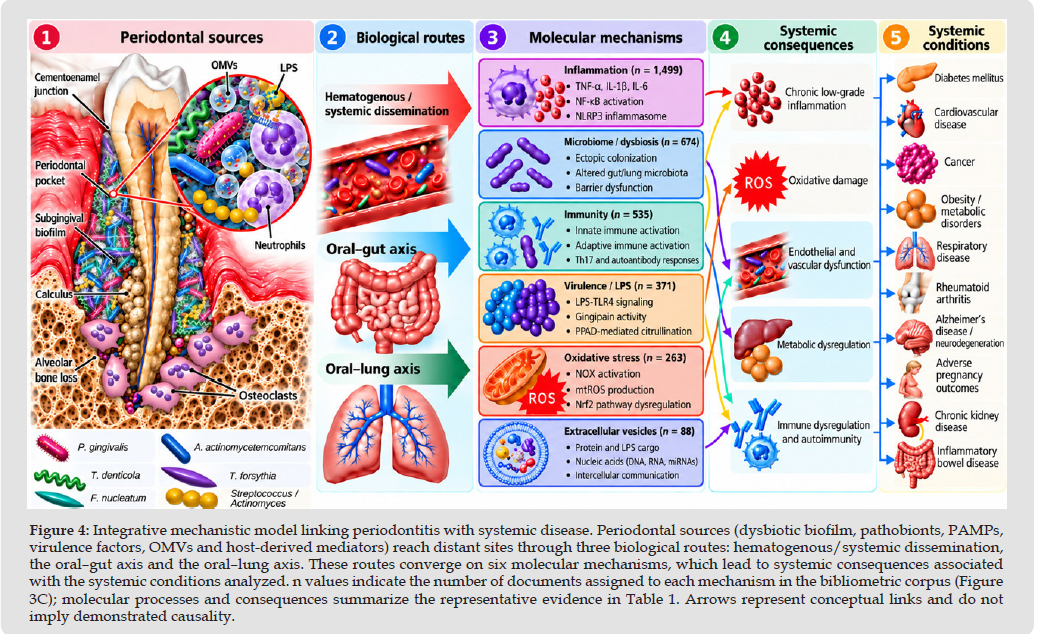
Modes of Communication Between Periodontal Lesions and Distant Organs
Complementing the bibliometric findings, the narrative evidence was organized into four modes of long-range communication, distinguished by the nature of the transmitted signal and the type of evidence supporting each mode (Figure 5). Adaptive immune trafficking (Figure 5A) involves the migration of immune cells reactive to oral antigens or pathobionts toward distant tissues, particularly the intestine. Direct trafficking (Figure 5B) refers to the dissemination of viable bacteria or microbial components, such as bacterial DNA, gingipains, LPS, and OMVs, to distant tissues. Systemic inflammatory signaling (Figure 5C) is mediated by circulating inflammatory mediators and acute-phase reactants and does not require microorganisms to be present in the recipient organ. Finally, central immune reprogramming (Figure 5D) describes the action of inflammatory signals on HSPCs in the bone marrow, leading to trained myelopoiesis and the generation of hyperreactive myeloid cells. The evidence supporting these modes differs. Adaptive immune trafficking and central immune reprogramming rest predominantly on animal models, whereas direct trafficking is supported mainly by human observational studies and experimental models. Systemic inflammatory signaling is the only mode with evidence from human interventional studies. These modes are not mutually exclusive and may coexist within the same periodontal–systemic connection.
Figure 5
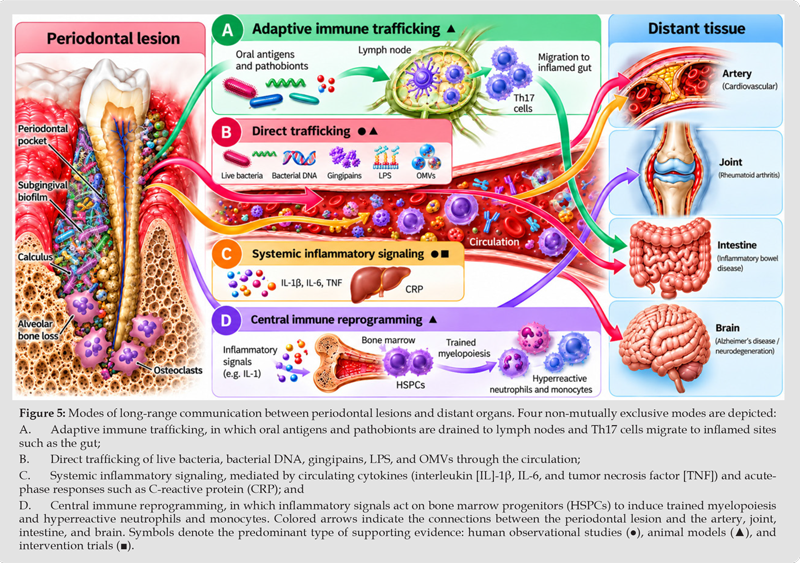
Levels of Evidence in Periodontal–Systemic Connections
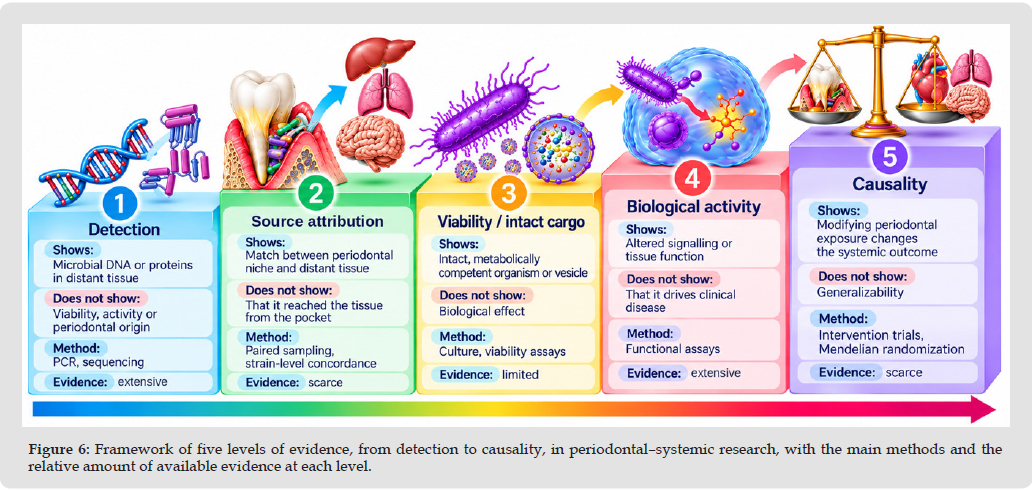
The reviewed evidence was organized into five conceptual levels, each reflecting what a given study design can establish regarding the connection between a periodontal lesion and a distant tissue. The first level, detection, involves identifying microbial DNA, proteins, or virulence factors in distant tissues using polymerase chain reaction (PCR), sequencing, or immunodetection. This demonstrates the presence of microbial material but does not establish microbial viability, biological activity, or oral origin. The second level, periodontal source attribution, involves demonstrating that microbial material detected in a distant tissue matches that found in the periodontal pocket of the same individual, ideally through strain-level identification using paired samples. However, this does not establish the route by which the material reached the distant tissue. The third level, viability or cargo integrity, involves demonstrating the presence of viable microorganisms through culture or viability assays, or confirming the structural integrity of extracellular vesicles. Nevertheless, these findings do not establish whether the detected material exerts biological effects on the recipient tissue. The fourth level, biological activity, involves demonstrating through functional assays that microbial material alters cellular signaling, immune responses, or tissue function. However, such findings do not necessarily establish that these effects contribute to clinically manifest disease. The fifth level, causality, involves determining whether changes in periodontal exposure lead to changes in systemic disease outcomes. This can be investigated through interventional studies assessing clinical endpoints, such as evaluating whether periodontal treatment improves a systemic condition, or through Mendelian randomization, a genetic approach used to strengthen causal inference.
Each level allows progressively stronger inferences, but evidence at a given level does not necessarily establish the preceding levels. Accordingly, evidence supporting a particular periodontal–systemic association may be distributed across nonconsecutive levels. In the representative evidence reviewed, the qualitative assessment revealed substantial heterogeneity across these levels (Figure 6). Evidence for detection was extensive, with numerous studies identifying microbial DNA, proteins, or virulence factors in distant tissues. Evidence for biological activity was also extensive, supported by functional assays demonstrating alterations in cellular signaling, immune responses, or tissue function. In contrast, evidence for periodontal source attribution was scarce, as few studies performed strain-level comparisons between periodontal pockets and distant tissues within the same individual using paired samples. Evidence for viability or cargo integrity was limited, with relatively few studies demonstrating viable microorganisms through culture or viability assays, or confirming the integrity of extracellular vesicles. Evidence for causality was also scarce, as only a limited number of associations have been investigated through interventional studies or Mendelian randomization. Overall, the literature frequently documents the presence of microbial material and its potential biological activity, but rarely establishes its periodontal origin or whether modifying periodontal exposure alters systemic disease outcomes.
Figure 6
The literature on periodontitis and systemic diseases has expanded rapidly over the past two decades. However, increasing publication output does not necessarily indicate a corresponding improvement in mechanistic understanding. Diabetes mellitus and cardiovascular disease accounted for the largest number of publications, yet only a small proportion of these documents explicitly mentioned a biological route of dissemination. This contrast should be interpreted cautiously, as a term-based search strategy may underestimate studies describing mechanistic processes using different terminology. Nevertheless, these findings suggest that much of the literature remains focused on establishing associations, whereas the biological pathways underlying these connections are less frequently addressed. The thematic shift toward the oral microbiome, periodontal pathogens, and biomarkers indicates a growing interest in mechanistic research, although this development has not yet translated into an equally detailed characterization of the pathways involved in periodontal–systemic communication. Systemic inflammation remains the most frequently proposed mechanism. Periodontitis has been associated with elevated circulating inflammatory markers, and periodontal treatment can reduce some of these markers, particularly CRP [9,10]. These findings are consistent with recent reviews describing periodontal inflammation as a contributing factor to other inflammatory diseases [3,7].
The clinical trial by Tonetti, et al. [32] provides some of the strongest human evidence: following a transient increase in systemic inflammation immediately after intensive periodontal treatment, endothelial function improved during follow-up. Nevertheless, these findings concern inflammatory biomarkers and intermediate vascular measures rather than clinical outcomes such as myocardial infarction or mortality. An additional conceptual limitation is that chronic low-grade inflammation is also present in obesity, smoking, aging, and many of the systemic diseases examined, which share risk factors with periodontitis. A mechanism capable of explaining nearly every association provides limited specificity in distinguishing among them. Its high frequency in the bibliometric corpus likely reflects both genuine biological relevance and its widespread use as a general explanatory mechanism. The direct trafficking hypothesis clearly illustrates why different levels of evidence must be distinguished. Periodontal pathogen DNA has been detected in atherosclerotic plaques [50], viable microorganisms have been isolated from atherosclerotic tissue [51], and gingipains have been identified in brain tissue [42].
These findings are relevant but do not provide equivalent levels of mechanistic evidence. Detecting microbial DNA does not establish that the microorganism was viable; demonstrating viability does not prove that it caused tissue damage; and identifying an oral bacterial species in a distant tissue does not establish its origin in a periodontal pocket, given the diversity of microbial niches within the oral cavity. An additional technical challenge arises from the susceptibility of low-biomass tissues, such as the vascular wall, placenta, and brain, to contamination introduced through laboratory reagents and sample processing [52]. Consequently, microbial detection in these tissues requires rigorous contamination controls. Figure 6 summarizes these distinctions by separating detection, periodontal source attribution, viability, biological activity, and causality as distinct levels of mechanistic demonstration.
Cancer, the third most frequently investigated systemic condition, illustrates the distinction between oral and periodontal origin. F. nucleatum has been consistently detected in colorectal tumors, where it has been linked to activation of the β-catenin signaling pathway through the FadA adhesin and to mechanisms of immune evasion [33-35]. These studies provide evidence of biological activity, one of the more advanced levels of mechanistic characterization, and support the involvement of oral microorganisms in the tumor microenvironment. However, they do not demonstrate that the bacteria originated from periodontal pockets. F. nucleatum is a common member of the oral microbiota and is not exclusively associated with periodontal disease. Thus, cancer illustrates how advanced functional characterization can coexist with limited evidence of periodontal source attribution, precisely the distinction that the proposed evidence framework is intended to clarify. Central immune reprogramming and adaptive immune trafficking provide potential explanations for a question that other pathways do not fully address: how a localized periodontal lesion may induce persistent systemic effects without requiring the continuous presence of microorganisms in affected tissues. Li, et al. [11] demonstrated in mice that periodontal inflammation can induce IL-1-dependent reprogramming of HSPCs, sustain the production of proinflammatory myeloid cells, and transfer this phenotype through bone marrow transplantation.
Similarly, Kitamoto, et al. [48] demonstrated that Th17 cells generated in response to oral pathobionts can acquire intestinal homing properties and contribute to intestinal inflammation when these microorganisms colonize the gut. Both lines of evidence rely predominantly on murine models, in which experimentally induced periodontitis does not fully reproduce the decades-long progression of human disease. Nevertheless, these mechanisms offer something that generalized inflammatory explanations often lack: experimentally testable predictions. If central immune reprogramming occurs in humans, corresponding alterations should be detectable in HSPCs from patients with periodontitis and should be at least partially modifiable following periodontal treatment.
Publication volume does not necessarily reflect the maturity of the underlying evidence. Inflammatory bowel disease and neurodegenerative disorders have attracted substantial recent research interest and are associated with compelling experimental mechanisms, yet the supporting evidence remains predominantly preclinical. Adverse pregnancy outcomes provide an important cautionary example: decades of epidemiological associations, inflammatory plausibility, and multiple clinical trials have not demonstrated a consistent reduction in preterm birth following periodontal treatment [53]. In diabetes, periodontal treatment has been associated with modest short-term reductions in glycated hemoglobin (HbA1c), but evidence regarding long-term clinical outcomes remains limited [54]. These findings do not argue against periodontal–systemic connections. Rather, they highlight an important methodological consideration: mechanistic plausibility does not guarantee clinical benefit, and emerging research areas may encounter similar limitations unless subjected to equally rigorous evaluation. From a clinical perspective, these findings indicate that periodontal treatment is fully justified by its established benefits for oral health, whereas potential systemic benefits should be communicated as plausible and, where demonstrated, generally modest rather than as guaranteed prevention or treatment of systemic disease. Given that much of the available evidence establishes either microbial detection or biological activity, claiming a causal relationship with a specific distant organ would exceed what the current data can support.
Accordingly, a second generation of studies should focus less on identifying additional associations and more on testing specific causal pathways. Studies investigating microbial trafficking should establish periodontal source attribution through paired sampling, strain-level resolution, and rigorous contamination controls. The detection of bacterial material should be systematically distinguished from microbial viability and biological activity. Mechanisms demonstrated in animal models, such as hematopoietic reprogramming and immune cell trafficking, should be investigated in humans through longitudinal studies addressing temporality, specificity, and reversibility following periodontal disease control. Finally, interventional trials should distinguish changes in intermediate biomarkers from changes in clinically meaningful outcomes and should report negative findings as well.
This study should be interpreted in light of several limitations. The corpus was retrieved exclusively from Scopus and restricted to English-language articles and reviews; therefore, it does not represent the entire available literature. The search strategy required explicit terminology related to systemic connections and may have excluded mechanistic studies using alternative terms. Consequently, the low frequencies observed for certain biological routes should be regarded as conservative estimates of their explicit representation in the retrieved literature. Classification using controlled dictionaries cannot fully capture semantic context, and co-occurrence within the same document does not establish a biological relationship, directionality, or causality. Cumulative citation counts were not normalized by publication age, and 2026 represented an incomplete publication year, potentially affecting temporal and citation analyses. Finally, the narrative synthesis and conceptual models were interpretative rather than exhaustive. They were developed without a formal risk-of-bias assessment and reflect a targeted selection of representative evidence.
Collectively, these findings support a shift in research emphasis. Periodontal–systemic connections are unlikely to be explained by a single route or mechanism; instead, they appear to involve overlapping biological processes whose relative contributions may vary across diseases and individual patients. The central challenge is no longer to expand the list of conditions associated with periodontitis, but to narrow the gap between epidemiological association and mechanistic demonstration. Addressing this challenge requires distinguishing evidence of detection, periodontal source attribution, viability, biological activity, and ultimately causality, without assuming that these levels must necessarily be established in a fixed sequence. The relevant question is not merely whether periodontitis is associated with a systemic disease, but which periodontal-derived signal produces which biological effect, through which route, under what biological conditions, and with what level of supporting evidence.
This bibliometric analysis of the Scopus-indexed literature shows that research on periodontal–systemic connections has centered on inflammation, microbiome/dysbiosis, immunity, and LPS-mediated virulence, whereas oxidative stress and extracellular vesicles remain comparatively less represented. Despite this breadth, the pathways linking the periodontal lesion with distant organs are rarely addressed explicitly: a biological route was named in at most 6.4% of the analyzed documents. The representative evidence reviewed is extensive for the detection of microbial components in distant tissues and for their biological activity, but scarce or limited for periodontal source attribution, microbial viability or cargo integrity, and causality. Of the four proposed modes of communication, only systemic inflammatory signaling is supported by human interventional studies. Future progress therefore depends less on identifying additional associations than on generating better-designed evidence, including paired sampling with strain-level concordance, viability assays, functional studies, and intervention trials.
The author gratefully acknowledges the Secretaría de Ciencia, Humanidades, Tecnología e Innovación (SECIHTI) for the financial support provided through the Estancias Posdoctorales por México program.
The search query, the list of Scopus identifiers (EID/DOI) of the 3,937 analyzed documents, the VOSviewer thesaurus, the controlled dictionaries, the co-occurrence matrices, the country ranking, and the Python script are openly available in Zenodo at https://doi. org/10.5281/zenodo.23362562. The full Scopus export is not redistributed because of database terms of use but can be regenerated using the search query and identifiers provided.
The conceptual illustrations in this manuscript (Figures 4-6) were created using generative artificial intelligence tools. ChatGPT (OpenAI) and Claude (Anthropic) were used to design the prompts and to generate and edit the illustrations, together with FigureLabs. All figures were reviewed, edited, and validated by the author, who takes full responsibility for their content and for the accuracy of the information they depict.
The author declares that there is no conflict of interest.

International Association of Landscape Archaeology, Czech Glass Society, Czech Republic

Department of Chemistry, Semenov Institute of Chemical Physics, USSR Academy of Sciences, Moscow, Russia

Neurology, LA BioMed Research Institute, USA

Associate Professor at Department of Breast and Thyorid Surgey, Chongqing General Hospital, China

Professor of Nuclear Medicine, Faculty of Medicine and Surgery, University of Milan, Milan, Italy





 Abstract
 PDF