info@biomedres.us
+1 (502) 904-2126
One Westbrook Corporate Center, Suite 300, Westchester, IL 60154, USA
Site Map
 ISSN: 2574 -1241
Received: October 13, 2026; Published: October 21, 2026
*Corresponding author: Cüneyt Toprak, World Medicine Pharmaceutical Company, Istanbul, Türkiye
DOI: 10.26717/BJSTR.2026.67.010450
Objective: To retrospectively evaluate four sequential development batches of a delayed-release tablet containing
mycophenolate sodium equivalent to 360 mg mycophenolic acid and to explore how formulation, granulation
and coating decisions affected manufacturability and in vitro release.
Methods: Batch compositions, process observations and the final ethanol-based wet-granulation process were
reviewed. Dissolution profiles of aqueous- and alcohol-based enteric-coating variants were compared with the
reference product after a 120-min acid stage in 0.1 N HCl followed by pH 6.8 phosphate buffer. Mean profiles
and exploratory f₁/f₂ metrics were calculated. Initial and six-month stability observations were summarized
descriptively.
Results: Early batches showed sticking tendency. Optimization of the binder/disintegrant system and implementation
of ethanol wet granulation yielded a manufacturable target core composition. The aqueous-coated
variant was closer to the reference profile (exploratory f₁=7.4, f₂=69.3) than the alcohol-coated variant (f₁=16.7,
f₂=47.4), which released more rapidly during the early buffer stage. Acid-stage release remained low, and reported
assay and impurity results remained within the predefined limits through six months.
Conclusion: Ethanol wet granulation yielded cores from which two enteric-coated variants were developed.
Both variants showed acceptable reported stability attributes over six months, but the aqueous-coated variant
more closely reproduced the reference dissolution profile. The coating process was therefore the differentiating
development criterion. Differences in film formation, hydration and pH-dependent opening provide plausible
explanations, although the present data do not establish the mechanism or regulatory profile similarity.
Keywords: Mycophenolate Sodium; Delayed-Release Tablet; Enteric Coating; Wet Granulation; Dissolution; Pharmaceutical Development
Mycophenolic acid is an immunosuppressive agent used particularly in solid organ transplantation. The enteric-coated form of mycophenolate sodium was developed to limit the release of the active pharmaceutical ingredient in the gastric environment and to shift drug release to the pH conditions of the small intestine. Therefore, the performance of the delayed-release dosage form depends not only on the composition of the tablet core but also on the core–coating interface, coating film integrity, and pH-dependent dissolution behavior [1-4]. In tablets containing a high drug load, powder flow, compressibility, sticking to the punches, and the formation of homogeneous granules may be critical factors during development. Although wet granulation can improve the flow and compaction properties of the powder bed, it requires careful control of the amount of granulating liquid, granulation endpoint, drying, and milling conditions. For delayed- release products, an additional balance must be achieved between the acid resistance of the enteric film and rapid, reproducible drug release in the buffer phase [3,5]. This study examines four sequential small-scale development trials and, in particular, the selection between aqueous- and alcohol-based enteric coating of the final ethanol-granulated cores. Its specific contribution is the integration of manufacturing observations, reference-comparative release profiles and six-month stability findings to show why satisfactory acid resistance and stability alone do not resolve the choice of a delayed-release coating process.
Study Design
The study involved an evaluation of routine new product development records. Four trial batches (Trial 1–Trial 4) were reviewed chronologically. Since the batches were not produced according to a formal factorial experimental design, the results were not used to establish the independent causal effects of excipients or process variables; rather, the sequential effects of development decisions were described.
Reference Product and Target Product Profile
A 360 mg strength, salmon-colored, oval, biconvex, delayed-release tablet was used as the reference product. The mean weight of the reference tablet was approximately 690 mg. The hardness of the coated tablet exceeded the measurement range of the instrument (>100 N), and disintegration of the tablet core was observed 11–12 minutes after fracture. The target product was designed with a nominal core weight of 640 mg and an undisclosed coated tablet weight, taking into consideration the pharmaceutical form and physical characteristics of the reference product. Table 1 summarizes the formulation ranges considered across the four development trials. These ranges are not complete quantitative formulas, do not necessarily sum to 100%, and should not be interpreted as the exact compositions of individual batches. The nominal core weight was 640 mg. The amount of mycophenolate sodium was adjusted for raw-material potency to provide the equivalent of 360 mg mycophenolic acid. The final ethanol-granulated core formulation was evaluated with aqueous- and alcohol-based enteric coatings; thus, the granulation liquid and coating medium represent distinct manufacturing decisions.
Table 1: Formulation development ranges and manufacturing approaches across four trials. Exact component quantities are not disclosed.
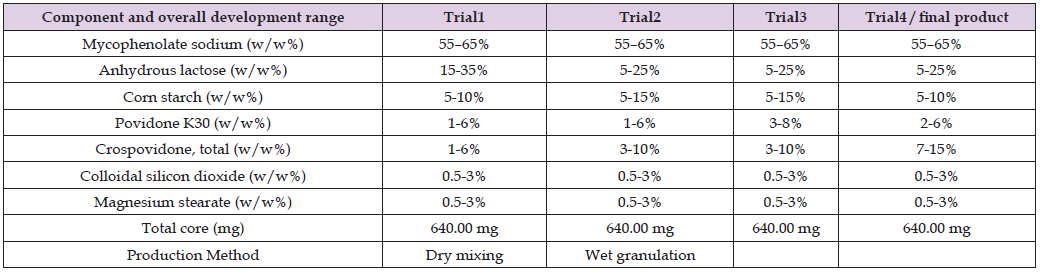
Across the development sequence, the variables were monitored in three main categories:
i. The granulation approach, involving a transition from a dry intragranular phase to ethanol-based wet granulation using 96% ethanol;
ii. The binder–disintegrant balance, represented by the relative levels of Povidone K30 and crospovidone; and
iii. The flow and lubrication system, represented by the relative levels of colloidal silicon dioxide and magnesium stearate.
In Trial 1, sticking was observed with the dry intragranular phase approach. In Trial 2, the tendency for sticking persisted despite the transition to ethanol-based granulation. In Trial 3, no sticking was observed during compression of approximately 150 tablets following readjustment of the binder–disintegrant and glidant–lubricant balance. In Trial 4, the disintegrant level was increased while the starch and binder levels were reduced, and the final manufacturing approach was selected. Because multiple variables were changed simultaneously, the results were not interpreted as the independent effect of any single component.
Final Manufacturing Process
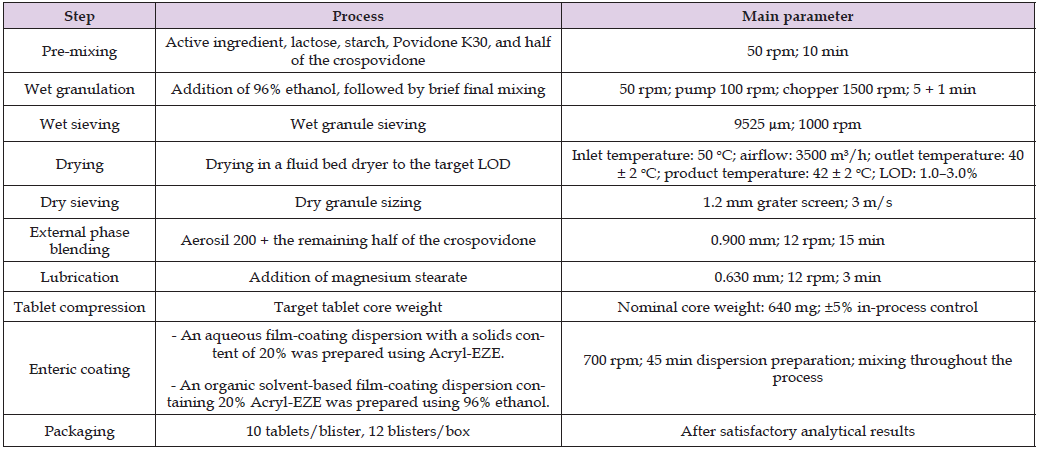
(Table 2).
Table 2: *Final Manufacturing Process and Proposed Critical Process Parameters.
Note: *The parameters have been defined and will be finalized during process validation.
Dissolution Testing
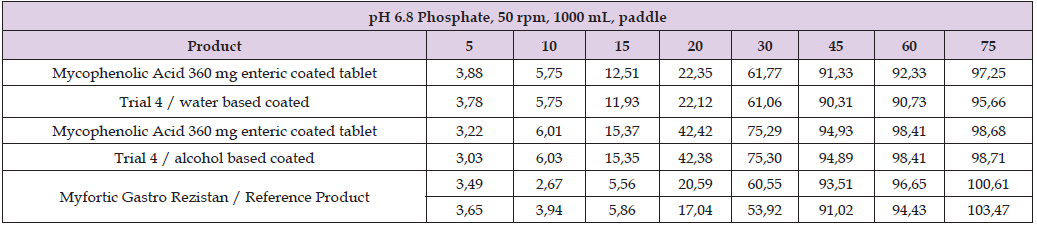
Dissolution was evaluated using USP Apparatus 2 (paddle) at 37.0 ± 0.5 °C and 50 rpm. The acid stage used 750 mL of 0.1 N HCl for 120 min, followed by transfer to 1000 mL of pH 6.8 phosphate buffer. The comparative profile dataset contained measurements at 5, 10, 15, 20, 30, 45, 60 and 75 min after transfer to buffer; the stability dataset reported the buffer-stage result at 60 min. Quantification was by UV spectrophotometry at 250 nm. Two recorded measurements per product/coating arm were available and were summarized descriptively.
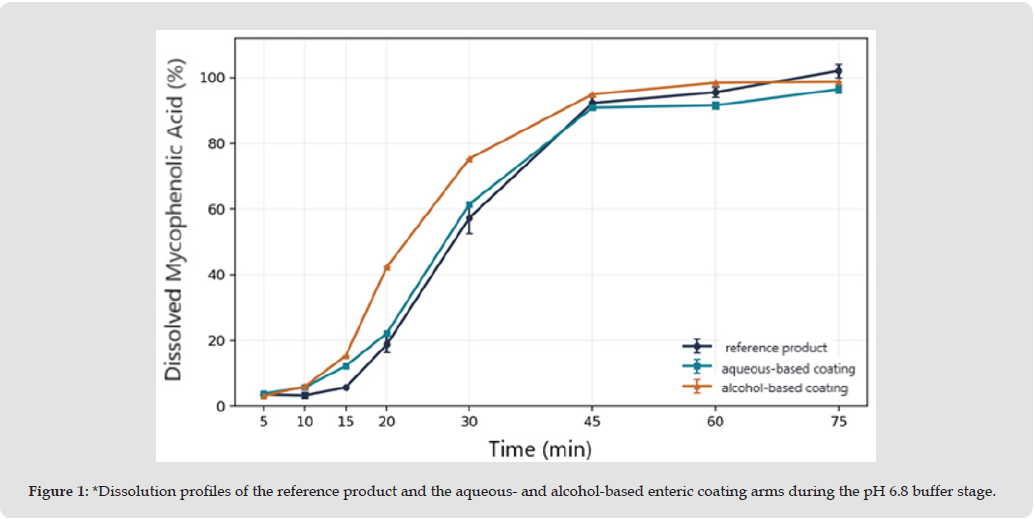
Table 3 presents the mean buffer-stage release calculated from the two recorded measurements per profile. Table 4 provides the underlying values. The difference factor (f₁), similarity factor (f₂) and root mean square error (RMSE) were calculated from the mean profiles [6]. The values in Table 5 use all eight recorded time points, including multiple points after release exceeded 85%, and are retained only as descriptive, exploratory development metrics. They are not guideline-compliant similarity assessments: only two measurements were available, their independence was not established, and the recommended unit number and time-point selection requirements were not met. No inference of bioequivalence or regulatory profile similarity was made.
Table 3: Mean dissolution results during the pH 6.8 buffer stage.
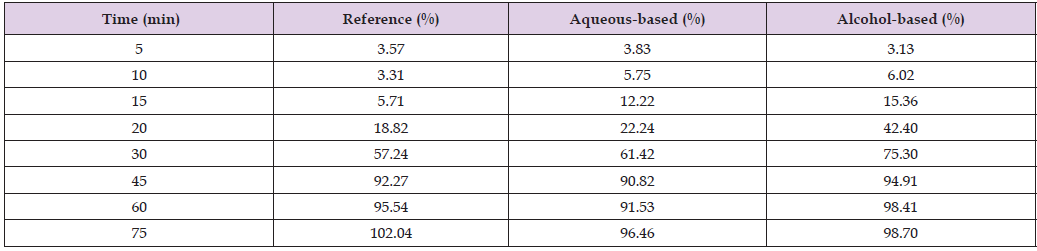
Table 4: Individual recorded buffer-stage dissolution measurements for aqueous-coated and alcohol-coated Trial 4 products and the reference product.
Note: Data points represent the mean, and error bars represent the standard deviation.
Table 5: *Exploratory comparison of the mean dissolution profiles.

Note: *Due to the limited number of units, the f₁/f₂ values should not be considered evidence of regulatory similarity.
Evaluation of Stability Data
The initial and six-month results for the aqueous-based (Trial 4) and alcohol-based (Trial 4) coating subgroups of the Trial 4 batch were evaluated across study arms designated as long-term, intermediate, and accelerated conditions. Appearance, mean weight, moisture content, assay, individual/total impurities, Z-isomer content, and two-stage dissolution results were summarized descriptively. The stability approach was discussed within the framework of ICH Q1A- (R2) [7].
Manufacturability and Formulation Selection
In Trial 1, sticking was observed during tablet compression despite the use of colloidal silicon dioxide (Aerosil 200) and magnesium stearate in a portion of the intragranular phase. In Trial 2, the dry granule moisture content was measured at 1.66% following ethanol- based wet granulation; however, a tendency for sticking persisted during a compression trial of approximately 100 tablets. In Trial 3, the dry granule moisture content was 2.07%, and no sticking was observed during compression of approximately 150 tablets. In Trial 4, the dry granule moisture content was recorded as 2.25%. Overall, the development sequence indicated that optimization of not only the granulation liquid but also the balance among the binder, disintegrant, starch, lubricant, and glidant was required to achieve acceptable manufacturability (Table 6).
Table 6: Key process observations from the development batches.

Comparative Dissolution Profiles
(Figure 1) The aqueous-coated variant more closely followed the reference during the release transition. At 20 min, mean release was 22.24% for the aqueous-coated variant and 18.82% for the reference, whereas the alcohol-coated variant released 42.40%. At 30 min, the corresponding values were 61.42%, 57.24% and 75.30%. The absolute deviations from the reference were therefore approximately 3.42 and 4.18 percentage points for aqueous coating, versus 23.59 and 18.06 percentage points for alcohol coating. Both variants exceeded 90% mean release by 45 min. The principal observed distinction was the timing of release after the pH transition, rather than a failure to achieve extensive release.
Figure 1
Acid Resistance and Six-Month Stability Observations
(Table 7) For the two coating variants, acid-stage release at baseline was approximately 0.61% and 0.43%, respectively, and was approximately 0.68% and 0.33% at month 6. These results suggest that the enteric barrier maintained its acid resistance over the six-month observation period. In the buffer phase, drug release at 60 min was 94.58% at baseline and ranged from 94.51% to 102.85% at month 6 for the aqueous-based coating, while the corresponding values were 93.64% at baseline and 101.32–105.61% at month 6 for the alcohol- based coating.
Table 7: *Ranges of Results Obtained from the Three Stability Study Arms.

Note: *Differences among conditions in the baseline results, as recorded in the source files, are summarized as ranges.
Granulation and Excipient Optimization
The chronological sequence of the development batches indicates that the sticking observed in the high-drug-load tablet cores cannot be attributed to a single excipient change. The transition from Trial 1 to Trial 3 involved several concurrent changes, including the introduction of ethanol-based wet granulation, reduction of the starch level, adjustment of Povidone K30 and crospovidone levels, and rebalancing of the magnesium stearate/colloidal silicon dioxide ratio. Therefore, the elimination of sticking should not be interpreted as a causal effect attributable to any individual component, but rather as the outcome of combined formulation and process optimization. In the final process, the use of crospovidone with half incorporated intragranularly and the remaining half extragranularly was intended to provide a practical balance between granule strength and rapid disintegration in the buffer phase. The short lubrication time may be considered a process control intended to limit the potential adverse effects of excessive magnesium stearate exposure on wetting and dissolution. The selected LOD range of 1.0–3.0% appears to provide a balance between flow/compression performance and the risk of sticking to the tooling.
Effect of the Coating Medium on Dissolution Behavior
Both final coated variants originated from the ethanol-granulated core formulation. Their satisfactory reported stability attributes and low acid-stage release indicate that the selection cannot be based on acid resistance alone. The aqueous-coated variant more closely reproduced the reference buffer-stage transition, while the alcohol-coated variant released earlier. The observed profiles are consistent with a difference in the effective hydration and opening kinetics of the enteric barrier, although dissolution measurements alone cannot separate polymer dissolution, film rupture, core disintegration and drug dissolution [8-9]. Several mechanisms could contribute. Solvent choice changes the conditions under which a film develops: dispersed particles must consolidate and coalesce during aqueous coating, whereas polymer deposited from a true organic solution forms a film through solvent removal and chain association. Solvent-dependent drying also influences polymer mobility and plasticizer distribution. Comparative film studies demonstrate that these changes affect film structure and dissolution, but do not establish a universal rule that aqueous films release more slowly [10]. In this study, the physical state of the alcohol-based preparation was not documented; it should therefore not be assumed to have been a true polymer solution. The observed direction of release is specific to the two formulations and processes investigated. At the molecular level, buffer penetration and ionization of carboxylic acid groups in the enteric polymer promote hydration and loss of film integrity.
The rate depends on the accessible functional groups, transport through the film and its local environment. The aqueous-coated variant’s closer match to the reference is therefore plausibly associated with a more comparable effective interval between the pH transition and exposure of the core, rather than with greater chemical stability of the active ingredient. This interpretation remains a hypothesis because film hydration, ionization and opening were not measured directly. Previous studies have reported marked differences in dissolution at pH 6.8 and high within-unit variability among enteric-coated mycophenolate sodium products [4]. These findings support the importance of not only acid resistance but also the rate and reproducibility of drug release in the buffer phase as critical quality attributes. Although the duplicate-measurement profiles available in the present study showed low variability, this observation was not confirmed using a larger number of units. Additional contributors include coating mass and thickness, drying or curing conditions, film defects, and solvent-dependent wetting or redistribution of soluble components at the core–coating interface. The interface can modify local pH and subsequent film dissolution; published work on highly water-soluble acidic cores supports its relevance [5], but cannot establish the same mechanism for mycophenolate sodium. Once the barrier opens, hydration and disintegration of the core become important.
Since coating weight gain, thickness, curing conditions, interfacial composition and matched process settings were not available, the difference is attributed to the overall coating formulation/process, not conclusively to water versus ethanol alone. Matched-weight coating trials, film microscopy and water-uptake measurements would distinguish these explanations.
Interpretation of Stability Findings
Both coating variants showed acceptable reported assay, impurity and acid-resistance results through six months. These findings support the suitability of both variants at the development stage and indicate that the closer reference dissolution profile, rather than a demonstrated stability advantage, favored aqueous coating. [8].
Strengths and Limitations of the Study
• The study’s specific contribution is a documented coating- selection decision in an ethanol-granulated mycophenolate sodium formulation: both coated variants showed acceptable reported six-month stability attributes, while their buffer-stage release transitions differed materially. This provides a product- specific development insight rather than a claim that ethanol granulation or aqueous enteric coating is itself a new technology.
• The reference product, two coating approaches, and sixmonth stability data are integrated into a single scientific narrative.
• Only two recorded measurements per profile were available, and their independence was not established. The all-timepoint f₁/f₂ calculations include multiple plateau points and are descriptive; they do not satisfy regulatory profile-comparison requirements.
• For some early development batches, only qualitative process observations were available, while data on hardness, friability, content uniformity, and individual tablet results were lacking.
• As the stability conditions and changes to analytical methods were not fully documented, no shelf-life estimation or statistical stability model was presented.
• In the absence of bioequivalence studies or clinical data, no inference regarding in vivo equivalence was made from the in vitro findings.
Ethanol-based wet granulation, together with formulation optimization, produced the final mycophenolate sodium core formulation equivalent to 360 mg mycophenolic acid. Two products were obtained by applying aqueous- and alcohol-based enteric coatings to this core formulation. Both products showed acceptable reported six-month stability attributes, including assay, impurities and acid resistance. The decisive difference was their dissolution behavior after transfer to pH 6.8 buffer: the aqueous-coated product more closely followed the reference profile, whereas the alcohol-coated product released appreciably faster at 20–30 min. Thus, aqueous enteric coating was selected as the preferred development approach on the basis of reference-matched release behavior, rather than a demonstrated difference in stability. The profile difference is plausibly explained by coating-dependent film formation and consolidation, plasticizer distribution, buffer penetration and pH-triggered polymer hydration/ ionization, together with possible differences in film thickness and core–coating interfacial behavior. These factors can alter the effective time required to expose and disintegrate the core. The present results demonstrate the direction of the observed difference but do not prove any individual mechanism. The main development insight is that ethanol granulation can be combined with aqueous enteric coating to obtain the closer reference release pattern under the tested conditions.
This study did not involve human or animal participants. It was a retrospective analysis of routine pharmaceutical development data. According to the policy of the target journal, the applicable ethical review exemption and/or institutional statement should be verified prior to submission.
All authors contributed to the conceptualization of the study, evaluation and scientific interpretation of the development data, and revision of the manuscript, and approved the final version of the manuscript.
This study was fully supported and funded by World Medicine Pharmaceutical Company. The facilities, materials, manufacturing activities, analytical studies, and technical resources used in the study were provided by World Medicine Pharmaceutical Company.
The authors are employees of World Medicine Pharmaceutical Company. World Medicine Pharmaceutical Company was the sponsor of the study and provided all financial, technical, analytical, and manufacturing support.
The data underlying this study are not publicly available due to commercial confidentiality and regulatory dossier obligations. The data may be made available on reasonable request, subject to institutional approval and applicable confidentiality requirements.

International Association of Landscape Archaeology, Czech Glass Society, Czech Republic

Department of Chemistry, Semenov Institute of Chemical Physics, USSR Academy of Sciences, Moscow, Russia

Neurology, LA BioMed Research Institute, USA

Associate Professor at Department of Breast and Thyorid Surgey, Chongqing General Hospital, China

Professor of Nuclear Medicine, Faculty of Medicine and Surgery, University of Milan, Milan, Italy





 Abstract
 PDF