info@biomedres.us
+1 (502) 904-2126
One Westbrook Corporate Center, Suite 300, Westchester, IL 60154, USA
Site Map
 ISSN: 2574 -1241
Received: September 16, 2026; Published: September 25, 2026
*Corresponding author: Konstantinos Fousekis, Physiotherapy Department, School of Health Rehabilitation Sciences, University of Patras, 26504 Patras, Greece
DOI: 10.26717/BJSTR.2026.66.010407
Background: Instrument-Assisted Soft Tissue Mobilization (IASTM) is usually carried out as a passive therapeutic
procedure. Nevertheless, current rehabilitation practice places a greater emphasis on active patient involvement
and on treatment based on movement. It is still uncertain whether active movement during IASTM
has the potential to improve clinical outcomes as compared with the conventional passive method. The present
study looked at the active and passive applications of ERGON® IASTM in patients with rotator cuff tendinopathy.
Methods: Forty adults who had been clinically diagnosed with rotator cuff tendinopathy (aged 25–45 years;
body mass 55–83 kg; height 1.59–1.81 m) were divided into two groups (with 20 in each group). In each group,
four treatment sessions were carried out over a period of four weeks. The passive group was given ERGON®IASTM
at first in static positions and then again during passive shoulder movements assisted by the therapist.
By contrast, the active group received the same treatment together with active shoulder movements carried
out by the patients. Both groups underwent the same pre-treatment massage and exercises aimed at improving
scapular motor control. Pain intensity (as measured by the Visual Analogue Scale; VAS), shoulder range of
motion (ROM), isometric strength, and self-reported pain and disability (as measured by the Shoulder Pain and
Disability Index; SPADI) were all evaluated.
Results: Both methods led to significant improvements in a number of clinical outcomes, but the active application
of ERGON® resulted in a greater overall reduction in pain than the passive treatment (VAS change: 5.05
versus 3.90 points; p=0.0028; Hedges g=1.04). Moreover, the active treatment also achieved greater overall improvements
in shoulder flexion range of motion (18.80° versus 13.15°; p=0.0041; g=0.95), in abduction range
of motion (16.95° versus 13.60°; p=0.0002; g=1.38), and in external-rotation range of motion (15.65° versus
11.15°; p<0.001; g=1.89). The active group also showed a greater overall improvement in isometric abduction
strength (5.67 versus 4.80 kg; p=0.0417; g=0.65), but the difference between the groups in overall external-rotation
strength was not significant (p=0.209). Lastly, the SPADI outcomes consistently indicated an advantage
for the active treatment, with greater improvements in pain, function, and the total score at the final assessment
(p=0.0016, p=0.0011 and p=0.0008, respectively; Hedges |g|=1.07–1.16).
Conclusion: Both passive and active ERGON® IASTM were found to result in significant improvements in patients
suffering from rotator cuff tendinopathy, but using active movement during instrument-assisted treatment
led to greater overall improvements in pain, self-reported function, shoulder range of motion, and some
strength measures. The results indicate that the way in which IASTM is administered may be important, and that
adding active movement to ERGON® IASTM may enhance its short-term clinical effects as compared with those
obtained using passive application alone.
Keywords: ERGON® IASTM; Instrument-Assisted Soft Tissue Mobilization; Rotator Cuff Tendinopathy; Active Movement; Shoulder Pain; Spadi; Range of Motion; Muscle Strength
Abbreviations: IASTM: Instrument-Assisted Soft Tissue Mobilization; VAS: Visual Analogue Scale; ROM: Range of Motion; RCT: Rotator Cuff Tendinopathy; SPADI: Shoulder Pain and Disability Index; SD: Standard Deviation
Rotator cuff tendinopathy (RCT) is one of the most frequent causes of shoulder pain and dysfunction of the upper limb in adults and is often linked with pain when the arm is raised or rotated externally, a reduced range of motion (ROM), muscle weakness, and difficulties in carrying out daily activities [1,2]. Instead of being simply an inflammatory condition, current models view tendinopathy as a complex, multifactorial disorder involving a disruption of tendon homeostasis, disorganisation of the collagen, changes to the extracellular matrix, and alterations in blood supply and nerve supply [3]. Significantly, structural abnormalities do not always correspond directly with the severity of symptoms, which in turn supports the idea that rehabilitation programmes should focus on alleviating pain, improving movement capacity, building strength, and enhancing function rather than concentrating solely on structural pathology [1,3]. Today’s methods of rehabilitating rotator cuff tendinopathy place a greater focus on active, patient-focused care. It is widely accepted that exercise forms a key part of non-surgical treatment, and current clinical practice guidelines suggest that active rehabilitation-including exercises aimed at improving motor control and involving resistance-should be used to alleviate pain and disability [4]. While manual and soft-tissue treatments might be used as supplementary measures, especially for temporarily reducing symptoms, their role is now seen as being within the context of active rehabilitation rather than as independent therapies [4,5].
This change in approach leads to the question of whether the clinical benefits of traditionally passive interventions can be improved by including active patient participation in the treatment process. IASTM consists of delivering controlled mechanical forces to muscles, fascia, tendons, and other soft tissues by means of instruments which are specially designed for the purpose. The supposed effects are changes in tissue mobility, the local mechanical properties, sensory input, pain, and range of motion, although the exact biological and neurophysiological mechanisms are still not completely understood [6,7]. Systematic reviews have found that IASTM may have beneficial effects on range of motion in healthy people and on pain and patient-reported function in those with injuries, while at the same time highlighting the variability between different protocols and stressing the need for more high-quality clinical research [6,8]. ERGON® IASTM consists of a structured approach to instrument-assisted soft tissue mobilization, including particular treatment strokes and application methods. Earlier studies have shown that changes occur acutely in flexibility, range of motion, and other functional factors after ERGON® has been applied. For instance, Fousekis [9] found similar improvements in hamstring flexibility whether the ERGON® treatment was given locally or at a distance along the superficial back myofascial line, indicating that the reaction to instrument-assisted treatment does not have to be limited to the area that was directly treated.
In the same way, Maniatakis [10] showed acute improvements in shoulder range of motion after administering ERGON® IASTM to elite volleyball players, offering initial evidence of its possible use in relation to the shoulder complex. Yet the majority of IASTM interventions are still mainly regarded as mechanical treatments carried out by the therapist, the patient staying rather passive. This could represent an important limitation in current approaches to tendinopathy rehabilitation. When movement is carried out, it leads to muscle contraction, tendon loading, joint movement, sensorimotor input, and voluntary motor control all while the external mechanical stimulus is being applied. As a result, carrying out IASTM in conjunction with movement may produce a completely different therapeutic environment from that which results when the instrument is used on relatively passive tissues. Looking at it from a mechanical point of view, when movement is active it changes the length of the muscles and tendons, the tension in the fascia, the stiffness of the tissues, and the relative position of the adjacent layers of soft tissue. When an instrument is used during either a shortening or a lengthening phase of active movement, the tissues are thus subjected to a combination of mechanical forces applied from outside and of loading which is generated inside the body.
From a neuromuscular standpoint, voluntary movement at the same time gives rise to proprioceptive and afferent input and involves the coordinated activation of the muscles of the rotator cuff and of the scapular muscles. This kind of combined stimulation could help in incorporating immediate changes in pain or in mobility into the pattern of actively controlled movement. In the case of RCTs this distinction is especially relevant since simply reducing symptoms is not enough if functional recovery is to take place. Rehabilitation is intended to restore mobility of the shoulder, the performance of the rotator cuff and scapular muscles, load tolerance and confidence in the use of the affected upper limb [4]. The existing clinical practice guideline suggests that active rehabilitation should be the first treatment approach for RCT and acknowledges that soft-tissue and manual interventions may be useful as part of a more extensive rehabilitation programme. The ERGON® IASTM may be carried out using either a passive or an active method of movement. When applying it passively, the therapist moves the shoulder while using the instrument; in the active method, the patient carries out the shoulder movements themselves while the therapist at the same time applies the ERGON® techniques. The active method thus brings together instrument-assisted mechanical stimulation with voluntary movement and neuromuscular activation.
In this protocol, the passive group had the ERGON® applied first in static positions and then during passive movements produced by the therapist, while the active group performed shoulder flexion, abduction, and external rotation whilst the instrument was being used. The length of treatment and the associated massage and scapular motor-control exercises were the same for both groups, so the only difference between the two interventions was the way in which the ERGON® was applied. Although IASTM is being used more and more in the field of musculoskeletal rehabilitation, there is still very little direct evidence showing the differences between active and passive application of the same instrument-assisted treatment. Earlier studies on the ERGON® have mainly looked at acute physiological or functional responses, usually carried out with healthy or athletic individuals, rather than comparing the various application methods in patients who have symptoms. As a result, it is not clear whether passive IASTM is enough or whether adding active movement improves the clinical response. This study was carried out with the aim of comparing the effects of active and passive ERGON® IASTM treatment on pain, shoulder-related disability, range of motion (ROM), and isometric muscle strength in patients suffering from rotator cuff tendinopathy. It was expected that both methods of treatment would lead to improved clinical outcomes, but it was believed that ERGON® IASTM used in conjunction with active movement would produce greater overall improvements in pain, function, shoulder ROM, and muscle performance than passive ERGON® application.
A comparative clinical study involving two groups was carried out in order to find out if the method of applying ERGON® Instrument-Assisted Soft Tissue Mobilisation (IASTM) has an effect on the clinical results obtained in adults suffering from rotator cuff tendinopathy. Forty adults-men and women aged between 25 and 45 years-with a medical diagnosis of rotator cuff tendinopathy were recruited from the wider Attica area of Greece. The criteria for inclusion were that the patients had shoulder pain and/or some degree of functional limitation and that they had been diagnosed by a physician as having rotator cuff tendinopathy. Exclusion criteria were any history of an acute traumatic shoulder injury, a full-thickness rotator cuff tear, having undergone recent shoulder surgery, the use of any medication prescribed for the current shoulder symptoms, the presence of any concurrent neurological, cognitive, or musculoskeletal disorders, and being simultaneously receiving conservative treatment for the shoulder problem, such as physiotherapy or treatment with platelet-rich plasma. Before taking part in the study, all the participants were given full information regarding the study procedures, the schedule of the intervention, the measurements to be taken and the equipment that would be used, and they provided written informed consent.
The participants (aged 25-45 years; body mass 55-83 kg; height 1.59-1.81 m) were randomly assigned in a 1:1 ratio to one of two groups, the passive ERGON® group (PASSIVE; n=20) or the active ERGON® group (ACTIVE; n=20), the random assignment being carried out by means of sealed envelopes. Each participant picked a sealed envelope which contained their group assignment and this determined whether they were assigned to the PASSIVE or ACTIVE intervention. Both groups took part in four treatment sessions spread over four consecutive weeks, with one session each week. The total length of treatment, the areas treated, the massage given before treatment, the time spent receiving ERGON® IASTM treatment, and the motor-control exercises carried out after treatment were the same in both groups. The main difference in the experiment was the way in which the shoulder was moved during the ERGON® IASTM: passive movement generated by the therapist in the PASSIVE group versus active movement generated by the patient in the ACTIVE group.
The therapeutic sequence used in each treatment session was the same. It began with a 5-minute soft-tissue massage to prepare the tissues and was then followed by about 15 minutes of ERGON® IASTM together with a short scapular motor-control exercise programme. During the ERGON® IASTM the participants were placed in both the prone and supine positions and the soft tissues of the cervical, thoracic, scapular and shoulder areas were treated. The areas that were treated included the suboccipital and cervical muscles, the thoracic paraspinal region, the scapular muscles, the pectoral muscles, the deltoid, the biceps brachii and the areas corresponding to the insertions of the rotator cuff tendons. The treatment protocol included a number of ERGON® strokes such as Rub, Wave, Razor, S-Globe, Deep Fascia and Cyriax. In the PASSIVE group, ERGON® IASTM was initially applied with the shoulder maintained in static positions and was subsequently continued. At the same time, the therapist passively moved the shoulder through the relevant movement patterns. Participants were instructed to remain relaxed and not actively contribute to shoulder movement during this phase. In the ACTIVE group, ERGON® IASTM was also initially applied in static positions; however, treatment was subsequently continued while participants actively performed shoulder flexion, abduction, and external rotation under therapist guidance. Thus, the ACTIVE condition combined the externally applied mechanical stimulus generated by the ERGON® instruments with voluntary shoulder movement and muscular activation. In contrast, the PASSIVE condition combined the same instrument-assisted treatment with externally generated movement. Following ERGON® IASTM, participants in both groups performed the same brief scapular motor-control program, including prone Y exercises and wall slides, emphasizing scapular positioning and control.
The primary clinical outcomes were pain intensity, shoulder-related pain and disability, shoulder range of motion (ROM), and isometric muscle strength. Pain intensity was assessed using a 10-cm Visual Analogue Scale (VAS), ranging from no pain to the worst imaginable pain, and was recorded immediately before and after each treatment session. We assessed shoulder-related pain and functional limitation using the validated Greek version of the Shoulder Pain and Disability Index (SPADI). The SPADI consists of 13 items divided into pain and disability domains, with higher scores representing greater symptom severity and functional limitation. The shoulder range of motion was evaluated with the use of a handheld goniometer. For flexion, abduction, and external rotation, standard positions for the participants and anatomical reference points were employed. Flexion and abduction were measured while the participants were in the supine position with the scapula properly stabilised; external rotation was also measured in the supine position with the shoulder abducted to 90° and the elbow flexed to 90°. Isometric shoulder strength was determined using a MicroFET2 hand-held dynamometer (Hoggan Scientific, Salt Lake City, UT, USA). Isometric strength for both shoulder abduction and external rotation was measured using standard testing positions. External rotation strength was assessed when the participants were sitting with the shoulder in a neutral position and the elbow flexed to 90°, and abduction strength was measured in the sitting position with the upper limb placed approximately 30°–45° in the scapular plane.
VAS, shoulder ROM, and isometric strength were assessed immediately before and after each of the four treatment sessions to evaluate both the immediate response to each session and the overall response across the four-week intervention period. For pain, change scores were calculated as ΔVAS = PRE − POST, with positive values representing pain reduction. For ROM and muscle strength, change scores were calculated as ΔOutcome = POST − PRE, with positive values indicating improvement. Overall treatment effects were calculated from the initial pre-treatment assessment to the final post-treatment assessment (PRE1 to POST4). SPADI changes were examined across repeated assessment points, with reductions in SPADI scores indicating improvements in shoulder-related pain and disability. Continuous variables were expressed as mean ± standard deviation (SD). We examined the distribution of continuous variables before inferential analysis. We examined the distribution of continuous variables before inferential analysis. We evaluated within-group PRE–POST differences using paired-samples t-tests. Between-group differences in change scores were assessed using Welch independent-samples t-tests, which do not require equality of variances between groups. Between-group effect sizes were calculated using Hedges g, providing an estimate of the magnitude of the difference while accounting for the relatively small group sample sizes. SPADI changes were similarly evaluated using paired-samples t-tests for within-group comparisons and Welch independent-samples t-tests for between-group differences in change from baseline. Statistical significance was set at p<0.05.
The four-week intervention was completed by all 40 participants, who have therefore been included in the analysis, there being 20 participants in the PASSIVE group and 20 in the ACTIVE group. Significant improvements were achieved by both interventions regarding pain, shoulder range of motion, muscle strength, and the SPADI outcomes during the treatment period. The decrease in pain from the starting point to the last evaluation after treatment was significantly more marked in the ACTIVE group than in the PASSIVE group (VAS change: 5.05 versus 3.90 points; p=0.0028; Hedges g=1.04). The participants in the ACTIVE group also showed significantly greater overall improvements in shoulder range of motion. In the case of flexion, the increase was 18.80° as compared to 13.15° in the PASSIVE group (p=0.0041; g=0.95); for abduction it was 16.95° compared to 13.60° (p=0.0002; g=1.38); and for external rotation the improvement was 15.65° versus 11.15° (p<0.001; g=1.89). The ACTIVE group showed a larger overall increase in shoulder abduction strength compared to the PASSIVE group (5.67 kg versus 4.80 kg; p=0.0417; g=0.65). However, the difference between the groups in external-rotation strength was not found to be statistically significant (p=0.209). The results of the SPADI were also in favour of the ACTIVE intervention. Larger improvements were seen in the pain, function, and overall SPADI scores at the final evaluation, with significant differences between the groups (p=0.0016, p=0.0011 and p=0.0008 respectively) and large effect sizes (Hedges |g|=1.07 to 1.16). In general, both methods of treatment were effective; nevertheless, the combination of ERGON® IASTM with active movement led to greater improvements in pain, shoulder range of motion, self-reported pain and disability, and in abduction strength, while no extra benefit was found for external-rotation strength (Table 1).
Table 1: Overall Changes from Baseline to Final Assessment in the PASSIVE and ACTIVE Groups.
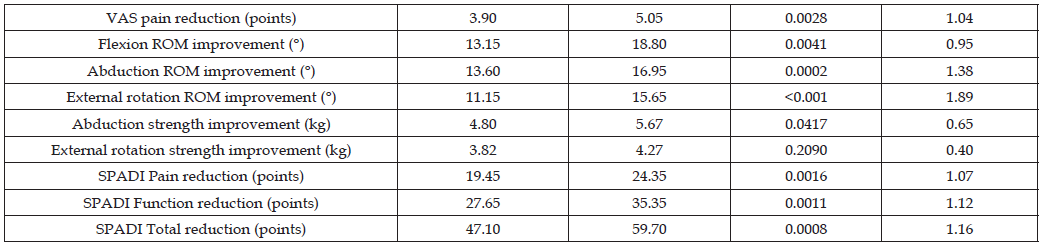
Note: Values represent overall changes from the initial baseline assessment to the final post-intervention assessment. For VAS and SPADI, positive values indicate symptom reduction; for ROM and strength, positive values indicate improvement. Bold values indicate statistically significant between-group differences (p<0.05). Hedges g values are presented as absolute magnitudes for consistency of interpretation. ROM, range of motion; VAS, Visual Analogue Scale; SPADI, Shoulder Pain and Disability Index.
The main result of the study was that both passive and active use of the ERGON® IASTM led to considerable clinical improvements in patients suffering from rotator cuff tendinopathy. Yet, when active shoulder movements were incorporated during the use of the instrument, there were greater overall improvements in a number of clinically important outcomes. Compared to passive application, the ACTIVE intervention resulted in greater pain reduction and greater improvement in shoulder-related disability, as well as greater gains in flexion, abduction, and external-rotation range of motion, together with a greater increase in abduction strength. On the other hand, no significant difference between the groups was found regarding external- rotation strength. Taken together, these findings indicate that the therapeutic response to ERGON® IASTM may depend not only on the mechanical stimulus provided by the instrument but also on the movement context in which that stimulus is given.
Pain decreased considerably in each of the two groups, which shows that both methods of applying ERGON® were of benefit. Nevertheless, the ACTIVE group had a significantly larger overall reduction on the VAS scale than the PASSIVE group (5.05 compared to 3.90 points; p=0.0028), the difference between the groups being large (Hedges g=1.04). This result is in line with earlier evidence suggesting that IASTM may help to improve pain and patient-reported outcomes [6,8]. Furthermore, Fousekis [11] found that pain decreased progressively together with improvements in shoulder mobility when ERGON® IASTM was used in combination with neuromuscular-control exercises in a patient with supraspinatus tendinopathy. Even though the evidence from a case study cannot prove comparative effectiveness, it does support the clinical justification for combining instrument- assisted treatment with active neuromuscular rehabilitation.
The biggest differences between the groups in this study were seen with regard to shoulder mobility. Those who had the active ERGON ® treatment showed significantly greater overall gains in flexion (18.80° compared with 13.15°; g=0.95), in abduction (16.95° as compared with 13.60°; g=1.38), and in external rotation (15.65° versus 11.15°; g=1.89). Earlier evidence has shown that improvements in range of motion occur after IASTM interventions [6,8]. More precisely, Maniatakis [10] found acute improvements in shoulder range of motion after receiving ERGON® IASTM in elite volleyball players. In a similar way, Simatou [12] showed that hip flexibility was improved following ERGON® treatment given to various areas of the myofascial lateral line. These results go beyond the existing evidence by indicating that the way ERGON® IASTM is administered may affect the size of the range of motion response.
The variation between active and passive application might to some extent be due to the different mechanical conditions produced during treatment. When active movement is taking place, voluntary muscle contraction and joint movement occur at the same time as the stimulus applied by the instrument. It is therefore the case that muscle-tendon length, tissue tension, and the relative displacement of neighbouring soft-tissue structures all change dynamically while the instrument is being used. On the other hand, in passive application, movement is produced externally without the same degree of voluntary motor activation. Even though various mechanical and neurophysiological mechanisms have been suggested to account for the effects of IASTM [6,7], the present study did not directly measure tissue deformation, stiffness, neural excitability, or sensory processing. It must therefore be regarded as plausible to accept these mechanisms as explanations rather than as proven causal pathways. A sensorimotor factor might also play a role. Since active shoulder movement involves voluntary motor activity, the processing of proprioceptive information, activation of the rotator cuff, and coordinated control of the scapula and humerus, when active movement takes place at the same time as instrument-assisted mechanical stimulation, external sensory input is combined with voluntary movement and muscular activation. It is therefore possible that the larger clinical response seen in the ACTIVE group is due to the interaction between the external mechanical stimulation, the internal loading produced, and the sensorimotor engagement, rather than just resulting from a greater passive ‘soft-tissue release’ effect.
Earlier research into ERGON® also indicates that the effects of instrument- assisted treatment go beyond just simple local mechanical actions. Fousekis [9] showed that ERGON® IASTM applied to either a local or a distant area of the superficial back myofascial line increased hamstring flexibility. Since the anatomical area and the group of patients in this study were different from those in the present study, these results support a wider interpretation of the functional responses linked with ERGON® IASTM and show that the changes after treatment cannot always be accounted for by a local structural alteration. The SPADI results reinforce the clinical significance of the current findings. Members of the ACTIVE group showed significantly greater improvements in SPADI pain, function, and overall scores, with large effect sizes between the groups. This point is important since an increase in range of motion by itself does not always mean that the patient’s ability to use the shoulder has improved. The fact that there were parallel improvements in VAS, ROM, and SPADI indicates that the benefit linked with active ERGON® treatment went beyond measures of impairment and was also evident in the participants’ reported level of pain and their sense of functional capacity.
The strength findings, however, do include an important qualification: although active treatment led to a significantly greater overall improvement in abduction strength, the difference between the groups in terms of external-rotation strength was not statistically significant. It therefore cannot be concluded that active ERGON® IASTM has a general strengthening effect. The four-week intervention was not set up as a progressive resistance-training programme. The improvements in the measured force could therefore have been due to decreases in pain, better movement tolerance, less pain-related inhibition, or short-term neuromuscular changes rather than to structural muscular adaptation. The findings described here also need to be understood in the context of the wider trend in the rehabilitation of rotator cuff tendinopathy towards active management. Current guidelines stress the importance of exercise, progressive loading, motor control, and the restoration of functional ability, passive or manual treatments being used mainly as supplementary measures rather than as standalone therapies [4,5]. Our results are in line with this approach; they do not indicate that ERGON® IASTM should take the place of therapeutic exercise, but rather show that a conventional therapist-led intervention might be more effective if it is incorporated into an active movement programme.
This explanation is likewise in line with the earlier clinical use of ERGON® in cases of shoulder disorders. It has previously been linked to improvements in supraspinatus tendinopathy when ERGON® IASTM is used together with neuromuscular-control exercises [11], and ERGON® IASTM combined with stretching has been found to lead to a reduction in pain and an improvement in shoulder mobility in patients with adhesive capsulitis [13]. Even though these reports constitute low-level evidence, they do support the idea that instrument-assisted treatment may be especially pertinent when it is included as part of a more comprehensive movement-oriented rehabilitation programme rather than being given as a standalone passive treatment. The question raised by the title, “Is Passive IASTM Enough?”, does not mean that passive treatment is ineffective. In fact, the PASSIVE group showed significant improvements over the course of the intervention period as well. The results thus suggest that incorporating voluntary movement when using the ERGON® may offer an extra short-term clinical benefit. The appropriate question to ask might therefore be not whether IASTM is effective but rather how IASTM should be delivered in order to best integrate it with active rehabilitation.
A key strength of this study was the standardisation of the therapeutic procedure. In both groups the number and frequency of the sessions were the same, the same massage preparation was used, the duration of ERGON® treatment was approximately the same, the same anatomical areas were treated and the same scapular motor-control exercises were carried out. The main difference in the experiment was whether the therapist or the participant produced the movement during the application of the instrument. This approach supports the conclusion that the between-group differences observed were due to the movement strategy that accompanied the application of ERGON®. Several limitations should nevertheless be acknowledged. The study included 40 participants aged 25-45 years, which limits generalizability to older individuals, athletes with different loading demands, and patients with other shoulder disorders. Treatment was delivered over only four weeks, and no long-term follow-up was performed; therefore, the persistence of the observed differences remains unknown. Participants and therapists could not be blinded to group allocation, and no sham-IASTM, exercise-only, or untreated control group was included. Furthermore, because both groups received multimodal treatment, the overall improvements cannot be attributed exclusively to ERGON® IASTM. Finally, the study evaluated clinical rather than mechanistic outcomes, and multiple comparisons were performed; therefore, the proposed mechanical and sensorimotor explanations require direct investigation.
Future research should look into whether the extra benefits linked with active ERGON® treatment continue after the treatment has stopped and also whether the same pattern is seen in other tendinopathies and musculoskeletal disorders. Comparing the results with those from an exercise-only and a sham-IASTM condition would help in identifying the specific role of instrument-assisted treatment. Further investigations into the mechanisms involving electromyography, elastography, quantitative sensory testing, or measures of neural excitability could then establish whether active movement affects the response to IASTM mainly through mechanical, sensory, neuromuscular, or combined pathways.
Clinical improvements were obtained in patients suffering from rotator cuff tendinopathy when using either the passive or active ERGON® IASTM. Yet, the incorporation of active shoulder movement while using the instrument led to greater overall improvements in pain, in shoulder-related disability, and in the range of motion for flexion, abduction, and external rotation, as well as providing a more selective benefit regarding muscle strength. It seems clear that the way in which IASTM is applied is important. Instead of considering ERGON® IASTM only as a passive soft-tissue method, combining it with voluntary movement might offer a more functionally appropriate therapeutic strategy since it involves both externally applied mechanical stimulation and active loading together with sensorimotor engagement. However, further research involving longer periods of follow-up and an examination of the mechanisms involved is needed in order to determine how long these effects last and to identify the mechanisms behind them.

International Association of Landscape Archaeology, Czech Glass Society, Czech Republic

Department of Chemistry, Semenov Institute of Chemical Physics, USSR Academy of Sciences, Moscow, Russia

Department of Educational Sciences, Research Centre Qualities of Teachers, School of Education – HAN, Nijmegen, Netherlands
Associate Professor at Department of Breast and Thyorid Surgey, Chongqing General Hospital, China

Neurology, LA BioMed Research Institute, USA





 Abstract
 PDF