info@biomedres.us
+1 (502) 904-2126
One Westbrook Corporate Center, Suite 300, Westchester, IL 60154, USA
Site Map
 ISSN: 2574 -1241
Received: September 08, 2026; Published: September 24, 2026
*Corresponding author: Anil Kiyilar, Product Development Responsible Specialist, Research and Development Center, World Medicine İlaç San. ve Ticaret A.Ş, Istanbul, Turkiye
DOI: 10.26717/BJSTR.2026.66.010403
Background: Ritonavir is a well-characterized polymorphic compound, and its crystalline form may influence
pharmaceutical performance, particularly dissolution and stability. Therefore, control of the solid-state form
during formulation development, manufacturing, and storage is an important consideration for product quality.
Objective: The aim of this study was to investigate the solid-state stability of Ritonavir Form II during the development
and manufacture of Ritonavir 100 mg film-coated tablets and to evaluate the potential for polymorphic
transformation during stability storage.
Methods: Ritonavir Form II was characterized by powder X-ray diffraction (PXRD) and differential scanning
calorimetry (DSC) prior to formulation development. Film-coated tablets were manufactured using a spray granulation
process. The finished product was subjected to long-term, intermediate, and accelerated stability conditions
at 25°C/60% RH for 24 months, 30°C/65% RH for 12 months, and 40°C/75% RH for 6 months, respectively.
PXRD was used to monitor the crystalline phase, while DSC was used to evaluate changes in thermal behavior.
Results: PXRD patterns of the initial finished product and stability samples showed the characteristic diffraction
profile of Ritonavir Form II, with no additional diffraction peaks, relevant peak shifts, or broadening indicative of
a change in crystalline phase. The PXRD profile remained comparable under all investigated storage conditions.
DSC thermograms obtained before and after 12 months of storage at 30°C/65% RH showed comparable thermal
behavior, with no additional thermal events associated with polymorphic conversion.
Conclusion: The results demonstrated that Ritonavir Form II was maintained during formulation development,
spray granulation, tablet manufacture, and the investigated stability periods. No evidence of polymorphic transformation
was observed under the applied manufacturing and storage conditions. These findings support the
robustness of the formulation and manufacturing process with respect to solid-state stability and provide scientific
support for the control strategy for polymorphic form in the finished product.
Keywords: Ritonavir; Form II; Polymorphism; Solid-State Stability; PXRD; DSC; Spray Granulation; Film-Coated Tablets
Ritonavir is a protease inhibitor with well-documented polymorphic behavior and has been extensively investigated with respect to its solid-state properties. Different crystalline forms of Ritonavir have been described, and changes in the solid-state form may potentially affect important pharmaceutical properties, including dissolution behavior, stability, and consequently product performance. Among the reported crystalline forms, Ritonavir Form II represents the selected polymorphic form used in the development of the present formulation. Because polymorphic transformation may occur during pharmaceutical processing or storage, preservation of the selected crystalline form throughout the product lifecycle is an important aspect of pharmaceutical development. Manufacturing processes involving exposure to solvents, mechanical stress, moisture, temperature variations, and drying conditions may potentially influence the solid-state characteristics of an active pharmaceutical ingredient (API).
In particular, spray granulation involves wet processing followed by drying and therefore represents a relevant manufacturing step for evaluating the potential for solid-state transformation. Accordingly, the assessment of polymorphic stability during both manufacturing and storage is important for establishing an appropriate control strategy. Powder X-ray diffraction (PXRD) is a primary analytical technique for the identification and monitoring of crystalline phases, while differential scanning calorimetry (DSC) provides complementary information regarding thermal transitions and changes in the solid-state structure. The objective of this study was therefore to investigate the stability of Ritonavir Form II during formulation development and manufacture of Ritonavir 100 mg film-coated tablets and to evaluate whether polymorphic transformation occurred during long-term, intermediate, and accelerated stability storage.
Materials
Ritonavir Form II was used as the API. The formulation consisted of microcrystalline cellulose, lactose monohydrate, copovidone, croscarmellose sodium, colloidal silicon dioxide, sodium stearyl fumarate, and ethanol (96%). A hypromellose-based film coating system was used for coating of the compressed tablets. The crystalline form of the received Ritonavir API was characterized prior to formulation development using PXRD and DSC.
Formulation and Manufacturing Process
Ritonavir 100 mg film-coated tablets were manufactured using a spray granulation process. The manufacturing process comprised the following sequential operations:
Spray granulation solution preparation → pre-blending → spray granulation → drying → dry sieving → sieving and blending → tablet compression → film coating → packaging.
The manufacturing process was selected to provide the required physical and pharmaceutical properties of the finished product while maintaining the solid-state characteristics of the API.
Powder X-Ray Diffraction Analysis
PXRD was employed for identification of the crystalline form and monitoring of potential changes in the solid-state structure of Ritonavir. The diffraction pattern of the Ritonavir API was initially characterized to confirm the presence of Form II. The finished product was subsequently analyzed at the initial time point and during stability studies. Comparative evaluation of diffraction patterns was performed by assessing the characteristic diffraction peaks of Ritonavir Form II and evaluating the presence of any additional peaks, relevant peak shifts, or changes in peak profile that could indicate a crystalline phase transformation or loss of crystallinity.
Differential Scanning Calorimetry
DSC analysis was performed as a complementary technique to PXRD for assessment of the thermal behavior of Ritonavir in the finished product. The initial finished product and samples stored at 30°C/65% RH for 12 months were analyzed. The thermograms were compared with respect to melting onset, peak temperature, enthalpy of fusion, and the presence of additional thermal events that could indicate a change in the solid-state form.
Stability Study Design
The finished product was subjected to stability studies under the following conditions: [1,2]
• Long-term: 25°C/60% RH for 24 months
• Intermediate: 30°C/65% RH for 12 months
• Accelerated: 40°C/75% RH for 6 months
Samples were evaluated at the initial time point and at the respective stability intervals. PXRD analysis was performed to monitor the crystalline phase throughout the investigated stability periods, while DSC analysis was performed on selected samples to provide complementary evidence regarding solid-state stability.
Characterization of Ritonavir Form II
The crystalline form of the received Ritonavir API was characterized prior to formulation development using PXRD and DSC. The PXRD pattern was consistent with the characteristic diffraction profile of Ritonavir Form II, confirming the selected crystalline form prior to incorporation into the formulation. This characterization established the initial solid-state state of the API and provided a reference profile for subsequent assessment of the finished product.
PXRD Evaluation of the Finished Product
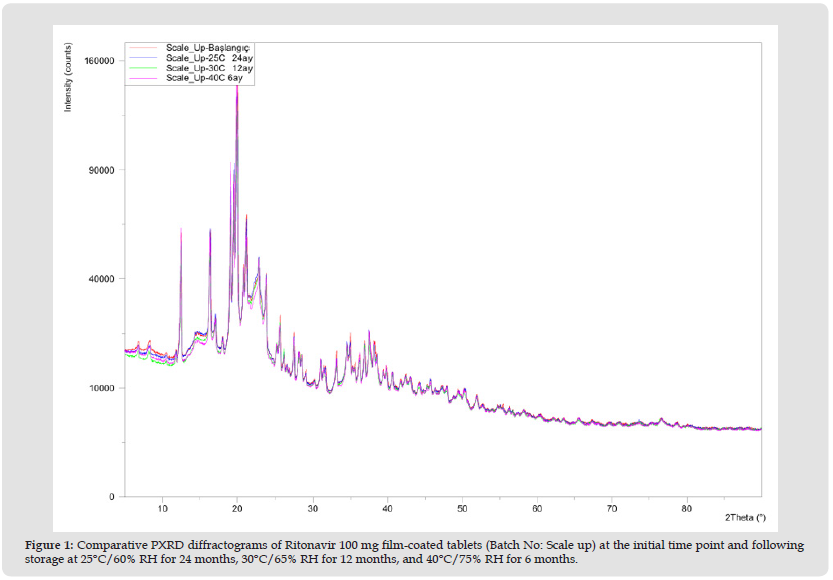
PXRD analysis was performed on Ritonavir 100 mg film-coated tablets from scale up batch at the initial time point and following storage under long-term, intermediate, and accelerated stability conditions. The diffraction pattern obtained from the initial finished product was comparable to the reference pattern of Ritonavir Form II. The characteristic diffraction peaks were retained following storage at 25°C/60% RH for 24 months, 30°C/65% RH for 12 months, and 40°C/75% RH for 6 months. No additional diffraction peaks attributable to another crystalline phase were observed. Furthermore, no relevant changes in peak position or profile were detected that would indicate a polymorphic transformation or substantial loss of crystallinity. The comparative PXRD diffractograms are presented in Figure 1. The preservation of the characteristic Form II diffraction profile following both the manufacturing process and stability storage indicates that no detectable crystalline phase transformation occurred under the investigated conditions.
Figure 1
DSC Evaluation
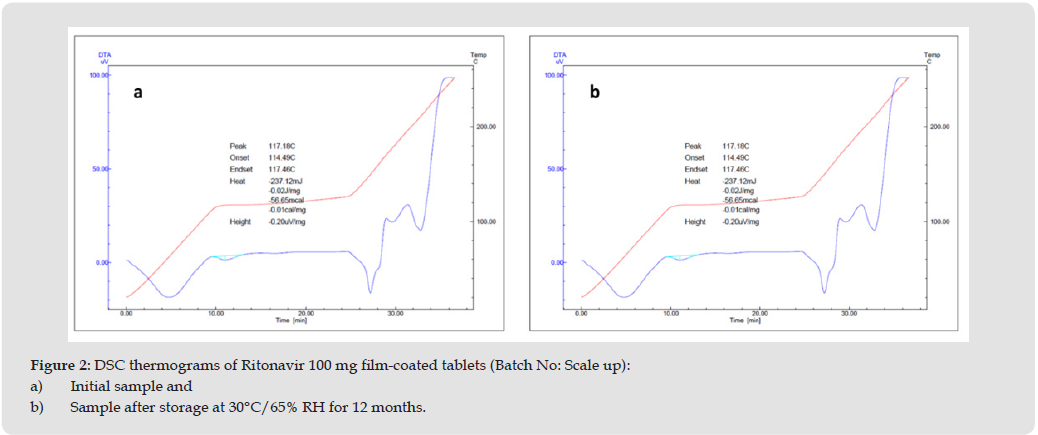
DSC analysis was performed on the initial finished product and on samples stored at 30°C/65% RH for 12 months. The initial and post-stability thermograms showed comparable thermal behavior. No relevant differences were observed in the melting onset temperature, peak maximum temperature, or enthalpy of fusion. In addition, no new endothermic or exothermic events associated with a potential polymorphic transformation were detected. The DSC thermograms are presented in Figure 2. The comparable thermal profiles before and after storage provide complementary evidence to the PXRD findings and further support the preservation of the solid-state characteristics of Ritonavir Form II during the investigated stability period.
Figure 2
Assessment of Solid-State Stability During Manufacturing
The manufacturing process included spray granulation, drying, sieving, blending, compression, and film coating. Among these operations, spray granulation and drying represent potentially relevant process steps with respect to changes in the solid-state characteristics of the API due to exposure to solvent, moisture, temperature, and subsequent drying. Despite these processing conditions, the PXRD profile of the finished product remained consistent with Ritonavir Form II. No evidence of formation of another crystalline phase was observed following manufacture. These findings indicate that the selected formulation composition and manufacturing process were suitable for maintaining the crystalline form of Ritonavir during tablet manufacture.
Assessment During Stability Storage
The stability results demonstrated preservation of the characteristic Form II PXRD pattern under long-term, intermediate, and accelerated conditions over the investigated periods. In particular, the absence of additional diffraction peaks or relevant changes in the diffraction profile after 24 months at 25°C/60% RH provides evidence that no detectable polymorphic conversion occurred under long-term storage conditions. Similarly, the results obtained under intermediate and accelerated conditions did not indicate a solid-state transformation. The DSC results obtained after 12 months at 30°C/65% RH were consistent with the PXRD findings and did not demonstrate any additional thermal event suggestive of polymorphic conversion. Overall, the complementary PXRD and DSC results indicate that the selected formulation and manufacturing process provided an appropriate level of control of the solid-state characteristics of Ritonavir Form II during the investigated stability periods.
Pharmaceutical Development and Control Strategy Considerations
Polymorphism was considered during pharmaceutical development because of the potential impact of changes in crystalline form on the quality and performance of the finished product. The combined PXRD and DSC assessment demonstrated that no detectable polymorphic transformation occurred during the investigated manufacturing and storage conditions. The preservation of the Form II crystalline profile was further consistent with the acceptable pharmaceutical quality attributes observed during stability studies [1,2,3]. From a pharmaceutical development perspective, these findings indicate that the risk associated with polymorphic transformation was adequately controlled by the selected formulation and manufacturing process. In accordance with the principles described in ICH Q6A, the need for routine control of polymorphic form in the finished product should be based on the demonstrated potential for polymorphism to affect product quality, performance, or stability. In the present study, no evidence of polymorphic transformation was observed during manufacture or the investigated stability periods [4]. Therefore, the findings provide scientific support for the justification of not including routine polymorphic form testing as a finished product specification parameter, while the solid-state characteristics of the API remain appropriately controlled through the established pharmaceutical development and manufacturing control strategy.
The present study investigated the solid-state stability of Ritonavir Form II during the development and manufacture of Ritonavir 100 mg film-coated tablets and during long-term, intermediate, and accelerated stability storage. PXRD analysis demonstrated preservation of the characteristic diffraction profile of Ritonavir Form II following spray granulation and throughout the investigated stability periods. Complementary DSC analysis showed comparable thermal behavior before and after storage, with no additional thermal events indicative of polymorphic conversion. Taken together, the PXRD and DSC results provide no evidence of detectable polymorphic transformation of Ritonavir Form II under the investigated manufacturing and storage conditions. The results therefore support the robustness of the selected formulation and manufacturing process with respect to solid-state stability. The findings also provide scientific support for the established control strategy and for the justification that routine polymorphic form testing is not required as a finished product specification parameter, based on the absence of demonstrated impact of polymorphic transformation on the quality and stability of the finished product under the investigated conditions [3,4].
This study was sponsored by World Medicine Pharmaceutical Company. The authors are grateful to Rusen KALENDER, the founder and chairman of the World Medicine Pharmaceutial Company. I will not forget to share with you our valuable advisors and teammate in the realization of this study. I would like to thank, Scientific Department Manager Cuneyt TOPRAK, Product Development and Technology Transfer Manager Gokay GUN and R&D Director Erdinc BABUC.

International Association of Landscape Archaeology, Czech Glass Society, Czech Republic

Department of Chemistry, Semenov Institute of Chemical Physics, USSR Academy of Sciences, Moscow, Russia

Department of Educational Sciences, Research Centre Qualities of Teachers, School of Education – HAN, Nijmegen, Netherlands

Associate Professor at Department of Breast and Thyorid Surgey, Chongqing General Hospital, China

Neurology, LA BioMed Research Institute, USA





 Abstract
 PDF