info@biomedres.us
+1 (502) 904-2126
One Westbrook Corporate Center, Suite 300, Westchester, IL 60154, USA
Site Map
 ISSN: 2574 -1241
Received: September 08, 2026; Published: September 24, 2026
*Corresponding author: Canberk Yilmaz, Product Development Senior Specialist, Research and Development Center, World Medicine İlaç San. ve Tic. A.Ş., İstanbul, Türkiye
DOI: 10.26717/BJSTR.2026.66.010402
Eltrombopag olamine presents an interconnected development challenge in which very low aqueous solubility, solid-state diversity, particle attributes, excipient chemistry, process-created microstructure and dissolution- method design may influence one another. This critical narrative review synthesises publicly available regulatory assessments, prescribing information, peer-reviewed studies, international quality guidance, pharmacopeial materials, and patent disclosures identified through 31 July 2026. The available evidence establishes that eltrombopag olamine is practically insoluble in aqueous buffers across pH 1-7.4 and that systemic exposure is highly sensitive to polyvalent cations. A high-calcium meal markedly reduces exposure, whereas the higher fasting exposure reported for the powder for oral suspension compared with the tablet is consistent with dosage-form-dependent availability but does not isolate microstructure as the sole causal factor. Regulatory assessments repeatedly examine solid form and particle-size distribution; however, particle-size criticality is conditional and may be moderated by morphology, agglomeration, wetting, excipient distribution, process history, and the dissolution environment. Qualitative similarity to the reference excipient system is informative but cannot replace understanding of grade, supplier, moisture, elemental profile, reactive-impurity burden, and functional performance. Overall, the evidence supports an integrated, product-specific development framework linking salt and solid-state control, particle and excipient attributes, process-created microstructure, discriminatory dissolution, stability, packaging, and strength bridging. Patents are treated as hypothesis-generating sources rather than evidence of regulatory acceptance or product superiority. No original experimental data were generated or analysed.
Keywords: Eltrombopag Olamine; Critical Narrative Review; Solid State; Particle-Size Distribution; Excipient Compatibility; Chelation; Dissolution; Generic Development; Quality by Design
Graphical Abstract
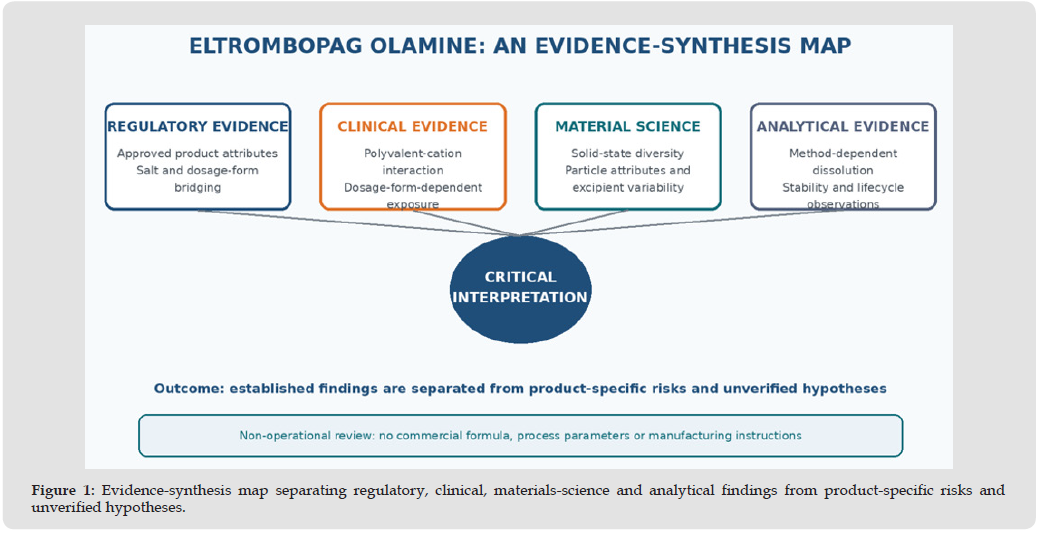
(Figure 1).
Figure 1
Immediate-release generic development is often described as a sequence of familiar tasks: select an active-substance specification, approximate the reference excipient system, choose a scalable process and demonstrate comparable dissolution and bioequivalence. Eltrombopag olamine challenges this linear model. Its low aqueous solubility, multiple solid-state possibilities, sensitivity to polyvalent cations and dosage-form-dependent exposure create a network in which a change intended to improve one attribute may adversely affect another. A finer active substance may increase apparent dissolution while worsening flow, segregation or lubricant sensitivity; a highly solubilising medium may produce complete release while concealing meaningful product differences; and an excipient that is pharmacopeially compliant may still differ in metal, moisture or peroxide profile. The central scientific question is therefore not whether a single formulation variable is intrinsically “critical”, but under which material-process-medium combinations its effect becomes relevant. This distinction is central to formulation science because apparently conflicting regulatory or experimental observations may reflect differences in the surrounding formulation, process, and analytical context. The objective of this review is to integrate those findings and to distinguish established evidence from product-specific observations and hypotheses requiring experimental confirmation.
Search Strategy and Eligibility Criteria
A structured critical narrative review was conducted rather than a systematic review or meta-analysis because the evidence base is heterogeneous and includes regulatory quality assessments, product labelling, clinical pharmacokinetic studies, solid-state research, international quality guidance, pharmacopeial materials, and patent disclosures. Searches were completed on 31 July 2026 using the websites and databases of the U.S. Food and Drug Administration, European Medicines Agency, International Council for Harmonisation, PubMed, the United States Pharmacopeia, Espacenet, and the World Intellectual Property Organization. Search concepts included eltrombopag, eltrombopag olamine, eltrombopag choline, solubility, salt and solid form, polymorphism, particle-size distribution, morphology, dosage- form exposure, polyvalent-cation interaction, reference composition, manufacturing approach, excipient compatibility, dissolution, stability, impurities, bioequivalence, and additional-strength biowaiver. Sources were included when they directly addressed at least one of these domains and provided an identifiable regulatory basis, experimental method, or primary technical disclosure. Statements that could not be verified from a primary or authoritative source were excluded or explicitly reframed as hypotheses.
Evidence Appraisal and Synthesis
Evidence was appraised according to source type, methodological transparency, product specificity, and directness. Regulatory assessments were assigned the greatest interpretive weight for approved product attributes and accepted control logic; peer-reviewed experimental studies were used for mechanistic or clinical interpretation; international guidelines provided the general development and analytical framework; and patents were used only to identify claimed forms, compositions, or technical strategies. Conflicting findings were retained and interpreted within their product and method context rather than collapsed into a single universal conclusion. This review is qualitative and hypothesis-generating; no original experimental data were generated or analysed (Table 1).
Table 1: Evidence hierarchy used to separate verified findings from hypotheses.

Physicochemical and Solid-State Constraints
The current United States prescribing information describes eltrombopag olamine as practically insoluble in aqueous buffer from pH 1 to 7.4 and sparingly soluble in water [1]. Commercial strengths are labelled as eltrombopag free-acid equivalents although the drug substance is the bis-olamine salt. This requires explicit salt-factor and potency correction in material balance, assay and batch documentation. The free acid also has a complex crystal landscape, with more than twenty reported forms, hydrates or solvates in the solid-state literature [2]. Public regulatory assessments therefore place justified emphasis on solid-form identity and particle-size control [3-5]. These findings do not prove that every small change in particle size or solid form will alter clinical performance. They establish instead that the attributes are plausible risk drivers whose criticality must be demonstrated within the specific formulation and process. This is a stronger and more defensible conclusion than treating a single particle-size limit as universally optimal.
Chelation and Dosage-Form Dependence
Clinical pharmacokinetic evidence provides the clearest mechanistic signal in the dataset. The current label reports that a standard high-calcium meal reduced tablet exposure by approximately 59% for area under the concentration-time curve and 65% for peak concentration [1]. The powder for oral suspension generated approximately 22% higher fasting exposure than the tablet, while its exposure was also substantially reduced by a high-calcium meal [1,6,7]. These observations confirm chelation as a major external determinant and are consistent with dosage-form-dependent availability; however, the available clinical evidence does not isolate product microstructure as the sole cause of the exposure difference. The clinical food interaction does not establish that normal lot-to-lot differences in trace elements within compliant excipients will produce a measurable in vivo effect. It does, however, provide a scientific basis for investigating whether excipient selection, pigment systems, supplier variability, or process-created microenvironments alter local coordination, wetting, or apparent dissolution. More recent formulation-specific studies reported bioequivalence between test and reference eltrombopag olamine tablets under fasting conditions and, in one study, under both fasting and fed conditions; these findings demonstrate that bioequivalence can be achieved but do not establish a universal formulation or manufacturing strategy [8,9].
Reference Formulation Logic
The reference tablet core contains mannitol, microcrystalline cellulose, povidone, sodium starch glycolate and magnesium stearate [1]. Functionally, this is a coherent system: mannitol is a non-reducing soluble diluent, microcrystalline cellulose supports compactability, povidone provides binding, sodium starch glycolate promotes disintegration and magnesium stearate provides lubrication. The coating varies by strength and contains selected pigments and polymers [1]. This composition should be interpreted as a benchmark rather than a ready-made development answer. Pharmacopeial name does not capture grade, particle size, surface area, water content, peroxide level or elemental profile. Qualitative similarity may reduce uncertainty, but product understanding requires evidence that selected grades and suppliers produce robust blend, granule, tablet and dissolution behaviour.
Particle-Size Criticality is Context Dependent
Public regulatory assessments evaluate active-substance particle size because eltrombopag is poorly soluble and because particle attributes can influence both release and processing [3-5]. Product-specific evidence nevertheless indicates that the effect may be absent or mitigated within an evaluated formulation and process. These findings are not contradictory when interpreted correctly: they demonstrate that particle-size criticality is conditional rather than universal. These findings support a “particle-size paradox”: an attribute may be sufficiently important to characterise and monitor while remaining insufficient, on its own, to predict dissolution or in vivo performance. The available public record does not isolate particle-size effects from morphology, specific surface area, agglomeration, wetting, excipient distribution, or process-created microstructure.
Manufacturing Process and Microstructure
Public assessment reports indicate that more than one manufacturing approach has been used for approved eltrombopag products, but most quantitative process details are redacted [4,5]. The public record therefore supports only a limited conclusion: process history may influence particle presentation, porosity and wetting, while no route can be identified as universally preferred from public evidence alone. Any stronger claim would require product-specific data that are not publicly available.
Dissolution as a Development Model
Dissolution findings for eltrombopag are strongly method dependent because of its very low aqueous solubility. Surfactant level, buffer composition, ionic strength, agitation, filtration and sample stability can change apparent release, but public sources do not establish a universal condition applicable to all products [3,10,11-16]. Published profiles should therefore be interpreted within the exact method used rather than compared across studies without qualification. Regulatory documents discuss robustness and discrimination as product-specific concepts; they do not provide a transferable recipe. A rapid or complete profile may reflect the test environment as much as the dosage form, so method sensitivity must be supported for the product under evaluation.
Stability and Analytical Control
Public quality reviews identify solid-form stability, particle-size change, impurities, tablet appearance and dissolution as interconnected lifecycle concerns. In the alternative-salt product, accelerated- condition discoloration was identified and resolved during review [3]. This example shows why colour cannot be treated as a cosmetic observation alone. It should be interpreted together with water content, related substances, coating composition and solid-state data. A stability-indicating analytical package should connect chemical degradation with physical performance. International guidelines support a lifecycle approach to analytical procedure development, validation, elemental impurities, and quality risk management [17-22]. Specific degradation pathways cannot be assigned without supporting mass balance, peak-purity assessment, and appropriate structural evidence (Table 2).
Table 2: Key findings and their formulation-science interpretation.
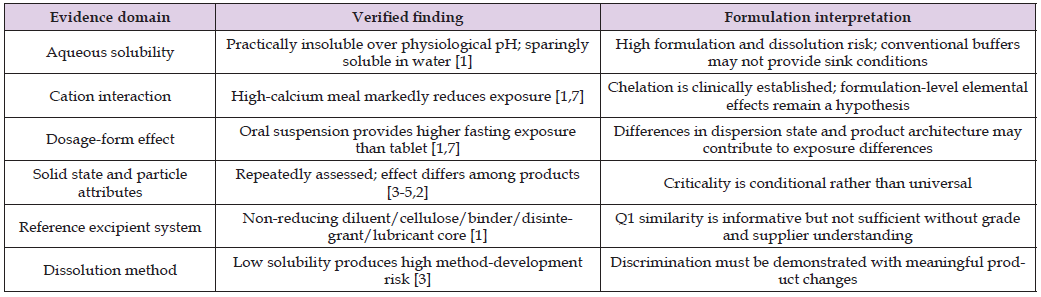
The proposed framework is intentionally non-prescriptive. It organises public evidence around dosage form, solid state, particles, excipients, dissolution, stability and strength bridging without presenting a commercial formula or fixed process parameters.
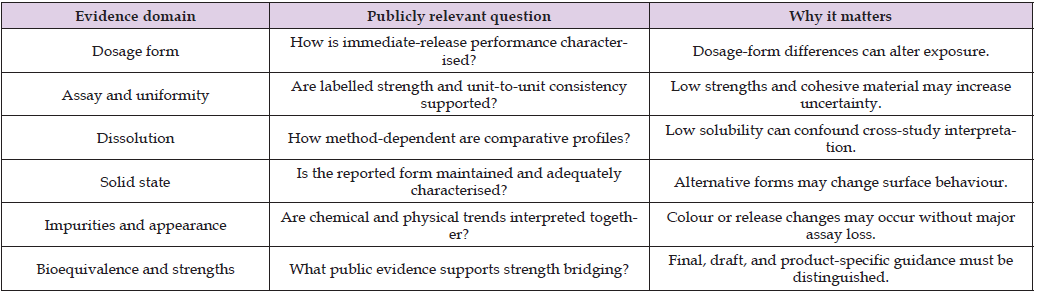
Evidence Domains and Product-Quality Questions
Table 3.
Table 3: Product-quality domains considered in the public evidence base.
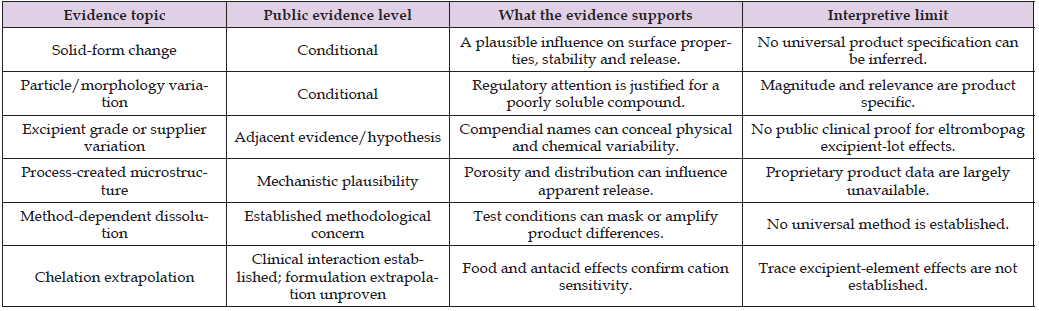
Evidence Certainty and Interpretive limits
Table 4.
Table 4: Evidence-confidence map and interpretive limits.
Evidence Gaps in the Public Record
Public sources do not resolve whether morphology, excipient grade, product ageing or process history independently explain observed release differences. These uncertainties are recorded here as evidence gaps rather than as an experimental plan.
The synthesis leads to three broad insights. First, eltrombopag is not merely a poorly soluble compound; it is a system in which solubility, chelation and dosage-form microstructure interact. Second, particle- size distribution is neither universally dominant nor irrelevant. Its effect emerges from the formulation and process context. Third, dissolution is an experimental model that can either reveal or conceal product differences depending on how it is designed. Together, these observations provide an integrated interpretation that extends beyond an excipient-by-excipient review. The principal contribution is the reconciliation of regulatory and experimental observations that may initially appear inconsistent when considered outside their product and method context. Public sources remain insufficient to rank specific active-substance lots, excipient grades, or manufacturing approaches.
Molecular Ionisation, Apparent Solubility and Precipitation Risk
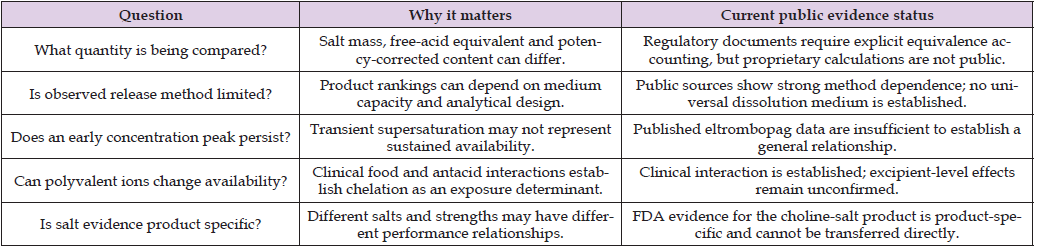
Eltrombopag cannot be understood by a single equilibrium-solubility number. The molecule contains multiple ionisable and coordination- capable groups, and the marketed olamine salt changes handling and salt-factor calculations without eliminating the low-solubility behaviour of the pharmacologically active moiety. The United States label describes the olamine salt as practically insoluble in aqueous buffers across pH 1-7.4 and only sparingly soluble in water [1]. Consequently, conventional compendial buffers may operate under non-sink or borderline-sink conditions, making the observed release profile a composite of disintegration, wetting, surface conversion, complexation, dissolution and possible precipitation rather than a simple measure of tablet rupture. A useful formulation interpretation distinguishes intrinsic solubility, total apparent solubility, transient supersaturation and the amount remaining molecularly available after contact with ions or colloidal components. A formulation can produce an early concentration maximum without maintaining that concentration throughout gastrointestinal transit.
Conversely, a slower but more sustained release may generate similar systemic exposure if the dissolved fraction remains available for absorption. This is one reason why a faster in vitro profile should not automatically be labelled superior. The scientifically meaningful question is whether the formulation and method reproduce the rate-limiting events that matter in vivo. The alternative choline salt illustrates the importance of separating salt identity from dose equivalence. FDA reviews for ALVAIZ describe development of a lower nominal choline-salt strength to match exposure from the established olamine product, demonstrating that equal labelled mass across salts cannot be assumed to produce equal exposure [3,23]. Evidence from the choline product is valuable for illustrating salt-dependent developability and bridging, but it must not be transferred directly to an olamine formulation as if the salts were interchangeable. Salt selection, solid form, free-acid equivalence and product microstructure must be evaluated as a connected system (Table 5).
Table 5: Molecular and biopharmaceutical questions highlighted by public evidence.
Solid-State Landscape: Identity Is Necessary but Not Sufficient
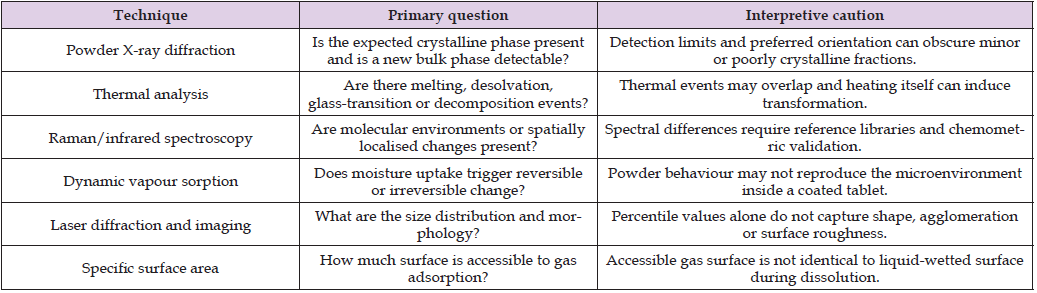
The solid-state literature reports an extensive crystal landscape for eltrombopag free acid, including numerous forms, solvates and hydrates [2]. The marketed drug substance is the bis-olamine salt, so free-acid polymorph literature does not by itself define the commercial solid-state specification. It does, however, demonstrate a strong tendency of the molecular scaffold to form alternative lattices and solvent- associated phases. Regulatory assessments accordingly evaluate drug-substance identity, crystallinity and particle attributes [3-5]. A robust review should therefore avoid two opposite errors: assuming that every reported free-acid form is relevant to the finished product, or assuming that a single initial powder-diffraction match eliminates lifecycle solid-state risk. Orthogonal characterisation is important because each technique answers a different question. Powder X-ray diffraction is sensitive to long-range order but may miss low-level amorphous material; differential scanning calorimetry and thermogravimetry detect thermal events and solvent loss but are not uniquely specific; Raman or infrared mapping can reveal spatial heterogeneity; dynamic vapour sorption probes moisture-driven behaviour; microscopy and surface-area measurements address morphology and exposed surface. No single test should be promoted as a universal release specification.
The control strategy should be proportional to demonstrated risk and should link the analytical signal to a relevant product attribute. Process history can alter the effective solid-state presentation even when the named crystalline form remains unchanged. Milling can increase defect density and electrostatic charging; wet processing can create transient dissolution-reprecipitation; drying can change residual solvent or water distribution; compression can modify porosity and contact area. These effects may alter wetting and release without producing a new bulk polymorph detectable by routine diffraction. For eltrombopag, the most informative solid-state programme is therefore not merely an identity check but a before-and-after comparison across representative material and product states (Table 6 & Figure 2).
Figure 2
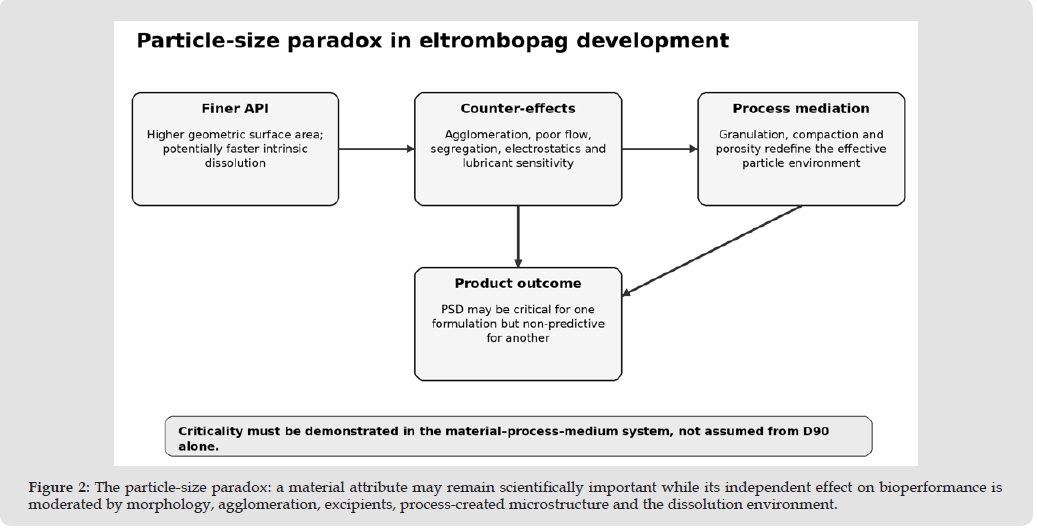
Table 6: Orthogonal solid-state and particle-characterisation toolkit.
The Particle-Size Paradox and the Need for Multivariate Specifications
Poor solubility makes particle-size distribution an intuitive risk, but a simple D90 limit can create false confidence. Two lots with similar D10, D50 and D90 values may differ in shape, fines content, agglomerate strength, surface area, electrostatic behaviour and crystal defects. Those differences can influence flow and segregation before they influence dissolution. Conversely, a formulation with rapid disintegration, favourable wetting and a porous microstructure may buffer moderate API particle-size differences. This explains why regulatory assessments can justifiably request particle-size evaluation while a product-specific study concludes that the tested range did not affect dissolution or bioavailability [3-5].
Criticality should therefore be framed as a conditional relationship rather than a permanent label. The relevant model is not ‘PSD causes dissolution’, but ‘PSD interacts with morphology, excipient distribution, granulation history, compression and medium properties to influence the effective surface presented to the liquid’. This multivariate view changes specification strategy. Development data should first establish which representation of the particle population is predictive: percentiles, surface area, image-derived shape descriptors, fines fraction or a combination. A tight numerical limit without predictive value can increase supply risk without improving product understanding. Public evidence does not establish which particle representation-percentiles, morphology, surface area or agglomeration- best predicts performance across products. The absence of comparative multi-product data is itself a central limitation and prevents a universal particle specification from being inferred.
Excipient Chemistry: Functionality, Reactive Impurities and Local Coordination
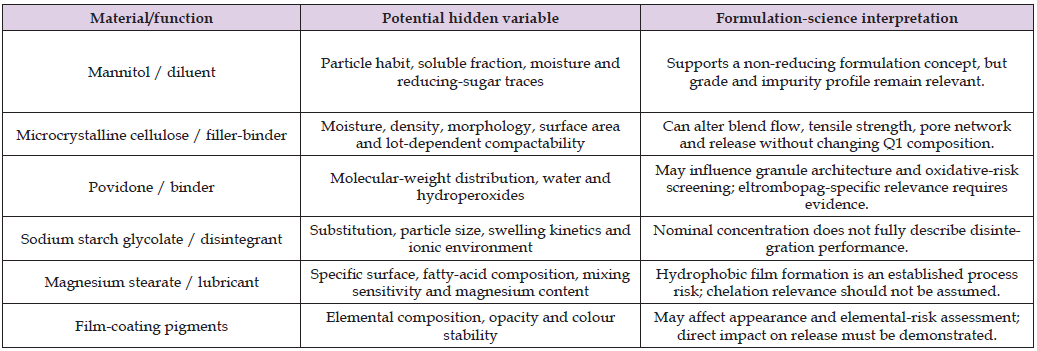
The reference excipient list is deceptively simple. Mannitol, microcrystalline cellulose, povidone, sodium starch glycolate and magnesium stearate form a conventional immediate-release core [1], but each material carries physical and chemical attributes that are invisible in a qualitative composition list. Mannitol grade affects particle habit, soluble-pore formation and residual reducing-sugar content. Microcrystalline cellulose varies in moisture, density, particle morphology and compactability. Povidone may vary in molecular-weight distribution and hydroperoxide burden. Sodium starch glycolate can differ in substitution, swelling kinetics and electrolyte response. Magnesium stearate introduces both a hydrophobic surface effect and a divalent metal-containing material, although this fact alone does not establish clinically relevant chelation. Reactive impurities deserve explicit consideration because compendial compliance does not ensure identical stability behaviour among suppliers or lots.
Hydroperoxides have been measured in commonly used polymeric excipients, and published studies show that peroxide impurities in povidone or crospovidone can promote oxidation of susceptible drug substances [24-27]. Reducing sugars, aldehydes, organic acids, and trace metals are additional classes of reactive impurities described in the excipient literature [24,25]. No public evidence demonstrates that these mechanisms necessarily control eltrombopag degradation; accordingly, they should be treated as plausible, testable risks whose priority is determined by forced-degradation knowledge and observed impurity trends. Chelation creates a separate but related question. The clinical effect of calcium-rich food and polyvalent-cation antacids is established [1,7,28]. It would be an overstatement to infer that normal trace elements in a compliant excipient automatically reduce bioavailability. Public evidence does not establish a product- level effect of excipient-grade elemental variability; any such relationship remains unconfirmed (Table 7).
Table 7: Excipient chemistry risk matrix for eltrombopag olamine tablets.
Manufacturing-Route Evidence and Its Limitations
Public sources describe direct-compression and granulation- based approaches across eltrombopag-related filings and patents, but the disclosed details are incomplete and frequently framed for regulatory or legal purposes. The routes may differ in how they affect distribution and porosity, yet the public evidence does not establish a generally superior process. Because process parameters, material grades and manufacturing scale are largely confidential, cross-product comparisons remain limited. Apparent differences in release cannot be attributed to route alone without matched material and product data. General quality guidance discusses process monitoring, but no public eltrombopag dataset demonstrates a validated relationship between a specific process signal and clinical performance. Such relationships should therefore be described as unconfirmed (Table 8).
Table 8: Manufacturing-route evidence and limitations in the public record.

Dissolution Evidence is Method Dependent
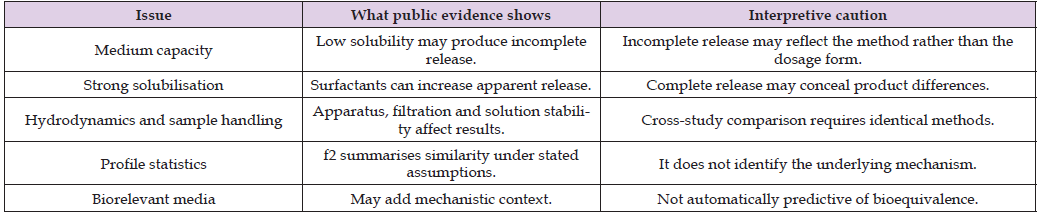
Published dissolution findings are method-specific observations. For a very poorly soluble compound, incomplete release may reflect medium capacity, while complete release may reflect strong solubilisation. Neither pattern alone proves inferior or superior product performance. Public regulatory sources identify method discrimination as important but do not define one transferable set of conditions. Differences in buffer species, surfactant, apparatus hydrodynamics, filtration and solution stability can change apparent profiles and limit cross-study comparison. Profile statistics such as f2 summarise similarity under the tested conditions; they do not identify mechanism and can be misleading when their assumptions are not met [12,13]. Biorelevant media may support mechanistic interpretation, but without matched in vivo data they should not be described as predictive of bioequivalence [14,15], (Table 9).
Table 9: Method-dependent dissolution issues and interpretive cautions.
Stability and the Analytical Lifecycle
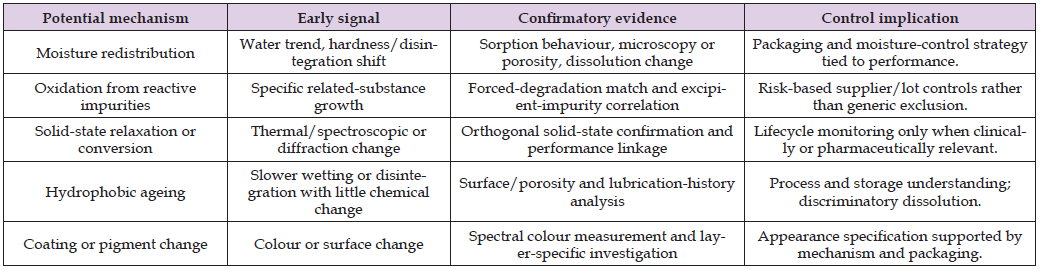
Stability should be interpreted as a network of physical and chemical changes. Assay and related substances remain essential, but a tablet can retain chemical compliance while its pore structure, disintegration, colour or dissolution changes. Moisture redistribution can plasticise binders, alter disintegrant performance or promote local mobility; coating pigments and polymers can change appearance; continued solid-state relaxation can modify wetting. The stability programme should therefore trend chemical impurities alongside water, appearance, mechanical attributes, disintegration, dissolution and, where risk indicates, solid-state markers.
Stress studies are most informative when they establish degradation mechanisms and analytical selectivity rather than merely generate a percentage loss.
Oxidative, hydrolytic, thermal, photolytic and humidity stresses should be interpreted against plausible excipient impurities and packaging exposures. If oxidation is observed, peroxide-containing excipients become a more credible risk; if moisture changes dissolution without chemical degradation, microstructural and disintegrant mechanisms deserve priority. This cause-and-effect reasoning is consistent with the analytical lifecycle principles in ICH Q14 and Q2(R2) [19,20]. Packaging is part of the formulation system. Moisture- vapour transmission, oxygen ingress, light protection, headspace, and desiccant use may alter the relative importance of risks identified during development. Accelerated conditions are useful for ranking and mechanism exploration, but extrapolation must recognise that transformation pathways can differ from long-term storage. A lifecycle control strategy should define which incoming-material and process changes trigger comparability work, which analytical trends act as early-warning signals, and how the dissolution method remains capable of detecting meaningful drift. This interpretation is consistent with the pharmaceutical quality-system, knowledge-management, and lifecycle principles described in ICH Q10 and ICH Q12 [29,30], (Table 10).
Table 10: Stability mechanism-to-signal map.
Evidence-Confidence Architecture
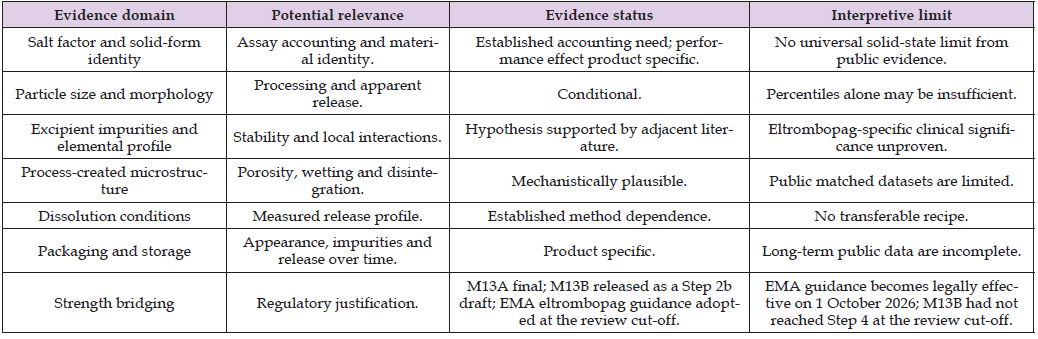
An evidence-confidence framework is more appropriate than a prescriptive control strategy in a public review. Poor aqueous solubility and cation-sensitive exposure are established findings; particle- size effects, excipient impurities and process-created microstructure are conditional; several other proposed mechanisms remain hypotheses. Negative product-specific evidence can reduce the apparent importance of a variable within a studied range, but it should not be generalised to every product. Likewise, a single successful batch cannot establish a universal relationship. The review therefore ranks evidence rather than recommending specifications (Table 11 & Figure 3).
Figure 3
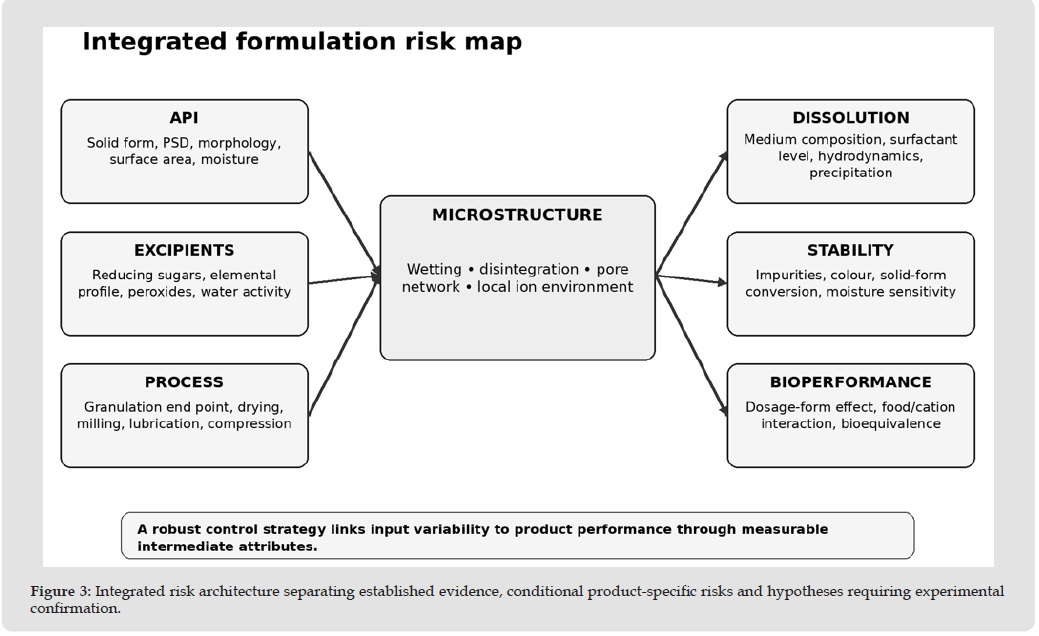
Table 11: Evidence domains, relevance and interpretive limits.
Regulatory And Patent Evidence: How to Use Apparently Conflicting Sources
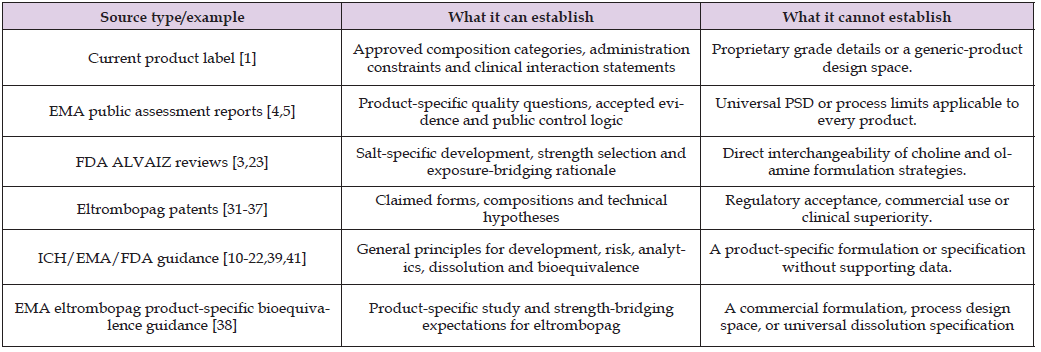
Regulatory assessments and patents answer different questions. An assessment report records the evidence considered for a specific approved product, often with confidential details redacted. A patent seeks legal scope and may describe broad option sets, predicted advantages or examples that are not equivalent to an approved control strategy. Patents are therefore useful for mapping formulation concepts, claimed solid forms and possible manufacturing routes, but they cannot establish that a composition is clinically superior or commercially implemented [31-37]. The regulatory record supports a product-specific interpretation. EMA assessments examine solid form and particle size because of the compound’s poor solubility, while product-level evidence may reduce the apparent criticality of particle size within the studied range [4,5]. FDA evaluation of the choline salt demonstrates that salt conversion, nominal strength, and exposure bridging require integrated evidence [3,23]. The EMA adopted product-specific bioequivalence guidance for eltrombopag in March 2026, with a legal effective date of 1 October 2026 [38]. General bioequivalence principles remain governed by the EMA bioequivalence guideline and ICH M13A [39,40]. The product-specific document should be distinguished from broader harmonised guidance. ICH M13B had been released as a Step 2b draft for regional consultation and had not reached Step 4 at the review cut-off [41]. M13B should therefore not be cited as final adopted guidance when discussing additional- strength biowaivers (Table 12).
Table 12: Regulatory and patent evidence map.
Unresolved Knowledge Gaps
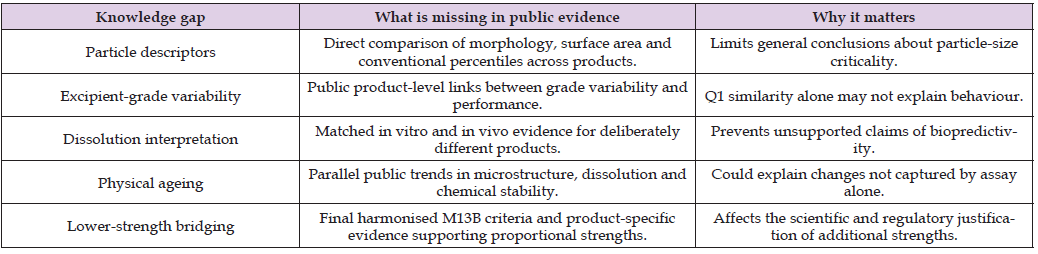
The public literature leaves several unresolved questions. It does not establish whether morphology or microstructure consistently predicts dissolution better than conventional particle-size percentiles, whether excipient-grade variability materially changes product performance, or whether physical ageing can precede chemical instability. Guidance relevant to lower-strength bridging continues to evolve. ICH M13A is final; ICH M13B had been released as a Step 2b draft and had not reached Step 4 at the review cut-off; and EMA product-specific guidance for eltrombopag had been adopted but was scheduled to become legally effective on 1 October 2026 [38,40,41]. These gaps identify priorities for future peer-reviewed work. The present article does not present an operational formulation, a manufacturing programme, or original experimental results. Future original research should use predefined methods, actual product-specific data, appropriate statistical analysis, and relevant ethical and regulatory oversight (Table 13).
Table 13: Unresolved knowledge gaps in the public evidence base.
This review is limited by redaction of proprietary manufacturing details and quantitative specifications in public assessment reports. Patent disclosures are selective and legally framed, and evidence from an alternative salt cannot be transferred directly to the olamine salt. The structured narrative approach did not include a formal risk-ofbias tool or quantitative meta-analysis and may therefore be affected by source-selection and publication biases. No original experimental data were generated, so the proposed relationships cannot establish causality or validate a commercial control strategy. In vitro chelation experiments, if performed in future work, would not by themselves establish clinical relevance. The framework should therefore be interpreted as a product-development evidence map and a basis for hypothesis- driven studies.
Eltrombopag olamine tablet development is best interpreted as an integrated problem of solid state, particle attributes, excipient chemistry, product microstructure, dissolution, stability, and packaging. The strongest public evidence supports very low aqueous solubility, clinically relevant sensitivity to polyvalent cations, dosage- form-dependent exposure, regulatory attention to solid form and particle attributes, and the need for a product-relevant dissolution strategy. The evidence does not support a universal particle-size target, a single preferred manufacturing route, or direct transfer of conclusions between the olamine and choline salts. Overall, the available evidence supports a product-specific, multivariate development strategy in which material attributes, excipient functionality, process- created microstructure, analytical conditions, packaging, and strength bridging are evaluated as an interacting system rather than as isolated variables.
The authors thank World Medicine İlaç San. ve Tic. A.Ş. for institutional support and access to scientific resources. The authors also acknowledge Ruşen Kalender for supporting the research and review programme.
1. Funding: This work was supported by World Medicine İlaç
San. ve Tic. A.Ş. through institutional time and access to scientific
resources. No external funding was received.
2. Competing Interests: All authors are employees of World
Medicine İlaç San. ve Tic. A.Ş. The authors declare no other competing
interests.
3. Author Contributions: C.Y.: Conceptualization, methodology,
investigation, data curation, visualization, writing - original
draft, writing - review and editing, and project administration.
C.T., G.G., and E.B.: Validation, scientific interpretation, writing -
review and editing, and supervision. All authors reviewed and
approved the final manuscript.
4. Data Availability: No original data sets were generated. All
regulatory documents, publications, guidelines, pharmacopeial
materials, and patent sources evaluated in this review are publicly
available and cited in the reference list.
5. Ethics Approval and Consent to Participate: Not applicable.
This review did not involve human participants, human biological
samples, or animals.
6. Use of Generative AI and AI-Assisted Technologies: An
AI-assisted language tool was used during drafting, restructuring,
and language refinement. The authors reviewed and verified
the scientific content, source attribution, interpretation, and final
wording and take full responsibility for the manuscript.

International Association of Landscape Archaeology, Czech Glass Society, Czech Republic

Department of Chemistry, Semenov Institute of Chemical Physics, USSR Academy of Sciences, Moscow, Russia

Department of Educational Sciences, Research Centre Qualities of Teachers, School of Education – HAN, Nijmegen, Netherlands

Associate Professor at Department of Breast and Thyorid Surgey, Chongqing General Hospital, China

Neurology, LA BioMed Research Institute, USA





 Abstract
 PDF