info@biomedres.us
+1 (502) 904-2126
One Westbrook Corporate Center, Suite 300, Westchester, IL 60154, USA
Site Map
 ISSN: 2574 -1241
Received: August 06, 2026; Published: September 22, 2026
*Corresponding author: Gergana Gecheva Fermendzhieva, Medical center “Pavel banya” OOD, Pavel banya city, Petko Kolev str, 16 Department Physiotherapy and Rehabilitation, Bulgaria
DOI: 10.26717/BJSTR.2026.66.010398
Background: Lumbar disc herniation (LDH) with radiculopathy may lead to significant functional impairment,
including gait disturbance and pain-related disability. While surgical decompression is indicated in severe cases,
many patients opt for conservative rehabilitation-based management.
Case Presentation: This case report describes a patient with MRI-confirmed lumbar disc herniation presenting
with unilateral radicular pain, sensory disturbances, and gait impairment. The patient declined surgical treatment
and was admitted to a structured physiotherapy and rehabilitation program emphasizing multimodal conservative
care, including underwater lumbar extension decompression therapy.
Intervention: The rehabilitation program included underwater lumbar extension traction, manual therapy, core
stabilization exercises, neurodynamic mobilization, and progressive gait training.
Outcomes: Following the intervention period, the patient demonstrated significant reduction in radicular pain,
improvement in neurological symptoms, and measurable enhancement in gait stability and walking tolerance.
Conclusion: Underwater lumbar extension decompression, as part of a comprehensive physiotherapy program,
may represent a useful adjunct in the conservative management of LDH in patients refusing surgical treatment.
Further controlled studies are required to validate efficacy and optimize protocols.
Keywords: Lumbar Disc Herniation; Radiculopathy; Underwater Traction; Spinal Decompression; Physiotherapy; Gait Impairment; Rehabilitation
Lumbar disc herniation (LDH) is a common degenerative spinal condition characterized by displacement of nucleus pulposus material beyond the intervertebral disc space, often resulting in nerve root compression and radicular symptoms. Clinical manifestations include low back pain, dermatomal pain, sensory deficits, motor weakness, and functional limitations such as impaired gait. Conservative treatment remains the first-line approach in the absence of progressive neurological deficits. Physiotherapy interventions aim to reduce pain, improve function, and restore mobility through multimodal rehabilitation strategies including exercise therapy, manual therapy, and spinal decompression techniques. Underwater lumbar extension decompression is a form of traction therapy performed in a hydrotherapeutic environment, where buoyancy and controlled loading facilitate spinal unloading and may reduce intradiscal pressure.
A patient presented to the rehabilitation department with:
• MRI-confirmed lumbar disc herniation (L5–S1 level)
• Unilateral radicular pain radiating to the lower limb
• Sensory disturbances (paresthesia and hypoesthesia in dermatomal
distribution)
• Motor weakness affecting ankle dorsiflexion
• Impaired gait pattern with reduced stance stability and antalgic
walking strategy
The patient explicitly refused surgical intervention and opted for conservative rehabilitation management. No red flags such as cauda equina syndrome or progressive severe neurological deficit were present.
The patient underwent two courses of underwater lumbar extension therapy, each lasting 10 days, within a period of one year. Each treatment course consisted of:
Underwater Lumbar Extension Therapy
• Conducted in a controlled hydrotherapy environment
• The patient was positioned in the fetal position in a specialized
hydrotherapy bath designed for underwater lumbar extension
using natural mineral water.
• Gradual axial loading and unloading cycles applied
• Aimed at reducing intradiscal pressure and nerve root compression
• Sessions performed multiple times per week under supervision
Exercise Therapy – Late-Stage 1 Month after the Underwater Lumbar Extension
• Core stabilization training (deep trunk musculature activation)
• Lumbar segmental control exercises
• Progressive functional strengthening
Gait Rehabilitation – Late Stage
• Step training and weight shifting
• Balance and proprioceptive exercises
• Gradual reintroduction of normal gait mechanics
Following completion of the rehabilitation program:
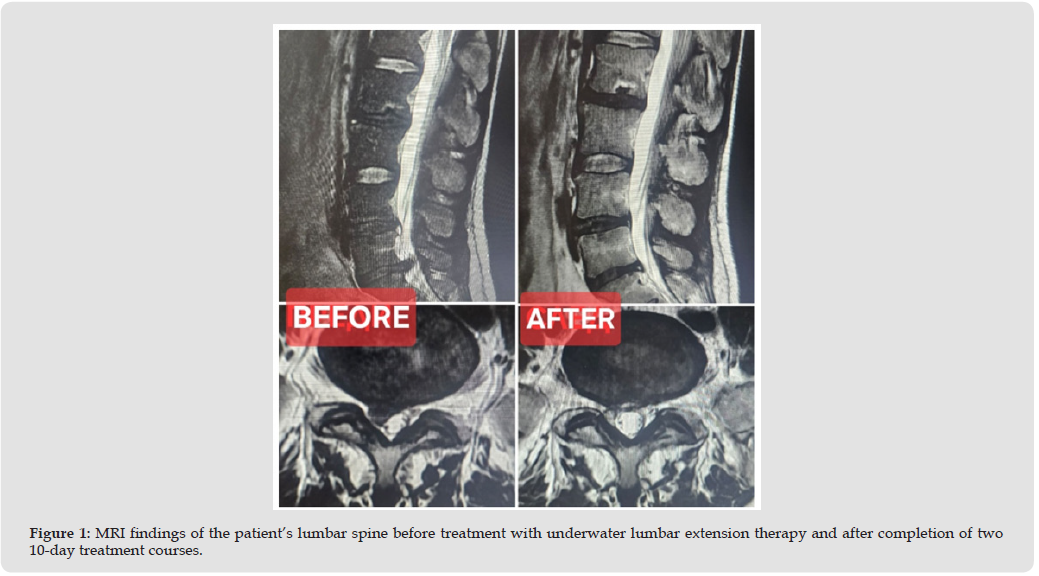
• MRI examination revealed resorption of the herniated disc
material (Figure 1)
• Significant reduction in radicular pain intensity
• Improvement in sensory symptoms
• Partial to near-complete recovery of ankle dorsiflexion
strength
• Improved gait symmetry and stability
• Increased walking tolerance and functional independence
The patient reported subjective improvement in quality of life and daily activity performance. No adverse effects related to underwater traction therapy were observed [1-5].
Figure 1
This case highlights the potential role of underwater lumbar extension decompression as an adjunct in conservative management of lumbar disc herniation with radiculopathy. The observed clinical improvement may be explained by several proposed mechanisms:
• Reduction of intradiscal pressure during spinal unloading
• Temporary enlargement of intervertebral foraminal space
• Decrease in mechanical nerve root compression
• Improved local circulation and reduction of inflammatory
mediators
• Neuromodulatory effects on pain perception
Current literature supports that most LDH cases improve with conservative care, and spontaneous symptom regression is common due to resorption mechanisms of herniated disc material. However, evidence for underwater traction techniques remains limited, with variability in protocols and lack of large randomized controlled trials. Therefore, this intervention should be considered as part of a multimodal rehabilitation strategy rather than a standalone treatment.
Underwater lumbar extension decompression therapy, when integrated into a comprehensive physiotherapy program, may contribute to pain reduction and functional recovery in patients with lumbar disc herniation and radiculopathy who decline surgical intervention. While promising, its clinical application requires further high-quality evidence to establish standardized protocols and long-term efficacy.

International Association of Landscape Archaeology, Czech Glass Society, Czech Republic

Department of Chemistry, Semenov Institute of Chemical Physics, USSR Academy of Sciences, Moscow, Russia

Department of Educational Sciences, Research Centre Qualities of Teachers, School of Education – HAN, Nijmegen, Netherlands

Associate Professor at Department of Breast and Thyorid Surgey, Chongqing General Hospital, China

Neurology, LA BioMed Research Institute, USA





 Abstract
 PDF