info@biomedres.us
+1 (502) 904-2126
One Westbrook Corporate Center, Suite 300, Westchester, IL 60154, USA
Site Map
 ISSN: 2574 -1241
Received: September 03, 2026; Published: September 21, 2026
*Corresponding author: Rizwana Shahid, Associate Professor Community Medicine, Rawalpindi Medical University, Pakistan
DOI: 10.26717/BJSTR.2026.66.010393
Although substantial part of health workforce in Pakistan is constituted by nurses, yet they are confronted with adverse socioeconomic factors and financial hardships. This narrative review is done by using eminent search engines and relevant Pakistani literature published during 2017 and 2026 in accordance with Scale for the Assessment of Narrative Review Articles (SANRA). This review integrates evidences from relevant peer-reviewed studies, organizational reports from nursing schools and health policy evidence to explore the trends in the economic and financial vulnerability of nurses in Pakistan. The review revealed five major themes that were inadequate renumeration relevant to workload and limited social protection, declining job satisfaction, occupational stress and burnout and overseas migration of skilled nursing professionals. Despite the scarcity of published evidence, escalating financial pressure among nurses is attributed to stagnant salary progression, marked wage disparities between public and private sector nurses, weak pension and social security benefits and persistent inflation. Some nursed therefore resigned from regular jobs and migrated abroad in search of better employment opportunities. This economic strain not only drastically impacts their job satisfaction but also comprises the quality of healthcare. Policy changes deemed necessary for financial security of nurses will take time because they need sustained political commitment, institutional reforms and coordination of multiple stakeholders. Addressing the financial hardship of Pakistani nurses is crucial for their economic well-being, their retention in the country and to achieve a resilient and sustainable health systems.
Keywords: Nurses; Socioeconomic Factors; Job Satisfaction; Burnout; Inflation; Health System
Nurses are foundation of health systems that encompass preventive, curative, rehabilitative and emergency care services. However, their workforce shortage across the globe emphasizes the need for sustained investment in nursing education, supportive employment and capacity building for their professional competence [1]. Pakistan has faced substantial economic and health challenges with inflation, devaluing of currency and fiscal constraints profoundly affecting the low- and middle-income households. Rising cost of basic necessities of life may diminish the purchasing powers of nurses and intensify their financial hardship [2]. The quality of nursing care has become one of the prime challenges worldwide that directs the attention of key stakeholders towards its contributing factors [3]. In Pakistan, there have been consistent reporting of insufficient salary package for nurses, inadequate financial rewards, excessive workloads and limited benefits that are strongly illustrative of malalignment of their remuneration with their job description [4]. About 65.57% and 83.82% of the nurses’ migration in Pakistan are attributed to various push and pull factors respectively [5]. In short, unstable economy and political turmoil are determined to be the prime factors contributing to cross-border migration of nurses [6].
Analyzing the migration of skilled and educated workers from Pakistan in 2024, nurses were tiered 5th amongst the highly qualified personnel. The Compound Annual Growth Rate (CAGR) of the nurses (2014-2914) illustrates the registration of 31.4% of the Pakistani nurses abroad [7]. Approximately 30% of the Pakistani nurses were reported with severe occupational stress particularly in Karachi that directs our attention towards their psychological well-being [8]. However, pooled prevalence of occupational burnout among our nurses was estimated to be 68% [9]. This narrative review is intended to synthesize evidence on the economic and financial challenges faced by nurses in Pakistan, including remuneration, cost-of-living pressures, employment insecurity, social protection, workload, and psychosocial well-being. This review would enable us to identify policy and health-system strategies to strengthen nurses’ economic security and retention in Pakistan.
Review Design
This narrative review was planned to synthesize the literature pertaining to the nurses’ economic scenario in Pakistan. Various cross-sectional studies, qualitative and mixed method studies, systematic reviews, meta-analyses and policies formulated by provincial finance department were analyzed. Studies directly emphasizing the financial burden are relatively limited, requiring synthesis across related domains rather than statistical pooling. This review was structured in accordance with the Scale for the Assessment of Narrative Review Articles (SANRA) checklist [10], particularly justification of the review, literature search strategy, appropriate citation of the sources, scientific reasoning and illustration of the relevant outcomes.
Literature Search
A focused search was undertaken using PubMed/MEDLINE, Scopus, Web of Science, CINAHL and Google Scholar alongside targeted searches of Pakistani medical and nursing journals. The search strategy employed Boolean operators “OR” to combine search. Search terms encompassed the concepts related to:
• “nurses” OR “nursing workforce”;
• “Pakistan” OR “Pakistani”;
• “salary” OR “remuneration” OR “income” OR “compensation”;
• “economic burden” OR “financial stress” OR “financial insecurity”;
• “job satisfaction” OR “job dissatisfaction”;
• “employment insecurity” OR “job insecurity”;
• “occupational stress” OR “burnout”;
• “workload” OR “staffing”;
• “turnover” OR “retention”; and
• “migration” OR “brain drain”.
Literature published from January 2017 to August 2026 was reviewed. Studies directly examining the Pakistani nurses were prioritized. However; international systematic reviews were evaluated where Pakistani evidence was inadequate.
Eligibility and Synthesis
Peer-reviewed empirical studies, qualitative studies, mixed-methods studies, systematic reviews, meta-analyses and relevant scholarly analyses were considered. Studies were narratively synthesized according to major thematic domains rather than subjected to quantitative meta-analysis. The key emerging themes were as follows” (Figure 1).
Figure 1
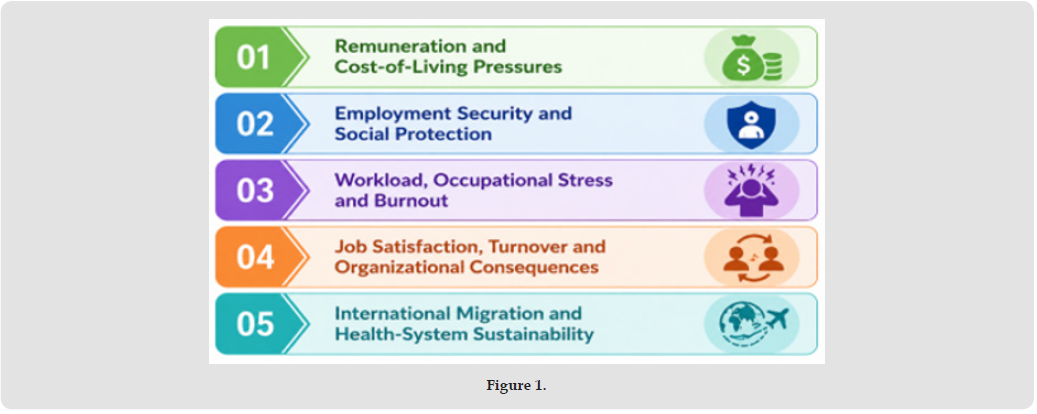
Salary Inadequacy as a Central Economic Challenge: Although economic well-being of the nurses worldwide is judged by their level of education, workload, occupational hazards and cost of living they face; their salary is considered one of the key indicators of their economic wellness [11]. Pakistani studies are suggestive of job satisfaction among nurses with the compensation given to them for their excessive workload. A study of Pakistani nurses examining communication, job clarity, supervisor support and fairness identified compensation among the factors associated with job satisfaction [12]. A cross-sectional study by Ahmad MS et al among nurses working in public and private sector hospitals elucidated that environmental and organizational attributes are the key determinants of their job satisfaction [13]. Evidences from international studies are suggestive of the positive correlation between remuneration and employee retention [14]. Consistent with these, job satisfaction and organizational commitment have been documented with a pivotal role in nurses’ intention to remain in their current employment [15].
Inflation and Declining Real Income: Dramatic increase in economic burden is felt when nominal salary rise fails to keep pace with inflation. The rising costs of basic necessities of life seems to erode the purchasing power of nurses [16]. Pakistan’s inflationary pressure has intensified the financial burden on the nurses. As nurses have to deal with human lives so their clinical responsibilities cannot be accomplished without their physical presence and extended duty hours. Despite their strict job description, nominal salary is offered to them that make them highly vulnerable to resultant economic challenges [17]. The economic consequences of insufficient remuneration may extend beyond immediate financial hardship and include reduced capacity to save, greater dependence on household or family income, increased reliance on borrowing. The financial catastrophe may also lead to postponement of educational and home-ownership plans [18]. Direct household-level studies of these consequences among Pakistani nurses remain limited, representing an important evidence gap.
Employment Security & Social Protection: Economic security is determined not only by the level of income but also by how predictable that income is over a period of time. Human resource hired on contract or adhoc basis often face greater uncertainty about future earnings and minimal access to the benefits like increments or pensions [19]. When healthcare systems face simultaneous shortage of workforce and financial constraints, organizations often turn shortterm employment arrangements to keep services running [20]. This creates a paradox: nurses are indispensable to resilient and sustainable health system, yet the employment conditions they receive frequently fail to reflect that significance [21]. Organizational support plays vital role for job satisfaction among nurses in Pakistan. In a study of 352 nurses across public and private sector hospitals, both organizational support and the perceived work environment were associated with job satisfaction and quality of patient care. Hence, organizational commitment is a crucial mediating factor in this relationship [13].
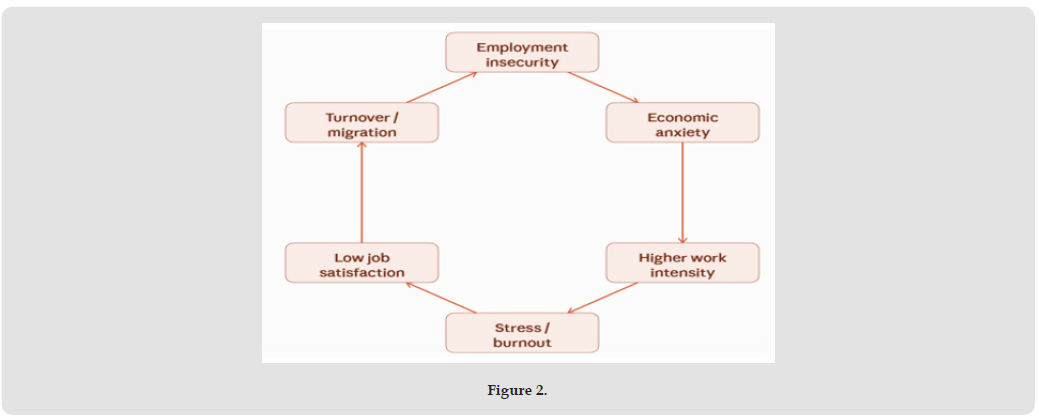
Leadership and psychological empowerment were found to be strongly correlated with workplace commitment and dedication to the organization among Pakistani nurses [22]. Transformational leadership is of paramount significant in leading nursing staff and has been recognized as one of the precursors of positive organizational outcomes. It enhances the chances of workforce retention and facilitates smooth executive of official work [23]. During economic instability and healthcare collapse, nurses often do additional shifts, have long working hours, or tolerate unfavorable work environment just for basic necessities of life [24]. This creates job insecurity cycle as depicted below. Interrupting this cycle demands stronger labour protections rather than reliance on individual coping capacity (Figure 2).
Figure 2
Staffing Shortages
Both public and private sector healthcare facilities may confront with shortage of nurses. When fewer nurses are available to provide care, existing workforce are subjected to additional workload [25]. This may manifest as overtime, missed breaks, extended shifts, high patient-to-nurse ratio. This enhances the likelihood of nervous and mental exhaustion [26]. Pakistani studies consistently highlight workload and staff shortage as fundamental operational difficulties. International evidences are strongly suggestive of the association between nurse staffing levels and nurse-related outcomes in terms of burnout and job dissatisfaction [27]. Meta-analyses have illustrated the associations between nurse staffing levels and nurse outcomes, while systematic reviews indicate that staffing models and approaches can substantially improve both nurse and patient outcomes [28,29].
Systematic review of cohort studies with prospective study design revealed positive association between staffing of less qualified nurses and suboptimal health indices [30]. When nurses perform additional tasks without remuneration, excessive workload effectively becomes a form of uncompensated labour intensity. Beyond this direct cost, high workload may result in indirect cost through sickness absenteeism and reduced work productivity [31]. Investing in adequate nurse staffing shouldn’t be seen as just another line item on a budget. It’s an investment - one that pays off in a more productive workforce, safer patients, and a health system that runs better for the long haul.
Occupational Stress and Burnout: The Financial-Psychological Interface
Earlier studies among Pakistani nurses point to the same conclusion. Of 288 nurses caring for COVID-19 patients, nearly half revealed the signs of burnout. More than a third experienced severe emotional exhaustion (37.2%) and severe depersonalization (36.8%), and almost half (46.9%) reported a diminished sense of personal accomplishment. These grave consequences were substantially attributed to the heavier patient loads [32]. The COVID-19 pandemic made us very clear about how deeply financial and psychological pressures can adversely affect the well-being of an individual. Healthcare workers in Pakistan weren’t just afraid or anxious of getting infected most of them were also worrying about money due to their predisposition to cumulative weight of fear, stress, and psychological strain [33]. Pakistani nurses were subjected to considerable psychological challenges and coping difficulties during the pandemic [34]. The consequences of nurse burnout worldwide extend beyond individual well-being.
A systematic review and meta-analysis by Li LZ et al were illustrative of not only the positive association of nurse burnout with their impaired healthcare but also highlighted the resultant compromised patient safety and quality of care. This factor also adversely affected the degree of patient satisfaction [35]. Burnout is a critical problem that cannot be managed at individual level. It is related to poor human resource management and fiscal challenges of an organization. Tackling the issue of burnout is not simple. Apart from multi-sectoral approach, there is need of coordinated efforts from all relevant stakeholders.
Job satisfaction isn’t shaped by any single factor - it’s the cumulative effect of multiple factors operating together. How well a nurse is paid, how heavy their workload is, how they’re managed, whether their contribution is recognized, how they get along with colleagues, whether there’s room for their professional growth, and whether the workplace treats them fairly - all of these feed into how satisfied a nurse ultimately feels at the workplace [36]. A study examining Pakistani nurses’ perception of calling also found relationships among career commitment, organizational commitment and job stress, demonstrating that intrinsic motivation does not eliminate the grave consequences of poor working climate [37]. This is of utmost importance specifically in Pakistan where nursing profession is perceived to have strong affiliation with service and sacrifice. Professional commitment can encourage nurses to work in unfavorable or unsupportive work environment, but sole reliance on professional altruism cannot substitute for fair remuneration and safe working conditions.
International literature emphasize that interventions directed toward improving nurse job satisfaction can be effective in improving the patient care [38]. Job satisfaction is closely associated with nurses’ career intentions, including their disposition to remain in or leave primary healthcare employment [39]. Therefore, improving financial security should be accompanied by improvements in organizational climate, acknowledgment and career development. Hence, Nurse turnover epitomizes one of the most critical economic consequences of poor employment settings. In Pakistan, several studies have delineated the issues correlated with turnover intention. When someone experiences bullying at work, apart from hurting it builds up as stress, and that stress is often what steers them to leave their job altogether [40]. when workplace become irritating for the employees and there is little support from management, or when gender discrimination is part of the everyday experience - it’s no surprise that people start thinking seriously about walking away. [41] More recent research continues to identify workplace bullying, job satisfaction and self-efficacy as important factors contributing to nurses’ turnover intentions [42]. Hospitals often pour money into recruiting new nurses to fill the gaps - but if they never stop to ask why their experienced nurses left in the first place, they’re just treating the symptom while the underlying problem keeps repeating itself [43].
International migration represents one of the most visible economic responses to the challenges encountered by Pakistani nurses. A qualitative study looking into why Pakistani nurses consider migrating found a mix of reasons behind that pull. Pay gaps mattered, but so did the country’s political instability, difficult working conditions, and a lack of opportunities to grow professionally. Personal safety was a real concern for many, and on top of all that, active recruitment efforts from other countries made leaving feel like a genuine, accessible option rather than just a distant idea [44]. The scale of this problem becomes clearer when you look at the numbers. Between 1971 and 2022, nearly 12,900 Pakistani nurses left the country -making up roughly a quarter of all healthcare professionals who migrated during that period. Researchers point to the same underlying drivers again and again: too few job opportunities, poor salaries, weak infrastructure, and a political climate that made staying feel unsustainable [45]. A study by Rizwan R et al on nurses’ brain drain in Pakistan correspondingly detects the socioeconomic and professional factors as contributors to international migration [5].
Global research backs this up too. A systematic review looking at nurse migration around the world found that whether nurses stay in the countries they move to often comes down to things like how well organizations prepare for and support incoming staff, how welcoming the social and cultural environment feels, and whether there are real opportunities to grow professionally and truly integrate into the new workplace [29]. A scoping review of migrant nurse retention identified personal, organizational, financial, political and environmental factors [46]. This perspective is not intended to question nurses’ right to seek opportunities abroad. Rather, it highlights the importance of improving the working and economic conditions at home, so that migration becomes a genuine personal choice rather than a necessity driven by financial hardship or limited professional opportunities [44].
This review has real strengths, but it’s worth being upfront about its limits too.
On the strengths side: rather than treating financial burden as simply a question of salary, this review pulls together economic, occupational, organizational and migration evidence to build a fuller picture. It also draws on recent Pakistani systematic reviews and meta- analyses, alongside Pakistan-specific studies and relevant international evidence on workforce economics. That said, a few limitations deserve honest acknowledgment. First, there simply isn’t much direct research measuring how financial strain plays out in Pakistani nurses’ households - so some conclusions here lean on indirect signals like job dissatisfaction, stress, burnout, turnover and migration, rather than on hard financial data. Second, most of the available Pakistani studies are cross-sectional and hospital-based, which makes it hard to draw firm causal conclusions or generalize findings nationally [47].
Third, the studies themselves aren’t always comparing like with like - instruments, populations and even how burnout, job satisfaction and turnover are defined vary considerably. The recent burnout meta-analysis, for instance, showed very high heterogeneity between studies. Fourth, salary data isn’t consistently reported in the peer-reviewed literature, which makes it genuinely difficult to compare public- and private-sector pay with much precision. And finally, since this is a narrative review rather than a systematic one, the synthesis presented here is interpretive by nature - it shouldn’t be read as a quantitative estimate of how widespread financial hardship actually is.
The economic struggles facing Pakistani nurses aren’t just about paycheck dissatisfaction - they’re a symptom of something bigger. Nurses are navigating rising inflation, shrinking purchasing power, insecure jobs, thin social protections, heavy workloads, chronic stress, burnout, workplace violence, and growing career frustration - all while opportunities to work abroad keep multiplying. None of these pressures exist in isolation. Financial insecurity pushes nurses to work harder and absorb more stress. Poor conditions feed burnout and dissatisfaction. Dissatisfaction pushes nurses toward the exit - whether that means leaving the profession or leaving the country. And every departure adds more weight onto the nurses who stay behind, closing the loop. Recent evidence showing how widespread stress and burnout have become among Pakistani nurses makes the case even harder to ignore. Global research tells the same story: staffing levels, organizational support, job satisfaction, and working conditions all shape whether nurses stay and how well patients fare. Investing in the economic security of nurses is not merely an employment intervention; it is an investment in patient safety, health-system sustainability and the future of Pakistan’s healthcare workforce.

International Association of Landscape Archaeology, Czech Glass Society, Czech Republic

Department of Chemistry, Semenov Institute of Chemical Physics, USSR Academy of Sciences, Moscow, Russia

Department of Educational Sciences, Research Centre Qualities of Teachers, School of Education – HAN, Nijmegen, Netherlands

Associate Professor at Department of Breast and Thyorid Surgey, Chongqing General Hospital, China

Neurology, LA BioMed Research Institute, USA





 Abstract
 PDF