info@biomedres.us
+1 (502) 904-2126
One Westbrook Corporate Center, Suite 300, Westchester, IL 60154, USA
Site Map
 ISSN: 2574 -1241
Received: September 07, 2026; Published: September 21, 2026
*Corresponding author: Yonggang Hu, Department of Clinical Laboratory, Naxi District People’s Hospital, Luzhou 646300, Sichuan, China
DOI: 10.26717/BJSTR.2026.66.010392
Non-alcoholic fatty liver disease (NAFLD; recently re-termed metabolic dysfunction-associated steatotic liver
disease, MASLD) has become the most prevalent chronic liver disease worldwide, yet pharmacologic options remain
limited and lifestyle modification is difficult to sustain. External therapies of traditional Chinese medicine
(TCM)-including acupuncture/electroacupuncture, moxibustion, acupoint catgut embedding, auricular acupressure,
acupoint application, and cupping/bloodletting-have attracted increasing attention as safe, low-cost, and
multi-targeted adjuncts for NAFLD. Although a growing number of systematic reviews and meta-analyses have
individually summarized single-modality interventions, no review has yet synthesized the emerging rationale
and evidence for combining these external modalities. This narrative review therefore
1) Summarizes the clinical and mechanistic evidence for each external modality,
2) Identifies the shared molecular targets that underlie their potential synergy,
3) Critically appraises the scarce but promising evidence for combined strategies, and
4) Proposes acupuncture combined with bloodletting cupping (cìluò báguàn) as a representative yet understudied
combination that warrants rigorous evaluation.
We conclude that, while current external-therapy evidence for NAFLD is promising, it is limited by small samples,
heterogeneity, and predominantly indirect or metabolic surrogate outcomes; well-designed, adequately
powered randomized controlled trials of rationally designed combination protocols are the logical next step.
Keywords: NAFLD; MASLD; Acupuncture; Electroacupuncture; Moxibustion; Acupoint Embedding; Cupping; Bloodletting; Combination Therapy; TCM
Abbreviations: MASLD: Metabolic Dysfunction-Associated Steatotic Liver Disease; NAFLD: Non-Alcoholic Fatty Liver Disease; TCM: Traditional Chinese Medicine; MAFLD: Metabolic Dysfunction-Associated Fatty Liver Disease; AMPK: AMP-Activated Protein Kinase; CI: Confidence Interval; SIRT1: Sirtuin 1; ALT: Alanine Aminotransferase; AST: Aspartate Aminotransferase; NASH: Non-Alcoholic Steatohepatitis; RCTs: Randomized Controlled Trials; MRI-PDFF: Magnetic Resonance Imaging Proton Density Fat Fraction; mTOR: Mechanistic Target of Rapamycin; ULK1: Unc-51-Like Autophagy Activating Kinase 1; TFEB: Transcription Factor EB; BMI: Body Mass Index; HOMA-IR: Homeostatic Model Assessment of Insulin Resistance; FOXO1: Forkhead Box Protein O1; Th17: T Helper 17; Treg: Regulatory T; TLR4: Toll-Like Receptor 4; ER: Endoplasmic Reticulum; PERK: Protein Kinase R-Like Er Kinase; ATF4: Activating Transcription Factor 4; CHOP: C/EBP Homologous Protein
Non-alcoholic fatty liver disease (NAFLD) is defined by excessive hepatocellular steatosis in the absence of significant alcohol consumption and other recognized causes of hepatic fat accumulation, and is increasingly regarded as the hepatic manifestation of the metabolic syndrome [1]. The condition encompasses a histologic and clinical spectrum ranging from isolated steatosis through steatohepatitis to progressive fibrosis, cirrhosis, and hepatocellular carcinoma, reflecting a long natural history in which only a subset of patients progress to advanced disease [1,2]. Although earlier meta-analytic syntheses had already reported a pooled global prevalence on the order of 25%, with substantial regional variation and rising incidence [3], a 2024 meta-analysis spanning 479 studies and more than 78 million participants updated the estimate to approximately 30% and affirmed that NAFLD tracks closely with the parallel epidemics of obesity and type 2 diabetes [4].
In 2023, a multinational Delphi consensus formally renamed the condition metabolic dysfunction-associated steatotic liver disease (MASLD), anchoring the diagnosis on the presence of hepatic steatosis together with at least one cardiometabolic risk factor [5], a definition subsequently operationalized in joint clinical-practice guidance [6]. This nomenclature shift reflects an evolving understanding of NAFLD/MASLD as a systemic, metabolism-driven disorder rather than a diagnosis of exclusion. (An earlier 2020 term, metabolic dysfunction- associated fatty liver disease [MAFLD], preceded the 2023 MASLD nomenclature; this review uses NAFLD as its primary descriptor while acknowledging the transition.) Current management is dominated by lifestyle intervention-dietary modification, caloric restriction, and exercise-which reliably reduces hepatic fat but is difficult to sustain long term, with frequent relapse once patients revert to prior habits.
Pharmacotherapy has advanced notably with the 2024 approval of resmetirom, a thyroid hormone receptor-beta agonist that achieved histologic resolution of steatohepatitis and fibrosis improvement in the MAESTRO-NASH trial [7]; however, its real-world availability, cost, and long-term safety remain to be established, and it is not yet accessible to the large majority of patients worldwide. This therapeutic gap has motivated growing interest in complementary approaches, among which external therapies of traditional Chinese medicine (TCM) occupy a distinctive niche [8]. External therapies of TCM comprise a family of non-pharmacologic, mostly somatosensory interventions-manual acupuncture and electroacupuncture, moxibustion, acupoint catgut embedding (thread embedding), auricular acupressure, acupoint application/ plaster, and cupping/bloodletting-that share the theoretical framework of meridian and acupoint stimulation.
They are attractive for NAFLD because they are generally inexpensive, minimally invasive, and free of the hepatotoxic risk associated with long-term use of some lipid-lowering agents. A dedicated mechanistic review has cataloged how electroacupuncture modulates hepatic lipid metabolism, inflammation, and cellular stress responses in NAFLD models [9], and acupuncture has been explicitly framed as a multi-targeted therapy suited to the multifactorial biology of obesity and its metabolic complications [10]. Consistent with this, a substantial preclinical literature demonstrates that acupuncture and related modalities engage AMP-activated protein kinase (AMPK), sirtuin 1 (SIRT1), nuclear factor kappa B (NF-κB), and autophagy, converging on lipid metabolism, insulin resistance, and inflammation [11-15]. Through shared somatosensory input pathways, these interventions also modulate appetite, autonomic function, and pain, providing a plausible basis for systemic effects that extend beyond the liver.
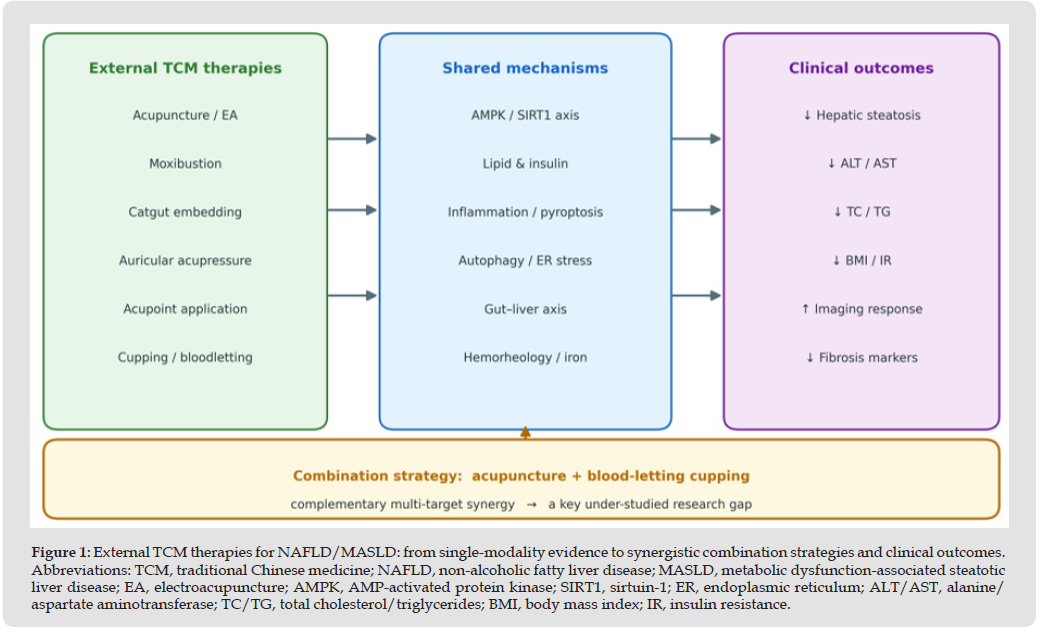
Despite this progress, the English-language literature remains fragmented. Reviews, systematic reviews, and pooled analyses have examined individual modalities-acupuncture, electroacupuncture, and acupoint embedding in particular-but, to our knowledge, no synthesis has specifically addressed the rationale and evidence for combining external TCM modalities in NAFLD [16-19]. This gap is clinically consequential: in real-world TCM practice, multiple external therapies are frequently combined (e.g., acupuncture with cupping, acupuncture with moxibustion) on the premise that distinct modalities acting on overlapping yet non-identical pathways may produce additive or synergistic benefit. The present review addresses this gap. We first critically summarize the single-modality evidence, then synthesize the shared mechanistic targets, and finally evaluate the emerging case for combination strategies, positioning acupuncture combined with bloodletting cupping as a representative, mechanistically coherent, but understudied combination that merits prioritized investigation. The overall structure of this argument-from single-modality evidence through shared mechanisms to combination strategies- is depicted in Figure 1.
Figure 1
We performed a narrative synthesis of the English-language literature indexed in PubMed/MEDLINE and relevant journal archives, supplemented by authoritative society guidelines and consensus statements, published up to 2026. Search terms combined disease terms (“non-alcoholic fatty liver disease”, “NAFLD”, “metabolic dysfunction- associated fatty/steatotic liver disease”, “MAFLD”, “MASLD”, “hepatic steatosis”, “metabolic syndrome”, “obesity”) with intervention terms (“acupuncture”, “electroacupuncture”, “moxibustion”, “acupoint catgut/thread embedding”, “auricular acupressure”, “acupoint application”, “cupping”, “wet cupping”, “bloodletting”, “phlebotomy”) and design terms (“systematic review”, “meta-analysis”, “randomized controlled trial”, “mechanism”). Reference lists of retrieved systematic reviews and key primary studies were hand-searched to identify additional sources. Given the scarcity of direct evidence for combined modalities, we prioritized the highest-quality studies for each single modality, explicitly flagged trials using metabolic or obesity-related surrogate outcomes, and interpreted these as background or indirect evidence rather than direct proof of hepatic efficacy. This review is narrative rather than a systematic review, and no formal risk-of-bias or GRADE assessment was performed.
Table 1 summarizes the representative clinical evidence for each individual external modality, which the following subsections appraise in turn.
Table 1: Representative clinical evidence for individual external TCM modalities in NAFLD.
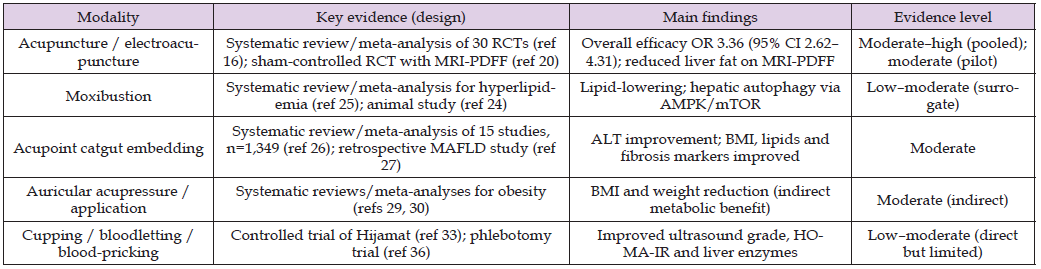
Note: Abbreviations: RCT, randomized controlled trial; MRI-PDFF, magnetic resonance imaging proton density fat fraction; OR, odds ratio; CI, confidence interval; ALT, alanine aminotransferase; BMI, body mass index; HOMA-IR, homeostatic model assessment of insulin resistance; AMPK, AMP-activated protein kinase; mTOR, mechanistic target of rapamycin.
Acupuncture and Electroacupuncture
Acupuncture-manual or electrical-has the most extensive evidence base among external TCM therapies for NAFLD. Two recent systematic reviews with meta-analyses are particularly informative. A 2025 meta-analysis of 30 randomized controlled trials (RCTs) reported that acupuncture, relative to controls, significantly improved the overall clinical effectiveness rate (odds ratio [OR] 3.36, 95% confidence interval [CI] 2.62–4.31), together with favorable effects on liver enzymes, blood lipids, glucose, and imaging outcomes, with no serious adverse events [16]. An earlier meta-analysis of acupoint therapy for NAFLD reached consistent conclusions and, in subgroup analyses, reported benefits for manual acupuncture, electroacupuncture, and acupoint embedding [18]. A further meta-analysis directly comparing acupuncture with conventional Western medicine reported superior overall clinical efficacy and greater improvement in alanine aminotransferase (ALT) and aspartate aminotransferase (AST) [19].
RCT-level imaging evidence is beginning to emerge. A randomized, sham-controlled pilot trial in patients with non-alcoholic steatohepatitis (NASH) demonstrated that 12 weeks of electroacupuncture significantly reduced liver fat content on magnetic resonance imaging proton density fat fraction (MRI-PDFF) relative to sham [20]. Together with registered multicenter sham-controlled protocols for electroacupuncture in MAFLD [21] and additional registered systematic- review protocols [22], these studies signal a move from surrogate biochemistry toward objective imaging and histologic endpoints. The most commonly reported acupoints across these trials and mechanistic studies include ST36 (Zusanli), ST40 (Fenglong), SP6 (Sanyinjiao), BL18 (Ganshu), and LR3 (Taichong), reflecting the “treating the liver via the spleen and transporting-phlegm” therapeutic logic central to TCM management of steatosis; observational clinical experience further emphasizes individualized point selection according to syndrome differentiation [23].
Moxibustion
Direct clinical evidence for moxibustion in NAFLD is thinner than for acupuncture, and much of what is known is extrapolated from its lipid-modulating effects. Preclinical work nonetheless supports biological plausibility: grain-sized moxibustion at ST36 promoted hepatic autophagy and reduced hepatic lipid accumulation in hyperlipidemic rats, an effect mediated through the AMPK/mechanistic target of rapamycin (mTOR)–Unc-51-like autophagy activating kinase 1 (ULK1)/transcription factor EB (TFEB) axis [24]. The thermal, acupoint- specific nature of moxibustion-capable of raising local tissue temperature and activating thermosensitive ion channels-distinguishes it mechanistically from needle acupuncture and may preferentially target cold- or deficiency-type metabolic phenotypes. Clinically, a 2026 systematic review and meta-analysis of moxibustion for hyperlipidemia identified a modest beneficial effect on lipid profiles, though the outcomes were primarily dyslipidemia surrogates rather than NAFLD-specific hepatic endpoints [25]. In TCM practice, moxibustion is most often selected for patients with “spleen-yang deficiency” or cold-damp presentations-syndromes in which warming therapy is traditionally indicated-positioning moxibustion as a syndrome- directed adjunct rather than a standalone first-line treatment, and underscoring the need for trials that stratify by TCM pattern.
Acupoint Catgut Embedding
Acupoint catgut (thread) embedding-a long-lasting form of acupoint stimulation in which an absorbable suture is implanted beneath the skin to provide sustained mechanical and chemical stimulation over days to weeks-has the strongest direct NAFLD evidence among the non-acupuncture modalities. A meta-analysis of 15 studies including 1,349 patients demonstrated that acupoint embedding, alone or in combination, was superior to conventional medication in reducing ALT in NAFLD patients with abnormal transaminases [26]. A 2025 retrospective study in phlegm-turbidity/blood-stasis MASLD patients reported that embedding improved body mass index (BMI), waist circumference, lipids, liver enzymes, and fibrosis-related markers, and was associated with changes in platelet-derived growth factor (PDGF), transforming growth factor-β1 (TGF-β1), and cytokeratin-18 (CK-18) [27]. In the metabolic domain, adding thread-embedding acupuncture to auricular acupuncture enhanced short-term weight reduction in a double-blinded randomized trial [28]. The prolonged, low-frequency stimulation afforded by embedding is frequently cited as a practical advantage for adherence in chronic conditions, reducing the need for repeated visits while maintaining sustained acupoint activation.
Auricular Acupressure and Acupoint Application
Evidence for auricular acupressure and acupoint application is substantial in the metabolic domain but remains largely indirect for NAFLD. Meta-analyses of auricular stimulation/acupressure report modest but statistically significant reductions in BMI, body weight, and related anthropometric indices in overweight and obese individuals [29,30], with a study of acupoint application showing similar metabolic effects [31]. The appeal of auricular approaches resides in their safety, low cost, and capacity for self-administration; a randomized feasibility trial integrating self-administered auricular acupressure with a smartphone application demonstrated acceptable adherence and signals of efficacy for weight reduction, suggesting a scalable, technology-assisted delivery model [32]. Because excess adiposity and insulin resistance are core drivers of NAFLD, these findings are mechanistically relevant and reinforce the multi-targeted, obesity-focused rationale articulated for acupuncture-based interventions [10]; however, they should not be presented as direct evidence of hepatic benefit, and dedicated NAFLD-outcome trials are still lacking.
Cupping, Bloodletting, and Blood-Pricking
This category is the most mechanistically distinctive and the least-studied in the English-language literature-precisely why it is central to the combination rationale developed below. A controlled clinical trial of Hijamat (wet cupping) in Iranian NAFLD patients reported relative improvement in hepatic ultrasound grade, homeostatic model assessment of insulin resistance (HOMA-IR), and liver enzymes compared with lifestyle modification alone, with good tolerability [33]. Meta-analyses of cupping for metabolic syndrome and obesity have shown significant benefits on waist circumference, body weight, and BMI [34,35]. Independently, therapeutic phlebotomy (bloodletting)-a procedure conceptually related to TCM blood-pricking- has demonstrated improvement in liver enzymes and histology in NAFLD patients with hyperferritinemia, consistent with the emerging recognition of iron overload as a therapeutic target in NAFLD [36,37]; an umbrella review further summarized the clinical advantages of phlebotomy across metabolic indications [38], and phlebotomy retains a well-defined role in iron-overload-related disorders [39]. Collectively, these lines of evidence converge on a clinically tangible consequence-reduction of excess iron and improvement of hemorheology- that is not shared by needle-based acupuncture and forms the basis of the synergy argument developed in Section 4.
The clinical promise of external TCM therapies is reinforced by a convergent preclinical literature identifying several overlapping molecular targets (summarized in Table 2); a recent review consolidates how electroacupuncture in particular engages AMPK, SIRT1, phosphoinositide 3-kinase (PI3K)/protein kinase B (Akt), and NF-κB signaling to improve steatosis and metabolic parameters [17].
Table 2: Shared molecular mechanisms and targets of external TCM modalities in NAFLD.

Note: Abbreviations: AMPK, AMP-activated protein kinase; SIRT1, sirtuin 1; FOXO1, forkhead box protein O1; NF-κB, nuclear factor kappa B; ER, endoplasmic reticulum; PERK, protein kinase R-like ER kinase; ATF4, activating transcription factor 4; CHOP, C/EBP homologous protein; mTOR, mechanistic target of rapamycin; ULK1, Unc-51-like autophagy activating kinase 1; TFEB, transcription factor EB; PDGF, platelet-derived growth factor; TGF-β1, transforming growth factor-β1; CK-18, cytokeratin-18.
Lipid Metabolism and Insulin Resistance
Electroacupuncture activates hepatic AMPK, curtailing gluconeogenesis and lipogenesis while promoting fatty-acid oxidation and autophagy; AMPK inhibition partially reverses these benefits, establishing a causal link [13]. Earlier work already demonstrated that electroacupuncture improves disordered lipid metabolism in diet-induced NAFLD rats [40]. Acupuncture also engages SIRT1/forkhead box protein O1 (FOXO1) signaling to promote cholesterol efflux [12] and improves insulin resistance in multiple clinical and experimental settings [11].
Inflammation
Acupuncture and electroacupuncture suppress the Toll-like receptor 4 (TLR4)/NF-κB axis [14], attenuate steatohepatitis in methionine- choline-deficient diet models [41], and inhibit hepatocellular pyroptosis through non-canonical pathways [15]; more recently, electroacupuncture has been shown to rebalance T helper 17 (Th17)/ regulatory T (Treg) cell populations through SIRT1-mediated anti-inflammatory signaling, further linking the immunomodulatory and metabolic actions of needling [42]. Together these effects dampen the sterile inflammation that drives steatohepatitis progression.
Cellular Stress and Autophagy
Electroacupuncture attenuates endoplasmic reticulum (ER) stress by downregulating the protein kinase R-like ER kinase (PERK)/ activating transcription factor 4 (ATF4)/C/EBP homologous protein (CHOP) pathway [43], while moxibustion and acupuncture enhance autophagy through AMPK/mTOR [13,24], facilitating clearance of ectopic lipid.
Gut–Liver Axis
Acupuncture and electroacupuncture reshape the gut microbiota and restore intestinal-barrier homeostasis in diet-induced NAFLD models, a mechanism increasingly recognized as central to metabolic liver disease [44,45].
Hemorheology and Iron Metabolism (Cupping/Bloodletting- Specific)
Bloodletting cupping and phlebotomy lower blood viscosity, reduce the circulating iron burden, and improve hemorheology-effects that converge on the same metabolic endpoints but through a mechanism not shared by needle-based therapies alone [36-38]. This mechanistic complementarity provides the theoretical backbone for combining acupuncture with bloodletting cupping: the former drives neural-metabolic reprogramming (AMPK/SIRT1/NF-κB/gut–liver), while the latter relieves hemorheologic and iron-related stress, potentially yielding additive benefit on hepatic steatosis and inflammation.
Rationale
Single external modalities each engage a subset of the pathways enumerated above, and no single modality adequately addresses the full spectrum of NAFLD pathophysiology-hepatic steatosis, insulin resistance, inflammation, gut dysbiosis, and, in a subgroup of patients, iron overload. Rational combination therefore represents a strategy to broaden target coverage, mirroring the multimodal logic now favored in pharmacotherapy (for example, the concurrent targeting of metabolic and inflammatory pathways in MASLD) and in lifestyle programs that pair diet, exercise, and behavioral support. In TCM clinical practice, combination is already the norm rather than the exception: acupuncture is frequently paired with moxibustion, with cupping, or with embedding according to syndrome differentiation, reflecting the principle that distinct modalities complement one another in both mechanism and temporal profile. In this framing, combination is not merely additive but seeks to recapitulate the multidimensional regulation that the liver’s concurrent metabolic, inflammatory, and hemodynamic derangements jointly require-an argument that follows naturally from the shared-target framework developed in the preceding section.
Emerging Evidence
Direct English-language evidence for combined external TCM protocols in NAFLD remains scarce and is mostly indirect. Electroacupuncture combined with lifestyle control has shown benefits over lifestyle control alone in obese NAFLD [46]; acupuncture combined with other modalities and with Chinese herbal decoctions is repeatedly described as a promising strategy in integrative reviews [8], and combined TCM–silibinin approaches have demonstrated pooled benefit in meta-analysis [47]. In the metabolic domain, the combination of thread embedding with auricular acupuncture produced additive weight reduction [28], illustrating that external–external combinations can yield greater effect than either modality alone. What is conspicuously absent is rigorous RCT-level evidence for specific, pre-specified external–external combinations with objective hepatic endpoints.
Acupuncture Combined with Bloodletting Cupping: A Representative Understudied Combination
Among candidate combinations, acupuncture combined with bloodletting cupping (cìluò báguàn, 刺络拔罐) is particularly compelling for three reasons. First, the two modalities are mechanistically complementary (Section 4), uniting neuro-metabolic and hemorheologic/ iron-related mechanisms. Second, both are well-established, low-cost, and safely deliverable in outpatient settings, favoring adherence and dissemination in primary and community care. Third, the combination is biologically plausible in the TCM framework of “transporting turbidity and resolving blood stasis” (huàzhuó qūyū, 化浊祛 瘀), directly aligned with the phlegm-dampness/blood-stasis (tánzhuó xuèyū, 痰浊血瘀) pathogenesis commonly invoked for NAFLD. To date, however, randomized data on this specific combination in NAFLD are essentially absent, representing a clear, tractable research gap. We propose that future trials evaluate the incremental benefit of adding bloodletting cupping to standardized acupuncture against acupuncture alone, using non-invasive imaging biomarkers such as MRI-PDFF as the primary outcome, with hepatic enzymes, lipids, anthropometry, and TCM syndrome scores as secondary endpoints, and with pre-specified subgroup analyses stratified by TCM pattern and baseline ferritin.
External TCM therapies are generally safe, with no serious adverse events reported across the principal meta-analyses [16,18]. The most commonly cited concern is transient procedural pain, particularly with bloodletting cupping and embedding, which can impair adherence; mitigation via operator training, standardized protocols, and thorough informed consent is therefore essential [33]. Additional practical considerations-infection control for invasive procedures, patient selection (for example, caution in anticoagulated patients or those with bleeding diatheses when performing cupping or phlebotomy, and avoidance of embedding in the setting of active skin infection or poor glycemic control), and standardization of acupoint selection and stimulation parameters-remain under-reported and represent a barrier to reproducibility and guideline integration.
The favorable safety profile is reinforced by the long history of clinical use of these modalities, although structured surveillance of rare adverse events is limited. For resource-limited and primary- care settings, the low cost, minimal equipment requirements, and once-weekly scheduling typical of many protocols offer a pragmatic advantage over chronically administered pharmacotherapy, and self-administered auricular approaches [32] may further reduce visit burden. These practical advantages are nevertheless counterbalanced by the absence of uniform practitioner-training and certification standards, the inconsistent reporting of stimulation parameters across studies, and the scarcity of head-to-head cost-effectiveness data relative to pharmacotherapy-gaps that must be closed before these modalities can be integrated into routine, guideline-endorsed care.
Several limitations temper the interpretation of current evidence. Most studies are small, single-center, and at high or unclear risk of bias; heterogeneity in acupoint selection, treatment frequency, duration, and co-interventions limits cross-study synthesis; and a substantial proportion of the positive signals derive from metabolic or obesity surrogates rather than hepatic endpoints [16-19,29,30]. Publication bias and the predominance of Chinese-language primary studies add further uncertainty, and the mechanistic literature is largely preclinical, raising questions about the translatability of specific molecular findings to human disease. Conclusive evidence for combined protocols is effectively absent. Future work should therefore prioritize:
1. Adequately powered, sham- or active-controlled RCTs of pre-specified combination protocols with objective hepatic endpoints (MRI-PDFF, transient elastography, and, where feasible, histology);
2. Standardization and reporting of intervention parameters in line with Standards for Reporting Interventions in Clinical Trials of Acupuncture (STRICTA)-adjacent frameworks and core outcome sets;
3. Head-to-head comparisons of combination versus single-modality arms to isolate synergy and quantify incremental benefit;
4. Mechanistic sub-studies coupling clinical outcomes with biomarkers of the candidate pathways (AMPK/SIRT1, inflammation, gut microbiota, iron metabolism); and
5. Health-economic and implementation analyses to establish the value proposition of these low-cost interventions in diverse healthcare systems.
External therapies of traditional Chinese medicine offer a safe, inexpensive, and mechanistically multi-targeted approach to NAFLD/ MASLD, with the strongest direct evidence for acupuncture/electroacupuncture and acupoint embedding, and distinctive hemorheologic/ iron-related mechanisms attributable to cupping and bloodletting. The field has matured from single-modality demonstrations toward a recognition that combination may be necessary to address the multifactorial biology of NAFLD. Acupuncture combined with bloodletting cupping exemplifies this rationale-mechanistically complementary, practically deployable, yet essentially untested. We call for rigorous trials of rationally designed combination protocols as the logical and timely next step in translating this ancient, low-cost therapy family into evidence-based care for one of the most prevalent liver diseases of our time, so that the promise suggested by converging mechanistic and indirect clinical evidence can be tested against the stringent standard of randomized, endpoint-driven evaluation.
Ethics Approval and Consent to Participate
Not applicable.
Consent for Publication
Not applicable.
Availability of Data and Materials
Not applicable.
Competing Interests
The authors declare that they have no competing interests.
Funding
This work was supported by the Luzhou Medical Association Research Project (grant No. 2024-YXXM-107).
Authors’ Contributions
Xiaorong Liu conceived and supervised the project. Yaoyuan Xu collected the clinical cases, analyzed the data, and drafted the manuscript. Yuexia Zhong and Demei Hu performed the clinical treatment. Mi He and Ling Zhang guided the questionnaire completion and consolidated the data. Ying Zhang and Yuanfeng Hu were responsible for blood sampling and patient follow-up. Yonggang Hu supervised the study and critically revised the manuscript. All authors read and approved the final manuscript.

International Association of Landscape Archaeology, Czech Glass Society, Czech Republic
Department of Chemistry, Semenov Institute of Chemical Physics, USSR Academy of Sciences, Moscow, Russia

Department of Educational Sciences, Research Centre Qualities of Teachers, School of Education – HAN, Nijmegen, Netherlands

Associate Professor at Department of Breast and Thyorid Surgey, Chongqing General Hospital, China

Neurology, LA BioMed Research Institute, USA





 Abstract
 PDF