info@biomedres.us
+1 (502) 904-2126
One Westbrook Corporate Center, Suite 300, Westchester, IL 60154, USA
Site Map
 ISSN: 2574 -1241
Received: September 01, 2026; Published: September 08, 2026
*Corresponding author: Fernando José Sadio Ramos, Polytechnic University of Coimbra, School of Education, Institute for Philosophical Studies (University of Coimbra / Foundation for Science and Technology), Portugal
DOI: 10.26717/BJSTR.2026.66.010379
Background: Modern veterinary education is overwhelmingly dominated by technical, biological, and clinical
instruction. Consequently, non-anthropocentric ethical frameworks, humanistic reflection, and systemic emotional
support mechanisms are marginalized. This clinical hyper-specialization leaves veterinary practitioners,
academic faculty, and students vulnerable to acute ethical distress, compassion fatigue, moral injury, severe
burnout, and disproportionately high rates of occupational suicide.
Methods: To address this systemic gap, we developed an intensive 8-to-10-hour humanistic-ethical educational
program designed for joint implementation among veterinary students, academic faculty, and clinical practitioners.
The curriculum synthesizes non-speciesist philosophical anthropology, relational ethics, stress-resilience
bioethics, and animal welfare legal philosophy. The methodology integrates eight active, participant-centered
workshop dynamics paired with qualitative narrative-reflective writing prompts.
Results / Observations: Rather than relying on rigid numerical matrices, participant learning and existential
growth are evaluated through post-exercise reflective texts. These narratives undergo inductive Qualitative Content
Analysis (Thematic Analysis) across four primary analytical dimensions: linguistic de-objectification, nuance
in ethical reasoning, empathetic resonance, and moral resilience.
Discussion & Conclusion: Embedding an active humanistic module into veterinary curricula builds existential
resilience, mitigates objectifying attitudes toward non-human creatures, and equips professionals to navigate
moral distress. While this program focuses on empowering human clinicians, it establishes the necessary conceptual
foundation for future advanced training dedicated directly to animal ontology and non-human personhood.
Keywords: Animal Ethics; Philosophical Anthropology; Veterinary Education; Moral Injury; Burnout & Suicide Prevention; Qualitative Research; Narrative Reflection
The historical trajectory of veterinary medicine has evolved from an agrarian, utility-driven discipline focused on livestock productivity to a comprehensive medical field encompassing companion animals, wildlife conservation, and biomedical research. However, this rapid technological expansion has not been accompanied by a parallel evolution in humanistic and ethical education. Pedagogical models in veterinary faculties remain largely entrenched in Cartesian mechanistic paradigms, where non-human animals are frequently treated as biological systems to be repaired rather than sentient creatures with subjective experiences. Crucially, this pedagogical gap exacts a devastating toll on the veterinary professional. Veterinary practitioners face unique, severe psychosocial pressures: navigating conflicting duties between animal patients and human clients, managing economic euthanasia, performing routine end-of-life procedures, and confronting continuous animal suffering. Without a structured humanistic foundation, these pressures manifest as chronic compassion fatigue, moral injury, and clinical burnout. Empirical studies globally indicate that veterinary professionals experience suicide rates up to four times higher than the general population—a alarming reality directly linked to unaddressed moral distress and existential isolation. To address this crisis, professional training must equip practitioners from their educational roots.
This paper presents an original, highly structured 8-to-10-hour humanistic-ethical training program created for collaborative groups of veterinary students, university professors, and clinical personnel. By combining non-speciesist philosophical anthropology, bioethics, active didactics, and qualitative narrative evaluation, the program aims to cultivate ethical agency, build psychological resilience, and transform institutional culture. Furthermore, by establishing the human capacity for ethical reflection, this program lays the groundwork for subsequent educational initiatives dedicated to exploring the intrinsic nature, ontology, and being of non-human animals.
Theoretical Foundations
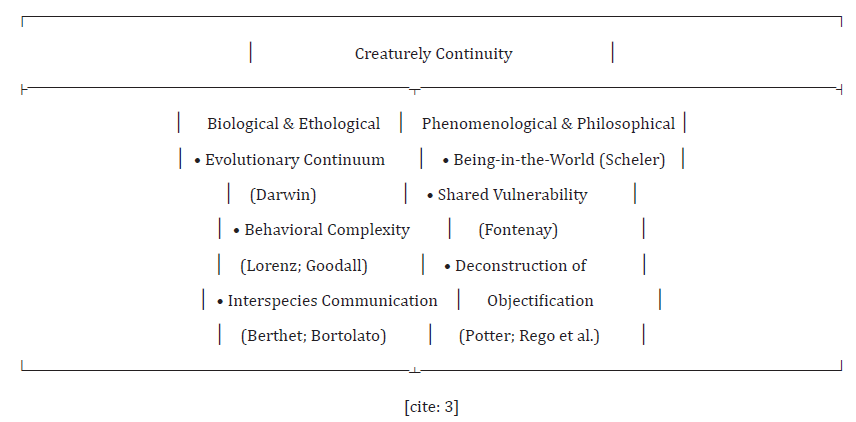
Philosophical Anthropology: Human and Animal as Creatures- in-the-World: Philosophical anthropology traditionally drew rigid, binary boundaries between humans and other animals (e.g., René Descartes’ automata model or Nicolas Malebranche’s denial of animal sensation). A comprehensive humanistic training must dismantle these reifying objectifications:
• Classical & Scholastic Roots: Aristotelian teleology recognized shared organic life (anima vegetativa and sensitiva) across species, while Thomas Aquinas placed creaturely orders within a cosmos of mutual vulnerability.
• Phenomenology & Continental Anthropology: Max Scheler and Elisabeth de Fontenay refute the image of humans as disembodied observers, emphasizing shared creaturely continuity. Humans and animals coexist within the shared existential state of being “creatures-in-the-world” (Sein-in-der-Welt).
• Ethological & Evolutionary Continuity: Darwinian evolution confirmed emotional and cognitive continuity across species. Konrad Lorenz, Desmond Morris, and Jane Goodall documented complex social and emotional lives in non-human animals, a reality reaffirmed by the Cambridge Declaration on Consciousness and recent breakthroughs in animal linguistics [1,2].
Normative Ethics, Stress Resilience, and the Prevention of Moral Injury: Veterinary ethical education must move beyond rigid administrative codes toward dynamic moral frameworks [cite: 3]:
• Sentience & Utilitarianism: Jeremy Bentham’s foundational metric (“Can they suffer?”) and Peter Singer’s principle of equal consideration of interests mandate the inclusion of animal suffering in moral calculations [cite: 3].
• Deontology & Subjects-of-a-Life: Tom Regan’s rights framework posits that animals possess intrinsic value, prohibiting their reduction to mere instrumental tools [cite: 3].
• Relational & Political Ethics: Sue Donaldson and Will Kymlicka propose a relational model assigning moral duties based on shared human-animal communities [cite: 3].
• Moral Injury & Professional Vulnerability: When clinicians are forced by financial constraints or client demands to act against their ethical convictions (e.g., convenience euthanasia), they experience moral injury [cite: 3]. Integrating humanistic ethics provides the cognitive tools necessary to process ethical conflict, reducing emotional exhaustion, burnout, and suicidal risk [cite: 3].
Human and Animal Rights & Judicial Precedents: Legal standards are shifting away from property-based categorizations of animals [cite: 3]:
• The Sandra Benchmark: The landmark legal ruling granting habeas corpus to Sandra, an orangutan recognized as a “non-human person” with fundamental rights [cite: 3].
• Systemic Bioethics: Van Rensselaer Potter’s bioethical vision and UNESCO’s Universal Declaration on Bioethics and Human Rights advocate for systemic protection over economic exploitation [cite: 3].
Course Structure and Target Audience
The program is designed as an intensive, interactive 8-to-10-hour module [cite: 3]. Crucially, it is delivered to mixed cohorts comprising undergraduate/graduate veterinary students, clinical staff, and academic faculty [cite: 3]. This multi-generational composition encourages dialogue, breaks down hierarchical barriers, and facilitates shared moral learning [cite: 3].
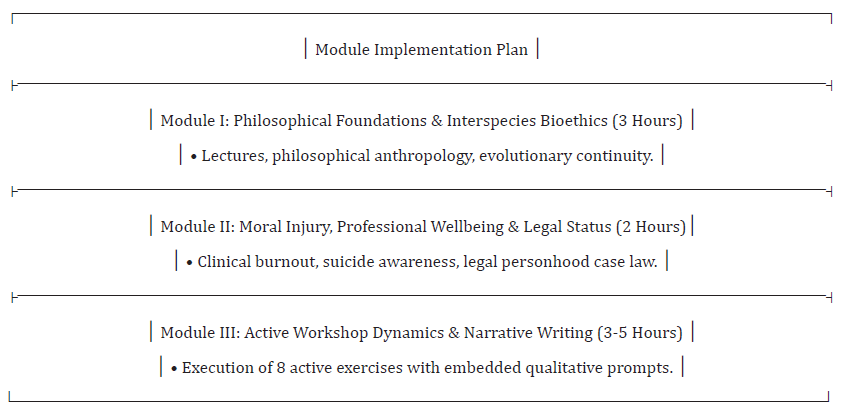
Active Didactic Workshops & Embedded Narrative Tasks
Workshop 1: Deconstructing Cartesian Objectification
• Active Dynamic: Group textual analysis comparing Descartes’ writings with routine veterinary intake forms to uncover clinical language that commodifies animal patients [cite: 3].
• Narrative-Reflective Prompt: “Describe a clinical or academic situation where an animal was treated strictly as an object or mechanical system. How did this impact your internal perception of your professional role, and how would you reframe that situation using non-speciesist terminology?” [cite: 3]
Workshop 2: Mapping Sentience and Evolutionary Continuity
• Active Dynamic: Analysis of bioacoustic communication and emotional expressions across companion, farm, and wild animals [cite: 3].
• Narrative-Reflective Prompt: “Reflect on an interspecies encounter where you clearly recognized emotional agency in an animal. How does acknowledging their subjective experience alter your professional responsibility toward them?”[cite: 3]
Workshop 3: Utilitarian vs. Deontological Decision Matrix
• Active Dynamic: Applying Singer’s utilitarianism and Regan’s deontology to real-world clinical dilemmas (e.g., experimental treatments vs. euthanasia) [cite: 3].
• Narrative-Reflective Prompt: “Detail a complex ethical dilemma from your practice. Analyze the tension between minimizing overall suffering and respecting the intrinsic rights of the animal patient. What core values guided your final choice?”[cite: 3]
Workshop 4: Relational Ethics & Marginalized Animals
• Active Dynamic: Role-playing exercise mapping moral obligations owed to animals based on their societal roles (companion, livestock, wildlife) [cite: 3].
• Narrative-Reflective Prompt: “Reflect on how societal utility shapes human empathy toward ‘livestock’ versus ‘companion animals’. Propose an explicit relational duty owed to an ‘invisible’ animal within your local community.”[cite: 3]
Workshop 5: Legal Personhood Analysis (The Case of Sandra)
• Active Dynamic: Mock trial debating a legal motion to grant non-human personhood to a captive animal [cite: 3].
• Narrative-Reflective Prompt: “Write a brief reflection from the standpoint of an animal legally recognized as a ‘person’ rather than property. How does this shift alter traditional veterinary authority and practitioner duty?”[cite: 3]
Workshop 6: Research Bioethics and Industrial Agriculture
• Active Dynamic: Simulated institutional review committee evaluating research protocols using Potter’s bioethics and the 3Rs framework [cite: 3].
• Narrative-Reflective Prompt: “Reflect on the tension between human economic/scientific interests and animal suffering. Articulate your personal position regarding the ethical boundaries of animal research or intensive farming.”[cite: 3]
Workshop 7: Moral Injury, Stress Resilience, and Suicide Prevention
• Active Dynamic: Guided debriefing on compassion fatigue, moral distress, convenience euthanasia, and strategies for psychological self-care [cite: 3].
• Narrative-Reflective Prompt: “Compose a personal narrative detailing an episode of ethical distress or moral injury you witnessed or experienced in practice. How did you navigate the emotional toll, and what systemic support is needed to protect practitioner wellbeing?”[cite: 3]
Workshop 8: Institutional Ethics Policy Drafting
• Active Dynamic: Collaborative drafting of an “Institutional Interspecies Ethics Charter” for veterinary teaching hospitals [cite: 3].
• Narrative-Reflective Prompt: “Formulate a personal professional commitment statement (1–2 paragraphs) outlining the humanistic, ethical, and self-care principles that will guide your future clinical practice.”[cite: 3]
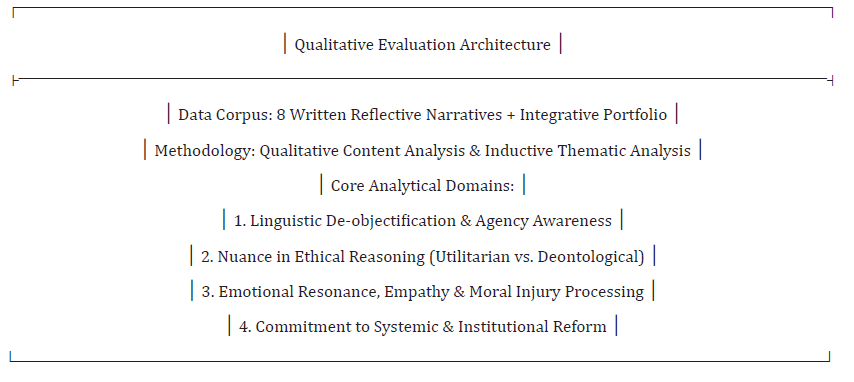
To capture conceptual growth, emotional development, and ethical awareness, participant outcomes are evaluated through an inductive, qualitative research design; evaluating ethical development demands capturing the internal “productive struggle” and reasoning process through interactive dialogue and ongoing portfolio reflections. This qualitative shift ensures that assessment focuses on authentic personal growth, critical judgment, and moral agency rather than mere task completion. [cite: 3].
Data Collection Protocol
The qualitative data corpus consists of the written reflective narratives submitted immediately after each workshop, supplemented by an end-of-course integrative portfolio [cite: 3].
Qualitative Data Analysis
The narrative corpus undergoes systematic Qualitative Content Analysis (Bardin [3]) and Thematic Analysis (Braun [4]) across four iterative phases [cite: 3]:
1) Familiarization: Repeated reading of reflective texts to establish deep data immersion [cite: 3].
2) First-Order Coding: Inductive generation of initial codes capturing emotional shifts, linguistic changes, and ethical dilemmas [cite: 3].
3) Thematic Categorization: Aggregating initial codes into primary thematic domains [cite: 3]:
Shift from Object to Subject: Transitions from mechanistic to agentic language regarding animal patients [cite: 3].
• Ethical Maturity & Decision-Making: Growing capacity to navigate conflicting duties beyond legalistic compliance [cite: 3].
• Empathetic Resilience & Moral Distress: Articulation of moral injury, emotional processing, and coping strategies [cite: 3].
• Institutional Advocacy: Willingness to champion structural humanistic changes in educational and clinical settings [cite: 3].
4) Narrative Synthesis: Constructing detailed qualitative profiles supported by participant quotes to document humanistic growth [cite: 3].
By centering pedagogical evaluation on qualitative narrative analysis, this program prioritizes experiential depth, critical self-awareness, and participant voice [cite: 3]. The qualitative model allows researchers to examine how students, professors, and clinicians navigate internal moral conflicts, redefine professional identity, and process existential stress [cite: 3]. Significantly, this intervention addresses a critical vulnerability in veterinary medicine: the psychological burden of unmediated moral distress [cite: 3]. By providing space to discuss ethical dilemmas, convenience euthanasia, and emotional exhaustion, the program serves as a protective factor against burnout, compassion fatigue, and occupational suicide [cite: 3]. Working directly with mixed groups of students and faculty establishes an intergenerational dialogue, fostering a supportive institutional culture [cite: 3]. Finally, this training program intentionally focuses on empowering human professionals and strengthening their ethical grounding [cite: 3]. By equipping clinicians with humanistic tools, the program establishes the necessary foundation for future educational modules dedicated specifically to exploring animal ontology, intrinsic value, and non-human being [cite: 3] [5-20].
Following the implementation of this educational intervention across participating veterinary faculties, collected narrative portfolios will be analyzed according to the Qualitative Content Analysis protocol detailed above [cite: 3]. Empirical results documenting participant growth will be reported in subsequent publications [cite: 3].
Funding
This research received no specific grant from funding agencies in the public, commercial, or not-for-profit sectors [cite: 3].
Competing / Conflicts of Interest
The author declares no competing financial or personal interests [cite: 3].
Ethics Approval and Consent to Participate
Ethics approval for qualitative narrative data collection will be obtained from the institutional Ethics Committee prior to program implementation [cite: 3]. Written informed consent for qualitative text analysis will be provided by all participants [cite: 3].
Consent for Publication
Not applicable at this protocol stage [cite: 3].
Data Availability
The qualitative analytical framework is fully detailed within this manuscript [cite: 3]. De-identified narrative excerpts will be archived in a secure institutional repository upon study completion [cite: 3].
Author Contributions (CRediT)
• Fernando José Sadio-Ramos: Conceptualization, Methodological Design, Didactic Curriculum Development, Narrative Framework Formulation, Writing – Original Draft & Editing [cite: 3].
Use of Generative-AI Tools
Generative AI tools (Gemini) were used during manuscript preparation for formatting alignment, synthesis of qualitative methodology, and bibliographic structure in accordance with journal guidelines [cite: 3]. The author maintains full accountability for all final content [cite: 3].

International Association of Landscape Archaeology, Czech Glass Society, Czech Republic

Department of Chemistry, Semenov Institute of Chemical Physics, USSR Academy of Sciences, Moscow, Russia

Associate Professor at Department of Breast and Thyorid Surgey, Chongqing General Hospital, China

Professor of Nuclear Medicine, Faculty of Medicine and Surgery, University of Milan, Milan, Italy

Department of Pharmaceutical Sciences, South University School of Pharmacy, USA





 Abstract
 PDF