info@biomedres.us
+1 (502) 904-2126
One Westbrook Corporate Center, Suite 300, Westchester, IL 60154, USA
Site Map
 ISSN: 2574 -1241
ISSN: 2574 -1241
ISSN: 2574 -1241
Received: August 29, 2026; Published: September 07, 2026
*Corresponding author: Luiz Eduardo Imbelloni, Co- responsible for the Anesthesiology Residency Program at Tatuapé Municipal Hospital, SP, Anesthesiology Consultant at Somosalle Group, Av. Epitácio Pessoa, 2356/203, Lagoa, 22411-072- Rio de Janeiro, Rio de Janeiro, RJ, Brazil
DOI: 10.26717/BJSTR.2026.66.010377
Unexpected difficulties during tracheal intubation for general anesthesia can result in catastrophic outcomes. Proper pre-anesthetic airway assessment is essential, and guidelines recommend selecting the airway management strategy according to the patient’s clinical characteristics, the physician’s expertise, the clinical context, and the availability of appropriately trained personnel and necessary equipment. A 76-year-old man with a documented history of difficult tracheal intubation requiring fiberoptic bronchoscopy was scheduled for elective laparoscopic rectosigmoidectomy. After conscious sedation with midazolam, fentanyl, and propofol, spontaneous ventilation was preserved and effective manual positive-pressure face-mask ventilation was confirmed before induction of general anesthesia. General anesthesia was subsequently induced, neuromuscular blockade was administered, and tracheal intubation was successfully performed on the first attempt by direct laryngoscopy, without complications. This case highlights the importance of integrating previous airway documentation with current clinical assessment, careful preparation, and a stepwise airway management strategy aimed at maintaining ventilation and progressively minimizing risk throughout anesthetic induction.
Keywords: Airway Management; Difficult Intubation; Tracheal Intubation; Face-Mask Ventilation; Human Factors; Non-Technical Skills
Planning for tracheal intubation during anesthesia should consider preoperative airway assessment, patient characteristics, the surgical procedure, anesthetic technique, and available human and material resources [1]. Tracheal intubation may be required to protect the airway, ensure adequate ventilation, and reduce the risk of pulmonary aspiration. Evidence has described the main anatomical predictors of difficult intubation [2], and recommendations addressing anticipation and management of airway difficulties have subsequently been published by the Canadian Society of Anesthesiologists [3] and the Brazilian Society of Anesthesiology [4]. During the pre-anesthetic consultation, the patient presented a document signed by a cardiologist strongly emphasizing previous difficulty with orotracheal intubation. According to the document, urgent assistance from another physician had been required during a previous surgery to achieve tracheal intubation using fiberoptic bronchoscopy. The attending surgeon had requested an otolaryngological evaluation, but its results were unavailable. No anesthetic record describing the circumstances, findings, or techniques employed during the previous airway management was available. This report highlights the importance of individualized assessment and systematic airway management planning in a patient with a history of difficult intubation and limited technical documentation. It illustrates a progressive risk-management strategy based on clinical assessment, preparation of human and material resources, and confirmation of effective manual face-mask ventilation before definitive induction of general anesthesia.
As this retrospective case concerned an event more than 15 years earlier, it was not registered on Plataforma Brasil at the time. Written consent for scientific publication was subsequently obtained from the patient’s family, preserving the patient’s identity and confidentiality. A 76-year-old man, 65 kg and 165 cm, with ASA physical status II, was admitted for elective laparoscopic rectosigmoidectomy. He had no relevant cardiopulmonary comorbidities, and preoperative laboratory tests were normal. Available documentation highlighted previous failed orotracheal intubation, subsequently managed with fiberoptic intubation, and advised caution in future airway management. Airway assessment identified predictors of difficult laryngoscopy and tracheal intubation: significant limitation of cervical extension, mouth opening ~4.5 cm, thyromental distance <8 cm, Mallampati class III, limited mandibular protrusion, and mild micrognathia. The procedure and anesthetic plan were discussed with the patient, his family, and the surgical team. A portable difficult airway unit was immediately available in the operating room, containing straight and curved laryngoscope blades of different sizes and conventional, short, and angled handles. A flexible fiberoptic bronchoscope, airway introducers, laryngeal mask airways and combitubes of different models and sizes, oropharyngeal and nasopharyngeal airways, and a cricothyrotomy kit were also available. A complete surgical setup for immediate tracheostomy was prepared, with a surgeon available for emergency surgical airway access and a physician experienced in fiberoptic bronchoscopy prepared for fiberoptic intubation.
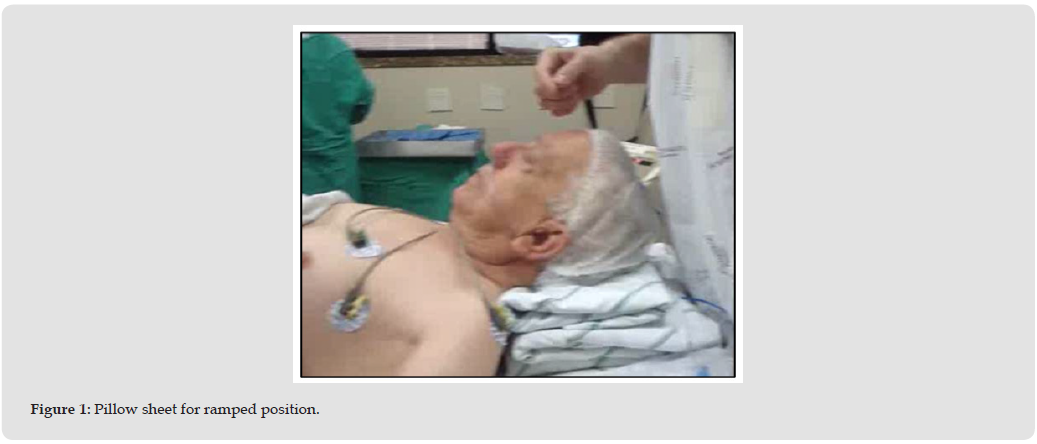
After placement of a 16-G catheter, standard monitoring included continuous electrocardiography, noninvasive blood pressure, and pulse oximetry. Ceftriaxone (1.0 g) was administered intravenously before sedation. The patient was positioned in the sniffing and ramped positions, using occipital, upper thoracic, and shoulder supports to optimize laryngeal exposure (Figure 1). Midazolam (2 mg), fentanyl (100 μg), and hyoscine (10 mg) were administered slowly and sequentially over ~10–15 minutes. Light sedation was maintained with responsiveness to verbal commands and effective manual positive-pressure face-mask ventilation. An additional 10 mg of propofol was then administered, and effective manual face-mask ventilation was reconfirmed. Only then was definitive induction of general anesthesia initiated. Intravenous lidocaine (80 mg) and an additional 100 μg of fentanyl were administered, followed by titrated 10 mg propofol boluses to an adequate anesthetic depth, totaling 120 mg. Rocuronium (0.6 mg/kg) was then administered while effective manual positive-pressure face-mask ventilation was maintained throughout the onset of neuromuscular blockade.
Figure 1
Following complete neuromuscular relaxation, direct laryngoscopy with a Macintosh size 5 blade on a short handle provided adequate glottic visualization and successful first-attempt tracheal intubation with a 7.0-mm cuffed, wire-reinforced endotracheal tube. Correct placement was confirmed by continuous capnography and bilateral chest auscultation, with no oxygen desaturation or airway- related complications. Monitoring included acceleromyography (TOF-Watch®), inspired and expired anesthetic gases, continuous esophageal temperature, and urinary output; arterial blood gases, serum electrolytes, complete blood count, and blood glucose were assessed as clinically indicated. At the beginning of the procedure, an additional 100 μg of fentanyl, 10 μg of sufentanil, and 40 mg of omeprazole were administered. Morphine (4 mg) and parecoxib (40 mg) and ondansetron (8 mg) were administered before the end of surgery. The procedure was uneventful, with no anesthetic or surgical complications. After confirmed neuromuscular recovery, the patient was extubated with preserved protective airway reflexes. After the procedure, the airway assessment, management strategy, and outcome were documented in the medical record and communicated to the patient and family to guide future anesthetic care. A signed document containing this information was also provided. Despite an uneventful course with no abnormalities or complications, the patient was transferred to the intensive care unit for precautionary postoperative observation.
A previous history of difficult intubation is relevant to anesthetic planning even when technical details of the prior event are incomplete or unavailable. Previous airway history should therefore be integrated with current airway assessment, clinical findings, procedural characteristics, and available resources [4]. Because no single test or clinical finding accurately predicts difficult intubation, assessment should combine multiple predictors with clinical judgment [5]. In the present case, airway management was conducted as a progressive risk-management process. During light sedation, spontaneous ventilation and responsiveness to verbal commands were preserved while effective manual positive-pressure face-mask ventilation was confirmed. After an additional 10 mg of propofol, effective manual facemask ventilation was confirmed again before definitive induction and neuromuscular blockade, progressively reducing uncertainty regarding the ability to maintain ventilation. Successful tracheal intubation by direct laryngoscopy on the first attempt does not invalidate the previously reported difficulty; rather, it reinforces that previous airway information should inform, rather than replace, a contemporary individualized assessment. Factors associated with difficult intubation include reduced thyromental distance, limited cervical mobility, micrognathia or retrognathia, mouth opening <3 cm, Mallampati class III–IV, increased neck circumference, morbid obesity, macroglossia, craniofacial abnormalities, and a previous history of difficult intubation [6].
In the previous procedure, however, only the history of difficult intubation was documented, without a detailed anesthetic record. Current assessment identified significant limitation of cervical extension, mouth opening of approximately 4.5 cm, thyromental distance <8 cm, Mallampati class III, limited mandibular protrusion, and mild micrognathia. Anatomical, pathophysiological, and cognitive changes associated with aging may affect intubation, ventilation, oxygenation, and aspiration risk [7]. Although the patient was 76 years old, no age-related factor had a clinically relevant impact on anesthetic induction or airway management. Adequate preparation for difficult airway management requires skilled personnel and appropriate resources for both planned and rescue strategies, with equipment and emergency resources readily available. In anticipated difficult intubation, airway management should be planned before anesthetic induction, with preservation of oxygenation and the ability to ventilate as fundamental priorities [1].
Although direct laryngoscopy remains an established technique, particularly when performed by an experienced operator, videolaryngoscopy has expanded airway management options and may improve intubation outcomes in selected settings [8]. Despite the clinical predictors and previous history of difficulty, direct laryngoscopy in this case provided adequate glottic exposure and successful first-attempt intubation. This outcome occurred within comprehensive prior planning, with alternative strategies and devices immediately available if required. A prospective study of 500 adults comparing the sniffing position with simple head extension during direct laryngoscopy demonstrated better glottic visualization and reduced intubation difficulty with the sniffing position, as assessed by the Intubation Difficulty Score [9].
Although a documented history of difficult intubation requires specific planning and preparation for alternative strategies, successful airway management depends on the interaction of multiple factors. In addition to patient characteristics, relevant factors include the anesthesiologist’s technical skills and proficiency with airway devices, as well as non-technical skills, including situational awareness, decision-making, communication, teamwork, and recognition of personal limitations. The availability of a trained team and the appropriate selection and functioning of equipment are also fundamental. Pharmacological preparation, patient positioning, and advance organization of rescue strategies are also important components of safety. The incorporation of new technologies and advanced devices represents an important evolution in airway management but does not replace the fundamentals of anesthetic practice. Careful assessment, planning, training, technical proficiency, and the availability of appropriate human and material resources remain essential. In this case, the integration of these elements, together with a cautious progression from sedation to general anesthesia and confirmation of effective manual face-mask ventilation before neuromuscular blockade, contributed to a structured and safe approach to a potentially difficult airway.
No.
No.
No.
No.
This paper has not been presented.

International Association of Landscape Archaeology, Czech Glass Society, Czech Republic

Department of Chemistry, Semenov Institute of Chemical Physics, USSR Academy of Sciences, Moscow, Russia

Neurology, LA BioMed Research Institute, USA

Associate Professor at Department of Breast and Thyorid Surgey, Chongqing General Hospital, China

Professor of Nuclear Medicine, Faculty of Medicine and Surgery, University of Milan, Milan, Italy





 Abstract
 PDF
PDF



























