info@biomedres.us
+1 (502) 904-2126
One Westbrook Corporate Center, Suite 300, Westchester, IL 60154, USA
Site Map
 ISSN: 2574 -1241
ISSN: 2574 -1241
ISSN: 2574 -1241
Received: August 24, 2026; Published: September 02, 2026
*Corresponding author: Julien Boblique, Independent Researcher in Systems Biology and Social Epigenetics (SET Theory), France
DOI: 10.26717/BJSTR.2026.66.010366
Contemporary clinical paradigms predominantly rely on reactive biochemical compensation, addressing systemic failures only after functional pathways exhibit macroscopic breakdown [1,2]. This reductionist approach often overlooks the non-equilibrium thermodynamic landscape and physical fluidic constraints that govern biological hardware [3,4]. The Science 4.0 framework introduces an architectural paradigm shift rooted in proactive biophysical flow steering and information-theoretic optimization [1]. In this paper, we formulate a multi-scale model coupling intracellular Signal-to-Noise Ratio (SNR) enhancement with macroscopic hydrodynamic boundary conditions [1,5,6]. We formalize the cellular information channel capacity under oxidative stress [5], model the biophysical advantages of nano-vectorized lipid carriers over mass-saturated crystalline inputs [1,2], and derive the governing equations of upstream hydraulic counter-pressure generated by peripheral mechanical obstruction [2,6]. By establishing a rigorous demarcation between micro-scale bioelectric signal filtering and macro- scale fluidic physics, this framework provides predictive metrics to differentiate true epigenetic drift from mechanical and environmental noise [1,2], laying the groundwork for sovereign biological systems engineering.
Keywords: Science4.0; Biological Sovereignty; Signal-to-Noise Ratio (SNR); Non-Equilibrium Thermodynamics; Hydrodynamic Resistance; Interfacial Vectorization; Systems Architecture
Conventional medicine treats biological systems through a descriptive and reactive lens: pharmacological agents target isolated molecular receptors to suppress symptoms or compensate for organ deficit once irreversible cellular exhaustion has occurred [1]. While this pharmacological paradigm has matured, it presents structural limitations in aging, multi-pathological, or hybrid biological systems where pharmacodynamics interact with mechanical wear, vascular stiffening, and electronic devices [2]. Living organisms are open, dissipative structures maintained far from thermodynamic equilibrium by continuous energy and information dissipation [3,4]. They operate as multi-scale networks of coupled non-linear oscillators [1]. Science 4.0 redefines biological maintenance as proactive systems engineering: organs are not isolated functional compartments, but interconnected processing units embedded within an integrated logistical and hydrodynamic circuit [1,2]. Restoring systemic integrity requires simultaneously optimizing micro-scale cellular communication and decompressing macro-scale fluidic bottlenecks [2,6].
Thermodynamic Entropy Production in Stressed Tissues
Within a living cell subjected to environmental, metabolic, or oxidative load, the local volumetric rate of entropy production, σ_ent, is governed by the summation of thermodynamic forces and conjugate fluxes [3,4]:

Where:
• J_ATP and A_ATP denote the reaction velocity and chemical affinity of ATP hydrolysis [3].
• J_k and ∇μ_k represent the diffusion flux and chemical potential gradient of metabolic substrates [4].
• Π and ∇v is the internal viscous stress tensor and cytoplasmic velocity gradient [4,6].
• T is the absolute physiological temperature (310.15 K).
Under homeostatic conditions, biological efficiency is maximized by maintaining high chemical affinity while minimizing dissipative entropy production (σ_ent → σ_min) [3]. Under sustained metabolic stress, A_ATP collapses, triggering unregulated mitochondrial electron leakage, excessive reactive oxygen species (ROS) synthesis, and cellular decoherence [1,2].
Mathematical Modeling of Bioenergetic Signal-to-Noise Ratio (SNR_Bio)
In the Science 4.0 framework, intracellular enzymatic cascades are modeled as Shannon communication channels transmitting regulatory instructions across a noisy medium [1,5]. We define the bioenergetic Signal-to-Noise Ratio as [1]:

Where:
• S_coherent = k · [ATP] · Φ_kin represents the coherent signaling power driven by structured kinase phosphorylation and metabolic flux Φ_kin [1].
• N_thermal = k_B · T · Δf represents the fundamental thermal noise floor across the active metabolic bandwidth Δf (k_B being the Boltzmann constant) [5].
• N_oxidative = ξ · [ROS]_cyt is the disruptive noise power generated by uncoupled free radicals and lipid peroxidation [1,2].
The maximum reliable information transmission capacity (C) through the intracellular repair network follows the Shannon-Hartley formulation [5]:

When chronic oxidative stress elevates [ROS]_cyt, the effective capacity approaches zero (C → 0), receptor-ligand interactions lose statistical fidelity, and the cell is locked into an uncontrolled epigenetic drift [1,2].
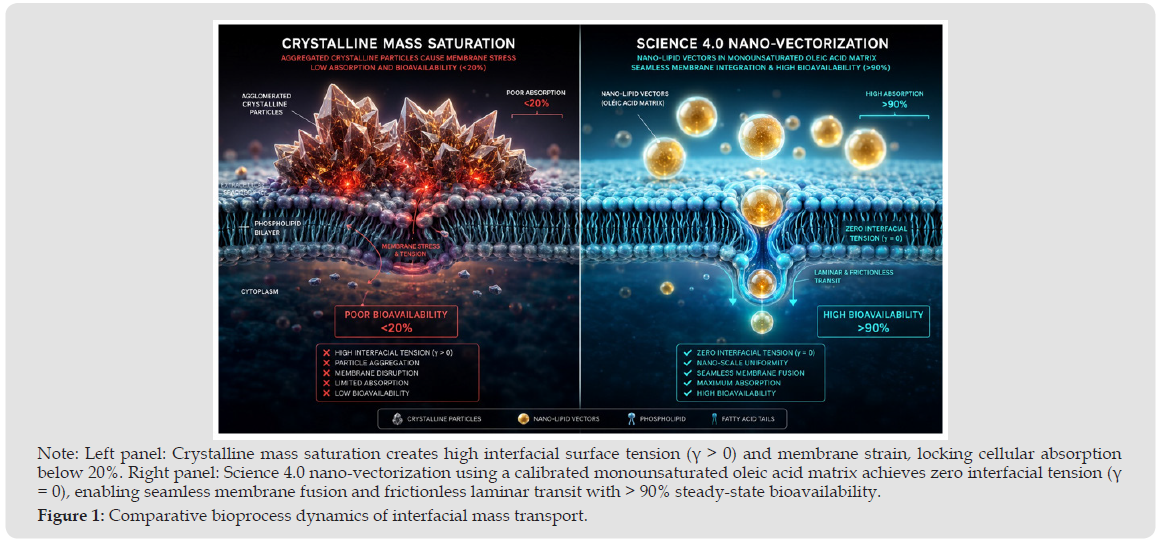
Traditional dietary supplementation and molecular interventions rely on raw crystalline mass inputs [1]. This brute-force loading creates interfacial impedance: crystalline aggregates exhibit high interfacial surface tension (γ > 0) at the intestinal and endothelial phospholipid membranes, trapping cellular absorption below 20% and inducing hepatic and renal filtration congestion [1,2]. Science 4.0 replaces bulk administration with calibrated nano-vectorized lipid carriers (e.g., monounsaturated oleic acid matrices, C₁₈H₃₄O₂) [1,2]. By matching the lipophilic index of the carrier to that of the cellular bilayer, the interfacial surface tension is minimized (γ → 0) [1]. Under Fickian interfacial mass transfer [4]:

Where K_part is the partition coefficient and δ_membrane are the bilayer thickness. Reducing interfacial tension and matching carrier rheology elevates steady-state molecular delivery efficiency to over 90% [1], preventing downstream molecular stasis while maximizing active antioxidant bioavailability (e.g., Ubiquinol, Lycopene) [1,2] (Figure 1).
Figure 1
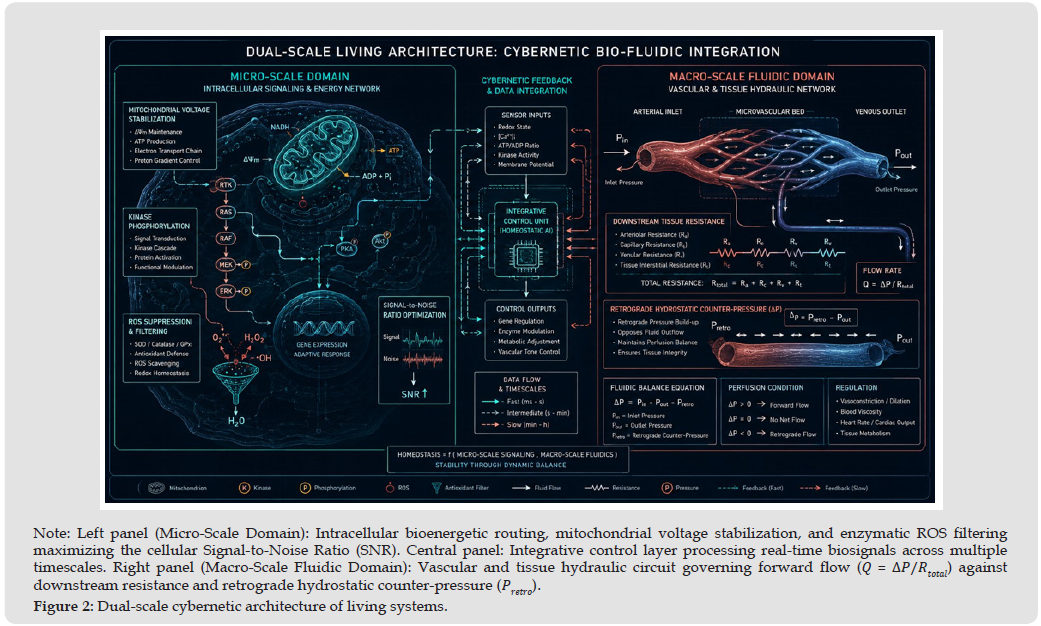
While molecular and biophysical signal optimization secures intracellular resilience [1], systems engineering must account for macroscopic hydrodynamic boundaries [2,6]. Aging biological hardware is subjected to strict mechanical constraints: vascular stiffening, organ hypertrophy, and mechanical outflow resistance [2].
Cybernetic Fluid Dynamics and Peripheral Resistance
In a closed or semi-closed biological hydraulic circuit (such as the renal-urogenital axis), the effective volumetric filtration rate (Q_filtration) is governed by the driving hydrostatic pressure gradient counteracted by total systemic resistance [2,6]:

Where:
• ΔP_net(t) is the net physiological driving pressure.
• R_vascular is the intrinsic baseline vascular resistance [6].
• C_organ(t) represents the dynamic tissue congestion and volumetric outflow restriction of the downstream organ [2].
• γ_mech is the non-linear coupling coefficient transferring mechanical impedance across adjacent anatomical structures [2].
Microscopic Signal Modulation vs. Macroscopic Physical Obstruction
A central theorem of science 4.0 is the hierarchical separation between signal-level filtering and fluidic physics [1,2]:
1. At the Micro-Scale (μm): Antioxidant vectorization and circadian chronopharmacology effectively suppress N_oxidative, stabilize mitochondrial voltage gradients (ΔΨ_m), and protect cell membrane integrity [1,2].
2. At the Macro-Scale (mm to cm): When downstream physical obstruction occurs (C_organ >> 0), retrograde hydrostatic pressure builds up [2]. Incompressible fluid physics dominates: retrograde pressure exerts mechanical shear on micro-vessels, triggering passive biomarker release and reducing upstream filtration independent of cellular oxidative state [2,6]. Biochemical signal optimization cannot overcome a rigid fluidic bottleneck [2]. Clinical engineering requires simultaneous biochemical stabilization and mechanical decompression [1,2].
Figure 2
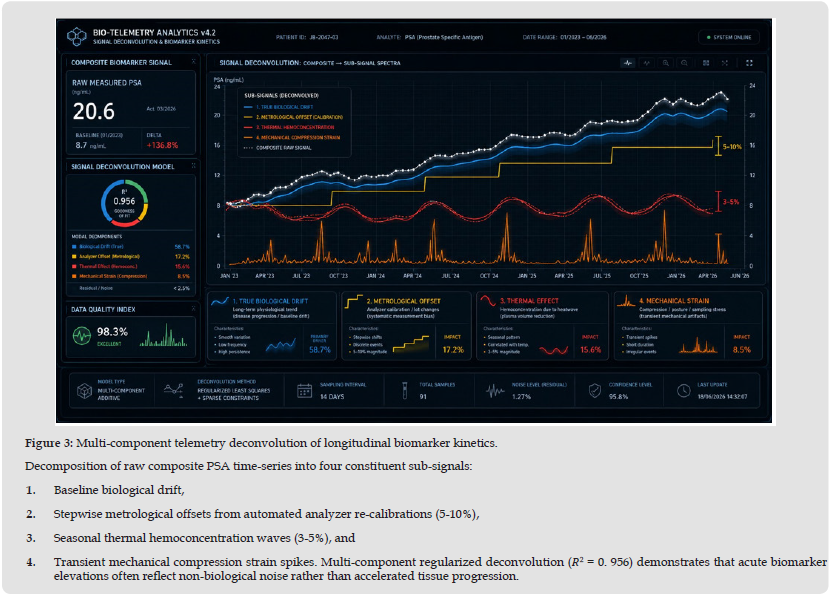
In continuous biological telemetry, measured variations in circulating biomarkers must be systematically deconvoluted into true biological drift, metrological drift, and physical stress [1,2]:

• ΔM_metrological: Inter-analyzer variance and calibration shifts (typically 5 to 10% between different automated immunoassay platforms).
• ΔM_thermal: Hemoconcentration induced by severe seasonal dehydration, reducing plasma free-water volume and artificially elevating concentration metrics by 3 to 5%.
• ΔM_mechanical: Acute retrograde compression and muscular strain releasing passive biomarkers into circulation [2].
Differentiating these components prevents clinical false alarms, ensuring that therapeutic decisions address true structural pathologies rather than transient environmental noise [1,2] (Figure 3).
Figure 3
Science 4.0 establishes an operational bridge between theoretical physics, non-equilibrium thermodynamics, and clinical systems biology [1,3,4]. Living hardware maintenance requires an integrated double-layer approach:
1. Bioenergetic Signal Governance: Maximizing cellular SNR_ bio via lipid-vectorized antioxidant carriers, circadian synchronization, and mitochondrial support [1,5].
Fluidic and Mechanical Decompression: Mitigating macroscopic hydrostatic back-pressure and structural outflow resistance through targeted clinical and surgical interventions [2,6]. By recognizing the precise interface where biochemical information routing meets macroscopic fluid mechanics, modern clinical architecture transitions from reactive pathology management to predictive, sovereign biological navigation [1,2].

International Association of Landscape Archaeology, Czech Glass Society, Czech Republic

Department of Chemistry, Semenov Institute of Chemical Physics, USSR Academy of Sciences, Moscow, Russia

Neurology, LA BioMed Research Institute, USA

Associate Professor at Department of Breast and Thyorid Surgey, Chongqing General Hospital, China

Professor of Nuclear Medicine, Faculty of Medicine and Surgery, University of Milan, Milan, Italy





 Abstract
 PDF
PDF



























