info@biomedres.us
+1 (502) 904-2126
One Westbrook Corporate Center, Suite 300, Westchester, IL 60154, USA
Site Map
 ISSN: 2574 -1241
ISSN: 2574 -1241
ISSN: 2574 -1241
Received: July 30, 2026; Published: August 20, 2026
*Corresponding author: Denis Nikolov, Heart and brain Center of Clinical Excellence, Pleven, Bulgaria, Pierre Curie 2, Pleven 5800, Bulgaria
DOI: 10.26717/BJSTR.2026.66.010352
Chronic kidney disease is highly prevalent among patients with heart failure, type 2 diabetes mellitus, hypertension, and atherosclerotic cardiovascular disease. Nevertheless, renal assessment in cardiology frequently remains limited to serum creatinine and estimated glomerular filtration rate. The urinary albumin-to-creatinine ratio provides complementary information by identifying kidney damage that may be present despite preserved glomerular filtration. Albuminuria is also independently associated with cardiovascular mortality, heart failure, and progressive kidney disease. Its detection may refine cardio-renal risk stratification and support timely initiation or optimization of renin–angiotensin system inhibitors, sodium–glucose cotransporter 2 inhibitors, and non-steroidal mineralocorticoid receptor antagonists in appropriately selected patients. This mini review discusses the clinical value, therapeutic implications, and practical limitations of routine urinary albumin-to-creatinine ratio assessment in contemporary cardiology. Routine measurement should be strongly considered in patients with increased cardio-renal-metabolic risk.
Keywords: Albuminuria; UACR; Chronic Kidney Disease; Cardiovascular Risk; Heart Failure; Cardiorenal Syndrome; KDIGO
Abbreviations: HF: Heart Failure; T2DM: Type 2 Diabetes Mellitus; AH: Arterial Hypertension; ACVD: Atherosclerotic Cardiovascular Disease; CKD: Chronic Kidney Disease; eGFR: Estimated Glomerular Filtration Rate; UACR: Urinary Albumin-To-Creatinine Ratio; SGLT2i: Sodium–Glucose Cotransporter 2 Inhibitors
The traditional boundaries between cardiovascular, renal, and metabolic diseases are becoming increasingly artificial. Heart failure (HF), type 2 diabetes mellitus (T2DM), arterial hypertension (AH), atherosclerotic cardiovascular disease (ACVD), and chronic kidney disease (CKD) frequently coexist and share common pathophysiological pathways. Consequently, cardiologists increasingly manage patients whose prognosis depends not only on cardiac function but also on the early recognition and treatment of renal injury. In everyday cardiology practice, kidney assessment often consists solely of serum creatinine and estimated glomerular filtration rate (eGFR). Although these parameters are essential, they describe renal filtration rather than kidney damage [1]. Patients may have clinically relevant albuminuria and an increased cardiovascular risk despite a preserved eGFR. Current Kidney Disease: Improving Global Outcomes criteria therefore classify chronic kidney disease according to both GFR and albuminuria categories, emphasizing that the two measurements provide complementary prognostic information. The urinary albumin- to-creatinine ratio (UACR) can be measured from a spot urine sample, avoiding the inconvenience and potential collection errors associated with 24-hour urine testing. Despite its availability and clinical relevance, UACR remains underused outside nephrology and diabetology [2]. This mini review summarizes why UACR assessment deserves a more prominent role in contemporary cardiology practice (Figure 1).
Figure 1

Albuminuria reflects abnormal glomerular permeability and may represent an early manifestation of kidney injury. UACR is preferred over the measurement of urinary albumin concentration alone because correction for urinary creatinine partially compensates for variations in urine concentration. A first-morning midstream urine specimen is generally preferred, although a random spot sample is acceptable in routine practice. According to KDIGO, albuminuria is categorized as A1 when UACR is below 30 mg/g, A2 when it is 30– 300 mg/g, and A3 when it exceeds 300 mg/g [3]. Persistent UACR of at least 30 mg/g is considered evidence of kidney damage and may establish the diagnosis of chronic kidney disease even when eGFR remains above 60 mL/min/1.73 m². Chronicity, however, must be demonstrated over at least three months, and an isolated abnormal result should not automatically be interpreted as chronic kidney disease. The importance of albuminuria extends beyond kidney diagnosis. Increasing UACR is associated with progressive kidney dysfunction, cardiovascular events, HF, and mortality across a wide range of eGFR values.
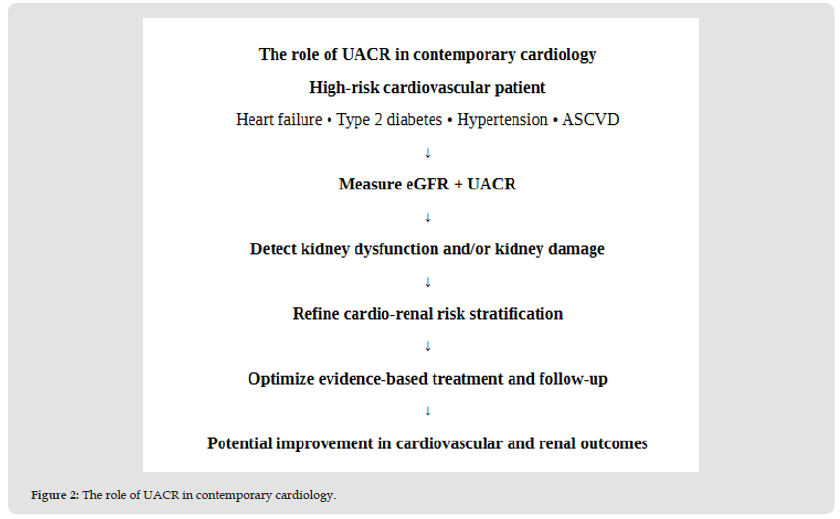
Albuminuria may reflect not only local glomerular damage but also generalized endothelial dysfunction, vascular inflammation, and increased permeability [4]. Therefore, it should be regarded as both a renal marker and a cardiovascular risk biomarker. Importantly, the relationship between UACR and adverse outcomes is continuous. Cardiovascular risk rises progressively with increasing albumin excretion rather than appearing only after a rigid diagnostic threshold has been crossed. Consequently, a patient with preserved eGFR but moderately increased albuminuria may have a substantially higher cardio-renal risk than suggested by serum creatinine alone (Table 1 & Figure 2).
Table 1:

Figure 2
Heart Failure
Renal dysfunction is common in patients with heart failure and may arise from reduced renal perfusion, venous congestion, neurohormonal activation, endothelial dysfunction, and coexisting diabetes or hypertension. Albuminuria is frequently present across the spectrum of left ventricular ejection fraction and is associated with worse clinical outcomes [5]. In HF patients, UACR provides information that cannot be obtained from eGFR alone. It may identify underlying CKD, refine prognostic assessment, and help characterize the broader cardio- renal phenotype. Nevertheless, UACR should not be used as an isolated criterion for prescribing heart failure therapies. Sodium–glucose cotransporter 2 inhibitors (SGLT2i) are recommended across a broad range of patients with heart failure irrespective of diabetes status or albuminuria level. UACR is therefore primarily a diagnostic and prognostic marker in this population rather than a mandatory prerequisite for SGLT2 inhibitor treatment.
Type 2 Diabetes Mellitus
The strongest case for routine UACR assessment exists in patients with T2DM. International recommendations support regular assessment of both eGFR and UACR because either parameter may become abnormal independently. Measuring only eGFR may therefore miss a substantial proportion of patients with early diabetic kidney disease [6]. The 2023 ESC guidelines recommend routine screening for kidney disease in patients with diabetes using both eGFR and UACR, while the 2026 ADA standards continue to recommend at least annual assessment in adults with T2DM. The result also has direct therapeutic implications. In patients with diabetes, hypertension, and albuminuria, angiotensin-converting enzyme inhibitors or angiotensin receptor blockers provide renal and cardiovascular protection when appropriately indicated and tolerated. SGLT2 inhibitors reduce the risks of CKD progression and cardiovascular events in patients with T2DM and CKD [7]. Finerenone may provide additional cardio-renal protection in selected patients with type 2 diabetes, persistent albuminuria, and adequate renal function and serum potassium levels despite optimized renin–angiotensin system blockade. Thus, failure to measure UACR may result not only in missed kidney disease but also in missed opportunities for evidence-based therapy.
Arterial Hypertension
Albuminuria is an established marker of hypertension-mediated organ damage. Its presence identifies patients with a higher likelihood of systemic vascular injury and increased cardiovascular risk, even when kidney filtration is preserved [8]. UACR may therefore improve risk stratification and strengthen the indication for intensive blood-pressure control and renin–angiotensin system blockade where clinically appropriate. For the cardiologist evaluating a patient with long-standing or difficult-to-control hypertension, UACR is a practical method of detecting subclinical renal involvement. It may also prompt assessment for additional target-organ damage and closer long-term follow-up.
Atherosclerotic Cardiovascular Disease
Patients with coronary, cerebrovascular, or peripheral arterial disease commonly have coexisting renal impairment. Albuminuria identifies residual risk that may not be captured by conventional cardiovascular risk factors or eGFR alone [9]. In such patients, UACR can contribute to a more complete assessment of systemic vascular disease and may identify an especially vulnerable subgroup requiring aggressive management of blood pressure, lipids, diabetes, smoking, and other modifiable risk factors. However, current evidence does not justify indiscriminate UACR testing in every low-risk cardiology patient. The greatest clinical yield is expected in patients with heart failure, diabetes, hypertension, established atherosclerotic disease, obesity, reduced eGFR, or other features of increased cardio-renal- metabolic risk [10].
UACR is convenient, but its interpretation requires clinical context. Albumin excretion may be transiently increased by strenuous physical exercise, fever, acute illness, urinary tract infection, marked hyperglycaemia, uncontrolled hypertension, menstruation, or acute decompensated heart failure. An abnormal result obtained during an unstable clinical condition should therefore be repeated after the precipitating factor has resolved.
Biological variability is another important limitation. Persistent albuminuria should preferably be confirmed using repeat measurements rather than diagnosed from a single sample [11]. The first-morning urine specimen reduces variability, although a random spot sample remains useful when morning collection is impractical. UACR may also be influenced by differences in urinary creatinine excretion related to age, sex, body composition, nutritional status, and muscle mass. Very low creatinine excretion can overestimate UACR, whereas high creatinine excretion may underestimate albumin loss. Consequently, unexpected results should be interpreted alongside the overall clinical picture and repeated when necessary. KDIGO specifically notes that ACR facilitates routine clinical use but is not free from potential misclassification.
Several factors contribute to the underuse of UACR in cardiology. It is often perceived as a nephrology-specific or diabetes-specific investigation, and it is rarely included in standard cardiology laboratory panels. Clinicians may also assume that a normal serum creatinine excludes meaningful kidney disease [12]. Fragmentation of care between cardiology, endocrinology, general practice, and nephrology further contributes to missed screening opportunities. These barriers are largely organizational rather than technical. UACR measurement is based on a spot urine sample and can easily be added to laboratory protocols for high-risk cardiology patients. Electronic order sets, automatic calculation by the laboratory, and inclusion in heart failure, diabetes, hypertension, and vascular disease pathways could substantially improve implementation.
UACR is an accessible and clinically informative biomarker that complements eGFR in the detection and classification of CKD. It also provides independent prognostic information regarding cardiovascular events, heart failure, renal progression, and mortality. Routine UACR measurement should therefore be strongly considered in cardiology patients with HF, T2DM, AH, established ACVD, or other features of increased cardio-renal-metabolic risk. The practical answer to the title question is therefore yes - but not indiscriminately in every patient. A targeted routine strategy in high-risk cardiovascular populations can improve recognition of chronic kidney disease, refine risk assessment, and identify patients who may benefit from earlier evidence- based cardio-renal therapy.

International Association of Landscape Archaeology, Czech Glass Society, Czech Republic

Department of Chemistry, Semenov Institute of Chemical Physics, USSR Academy of Sciences, Moscow, Russia

Department of Educational Sciences, Research Centre Qualities of Teachers, School of Education – HAN, Nijmegen, Netherlands

Associate Professor at Department of Breast and Thyorid Surgey, Chongqing General Hospital, China

Neurology, LA BioMed Research Institute, USA





 Abstract
 PDF
PDF



























