info@biomedres.us
+1 (502) 904-2126
One Westbrook Corporate Center, Suite 300, Westchester, IL 60154, USA
Site Map
 ISSN: 2574 -1241
ISSN: 2574 -1241
ISSN: 2574 -1241
Received: August 06, 2026; Published: August 20, 2026
*Corresponding author: Shashikumar K Paknikar, Nishant Aromas Pvt. Ltd., PLDC, Near BIDCO, Palghar (W) 401404, India
#Dedicated to loving memory of Professor M. S. Wadia
DOI: 10.26717/BJSTR.2026.66.010351
We have studied the structural correlationship between Prattinin A (1) and its congeners. Though a cursory look may not show any relationship but keeping in mind the known molecular rearrangements clearly show how the carbon skeleton of 1 gets converted into molecules with 3-different unprecedented carbon frameworks. It reflects on the biosynthetic pathway for natural diterpene molecules 4, 6 and 7. All of them belong to 4,5-seco- Prattinin A skeleton
Keywords: Salvia Pratti; 4,5-Seco Rearranged Abietane; Eight Membered Cyclic Ether
Chemical composition of the roots of Salvia prattii led to the isolation and identification of a new rearranged abietane diterpenoid, Pratttinin A (1) [1]. Its structure was elucidated by interpretation of the 1D and 2D NMR spectra and completed by the analysis of the HR-ESI-MS data. We have studied the structural correlationship between 1 and its congeners 4, 6 and 7. The present study revealed how Prattinin A (1) gets transformed into three previously unprecedented carbon skeletons. In-fact the genus Salvia has been reported to produce several rearranged abietane diterpenes [2-6]. Many of these are C4-C5 seco rearranged abiatanes. A striking feature of the present study, all the three new carbon framework (4, 6 and 7) indictes that in the C4-C5 bond gets cleaved to generate the C4-C5 seco-rearranged 6,7-dehydro-ferruginol (3). Besides the interesting structural features, the diterpenes isolated from the genus Salvia are known for their biological activities such as anti-oxidant, antimicrobial, cytotoxic and antihuman immunodeficiency virus activities [7-10].
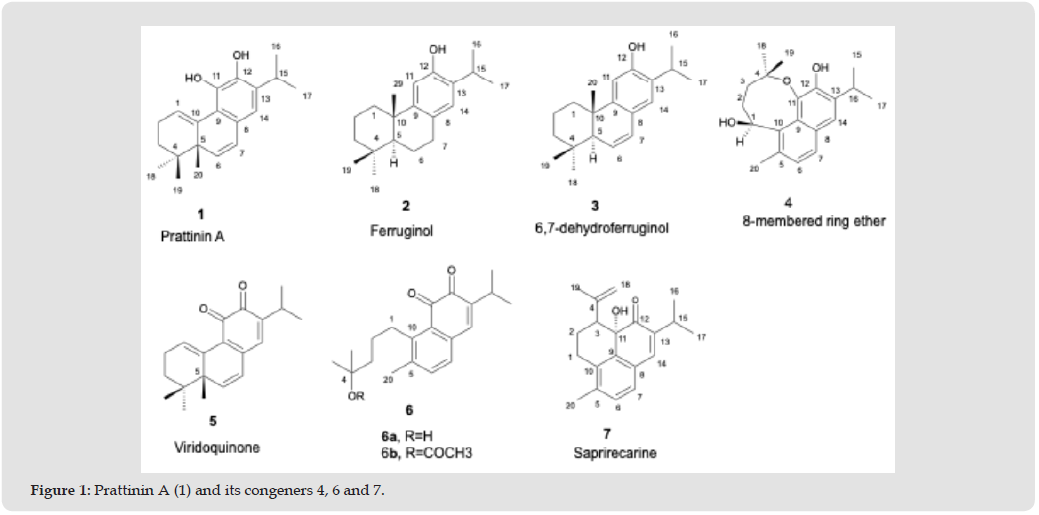
In the present study, we propose the structural correlation among congeners isolated from the same source and demonstrate how these results can lead to an understanding of their biogenetic origin. Prattinin A (1), a rearranged abietane diterpenoid isolated from Salvia pratti (Labiatae) [1], is a blue-coloured compound. Structure 1 was established through exhaustive NMR studies. Including Prattinin A (1), there are seven congeners (Figure 1), which interestingly represent three unprecedented carbon skeletons. Their biosynthetic origin is therefore of considerable interest. Here, we outline three interrelated biosynthetic pathways derived from Prattinin A. The first compound isolated and characterised as 10-isopropyl-2,6,6-trimethyl- 2,3,4,5-tetrahydronaphtha[18-bc]oxacine-5,11-diol (4) from Salvia pratti Hems [11] involves C-1, C-2, C-3, C-4, C-9, C-10, C-11 and C-11 phenolic oxygen to form an eight-membered cyclic ether, based on abietane carbon numbering (Scheme 1).
Figure 1
Scheme 1
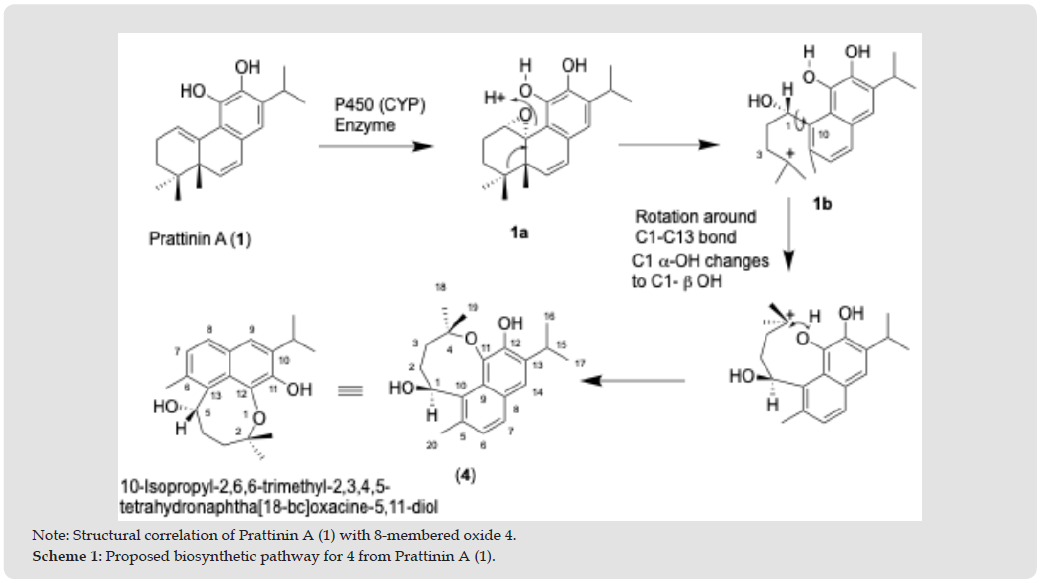
Prattinin A (1) undergoes monooxygenation with enzyme P450 (CYP) to give epoxide intermediate 1a [12]. Under acid-catalysed conditions, 1a is converted via a tertiary cationic intermediate, 1b, which undergoes free rotation of the C-1—C-10 bond, as shown in Scheme-1, to reach the bond-closing distance of the C-11 phenolic oxygen. This affords the eight-membered cyclic ether 4. Due to free rotation, the C5-α OH changes to the C5-β OH configuration. Independently, Zhang et.al. isolated the same compound from Nardostachys chinensis [13] and, besides exhaustive spectral analysis, established the structure unambiguously by single-crystal analysis, as shown in Scheme 1. The carbon numbering differs from 4 because the oxygen of the eight-membered cyclic ether is used in numbering the molecule. In addition, the molecule is viewed differently. Examination of molecular models, however, established its equality with 4. A literature search showed that, among sesquiterpenes, heliannuols A-D possess an eight-membered cyclic ether ring [14,15].
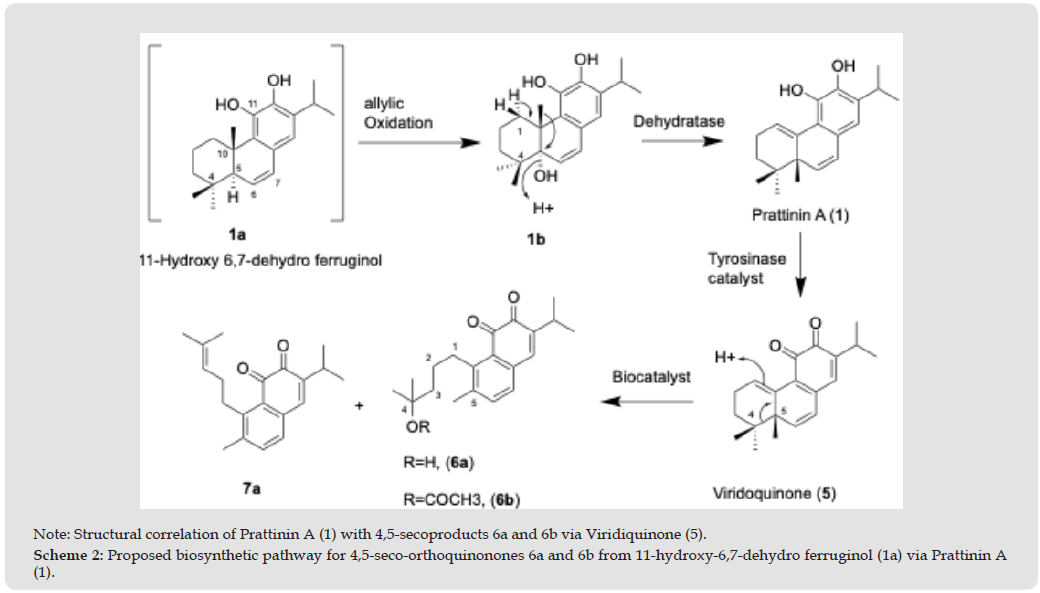
Furthermore, biological activity studies revealed that these eight-membered cyclic ethers may serve as potential therapeutic candidates with diverse biological activities. Compound 6 isolated from Salvia prionitis [16] possesses an unprecedented carbon skeleton, a rearranged abietane-type diterpene in which the methyl group at C-10 in abietane is shifted to the C-5 position. A plausible biogenetic pathway is shown in Scheme 2, with an assumption that 6a and 6b derived from an abietane-type diterpenoid via Prattinin A (1). Structural correlation of Prattinin A (1) with 4,5-seco compounds 6a and 6b and the transitory intermediate 7a, occurs via viridoquinone (5). It is of interest to note that viridoquinone (5) has been isolated as a natural product from Salvia pratti (Labiatae) [1] and also Salvia viridis [17]. The 1,2-catechol group of Prattinin A (1) is oxidised to the ortho-quinone group of viridoquinone (5), a congener of 1. This oxidation is common and is known to occur with a tyrosinase catalyst [18]. Under the acidic medium of a biocatalyst, the ring A olefinic linkage is protonated, with simultaneous cleavage of the C4—C5 bond, to generate the C4—C5 seco-abietane skeleton.
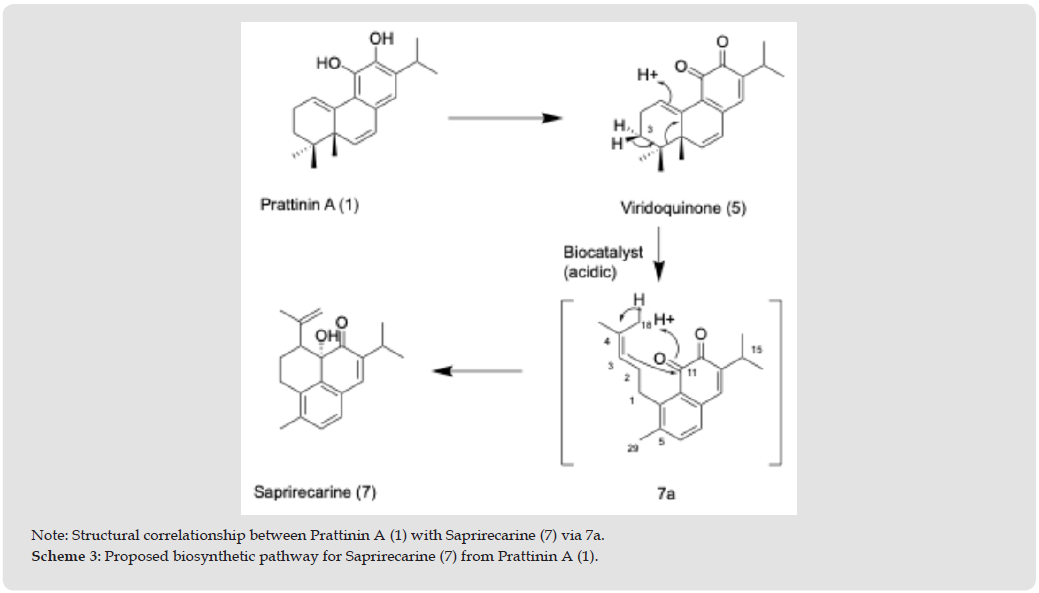
The tertiary cation generated at C4 is neutralised with water and acetic acid to give 6a and 6b (Scheme 2). The proposed biosynthetic pathway for naturally occurring saprirecarine (7) [1,16,19] from Pratinin A (1) may be envisaged via viridiquinone (5) which can lose an adjacent proton to form 7a, which under the acidic medium of a biocatalyst, produces saprirecarine (7) as the end product (Scheme 3). The structural correlation between Prattinin A (1) and its congeners convincingly demonstrates the pathways involved in the biosynthesis of 4, 6a, 6b, and 7 from 1, (Schemes 1, 2 & 3). However, one important question remains: what is the biosynthetic pathway for Prattinin A (1)? The isolation of ferruginol (2) and 6,7-dehydroferruginol (3) also from Salvia pratti (Labiatae) [1] suggests their involvement, along with a missing link, namely 11-hydroxy-6,7-dehydroferruginol (8). These steps are shown in Scheme 4.
Scheme 2
Scheme 3
Scheme 4
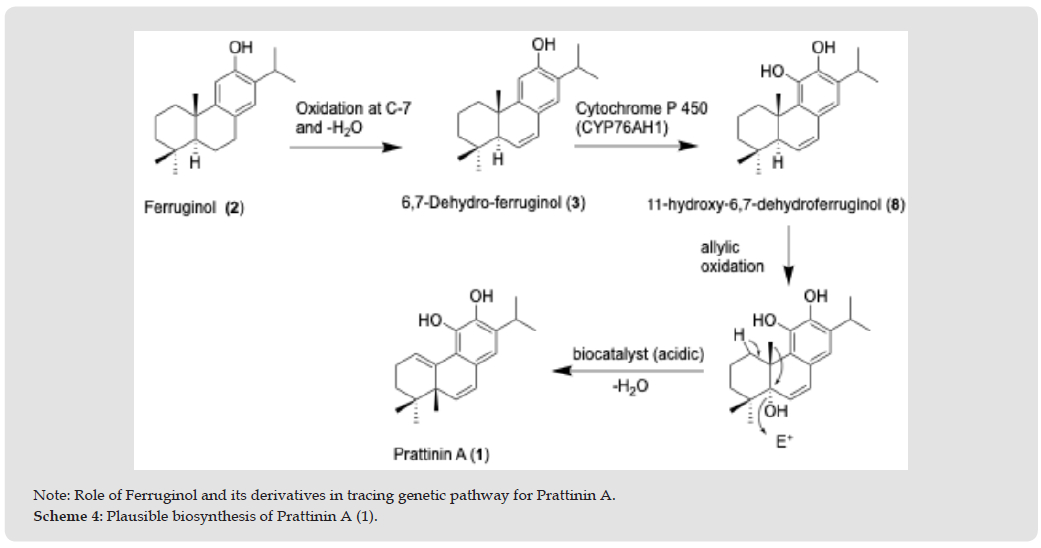
We have presented the simplicity and utility of structural correlation among congeners of Prattinin A (1) to derive a biosynthetic link between 1 and 4, 6a, 6b, and 7. The role of ferruginol (2) and 6,7-dehydroferruginol (3) in proposing a plausible biosynthetic pathway is presented (Scheme 4). All three unprecedented carbon skeletons are proposed to arise after the C10 angular methyl group undergoes a stereospecific 1,2-methyl shift to C5, generating a tertiary cation at C10. This transformation provides the basis for the formation of C4– C5 seco-abietanes. In the present study, these new carbon skeletons may be designated as C4–C5 seco-prattinanes.
The authors declare that they have no conflict of interest.
We thank Professor Shailesh R. Shah, The Maharaja Sayajirao University of Vadodara, for his interest and help during manuscript preparation. We are thankful to Mr. Nagaraj Gouda for providing difficult- to-access references. We also thank Mr. Ramakant Harlalka, Managing Director, Nishant Aromas, for his interest.

International Association of Landscape Archaeology, Czech Glass Society, Czech Republic

Department of Chemistry, Semenov Institute of Chemical Physics, USSR Academy of Sciences, Moscow, Russia

Neurology, LA BioMed Research Institute, USA

Associate Professor at Department of Breast and Thyorid Surgey, Chongqing General Hospital, China
Professor of Nuclear Medicine, Faculty of Medicine and Surgery, University of Milan, Milan, Italy





 Abstract
 PDF
PDF



























