info@biomedres.us
+1 (502) 904-2126
One Westbrook Corporate Center, Suite 300, Westchester, IL 60154, USA
Site Map
 ISSN: 2574 -1241
Received: July 27, 2026; Published: August 13, 2026
*Corresponding author: Yong Tan, Independent researcher in NN, GX, China. E-mail: yongtan_navigation@outlook.com/p>
DOI: 10.26717/BJSTR.2026.66.010340
Keywords: Systemic Lupus Erythematosus; Autonomic Nervous System; Progesterone; Nasal Mucosal Hyperplasia
The systemic lupus erythematosus (SLE) may be referred to a chronic, malignant, and long-hauled autoimmune disorder. There can be 180 autoantibodies against varieties of self-tissues existing in body with SLE to profile systemic autoimmunity and its aberrant responding [1], even to phospholipid that sustains cytomembrane exposure to autoimmune attack, too. In epidemiology, the prevalence presents female predisposition [2] and hypertension is more common [3] for 74% incidence and features with the resistant phenotype with near double overtaking typic controls [4]. Nevertheless, for such systemic spectrum disorder, to surprise, diabetes mellitus, as we have learned, sounds few cases. In clinic, researchers always agree that SLE holds a strong causality with sexual hormones imbalance in patients within symptoms flare or remission [5]. These hormones including estradiol, progesterone, prolactin, testosterone and even more either the luteinizing hormone or the follicle-stimulating hormone are interrogated [6-10] for shed light on how do their leverages modulate morbid autoimmunity. When with this clue to retrospective, the pathogenesis appears well-nigh to come down to genic and its pathological expressions in body.
Other than these predominant tones, we suggest SLE is a complication of a metabolic disorder Autonomic Nervous System (ANS) bears. The novel hypothesis we spot is rather counter-intuitive while there has already been a sign hidden in zoopery [11] that denervation on kidneys and around is still nothing to suppress hypertension flare in mice with SLE. This outcome corroborates a high-confident epidemiological questionary, complicated blood-pressure attack likely not only prior to SLE flare in chronology but its resistant character even more remarkable or onset-age in childbearing which number is markedly lower than the mean epidemiology suggests typic population with primary hypertension [12]. Additionally, this zoopery is cited in double digits since exposed more likely due to outcome conflicting with the mass opinion or anything but to answer why; therefore, spleen makes the relay responsible for a pathological conduction from ANS to adrenal disorder [13] by working innervating pathology translating into humor immunity.
That essay spots sympathetic nerve inflamed by SLE thus into excitation and then moves to spark spleen and involved autoimmune response towards adrenal activation yet, down this line, why parasympathetic nerve in silence than conferred to excite? And, the challenge can be having on the nephritis contribution to hypertension, but the latter onset more often ahead of facial rash, the precursor of former in SLE etiopathogenesis. Our such aggressive postulation is original to a novel pathway that undertakes transferring glucose to ANS for meet its momentarily intake glucose to sustains autonomic regulation frequently exciting for respond to internal/external stresses yielding. But other than autism spectrum disorder SLE is ANS hyperglycemia [14] wherefore hypertension is acquired to interpret of a complication no less than as SLE.
Another earlier zoopery [15] made before 1996 is significant on NZB/NZW mice which make is spontaneously prone to with SLE applied in vivo at least since 1968 [16] in the matter of what we have known. With exogenous testosterone exposure in subcutaneous way, these offsprings delivered by testosterone-treated dam which SLE conditions parallel with sham group originally intended to materialize sexual hormones imbalance more likely reshape development of autoimmune system into morbid though, yet leaves a challenge over these mice over which lifetimes, data discovers unexpectedly prolonged. With motivation off immunopathological pattern, our innervated opinion concerns to progesterone elevated excessively or testosterone lowered during trimester that likely develops nasal membrane hyperplasia leading to ANS hyperglycemia. This pathological progression may promote spontaneously blood sugar infiltration in facial cutaneous/subcutaneous that likely eventually brings on recessive necrosis—present erythematous flare that signs SLE with potential comorbid autoimmune aberrant response activated.
On the other hand, allergic rhinitis or asthma is suggested as precursor that gives rise to the risk of developing SLE higher than control who without such upper respiratory diseases or involved for 1.4 times [17]. As a result of nasal membrane hyperplasia, individual with SLE as well presents a predilection with severe symptoms of covid [18]. This serious more likely results from an enhancement of several pathologies of injury cumulation. The interesting is the energy-metabolism disorder ANS lives with sounds two opposite facets or polars, hypoglycemia (leading to autism spectrum) and hyperglycemia (leading to lupus spectrum), both wayward presenting, respectively corresponding to nasal mucosa with hypoplasia or hyperplasia that is the convergence from varieties of epigenetic factors militating via altering maternal sexual hormone levels. Therefore, we can have Appendix Table 1 in following to exhibit their several clinical manifestations to mirror this pathological duality of ANS.
Appendix Table 1.
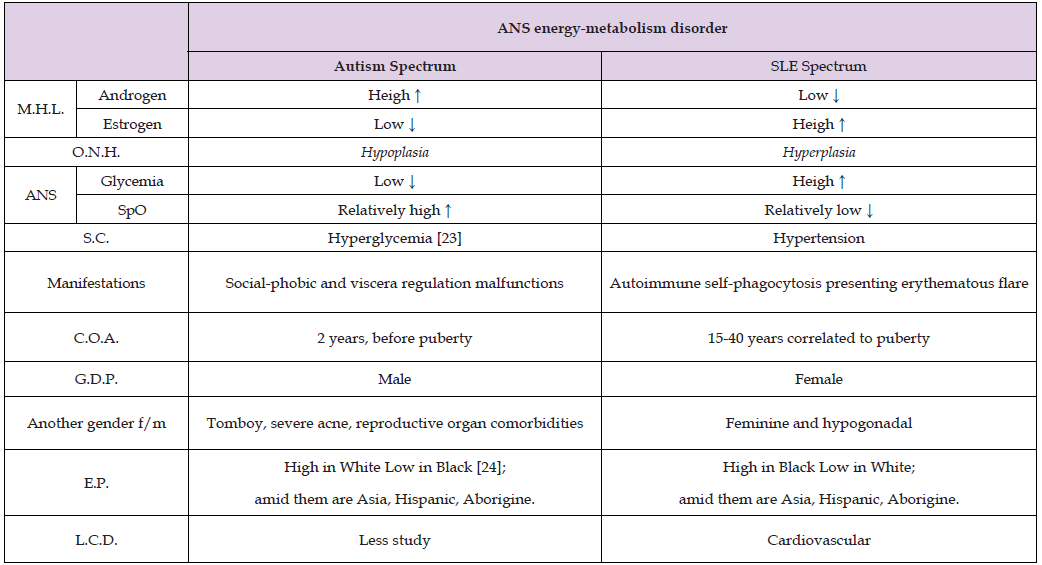
Note: M.H.L. Maternal Hormones levels; O.N.H. Offspring’s Nasal Histology; S.C. Serum compensation; C.M. Clinic Manifestations; C.O.A. Common Onset Age; G.D.P. Genger Difference in prevalence; C.G. Comorbidity of Genger; E.P. Ethnic Prevalence; L.C.D. Leading Causes of Death.
The progesterone plays a dual-role during both periods, prenatal and postnatal. What with this hormone’s exposure prevents offsprings from developmental attack, and what with the excessive to develop SLE in future; in addition, it renders immunosuppressive after SLE flare [19]. In the light of our hormonal pathogenesis, it may explain that why maternal SLE able to increase the risk of autistic labor [20] which may wrought 40% odds far overtaking the means of 1 in 31, the CDC reported the monitoring data from16 States in U.S. 2025 [21-24]. Therefore, however, our opinion accents that the SLE prophylaxis holds a special significance greater than management for immune disorder flare and, look forwards to our novel etiopathogenesis can avail the specific diagnosis, prognosis and management relevant to SLE.

International Association of Landscape Archaeology, Czech Glass Society, Czech Republic

Department of Chemistry, Semenov Institute of Chemical Physics, USSR Academy of Sciences, Moscow, Russia

Neurology, LA BioMed Research Institute, USA

Associate Professor at Department of Breast and Thyorid Surgey, Chongqing General Hospital, China

Professor of Nuclear Medicine, Faculty of Medicine and Surgery, University of Milan, Milan, Italy





 Abstract
 PDF