info@biomedres.us
+1 (502) 904-2126
One Westbrook Corporate Center, Suite 300, Westchester, IL 60154, USA
Site Map
 ISSN: 2574 -1241
ISSN: 2574 -1241
ISSN: 2574 -1241
Received: July 11, 2026; Published: July 31, 2026
*Corresponding author: Alissa K C, St Francis Emory Medical Center, Columbus, Georgia
DOI: 10.26717/BJSTR.2026.66.010329
Cushing’s Syndrome is a rare disorder resulting from prolonged exposure to elevated levels of glucocorticoids. While Cushing’s disease, associated with a pituitary corticotroph adenoma, is the most prevalent cause, endogenous Cushing’s Syndrome may also arise from adrenal lesions, including cortisol-producing adenomas, adrenocortical carcinoma, and other forms of hyperplasia. Surgical resection is the mainstay of treatment; however, there is an ongoing debate regarding the optimal management of hypercortisolism, especially when associated with adrenal incidentalomas. Here, we present two cases of Cushing’s Syndrome to explore the potential advantages of medical versus surgical management. The first case involves a 60-year-old woman with a complex medical history, who was incidentally discovered to have a left adrenal mass. Clinical presentation included hypertension, hyperglycemia, and obesity, leading to a diagnosis of Cushing’s Syndrome. She underwent adrenalectomy, with preoperative planning for potential adrenal insufficiency. The second case describes a 68-year-old man with bilateral adrenal masses, presenting with weight gain, fatigue, and excessive sweating. Laboratory investigations confirmed Cushing’s Syndrome, and given his age, comorbidities, and tumor characteristics, a medical management approach was adopted. In conclusion, the management of endogenous Cushing’s Syndrome requires a tailored approach, choosing between surgical or medical options based on the etiology of hypercortisolism and patient-specific factors. While surgical excision of cortisol-secreting tumors is preferred in many cases, medical management may be indicated under certain circumstances. Continuous monitoring is essential to manage potential complications, such as adrenal insufficiency. These cases highlight the importance of individualized treatment strategies for patients with Cushing’s Syndrome secondary to adrenal incidentalomas.
Abbreviations: CD: Cushing’s Disease; CS: Cushing’s Syndrome; LNSC: Late-Night Salivary Cortisol; UFC: Urinary Free Cortisol; COPD: Chronic Obstructive Pulmonary Disease; CPA: Cortisol-Producing Adrenal Adenoma
Cushing’s Syndrome refers to the constellation of clinical and laboratory findings that is seen in patients exposed to excess glucocorticoids. The most common cause of endogenous Cushing’s Syndrome is Cushing’s disease (CD), which is an ACTH-dependent hypercortisolism linked to a pituitary corticotroph adenoma. [1] Whereas the most common cause is iatrogenic from medically prescribed corticosteroids, endogenous Cushing’s Syndrome is a rare disorder. European population-based studies have reported two to three cases per 1 million inhabitants per year. [2] Endogenous Cushing’s Syndrome (CS) is caused by an excess of adrenal glucocorticoid secretion which is adrenocorticotropin (ACTH)-dependent or independent. ACTH-independent adrenocortical causes of CS account for up to 20% of CS in adults, and 15% in children over 7 years of age. Adrenal adenomas are the most common type of incidentally found adrenal tumors, also known as adrenal incidentalomas, which can be either hormonally active or inactive. [3] In both adults and children, adrenocortical lesions causing CS include the common, isolated and sporadic, solitary cortisol- producing adenoma, the rare adrenocortical cancer, and a spectrum of recently recognized, bilateral hyperplasias, micronodular adrenal disease and its pigmented variant, primary pigmented nodular adrenocortical disease. [4] Endogenous CS is usually characterized by hypertension, hyperglycemia, obesity, osteoporosis, facial rounding, dorsocervical fat pad, thin skin, purple striae, hirsutism, and mood disorders.
Efficient diagnostic and screening strategies lead to the diagnosis of a significantly higher number of cases of Cushing’s Syndrome. As a screening test, the Endocrine Society’s Clinical Practice Guidelines recommend a single test with high diagnostic accuracy, among the 1-mg dexamethasone suppression test (1-mg DST), late-night salivary cortisol (LNSC), and 24 h urinary free cortisol (UFC). [5] Surgical resection of the causal lesion(s) is the first-line and the most effective treatment to normalize cortisol secretion. In addition, symptomatic treatments of co-morbidities are often necessary both during the active phase of the disease and for persisting co-morbidities after cessation of hypercortisolism. Second-line treatments include various pharmacological treatments, bilateral adrenalectomy, and radiotherapy of corticotroph tumors. The choice of these treatments is complex, must be performed in a multidisciplinary expert team, and should be individualized for each patient after a shared decision-making approach. There is very limited and conflicting data regarding whether surgical treatment of patients with hypercortisolism in the setting of an adrenal incidentaloma is superior to medical treatment of comorbidities alone. So, this case series aims to find the significance and benefit of medical versus surgical management of Cushing’s Syndrome done in these cases, which could also help decide the treatment modality of Cushing’s Syndrome.
Case 1
We present a case of a 60-year-old woman who was referred to our Endocrine clinic for an evaluation of an incidentally discovered 2cm left-sided adrenal tumor on a computed tomography scan that was done for an evaluation of abdominal and back pains in 2022. She had a complex medical history of coronary artery disease, peripheral arterial disease, degenerative disc disorder, arthritis, poorly controlled diabetes, uncontrolled hypertension, hypercholesterolemia, and chronic obstructive pulmonary disease (COPD). The patient has a long-standing history of uncontrolled hypertension but even after taking Lisinopril 40 mg daily, her Blood pressure recording showed 187/100 mm of Hg a day before her visit. The patient’s social history revealed that she is a current smoker, consuming 11-20 cigarettes per day for 30 years and occasionally consuming alcohol. She mentioned an allergy to gabapentin. She also has a history of hysterectomy. Her mother had a history of hypertension, cancer, and hyperlipidemia. There is no family history of MEN1 syndrome or any adrenal tumors.
On examination, the patient appeared alert and oriented. Her vitals showed a BP recording of 138/80 mm of Hg, a heart rate of 84 beats per minute, and a BMI of 32.12kg/m2. There were no abnormal findings in her general, cardiovascular, respiratory, abdominal, or neurological examination. In addition to the incidental adrenal tumor, the CT scan showed extensive diffuse atheromatous changes in the iliac arteries, with significant stenosis in the left external iliac artery and the mid to distal right superficial femoral artery.
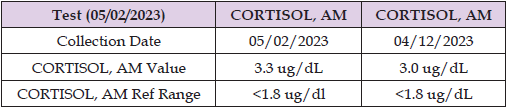
Her Echo showed the left ventricular ejection fraction was 55- 60% with moderate concentric left ventricular hypertrophy and Grade I diastolic dysfunction (Impaired relaxation filling pattern). She was advised for routine lab investigations and was asked to follow up after the results. On her second visit, her CBC showed an increased RBC count of 6.07*10*12/L, Hb of 17.2 g/dl, and hematocrit of 53%. All the other CBC parameters fell within the reference range. A comprehensive metabolic panel showed normal electrolytes, RFTs, and LFTs. Her blood glucose level was high at 347 mg/dL. DHEA was 89 μg/dL. Aldosterone was 8.9 ng/dl and renin activity of 0.8. 24-hour urine catecholamines and metanephrines were in the normal reference range. 24-hour urine cortisol was 82 μg/24 h, Morning cortisol was 3 μg/dL after a low dose of dexamethasone suppression test with concomitant dexamethasone of 297 ng /dl. Her findings were suggestive of Cushing syndrome. The assessment includes a diagnosis of left adrenal adenoma, and the differential diagnoses considered are primary hyperaldosteronism, Cushing syndrome, primary adrenal malignancy, or a benign adenoma. She was advised for a confirmatory 8 mg dexamethasone suppression test. She was also advised for the Morning cortisol test, and ACTH, and was asked for a telephonic follow- up after the lab results. During the follow-up visit, the patient’s adrenal lab results showed abnormal cortisol levels, raising suspicion of Cushing syndrome. After the dexamethasone suppression test, the serum cortisol was 3.3 μg/dL, higher than the reference range confirming Cushing syndrome.
Her laboratory investigation showed – (Tables 1 & 2) After the above investigations, she was diagnosed with adrenal adenoma, left (Primary), and anticipated adrenal insufficiency if she underwent adrenalectomy. She was referred to surgery to evaluate for an adrenalectomy. She was also counseled for symptoms of adrenal insufficiency as a potential consequence of adrenalectomy and was prescribed hydrocortisone 10 mg twice daily and methylprednisolone 125 mg as an emergency resume injection for adrenal crisis. She was advised for endocrinology follow-up two months post adrenalectomy.
Table 1:
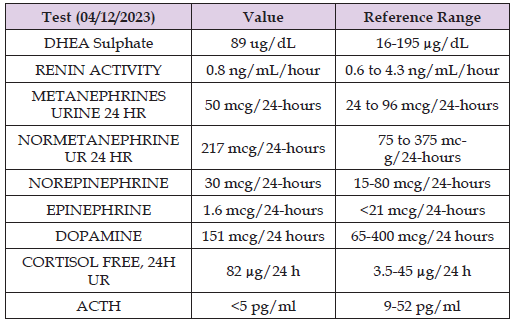
Table 2:
Case 2
A 68-year-old male, presented with a constellation of symptoms including recent weight gain, chronic fatigue, excessive sweating, nocturia, and insomnia was referred to the Endocrinology service by his primary care physician due to bilateral adrenal tumors. His medical history included prediabetes, hypertension, dyslipidemia, and coronary artery disease. These symptoms had progressively worsened over the past year, prompting further investigation. The patient is currently on multiple antihypertensives including metoprolol, lisinopril, and hydrochlorothiazide. He is also taking rosuvastatin, clopidogrel, ezetimibe and rivaroxaban for CAD and dyslipidemia. There is no family history of MEN1 syndrome, pheochromocytoma, von Hippel- Lindau disease, or neurofibromatosis. The patient had a normal birth and developmental history and had received all required vaccinations appropriate to his age. Additionally, the patient also has a history of vasectomy. During the initial visit, the patient reported a weight gain of 5 lbs in a few months. He is also experiencing symptoms such as nocturia and wakes up at least once a night to void. He reported fatigue, decreased hearing, ringing in ears, snoring, easy bruising, and numbness and tingling. He also complained of insomnia and anxiety. He denied having headaches or panic attacks. The patient is experiencing excessive sweating and diarrhea. He was taking levothyroxine 150 mcg once a day.
Also, he was taking herbal medication including ginkgo biloba and echinacea. On examination, his vitals were stable and there was no significant finding on physical examination. CT scan showed bilateral adrenal nodules. The right adrenal nodule measured approximately 3.2 cm with characteristics compatible with the adenoma and the left adrenal nodule measured approximately 2.2 cm compatible with a benign adenoma. MRI revealed bilateral adrenal nodules which were indeterminate by MRI imaging most likely adrenal adenoma in the absence of any known malignancy along with larger adrenal nodules on the right measuring 3.4 x 2.0 cm. This could be further evaluated with follow-up CT adrenal mass protocol.
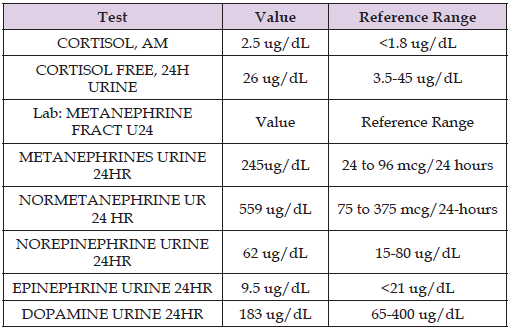
His laboratory results showed:
(Table 3) In his follow-up visit, 24-hour urine cortisol was 26 ug/ dL. Catecholamine and metanephrine values were in the normal range. A complete blood count showed normal hemoglobin and hematocrit. A comprehensive metabolic panel showed low potassium of 3.3mg/ dl, sodium 137 mg/dl, BUN 16 mg/dl with a creatinine of 1 mg/dl, DHEA 39 ug/dL, aldosterone 4.9ng/dl and renin 24 μg/L. He was advised on a confirmatory high-dose dexamethasone suppression test which revealed morning cortisol of 2.5 ug/dl which indicates Cushing Syndrome. Given the patient’s advanced age and multiple comorbid conditions, and size of the tumor surgical intervention was deemed less suitable. Therefore, the management plan focused on medical therapy. Medical management was selected as the initial treatment modality to manage cortisol levels and mitigate symptoms. Regular monitoring was established to assess the efficacy of the medication and to make any necessary adjustments to the treatment regimen.
Table 3:
The treatment of endogenous Cushing’s Syndrome can be classified into two: medical management and surgical management, depending on the cause of hypercortisolism. Surgical management is generally the gold standard in most of the hypercortisolism causes.
Surgical Treatment
For Cushing’s Syndrome caused by a unilateral adrenal adenoma, surgical removal of cortisol-secreting tumor results in definitive management and is often considered the first-line management. In cortisol-producing adrenal adenoma (CPA), unilateral adrenalectomy cures 100% of CPA and uses a laparoscopic approach. Bilateral adrenalectomy, which can generally be performed by laparoscopic surgery, offers remission of Cushing’s Syndrome in virtually 100% of the patients with any cause of Cushing’s Syndrome that has not been cured by etiologic surgery, except for recurring or metastatic cortisol secreting Adrenocortical carcinoma. [6] Laparoscopic surgery has minimized morbidity and improvement is immediate after resection in these patients who are hypertensive pre-operatively or have other complications of Cushing Syndrome. [7] The most common and serious complication of adrenalectomy is adrenal insufficiency, which has the potential to be life-threatening in the absence of intravenous corticosteroids given immediately after surgery and switched to steroid oral supplements as soon as the patient starts oral intake. This makes the post-op follow-up a crucial step to deal with transient adrenal insufficiency.
Medical Treatment
For patients of adrenal adenoma deemed unfit for surgery, medical management with drugs such as inhibitors of cortisol synthesis (such as osilodrostat, ketoconazole, metyrapone) and inhibitors of glucocorticoid receptors (Mifepristone) can be used, but it does not offer a cure. The indications for medical treatment are limited to Cushing’s disease, ectopic ACTH-producing tumor, and primary bilateral macronodular hyperplasia. Medical treatment can be done before surgery for Cushing syndrome due to Cushing disease or ectopic ACTH tumor requiring multitherapy or those with severe symptoms. Medical management might also be required postoperatively if there is a failure of pituitary surgery in cases with Cushing’s disease. The adrenal tumor in the first case was an incidental finding. The goal of therapy is based on finding the answer if the tumor is malignant and/ or functioning.[8] A predictive factor for malignancy is the diameter of the adrenal tumor, as reflected by the study in which over 800 patients were recruited. [9] The dexamethasone suppression test was done in the first patient, and it was abnormal suggesting an ACTH-independent tumor. Afterward, the diagnosis of Cushing’s Syndrome was confirmed by the high-dose dexamethasone suppression test. For ACTH-independent tumors, adrenalectomy is recommended, and it is effective and safe. [10] Some of the adenomas can be functional and can cause high cortisol. Interestingly, these adrenal adenomas account for 10% of Cushing’s Syndrome.
Laparoscopic adrenalectomy performed by an experienced endocrine surgeon is associated with less hospital stay, postoperative morbidity, and cost in contrast with the open laparotomy, hence is preferred over the latter. Additionally, if the size of the adenoma is less than 6 cm, the standard is to perform surgery via the laparoscopic approach. It takes about 2 to 12 months for the signs and symptoms to subside after the adrenalectomy. Moreover, some of the manifestations, such as glucose intolerance, hypertension, and osteoporosis may not go away completely, but they show improvement. Unfortunately, despite remission being achieved, impaired quality of life may be experienced by patients. However, patients with benign diseases show excellent long-term outcomes. Contrary to the prognosis in the benign cases, the patients with malignancy have a variable outcome, depending on the management of cancer and control of hypercortisolism. However, in the second case, medical management was preferred because of the advanced age of the patient. Surgical treatment is the main treatment, irrespective of the etiology. However, medical treatment is indicated when surgical intervention is contraindicated, delayed, or unsuccessful. Ketoconazole can be prescribed as the initial therapy. Unfortunately, hepatotoxicity is a rare side effect; therefore monitoring liver function tests is a must. Metyrapone can be added if cortisol secretion is not controlled by ketoconazole.
Even though both cases had the same primary diagnoses, the preferred management was different in both. The treatment of choice depends upon various factors like any contraindication to surgery, the patient’s unwillingness to undergo surgery, and the presence of comorbidities which concludes that it is imperative to take an approach based on individual needs. Therefore, through this case series of Cushing’s Syndrome caused by adrenal adenoma, we have tried to ascertain who benefits from surgical management, the role of medical management, and how to pick between the two treatments for a specific patient.
There are no Conflicts of interest to Disclose.
No funding has been received to write this paper

International Association of Landscape Archaeology, Czech Glass Society, Czech Republic

Department of Chemistry, Semenov Institute of Chemical Physics, USSR Academy of Sciences, Moscow, Russia

Associate Professor at Department of Breast and Thyorid Surgey, Chongqing General Hospital, China

Professor of Nuclear Medicine, Faculty of Medicine and Surgery, University of Milan, Milan, Italy

Department of Pharmaceutical Sciences, South University School of Pharmacy, USA





 Abstract
 PDF
PDF



























