info@biomedres.us
+1 (502) 904-2126
One Westbrook Corporate Center, Suite 300, Westchester, IL 60154, USA
Site Map
 ISSN: 2574 -1241
ISSN: 2574 -1241
ISSN: 2574 -1241
Received: July 16, 2026; Published: July 29, 2026
*Corresponding author: Seamus Kelly, Georgetown University, Washington, DC, USA
DOI: 10.26717/BJSTR.2026.66.010327
Introduction: Allulose (D-psicose) is a rare monosaccharide that reduces postprandial glycemia in controlled
feeding trials, but real-world evidence using continuous glucose monitoring (CGM) under free-living conditions
is limited. This case series evaluates the glycemic effects of an allulose-containing gummy (GlucoSupreme™
Gummies, 5.7 g allulose/serving) in healthy adults wearing CGMs over a 6-day alternating exposure protocol.
Case Summaries: Fifteen individuals participated in the 6-day protocol using CGM and the Well World™ meal
tracking platform. On odd numbered days (1, 3, 5), participants consumed their typical diet without supplementation;
on even numbered days (2, 4, 6), participants consumed GlucoSupreme™ Gummies (3 gummies providing
5.7 g allulose) with meals. After exclusion of 4 participants for insufficient CGM data or protocol deviations, 11
participants (8 “Tier 1” with complete data, 3 “Tier 2” with minor data gaps) were included in the analysis.
Findings: Twenty-four-hour mean glucose trended lower on gummy days (88.3 vs. 89.0 mg/dL; mean within-
participant difference -1.4 mg/dL; 6/8 participants directionally favorable; p = 0.066). Post-meal glucose was
significantly lower on gummy days across 48 paired meal comparisons (mean difference -6.9 mg/dL; 69% favorable;
p = 0.006), with the strongest effects at breakfast (-9.1 mg/dL; 80% favorable) and dinner (-9.8 mg/dL;
76% favorable; p = 0.015) and no reliable effect at lunch. Within-day glycemic variability (standard deviation)
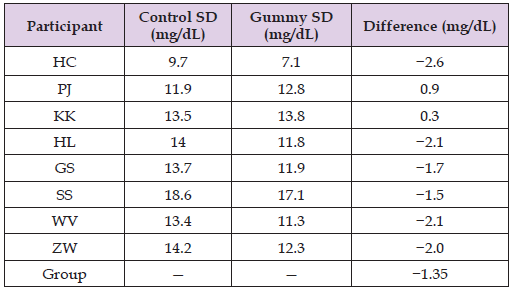
was significantly reduced on gummy days (mean difference -1.35 mg/dL; 6/8 favorable; p = 0.019).
Conclusion: In this real-world CGM case series, a single-serving allulose gummy taken with meals was associated
with clinically meaningful reductions in post-meal glucose excursions and in overall within day glycemic
variability. These observations extend controlled-trial evidence into free-living conditions and support formal
randomized evaluation.
Postprandial hyperglycemia is increasingly recognized as an independent contributor to cardiac and metabolic risk, distinct from fasting glucose. Repeated, high-amplitude glucose excursions following meals are associated with oxidative stress and endothelial dysfunction. Glycemic variability — the degree to which glucose oscillates around its daily mean — has emerged as a complementary marker of metabolic stress that CGM is uniquely positioned to capture [1]. D-allulose is a rare functional monosaccharide and a structural isomer of D-fructose that occurs naturally in small quantities in figs, raisins, jackfruit, and maple syrup. Unlike conventional sugars, allulose is metabolized differently: approximately 70% of an ingested dose is absorbed in the small intestine, but more than 99% of the absorbed fraction is excreted unchanged in the urine, and the portion reaching the colon undergoes only minimal microbial fermentation [2]. Because it contributes negligibly to caloric intake while providing roughly 70% of the sweetness of sucrose, allulose has attracted growing interest as a palatable strategy for supporting metabolic health when consumed alongside carbohydrate-rich meals. The clinical evidence base for allulose consists predominantly of controlled acute-feeding studies using standardized carbohydrate challenges. A systematic review and meta-analysis of eight randomized controlled trials in 145 healthy adults found that 5–10 g of allulose co-ingested with carbohydrate significantly lowered postprandial glucose area under the curve (AUC) relative to control [3].
When co-ingested with 75 g of maltodextrin in healthy adults, reductions in postprandial glucose AUC of approximately −22% with 5 g and −32% with 7.5 g of allulose have been reported, an effect attributed to inhibition of both starch digestion and subsequent glucose absorption [4]. Randomized trials of sucrose-containing beverages (50 g sucrose) with graded allulose doses of 2.5, 5, 7.5, or 10 g likewise showed lower postprandial glucose and insulin responses than sucrose alone, with larger early-glucose reductions at higher doses (>5 g) but measurable improvement already at 5 g [5]. Across acute trials spanning roughly 2.5–15 g co-ingested with carbohydrate-containing foods or beverages, participants have consistently exhibited attenuated postprandial glucose excursions, with several studies also reporting reduced insulin responses [2,6]. Benefit has also been demonstrated in individuals with impaired glucose regulation. In a randomized crossover meal study of 26 participants, 5 g of allulose taken with a standard meal lowered postprandial glucose at 30 and 60 minutes and reduced glucose AUC by −11.5%, with a greater suppressive effect in the subgroup with borderline diabetes [7]. In a separate trial in adults with type 2 diabetes, 10 g of allulose added to a 75 g oral glucose tolerance test significantly reduced incremental glucose AUC by −8% relative to control [8]. One study further suggests the acute glucose-lowering effect of allulose may be more pronounced in individuals with impaired glucose regulation than in normoglycemic subjects [7].
Beyond glycemia, single-dose allulose has been associated with increased postprandial fat oxidation [9] and changes in incretin secretion, including GLP-1 [10], and longer-term intake has been linked to reductions in body fat mass [11]. Several mechanisms have been proposed for these effects. Preclinical work indicates that allulose may inhibit intestinal α-glucosidase, slowing the breakdown of complex carbohydrate and delaying glucose absorption, and may compete with glucose and fructose for intestinal transport—glucose is taken up primarily via SGLT1, while fructose and allulose enter enterocytes via GLUT5, with all three exiting via GLUT2 [3]. Allulose has additionally been associated with increased hepatic glucokinase activity and enhanced glycogen synthesis, favoring hepatic glucose uptake and storage, and with augmented secretion of the incretin and satiety hormones GLP-1, CCK, and PYY [10]. Despite this consistent controlled- trial signal, real-world data derived from CGM under free-living dietary conditions — where meal composition, timing, and daily activity vary naturally — remain limited. This case series addresses that gap by reporting the glycemic effects of GlucoSupreme™ Gummies, a commercially available gummy delivering 5.7 g of allulose per 3-gummy serving alongside prebiotic resistant starch and a postbiotic, in fifteen healthy adults tracked over a six-day alternating-exposure protocol with continuous glucose monitoring. The paradigm case, a participant who adhered perfectly to the protocol (HL), is presented in detail to illustrate the within-subject pattern.
Participants
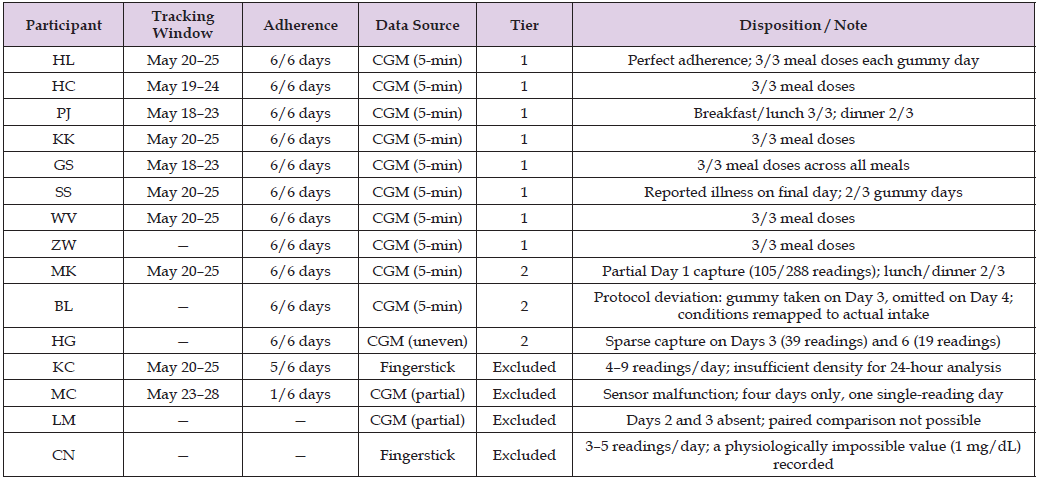
Fifteen generally healthy adults without a diagnosis of diabetes participated in a six-day self-monitoring protocol. No participant reported use of glucose-lowering medication during the study period. Participants tracked glucose continuously by CGM and logged supplement intake, meals, sleep, movement, hydration, and subjective symptoms using the Well World™ platform. Because data completeness varied substantially across participants, a transparent three-tier classification was applied prior to analysis (Table 1). Tier 1 comprised participants with complete six-day CGM records at full sampling density and correct protocol adherence; Tier 2 comprised participants whose data were usable with documented caveats; and the Excluded group comprised participants whose data could not support valid paired comparison. The primary analysis was restricted to the eight Tier 1 participants. Tier 2 participants are reported descriptively where informative; excluded participants contributed no data to the analysis.
Table 1: Participant classification and disposition.
Baseline Glucose Characteristics
Among Tier 1 participants, Day 1 (no-gummy) 24-hour mean glucose ranged from 76.8 to 97.0 mg/dL (group mean 87.0 mg/dL), consistent with healthy insulin sensitivity. No participant had a baseline mean glucose ≥100 mg/dL, and no hypoglycemic event (<54 mg/dL) was recorded in any participant’s CGM trace at any point in the study.
Timeline and Intervention
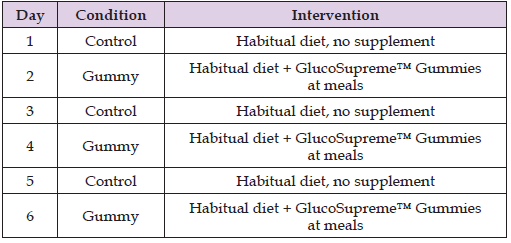
The six-day protocol alternated exposure on a fixed schedule (Table 2). On no-gummy days, participants consumed their habitual diet without supplementation. On gummy days, participants consumed GlucoSupreme™ Gummies (3 gummies providing 5.7 g of allulose) with each main meal.
Table 2: Six-day alternating-exposure protocol.
GlucoSupreme™ Gummies (Designs for Health, Inc.) are strawberry- flavored gummies providing 5.7 g of allulose per 3-gummy serving (1.9 g per gummy), together with 3 g of soluble tapioca fiber (prebiotic resistant starch) and 15 mg of heat-treated Lactobacillus casei (a postbiotic). Each serving contains 10 calories, zero sugar, and zero net carbohydrates. The product is gluten-free, dairy-free, soy-free, non-GMO, and suitable for vegetarians and vegans. The labeled recommended use is 3 gummies before or after meals, particularly higher- carbohydrate meals.
Preclinical evidence indicates that allulose can inhibit intestinal α-glucosidase, slowing the breakdown of complex carbohydrate and delaying glucose absorption. Allulose also shares intestinal transport pathways with glucose and fructose—glucose is taken up primarily via SGLT1 while fructose and allulose enter enterocytes via GLUT5, with all three exiting via GLUT2—raising the possibility that allulose competitively reduces glucose absorption. Beyond the gut, animal studies associate allulose with increased hepatic glucokinase activity and enhanced glycogen synthesis, which would favor hepatic glucose uptake and storage. Allulose has additionally been shown to augment secretion of incretin and satiety hormones, including GLP-1, in controlled human studies. [10] Each of these mechanisms acts either at or shortly after a meal, which coheres with the postprandial effect seen here. The product also contains prebiotic resistant starch (soluble tapioca fiber) and a heat-treated Lactobacillus casei postbiotic. While the glycemic effects observed in this short study are attributed to allulose, resistant starch has independently been associated with lower postprandial glucose and insulin responses [12,13] and it cannot be excluded as a potential minor contributor.
This case series is reported in accordance with CARE (Case Report) guidelines [14].
Data Acquisition
Interstitial glucose was sampled by consumer-grade CGM at 5-minute intervals, yielding up to 288 readings per participant per day. Across all included participants, approximately 17,500 CGM readings were analyzed. Post-meal glucose values for breakfast, lunch, and dinner were recorded for each participant and compiled alongside the continuous trace.
Condition Assignment
Days 1, 3, and 5 were designated control (no gummy) and Days 2, 4, and 6 were designated gummy days, consistent with the fixed protocol. For one participant (BL), documented supplement logs indicated the gummy was taken on Day 3 and omitted on Day 4. As a result, her condition labels were remapped to reflect actual intake prior to analysis.
Data Quality and Exclusions
Exclusions were defined a priori and applied transparently. Participants with fingerstick-only records (≤9 readings/day) were excluded from analysis because their resolution was insufficient to characterize a 24-hour profile. Individual readings below 30 mg/dL or above 400 mg/dL were removed as physiologically implausible. One post-meal comparison (SS, lunch, Day 1 vs. 2) was excluded as a dietary outlier: the gummy-day value (155 mg/dL) exceeded the control-day value (102 mg/dL) against the direction and magnitude of all other comparisons. This reading also coincided with that participant’s highest daily maximum in the study (185 mg/dL), indicating a substantially different meal rather than a supplement effect.
Outcome Definitions
Three outcomes were specified. Twenty-four-hour mean glucose was the arithmetic mean of all CGM readings within a calendar day. Glycemic variability was the within-participant standard deviation (SD) of CGM readings, computed separately for the pooled control days and the pooled gummy days. Post-meal glucose was the recorded post-meal glucose value logged for each main meal (breakfast, lunch, dinner) on each day; paired comparisons were formed between each control day and its immediately following gummy day.
Statistical Methods
For each Tier 1 participant, mean glucose and SD were computed by condition, and a within-participant difference (control minus gummy) was derived. Group-level effects were tested by one-sample t-test on these participant-level differences, with a positive difference indicating a lower value on gummy days. Paired post-meal comparisons were analyzed by one-sample t-test and confirmed by the Wilcoxon signed-rank test. Day-level within-participant comparisons were tested by independent samples t-test. All tests were two-sided with α = 0.05. Analyses were performed in Stata and R.
Twenty-Four-Hour Mean Glucose
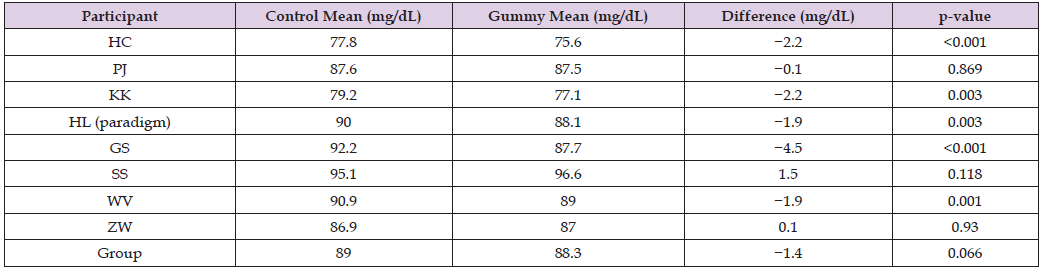
Across the eight Tier 1 participants, 24-hour mean glucose was lower on gummy days in six of eight participants, with a group mean within-participant reduction of 1.4 mg/dL. The effect approached but did not reach statistical significance (Table 3; t = 2.174, p = 0.066). Negative differences indicate lower glucose on gummy days. Group p-value from one-sample t-test on participant-level differences.
Table 3: Twenty-four-hour mean glucose by condition (Tier 1, n = 8).
Post-Meal Glucose
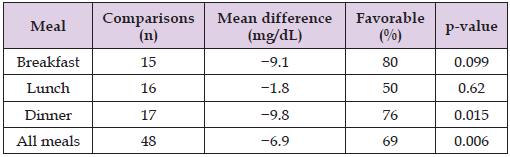
Across 48 paired post-meal comparisons in eight participants (after predefined exclusions), post-meal glucose was lower on the gummy day in 69% (33/48) of comparisons. The mean paired reduction was 6.9 mg/dL, statistically significant by both parametric and nonparametric tests (t = 2.911, p = 0.006) with a medium effect size (Cohen’s d = 0.43). The effect was meal-dependent (Table 4). Breakfast and dinner showed the strongest and most consistent reductions, while lunch showed no reliable effect. Negative differences indicate lower glucose on gummy days.
Table 4: Post-meal glucose reduction by meal (paired comparisons).
Glycemic Variability
Within-day glucose SD was lower on gummy days in six of eight participants, with a group mean reduction of 1.35 mg/dL (Table 5; t = 3.043, p = 0.019). Notably, this reduction was present even in participants whose mean glucose did not fall: SS, whose 24-hour mean was marginally higher on gummy days, nonetheless showed a reduction in SD (18.6 → 17.1 mg/dL), indicating that the intervention tightened the glucose trace independently of any shift in its central tendency. Negative differences indicate reduced variability on gummy days. Group p = 0.019.
Table 5: Within-day glycemic variability (SD) by condition (Tier 1, n= 8).
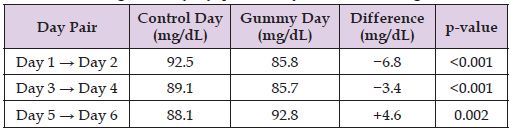
Daily Maximum Glucose Mean daily maximum glucose did not differ meaningfully between conditions (difference −0.5 mg/dL; p = 0.89), indicating that the intervention attenuated average post-meal excursions without reliably lowering absolute daily peaks. Paradigm Case: HL HL adhered perfectly to the protocol (100% tracking, 3/3 supplement doses at every meal on every gummy day) and provides the most internally valid within-subject comparison. In two of the three day-pairs her 24-hour mean glucose fell substantially on the gummy day (Table 6). In the third pair (Day 5 vs. 6), her 24-hour mean rose; time-of-day decomposition attributed this to elevated overnight and morning glucose on Day 6 (overnight mean 81.3 vs. 73.8 mg/dL; morning 97.9 vs. 88.3 mg/dL), while her post-meal values remained lower with the gummy at all three meals (breakfast 98→75; lunch 98→93; dinner 106→88 mg/dL). Across all nine of her meal comparisons, seven (78%) favored the gummy, with a mean reduction of 9.9 mg/dL. This phenomenon — lower post-meal glucose with the gummy despite a higher fasting/overnight baseline on the same day — illustrates that the intervention’s effect is concentrated in the postprandial window and can be masked at the 24-hour level by unrelated variation in fasting glucose.
Table 6: Paradigm case (HL): paired-day 24-hour mean glucose.
Adherence, Tolerability, and Subjective Reports
Supplement adherence among Tier 1 participants ranged from 2/3 to 3/3 gummy days fully compliant at the meal level. No participant reported gastrointestinal or other adverse effects attributable to the gummy, consistent with the established tolerance profile of allulose at the doses used. No participant attributed any negative symptom to the intervention.
Notable Individual Observations
WV displayed a distinctive pattern in which all three lunch comparisons showed higher glucose on gummy days (+13, +22, +15 mg/ dL) while dinner comparisons were mixed. This isolated pattern most likely reflects a consistently higher-glycemic lunch on gummy days rather than an effect of the intervention, and it illustrates the confounding inherent to an uncontrolled free-living diet.
Principal Findings
This case series yields two related but distinct findings and one informative null result. First, post-meal glucose was significantly and consistently lower on gummy days (−6.9 mg/dL; p = 0.006), an effect concentrated at breakfast and dinner. This is the outcome most directly attributable to allulose. Second, within-day glycemic variability was significantly reduced (SD −1.35 mg/dL; p = 0.019), a whole-day phenotype that follows from repeated attenuation of meal-driven excursions and that was observable even when mean glucose did not fall. Third, the 24-hour mean glucose showed a consistent but non-significant trend (−1.4 mg/dL; p = 0.066). The paradigm case (HL) makes this dissociation concrete: the postprandial effect persisted even on the single day when the 24-hour mean moved in the opposite direction because of an unrelated rise in fasting glucose.
Relationship to Existing Evidence
The magnitude and direction of the post-meal effect observed here are consistent with the controlled literature. Randomized trials co-ingesting allulose with carbohydrate have repeatedly shown attenuated postprandial glucose at doses of approximately 2.5–15 g, with effect sizes in the small-to-moderate range—closely matching the Cohen’s d of 0.43 observed in the present free-living data at a 5.7 g serving [3,6]. The concentration of benefit at breakfast and dinner, with a null effect at lunch, is compatible with meal-composition differences under free-living conditions, since allulose’s effect is greatest when co-ingested with higher-glycemic carbohydrate loads. The glycemic- variability finding extends this literature rather than merely reproducing it. Prior controlled studies quantified glucose exposure as incremental AUC over a fixed post-challenge window; to our knowledge, none has reported the effect of allulose on within-day glucose SD derived from continuous monitoring. Because glycemic variability is linked to oxidative stress independently of mean glucose, the observation that a single-serving gummy narrows the daily glucose trace is a clinically relevant addition to the evidence base and a natural target for confirmatory study.
Strengths
The principal strength of this series is its validity: glucose was monitored continuously under free-living conditions rather than in response to a standardized laboratory challenge, at 5-minute resolution across roughly 17,500 readings. The within-subject crossover structure controls for stable inter-individual differences in metabolism, and the inclusion of a perfectly adherent paradigm case provides a high-validity illustration of the within-subject pattern. Finally, the tiered participant classification separated high-quality data from records compromised by hardware or adherence problems.
Limitations
Several limitations should be considered prior to interpretation. Diet was neither standardized nor formally recorded, so meal composition and carbohydrate load could differ between paired days; the three-cycle crossover mitigates but does not eliminate this confounding, as the WV lunch pattern illustrates. The sample is small (eight primary participants) and there was no blinding or placebo control. Finally, the composite formulation (inclusion of a postbiotic) prevents attribution of the entire effect to allulose alone.
Conclusion
In this real-world CGM case series of healthy adults, an allulose- containing gummy taken with meals was associated with a statistically significant reduction in post-meal glucose and in within- day glycemic variability. The findings translate the established controlled-trial signal for allulose into free-living conditions and, in the case of glycemic variability, extend it. Randomized, placebo-controlled trials with standardized or fully recorded diets and CGM-derived incremental AUC are warranted to confirm these observations and to define the dose-response relationship.
All participants provided written informed consent prior to enrollment, including consent for the collection of CGM data and for the publication of their results.
Conflicts of Interest
Participants were employees of Designs for Health, Inc., the manufacturer of GlucoSupreme™ Gummies. Dr. Oscar Coetzee is the VP of education at Designs for Health.
Funding
This case series received no external grant funding. The investigational product and data-collection platform were provided by Designs for Health, Inc. as part of a voluntary internal employee wellness program.
Data Availability
The datasets analyzed in this case series — including CGM records, Well World™ activity reports, and the compiled analysis workbook — are available from the corresponding author on reasonable request. Access is subject to a data-sharing agreement and the sponsor’s confidentiality requirements.
Acknowledgement
Special thanks to Katie Jones from Well World collecting, monitoring the study data and Sahana Prakash for data analytics and statistical evaluations.

International Association of Landscape Archaeology, Czech Glass Society, Czech Republic

Department of Chemistry, Semenov Institute of Chemical Physics, USSR Academy of Sciences, Moscow, Russia

Associate Professor at Department of Breast and Thyorid Surgey, Chongqing General Hospital, China

Professor of Nuclear Medicine, Faculty of Medicine and Surgery, University of Milan, Milan, Italy

Department of Pharmaceutical Sciences, South University School of Pharmacy, USA





 Abstract
 PDF
PDF



























