info@biomedres.us
+1 (502) 904-2126
One Westbrook Corporate Center, Suite 300, Westchester, IL 60154, USA
Site Map
 ISSN: 2574 -1241
Received: June 17, 2026; Published: July 24, 2026
*Corresponding author: Seung Youn Hong, Department of Senior Business, Kangnam University, Yongin, Republic of Korea
DOI: 10.26717/BJSTR.2026.66.010323
Step-based walking goals are simple, measurable, and compatible with consumer wearable devices, and recent large meta-analyses have established that all-cause mortality decreases progressively with higher daily step counts up to approximately 7,000–10,000 steps/day. However, evidence describing very high daily step targets sustained over several years remains scarce, particularly in midlife women undergoing the menopausal transition. This single-participant longitudinal case report describes three years of wearable-supported walking at a daily target of 20,000 steps/day and the accompanying changes in body composition, fasting glucose, lipid profile, and menstrual-cycle regularity in a 51-year-old Korean perimenopausal woman who used a Fitbit Versa 3.0 from June 2019 to June 2022. Across 1,095 days, the participant accumulated 22,979,788 steps (mean 20,986 steps/day), 16,508 stairs climbed, 9,531 miles of distance, and 2,432,161 kcal of estimated energy expenditure.
Menstrual-cycle length was stable during the first two study years (mean 27.3 days each year) but became more variable in the third year (mean 29.4 days; SD 3.65). From 2019 to 2021, body weight decreased from 58.1 to 56.5 kg, percent body fat decreased from 33.0% to 31.1%, fat-free mass increased slightly from 38.7 to 38.9 kg, high-density lipoprotein cholesterol (HDL-C) increased, and triglycerides decreased. In 2022, however, body weight increased to 57.9 kg, fat-free mass decreased to 37.3 kg, fasting glucose increased to 90 mg/dL, low-density lipoprotein cholesterol (LDL-C) increased to 132 mg/dL, HDL-C decreased to 78 mg/dL, and triglycerides nearly doubled to 97 mg/dL. Sustained wearable-supported walking at approximately 20,000 steps/day was feasible for three years and was accompanied by early favorable body-composition and lipid-related changes; however, during the period when menstrual-cycle variability increased, high daily step volume alone did not prevent adverse shifts in several body-composition and metabolic markers. These findings suggest that step count alone, even at a very high level, may be insufficient to preserve body composition and lipid profile during the menopausal transition, and that larger prospective studies integrating step volume, walking intensity, diet, and resistance exercise are needed.
Keywords: Walking; 20,000 Steps; Wearable Device; Fitbit; Body Composition; Lipid Profile; Perimenopause; Case Report
Abbreviations: HDL-C: High-Density Lipoprotein Cholesterol; LDL-C: Low-Density Lipoprotein Cholesterol; CVD: Cardiovascular Disease; MVPA: Moderate-to-Vigorous Physical Activity; SWAN: Study of Women’s Health Across the Nation; FFM: Fat-Free Mass; ICOMES: International Congress on Obesity and Metabolic Syndrome
Physical inactivity is among the leading modifiable risk factors for premature mortality and chronic disease, and the World Health Organization’s 2020 recommendations on physical activity and sedentary behavior advise that adults accumulate at least 150–300 min/ week of moderate-intensity aerobic activity, or 75–150 min/week of vigorous-intensity activity, alongside muscle-strengthening work undertaken on two or more days each week [1,2]. Walking remains one of the most accessible forms of physical activity because it requires no specialized facility and can be monitored easily with step-counting devices, and step-based goals translate physical-activity advice into a concrete behavioral target [3]. The widely promoted 10,000-steps/ day target originated as a marketing slogan rather than from empirical evidence, although accelerometer-based studies subsequently confirmed that daily step counts in the range of approximately 7,700– 11,000 steps/day correspond to meeting the 150 min/week MVPA guideline in adult populations [4]. More recent evidence from large perspective cohorts and pooled analyses indicates that taking more steps each day tracks with lower risk of death from any cause, cardiovascular disease (CVD), newly diagnosed dementia, type 2 diabetes, obesity, and major depressive disorder [5-8].
In a meta-analysis of 15 international cohorts comprising 47,471 adults, Paluch and colleagues showed that mortality risk decreased progressively up to approximately 6,000–8,000 steps/day in adults aged ≥60 years and 8,000–10,000 steps/day in adults <60 years, with diminishing additional benefit at higher step counts [5]. Working with a nationally representative US sample, Saint-Maurice and colleagues described a comparable graded relationship in which higher daily step counts predicted lower all-cause mortality; once step volume was taken into account, however, stepping intensity showed no independent association with mortality [6]. The 226,889-participant meta-analysis by Banach et al. confirmed a continued nonlinear reduction in all-cause and CVD mortality with increasing daily steps, with no clearly defined upper threshold of harm [7]. In the All of Us Research Program, Master et al. linked Fitbit-derived step counts to electronic-health-record outcomes and showed inverse associations with incident obesity, sleep apnea, gastroesophageal reflux disease, and major depressive disorder over a median of 4 years of monitoring [8]. Despite this rapidly accumulating evidence, very high daily step targets such as 20,000 steps/day sustained over multiple years have received little case-based documentation, particularly in midlife women.
Consumer wearable activity trackers can support physical-activity behavior change by providing immediate feedback, goal visibility, and longitudinal records of activity, and meta-analyses indicate small-to-moderate short-term increases in daily steps and moderate- to-vigorous physical activity (MVPA) [9-11]. Sustained engagement, however, remains a persistent challenge: many consumer-device users discontinue tracker use within the first six months, and most randomized trials have follow-up periods shorter than 16 weeks [10,12]. Habit-formation theory suggests that repeated performance in stable contexts, clear goals, contextual cues, and coping plans help convert effortful behavior into a more automatic routine [12,13]. A daily 20,000-step goal maintained for several years therefore provides an informative self-tracking model for examining adherence, feasibility, and accompanying physiological change under real-world conditions. Midlife women represent a particularly important population for studying the interaction between walking behavior and cardiometabolic outcomes. The American Heart Association 2020 scientific statement identified the menopausal transition as a window of accelerated CVD risk in women, characterized by adverse changes in body fat distribution, lipids and lipoproteins, vascular health, and metabolic measures—changes that are at least partly independent of chronological aging [14].
Drawing on longitudinal data from the Study of Women’s Health Across the Nation (SWAN), Greendale and colleagues showed that fat mass began to accumulate twice as fast, and lean mass started to fall, from roughly two years before the final menstrual period until about two years afterward, after which body composition tended to stabilize [15]. Earlier observational data from the MONET study and a controlled longitudinal study by Poehlman et al. also document increases in fat mass, visceral fat, and unfavorable shifts in lipid profile across the menopausal transition [16,17]. Physical activity may partly counteract these unfavorable changes, but the relative contributions of walking volume, walking intensity, diet, sleep, ovarian aging, and chronological aging remain difficult to isolate in an uncontrolled real- world setting [14,15,18].
The purpose of this case report was to describe a three-year period in which a 51-year-old perimenopausal woman used a wearable device to maintain a 20,000-step/day walking target. The report emphasizes adherence to a high daily step target and describes changes in body composition, fasting glucose, lipid profile, and menstrual-cycle regularity over the observation period.
Study Design
This was a single-participant longitudinal case report based on retrospectively summarized self-tracking data and routine health-examination data collected from June 2019 to June 2022. Because the report describes one individual, descriptive statistics were used and no inferential statistical testing was performed.
Participant and Setting
The participant was a 51-year-old Korean perimenopausal woman with college-level education. The source case materials indicated that the participant neither smoked nor used alcohol. Reported family history included hypertension, type 2 diabetes, stroke, ischemic heart disease, knee arthritis, spinal stenosis, and rheumatoid arthritis. The walking program was self-directed and performed in daily life rather than as a supervised clinical intervention.
Walking Exposure and Wearable Device
The physical-activity exposure was a daily target of 20,000 steps. Walking was performed seven days per week, and the duration of each walking day was determined by the time required to reach the daily step target. Walking intensity was not standardized or prescribed. A Fitbit Versa 3.0 was used to monitor steps, stairs climbed, estimated walking distance, and estimated energy expenditure. Fitbit data were downloaded from Fitbit.com and summarized by study year.
Measurements
Body composition was assessed using InBody 720 (InBody, Seoul, Republic of Korea). Within the available source records, body-composition reporting was limited to three variables: body weight, percent body fat, and fat-free mass (FFM). Fasting glucose, low-density lipoprotein cholesterol (LDL-C), high-density lipoprotein cholesterol (HDL-C), and triglycerides were obtained from routine annual health examinations performed at Kangbuk Samsung Medical Center. Menstrual- cycle length was self-reported and summarized by study year as mean and standard deviation. Sleep variables were tracked in the source materials, but exact raw values were not available; therefore, sleep was not treated as a primary analytic outcome.
Data Analysis
Annual and total Fitbit values were summarized descriptively. Daily mean values were calculated across 1,095 observation days. Body-composition and fasting laboratory values were displayed in tables and figures. Because this report involved one participant, the results should be interpreted as descriptive longitudinal observations rather than estimates of causal effect.
Ethics Approval and Consent
Written consent for publication of this case report and the summarized self-monitoring and health-examination data was obtained from the participant. Institutional ethics review requirements should be confirmed with Kangnam University policy and the journal requirements for single-participant case reports prior to submission.
Participant Characteristics
Participant characteristics and walking exposure are summarized in Table 1. The defining feature of the case was maintenance of a very high daily step target during a three-year midlife period overlapping with increasing menstrual-cycle variability.
Table 1: Participant characteristics and walking exposure.
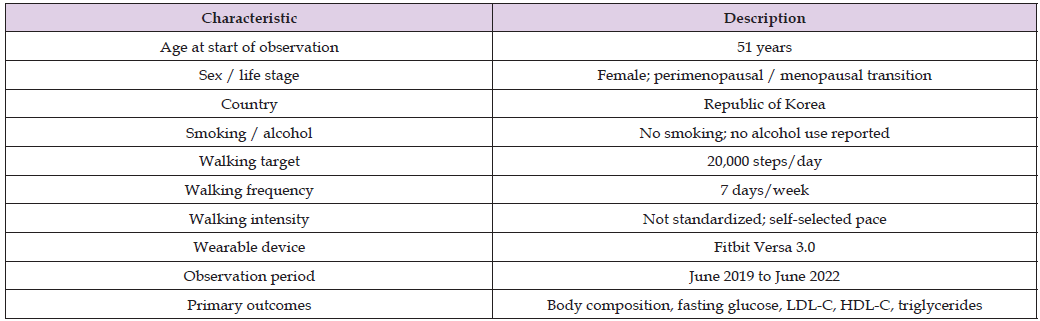
Note: Family history reported in the source materials included hypertension, type 2 diabetes, stroke, ischemic heart disease, knee arthritis, spinal stenosis, and rheumatoid arthritis.
Menstrual-Cycle Pattern
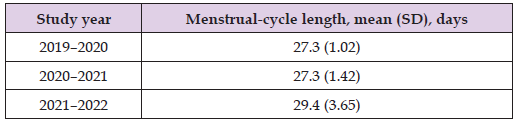
Menstrual-cycle length was stable during the first two study years, with a mean of 27.3 days in both 2019–2020 and 2020–2021. During 2021–2022, mean cycle length increased to 29.4 days and variability increased substantially, with an SD of 3.65 days (Table 2).
Table 2: Menstrual-cycle length by study year.
Fitbit-Derived Walking Data
Across 1,095 observation days, the participant accumulated 22,979,788 steps, corresponding to a mean of 20,986 steps/day. Annual step counts were 7,870,451 in 2019–2020, 8,019,910 in 2020–2021, and 7,089,427 in 2021–2022. Total Fitbit-derived stairs climbed were 16,508, total distance was 9,531 miles, and total estimated energy expenditure was 2,432,161 kcal (Table 3).
Table 3: Fitbit-derived walking data over three years.

Note: Daily mean values were calculated across 1,095 observation days. Energy expenditure is a Fitbit-derived estimate and should not be interpreted as directly measured calorimetry.
Body Composition
Changes across the three body-composition variables over the observation period are presented in Table 4 and Figure 1. From 2019 to 2021, weight decreased from 58.1 kg to 56.5 kg, percent body fat decreased from 33.0% to 31.1%, and fat-free mass increased slightly from 38.7 kg to 38.9 kg. In 2022, weight increased to 57.9 kg, percent body fat increased to 31.4%, and fat-free mass decreased to 37.3 kg.
Figure 1
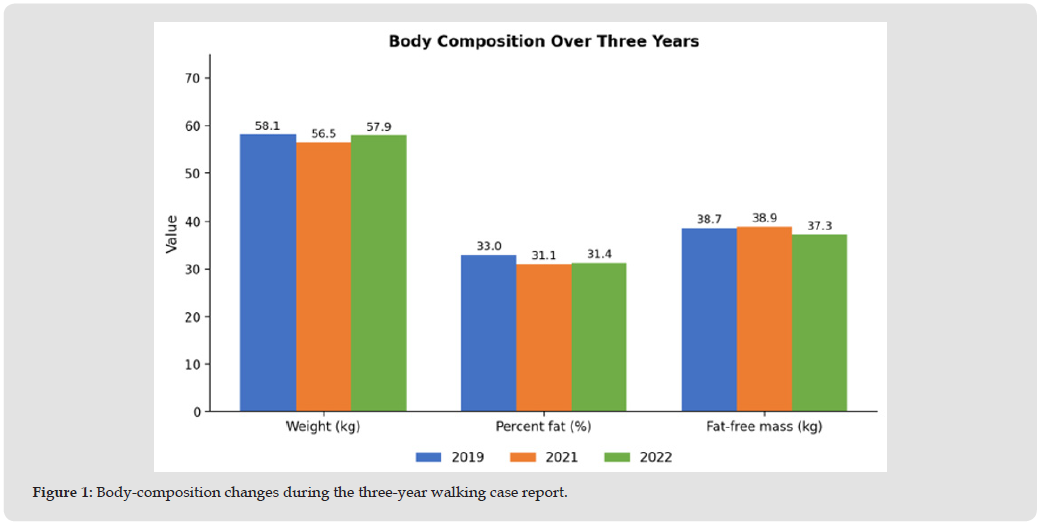
Table 4: Body-composition changes.

Fasting Glucose and Lipid Profile
Fasting glucose and lipid-related values are summarized in Table 5 and Figure 2. Fasting glucose remained between 76 and 79 mg/dL from 2019 to 2021, then increased to 90 mg/dL in 2022. LDL-C decreased from 116 mg/dL in 2019 to 112 mg/dL in 2020 but increased to 126 mg/dL in 2021 and 132 mg/dL in 2022. HDL-C increased from 77 mg/dL in 2019 to 89 mg/dL in 2021, then decreased to 78 mg/dL in 2022. Triglycerides decreased from 53 mg/dL in 2019 to 49 mg/dL in 2021, then increased to 97 mg/dL in 2022.
Figure 2
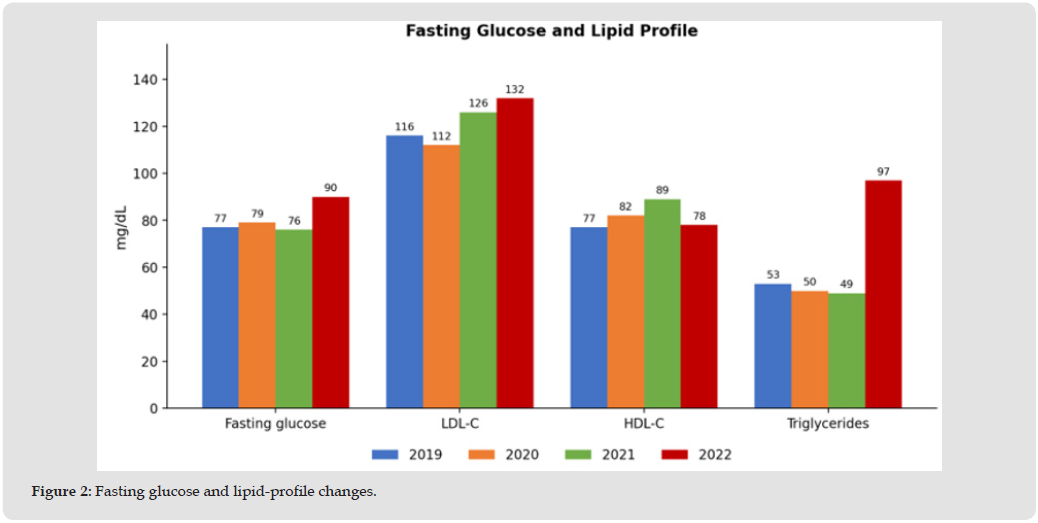
Table 5: Fasting glucose and lipid-profile changes.

This case report documents a rare three-year observation of a daily 20,000-step walking target supported by a consumer wearable device. The most notable behavioral finding was feasibility: the participant sustained a mean of 20,986 steps/day across 1,095 consecutive days. This level of adherence is unusual because the majority of consumer-tracker interventions show early increases in activity followed by progressive disengagement, with most wearable-device users discontinuing the device within six months of starting [10,12]. In this case, daily feedback from the Fitbit Versa 3.0, a clear and consistent step target, and repeated self-monitoring appear to have supported a durable walking habit consistent with key elements of habit- formation theory—initiation, contextual cueing, action planning, and coping planning [12,13]. The early physiological pattern was generally favorable. By 2021, body weight and percent body fat had decreased, fat-free mass had increased slightly, HDL-C had increased, and triglycerides had decreased. These observations are consistent with the general literature suggesting that walking and other low- to moderate-intensity physical activity can improve body composition and lipid-related risk markers in some populations [3,4,18,19].
The participant’s daily mean of 20,986 steps/day during this period was well above the thresholds at which dose–response curves for all-cause mortality begin to plateau in recent meta-analyses—approximately 6,000–8,000 steps/day in older adults and 8,000–10,000 steps/day in adults under 60 years [5,6]—suggesting that, in this individual, the additional step volume may have provided psychological and behavioral benefits (goal achievement, consistency, habit reinforcement) rather than further mortality-relevant cardiometabolic gain. The later trajectory was more complex. In 2022, despite continued high step volume, fat-free mass decreased by approximately 1.6 kg from the 2021 peak, fasting glucose increased to 90 mg/dL, LDL-C increased to 132 mg/dL, HDL-C decreased from the 2021 peak of 89 mg/dL to 78 mg/dL, and triglycerides nearly doubled from 49 to 97 mg/dL. The timing of these changes is clinically relevant because menstrual-cycle variability also increased in the third study year, with the SD of cycle length rising from approximately 1.4 days to 3.65 days—a pattern consistent with the Stages of Reproductive Aging Workshop (STRAW+10) definition of late perimenopause [14,15].
The American Heart Association 2020 scientific statement explicitly identified the menopausal transition as a period of accelerated CVD risk in women, characterized by unfavorable changes in body fat distribution, lipid profile (rising LDL-C and apolipoprotein B, falling HDL-C function), and vascular health that occur at least partly independently of chronological aging [14]. Longitudinal data from SWAN show that the rate of fat-mass gain doubles and lean mass begins to decline approximately two years before the final menstrual period [15]. The pattern observed in this case—loss of fat-free mass, modest fat regain, and adverse lipid and glucose trajectories despite maintained high step volume—is consistent with these large-cohort observations and illustrates that step count alone, even at a very high level, may not be sufficient to prevent menopausal-transition-related cardiometabolic shifts in an individual midlife woman. The case also highlights the distinction between walking quantity and walking quality. The participant achieved a high volume of steps, but walking intensity was not standardized or measured by cadence, and resistance- exercise exposure was not part of the program.
Current step-based research suggests that step volume is a useful target for behavioral goal-setting, but cadence, intensity, total energy balance, and resistance exercise remain important for cardiometabolic adaptation and lean-mass preservation [5,6,8,19]. For midlife women, future interventions may need to combine daily walking goals with structured moderate-to-vigorous activity, resistance exercise to preserve lean mass during the menopausal transition, dietary monitoring, and individualized feedback on cardiometabolic risk markers.
Limitations
The findings should be interpreted with caution. This was a single- person case report without a control condition, randomization, standardized diet assessment, medication tracking, or repeated laboratory measurements at tightly controlled intervals. Fitbit-derived energy expenditure and distance are device-based estimates, not directly measured calorimetry, and consumer-wearable accuracy varies across activity types and intensities [9]. The supplied source materials did not include raw daily step distributions, body mass index, waistto- hip ratio, basal metabolic rate, detailed dietary records, medication history, or exact sleep-stage values. Hormone levels (FSH, estradiol) were not measured to confirm menopausal stage by STRAW+10 criteria; cycle-length variability was used as an approximate indicator. Therefore, the report is best understood as a descriptive longitudinal observation, not evidence that 20,000 steps/day causes specific body-composition or lipid changes.
Practical Implications
Despite these limitations, the case has practical value. It demonstrates that a wearable-supported 20,000-step daily walking target can be sustained for three years by a motivated perimenopausal woman, with mean daily step counts more than double the public-facing 10,000-step heuristic and roughly four-fold higher than the step counts at which dose–response curves for all-cause mortality begin to plateau in recent meta-analyses [5-7]. It also provides a cautionary message for clinicians and public-health practitioners: maintaining a very high daily step volume is a meaningful behavioral achievement, but step count alone should not be assumed to fully protect against menopausal-transition-related changes in body composition and metabolic profile. The American Heart Association recommendation to monitor cardiometabolic risk closely during the menopausal transition, and to combine aerobic activity with resistance training and dietary management, remains particularly important for midlife women regardless of step count [14,15].
A self-directed daily walking target of 20,000 steps supported by Fitbit monitoring was sustained for three years, producing an average of 20,986 steps/day over 1,095 consecutive days. Early changes in body composition and several lipid-related markers were favorable, but in the third year, when menstrual-cycle variability increased, several markers shifted in an unfavorable direction. This case suggests that high daily step volume is feasible and may be health-supportive as a behavioral foundation, but step count alone does not guarantee preservation of body composition and lipid profile during the menopausal transition. Prospective studies with larger samples, objective intensity measures, dietary assessment, and STRAW+10 menopausal staging are needed.
A preliminary version of this work was presented in poster form at the 2022 International Congress on Obesity and Metabolic Syndrome (ICOMES), Conrad Seoul, Republic of Korea, 2022.
The author declares no conflict of interest.
No specific funding was received for this case report.

International Association of Landscape Archaeology, Czech Glass Society, Czech Republic

Department of Chemistry, Semenov Institute of Chemical Physics, USSR Academy of Sciences, Moscow, Russia

Department of Educational Sciences, Research Centre Qualities of Teachers, School of Education – HAN, Nijmegen, Netherlands

Associate Professor at Department of Breast and Thyorid Surgey, Chongqing General Hospital, China

Neurology, LA BioMed Research Institute, USA





 Abstract
 PDF