info@biomedres.us
+1 (502) 904-2126
One Westbrook Corporate Center, Suite 300, Westchester, IL 60154, USA
Site Map
 ISSN: 2574 -1241
ISSN: 2574 -1241
ISSN: 2574 -1241
Received: July 06, 2026; Published: July 22, 2026
*Corresponding author: Nikolay Petrov Takuchev, Trakia University, Stara Zagora, Bulgaria
DOI: 10.26717/BJSTR.2026.66.010314
This work shows a statistically significant link between the fluxes of high-energy positively charged particles reaching Earth and the number of Down syndrome births in Eastern European countries. This is not the only example of the harmful effects of streams of solar positively charged particles on human health. In a series of publications (Takuchev [1,2]), numerous cases of the harmful effects of this radiation on health and life are described. The rise in mortality occurs within a risk zone in the Northern Hemisphere, running parallel to the equator and limited by the parallels of 30° and 50° north latitude. A hypothetical mechanism, supported by observational evidence, suggests this dangerous phenomenon is caused by high-energy solar alpha particles that penetrate the geomagnetic field and atmospheric resistance, reaching the Earth’s surface in a limited area and causing various harms in the human body.
Keywords: Down Syndrome; Eastern Europe; WHO; Solar Alpha Radiation; Satellites
Abbreviations: EPS: Energetic Particles Sensor; EPEAD: Energetic Proton Electron and Alpha Detector; NUTS: Nomenclature Des Unités Territoriales Statistiques; GOES: Geostationary Operational Environmental Satellites; DS: Down Syndrome; NHS:UK National Health Service; CRDb: Cosmic Ray Data Base; SMEs: Solar Mass Ejections
The Sun’s dual impacts on health, both negative and positive, have been well known for a long time. Many studies have shown a link between these health effects and electromagnetic radiation from the sun, including UV and visible light. This article explores the possibility that a different type of solar radiation—corpuscular radiation—may directly affect the body. Streams of high-energy, positively charged particles that can penetrate Earth’s atmosphere and the human body can significantly disrupt normal cellular processes. Below, based on statistics from the World Health Organization, European Health Information Gateway [3], the unexpected phenomenon – an association between solar alpha radiation and the number of births with Down’s syndrome is described and discussed. The impact of solar alpha radiation on human health is also reflected in mortality statistics for various diseases (Takuchev [1,2]), making this invisible cause one of the leading causes of death worldwide.
Health Statistics Data
The analysis below is based on authoritative health data sources: the WHO European Health Information Gateway [3] and EUROSTAT [4]. The statistical parameters, birth rate with Down syndrome, and mortality rate, were used as characteristics in the study. The birth rate is the number of births with Down syndrome per 100000 live births, and the mortality rate is the number of deaths per 100000 inhabitants. The data represent the annual rates by country and year. EUROSTAT provides access to data on mortality rates by specific causes for European Union countries, the European Economic Area, and candidate countries for EU membership. Geographically, these countries are situated in Europe and the Mediterranean region. Data are grouped by NUTS (Nomenclature Des Unités Territoriales Statistiques in French, the nomenclature of territorial units for statistics). In the study, mortality rates data from the EUROSTAT shortlist were used. In the EUROSTAT shortlist, mortality rates are grouped by causes of death into 92 groups, primarily diseases. These groups are related to the classes of the International Statistical Classification of Diseases and Related Health Problems (ICD-10, 2010). The shortlist includes mortality rates for EU countries (NUTS-1) and EU regions (NUTS-2, which are smaller areas within the larger NUTS-1 countries). Currently (2023), the shortlist includes mortality rate data for the period 2011-2020. Annual mortality rate data were extracted for 353 European regions (NUTS-2) separately for each shortlist group from 2011 to 2019 (the last pre-pandemic year).
Satellite Data
Satellite data on corpuscular radiation – protons and alpha particles detected by the satellites of the series GOES (Geostationary Operational Environmental Satellites) were obtained from a NOAA site: Data from GOES satellites, 2023. The satellites of the GOES series orbit in geostationary orbit (above the Earth’s equator) at an altitude of 36,000 kilometers above the Earth’s surface, completing one lap in 24 hours. They “hang” over a specific point on the Earth’s surface and are not shaded by the Earth at their circumference around it. Data on alpha- particle and proton fluxes (unit: (number of particles.cm-2.s-1.sr-1. MeV-1) within energies of 3.8 – 21.3 MeV were used. The fluxes were detected by the satellite high-energy particle detectors:
1. Energetic Particles Sensor (EPS), and
2. Energetic Proton, Electron, and Alpha Detector (EPEAD). The data are available at 5-minute intervals, with up to 25 reports per interval.
The year-averaged fluxes of protons and alpha particles are highly correlated over the energy range from 3.8 to 21.3 MeV, indicating that the phenomenon is evident in both the mean proton and alpha particle flux data. As explained below, only the average flux of high-energy alpha particles is included as incident radiation in the following examples.
Data Processing
The correlation coefficients (Lakin [5]) between both the annual- averaged alpha radiation flux and the annual rate of births with Down syndrome for several countries in Europe and the Mediterranean were calculated. In mathematical statistics, the level of statistical significance is a parameter that indicates the reliability of the calculated correlation coefficient. The smaller the value of this parameter, the more reliably the correlation coefficient is established, i.e., the more reliably a cause-and-effect relationship has been established between the annual flux of solar alpha radiation and the rate of Down syndrome births. In scientific studies, a level of statistical significance of 0.05 or less is typically accepted as a criterion for the reliability of the correlation coefficient. The correlation coefficient and its level of statistical significance are related. For the 9 years included in the study, a minimum correlation coefficient of 0.668 corresponds to a statistical significance level of 0.05. The influence of solar alpha radiation on the number of Down syndrome births in Europe was compared with its impact on mortality rates across Europe.
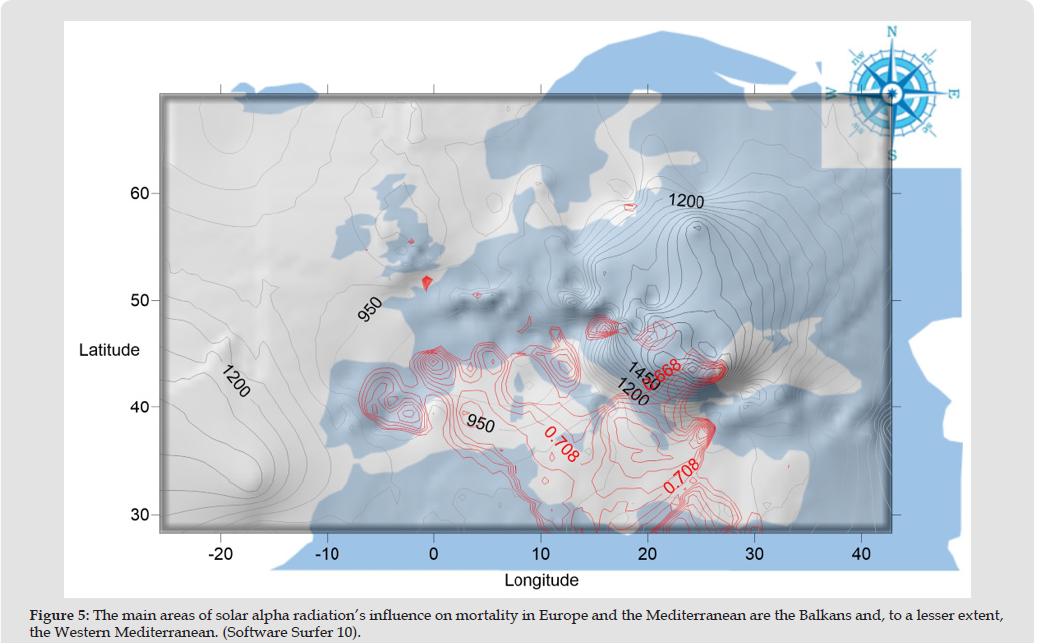
For this comparison, a map was created showing the distribution for 2012 of the annual mortality rates for “All causes of death (A00-Y89) excluding S00-T98 (EUROSTAT mortality shortlist number 1)” across 353 NUTS-2 European regions. The year 2012 was selected because it had the highest annual mortality rate, coinciding with the highest annual alpha particle flux during the studied period 2011– 2019. On the map, black isolines show the distribution of mortality rates across Europe and the Mediterranean in 2012. Red isolines show the correlation coefficient (>0.668) between annual mortality rates and the annually averaged alpha-particle flux for 2011–2019. Data on the coordinates (latitude and longitude) of the NUTS-2 region centroids included in the study, obtained from Google Earth, were used to create the map.
Mapping was performed using Golden Software Surfer 10, with kriging interpolation selected. A causal link between cosmic alpha radiation and mortality rate is reliably established in areas enclosed by red isolines (with a statistically significant correlation coefficient above 0.668). If some maxima in mortality rates coincide with regions of high correlation coefficients, then alpha radiation contributes significantly to mortality in those regions. To the extent that the hypothetical mechanism proposed below, which explains the observed phenomenon, assumes that charged particles of high energy pass through the atmosphere and reach the Earth’s surface, the energy required for this process was calculated using databases and calculators PSTAR [6] and ASTAR [7]. Geomagnetic field data were obtained from the INTERMAGNET site (Data on the geomagnetic field [8]).
Down syndrome (DS), characterized by an extra free chromosome 21 (trisomy 21), is the most common genetic cause of congenital malformations and learning disabilities. The extra chromosome 21 is usually inherited from the mother in over 90% of cases, and the incidence increases with maternal age (Hultén, et al. [9]). From 2011 to 2015, Europe saw 8,031 annual live births of children with Down syndrome, with a rate of 10.1 per 10,000 live births. In Bulgaria, the rate is 4.54 births with Down syndrome per 10,000 live births (de Graaf, et al. [10]). What causes Down syndrome? According to Oxford Health NHS (UK National Health Service) Foundation Trust (2026), no behavioural or environmental factors are known to cause Down syndrome. Most of the time, Down syndrome isn’t inherited. It results from a cell division error during early fetal development.
Figures 1, 2, and 3 show the time dependences in the interval 2011 – 2019 of two numerical sequences:
• Of the detected annual fluxes of alpha particles from satellites of the GOES series – 10, 11, 12, 13, and 14, and
• Of the annual rate of Down syndrome births for some countries of the European Union.
Figure 1
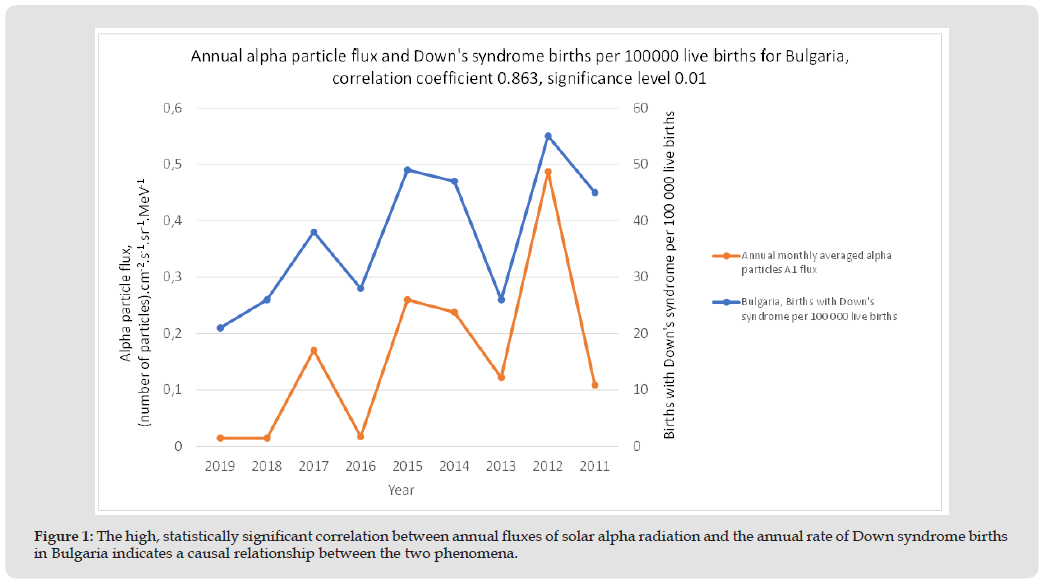
Figure 2
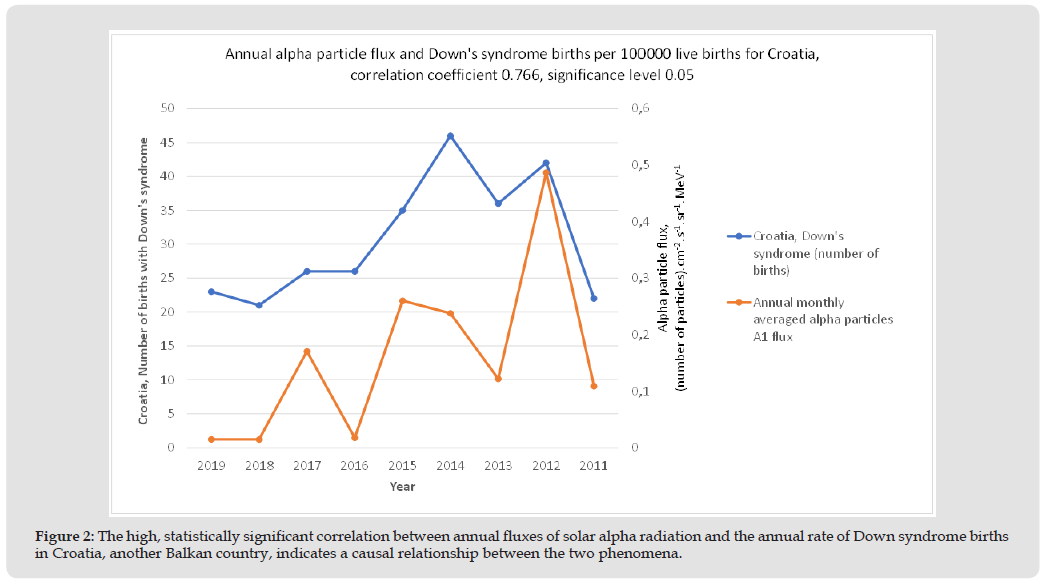
Figure 3
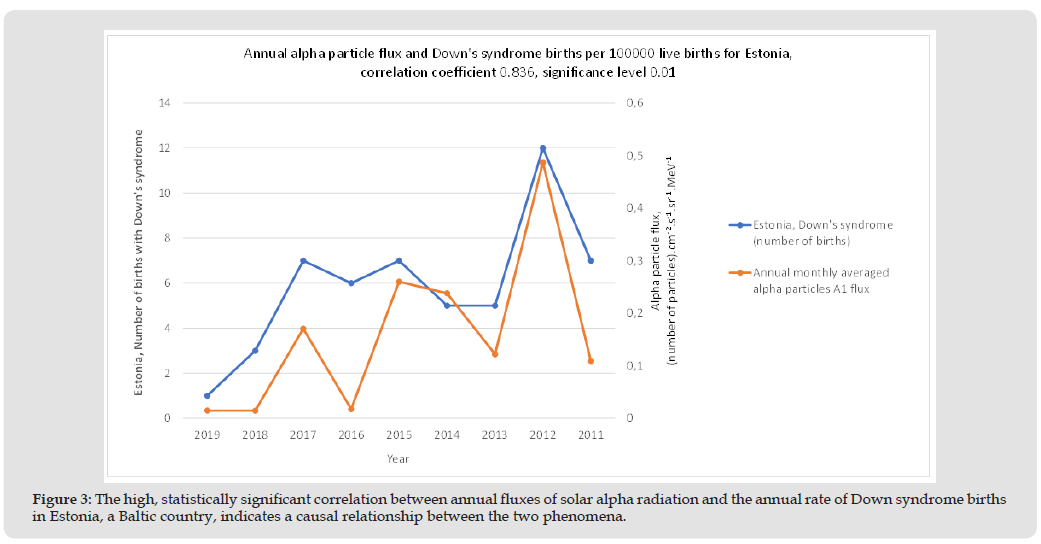
The high correlation between the two numerical sequences is evident, suggesting a causal relationship.
The analogous correlation coefficients for the other countries of the Balkan Peninsula are also positive, but are not statistically significant. Figure 4 shows the dependence of the Down syndrome birth rate on the flux of alpha particles for Bulgaria for the studied interval 2011 – 2019.
Figure 4
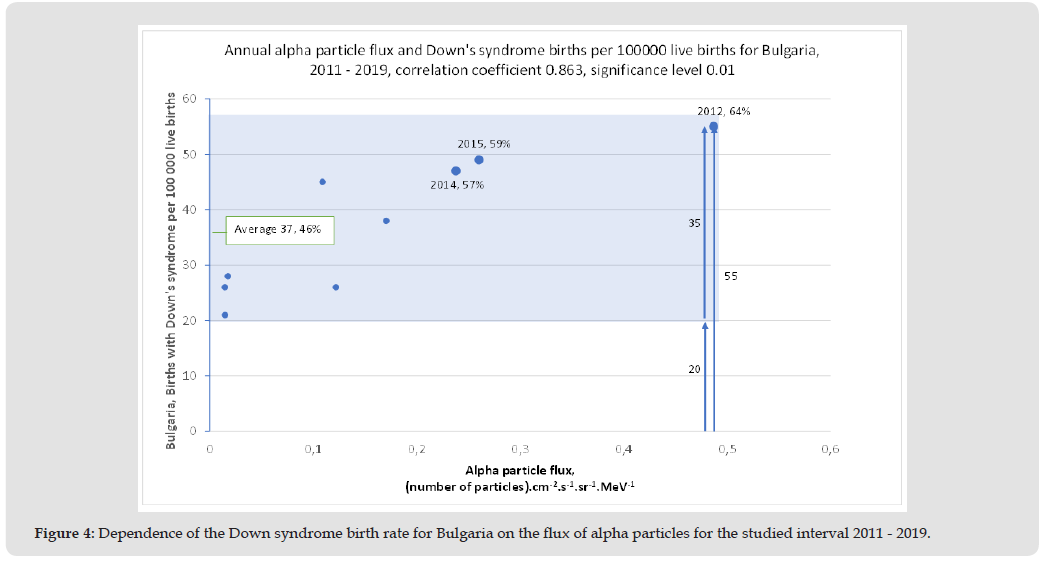
The dependence is shown by dots inside a dark rectangle. The cause of Down syndrome is probably complex. Exposure to alpha particle fluxes is only one possible influence. Some births with Down syndrome do not depend on the flow of high-energy solar alpha particles. In the figure, these are represented by the light area below the dark rectangle, with a height that is independent of alpha radiation, totaling 20 births. The total number of births with Down syndrome can be expressed as the sum of births unaffected by alpha radiation (the height of the light area—20 births) and those dependent on alpha radiation, counted from the bottom of the dark rectangle. The proportion of alpha radiation-dependent births among total Down syndrome cases indicates the influence of solar alpha radiation among the causes. Figure 4 illustrates how to calculate this indicator. In 2012, Bulgaria recorded 55 births with Down syndrome per 100,000 live births. Of these, 20 are independent of alpha radiation, and 35 are dependent on it. The percentage of alpha radiation-dependent births was 35/55, or 64%, indicating that approximately two-thirds of Down syndrome births in Bulgaria that year were affected by solar alpha radiation flux. In 2014 and 2015, more than 50% of Down syndrome births in Bulgaria were also influenced by the solar alpha radiation flux. The most plausible mechanism explaining the probable relationship between solar corpuscular radiation and births with Down syndrome is the direct impact of a high-energy particle on the expectant mother’s body. The ionization caused by such a particle in biological tissue can result in severe damage during meiosis in egg formation, damage that the body cannot repair.
It can be assumed that the damage caused by such particles to the process of cell division is complex, but only embryos with trisomy 21 survive; the others are lost through spontaneous abortion or fetal death before or after birth. This hypothesis explains the association between Down syndrome and maternal age. The embryos that will become future eggs remain in the woman’s body for years. The duration of stay in the body increases the probability that the future egg will encounter a high-energy solar particle that has penetrated to the earth’s surface; i.e., the older the woman in labor, the more likely it is that the egg will be damaged by external impact from a high-energy particle. In principle, such particles may originate from sources beyond the Sun, such as deep space, the environment surrounding the organism, and even radionuclides accumulated in the organism itself, but statistics show that the main cause of Down syndrome is particles of solar origin, whose flow many times exceeds that of all other possible sources. The hypothesis presented suggests that the frequency of births with Down syndrome is lower the younger the mothers are. This is confirmed in Bulgaria by the births of one of the ethnic groups with traditions of early marriage and childbirth. The largest proportion (89,7%) among mothers aged less than 19 years is Roma women (also known as “gypsy”, 4% of the country’s population). Among them, some have had four pregnancies by this age (Dimieva [11]). The average age of the mother at the birth of the first child across all ethnic groups in Bulgaria in 2024 was 27.6 years, about twice the average age of Roma women at their first births (National Statistical Institute of Bulgaria: Average age of the mother at the birth of the first child, 2026). After the closure of specialized schools in Bulgaria for students with intellectual disabilities, especially those with Down syndrome, these students now attend general education schools.
The proportion of students with Down syndrome in Bulgarian primary schools is low but not zero. In Bulgaria, Roma communities are often concentrated in settlements or urban neighbourhood’s, resulting in a high number of Roma students in local schools. Unlike the average rate of Down syndrome in Bulgarian primary schools, some schools with over 80% Roma students have an almost zero incidence of students with Down syndrome (Nikolova, et al. [12]). Without explaining this phenomenon, the authors highlight the fact that the number of children with Down syndrome among the Roma community is significantly lower compared to other ethnic groups in the country. This fact provides indirect confirmation of the conclusion above, based on the hypothesis that charged particles from the external environment affect the future mothers’ organisms, namely, that younger mothers should give birth to fewer children with Down syndrome. Solar alpha radiation fluxes, in addition to being a potential cause of Down syndrome, may also be an invisible factor contributing to various human death causes, mainly diseases (Takuchev [2,11]). The phenomenon might be explained by particles penetrating the atmosphere and reaching the Earth’s surface. This is evident in the annual mortality statistics of several countries across the Northern Hemisphere. The countries where this phenomenon occurs are located in a band parallel to the equator, roughly between 30° and 50° north latitude. This phenomenon is also expected to affect mortality in countries south of the equator. However, their mortality data is limited, unreliable, or missing, which prevents accurate conclusions about its impact in the Southern Hemisphere.
The phenomenon is observed in the annual mortality statistics data of small countries. It is not visible in the statistics of large countries within the same band. This suggests that the impact on the Earth’s surface is short-lived and limited to a small area, comparable to the size of a small country, but it is hidden in large country statistics because it does not affect the entire area of the large country at once. This conclusion is confirmed for the USA, where data on mortality by individual state are available (Takuchev [12]). The mortality statistics of the European Union are suitable for studying the phenomenon because they are based on statistical regions that are smaller than a country but still large enough to include a statistically sufficient number of inhabitants. Figure 5 shows, using blue isolines, the distribution of mortality by the group cause “All causes of death (A00-Y89) excluding S00-T98” of the EUROSTAT shortlist in 2012 – the year with the highest mortality (and the maximum solar alpha emission) during the studied interval 2011 – 2019. The map was made from data for 353 NUTS-2 regions in Europe and the Mediterranean. A region with increased mortality stands out over Eastern Europe, with a maximum in the Balkans. Red isolines outline the areas of statistically significant correlation coefficients for the dependence of mortality from the same group cause in each NUTS-2 region on the annual flux of solar alpha radiation detected by GOES satellites for the studied interval, 2011 – 2019. Two areas of maximum impact stand out – the Balkans and the Mediterranean. Once again in the Balkans, there is a marked coincidence between mortality and solar alpha radiation detected by the GOES satellites. The strong link between solar alpha radiation fluxes and the number of births with Down syndrome aligns with the high correlation of these fluxes with mortality from various causes in a specific area—the Balkans—adding further evidence of the diverse negative effects of solar alpha radiation on health.
Figure 5
The provided examples clearly demonstrate the influence of solar alpha radiation on cell processes (Down syndrome) and mortality rates from various diseases. The exact mechanism behind this effect still remains unknown. A proposed explanation is outlined below, addressing many of the questions that arise.
1. An observed phenomenon – the relationship between Down syndrome and mortality rates from various diseases in the statistics of many countries, mainly located between the 30°N and 50°N latitude band – is strongly correlated with fluxes of positively charged particles with energy of 4 – 21 MeV, detected by the GOES series satellites in Earth orbit. The detected alpha particle flows are mostly pulses lasting less than 5 minutes (the averaging interval of the detecting device) to a few days.
2. Proposed hypothesis – positively charged particles with high energy penetrate the Earth’s atmosphere and reach the surface, potentially harming human health.
3. Observed fact: The particle flux-related mortality increases as the average altitude of the affected area rises (Takuchev [13,14]). It is likely due to the more intense radiation flux penetrating the thinner atmosphere over mountainous regions – an argument supporting the hypothesis.
4. The source of positively charged particle flows is the Sun. Mortality increases with observable processes on the Sun, such as Solar Mass Ejections (SMEs) directed toward Earth and flares (phenomena on the solar surface that can be observed with other astronomical means, Takuchev [13,14]). The Alpha Magnetic Spectrometer (AMS-02) on the International Space Station measures the cosmic rays, excluding those of solar origin (when shielded from the Sun by the station’s solar panels). Specifically, it measures the flow of 3He and 4He (alpha particles) in the galactic cosmic rays. The measurements show (Cosmic Ray Data Base (CRDB), charged cosmic rays, [15]) an increasing annual flux of alpha particles in cosmic rays from 2011 to 2017 (the latest available data), while the flux of GOES- registered (solar?) alpha particles during the same period is decreasing (see Figures 1-3 above). Indirect evidence that the Sun is a source of high-energy alpha particles is that this explanation convincingly accounts for downstream processes that ultimately lead to death on the surface.
5. Positively charged solar particles that can reach Earth’s surface are high-energy alpha particles. Calculators (PSTAR [6] ASTAR [7]) evaluate the penetration parameters of protons and alpha particles in various substances, especially in air. Calculations using data for a homogeneous atmosphere – an atmospheric model with constant density, temperature, and pressure decreasing with height (Takuchev [13,15]) – show that only particles with energies above 2.4 GeV for protons and over 6.2 GeV for alpha particles can penetrate the Earth’s atmosphere to reach the surface. No protons above 0.7 GeV have been detected by GOES satellites, but alpha particles with energies above 3.4 GeV have been observed, and, hypothetically, also those above 6.2 GeV as well (Takuchev [13,15]). Therefore, the particles reaching the Earth’s surface are likely high-energy alpha particles. Associated with surface mortality are only fluxes of alpha particles with a magnitude of at least 1000 particles.cm-2.s-1.sr-1.MeV-1.
6. It is assumed that the alpha particles detected by the satellites were emitted simultaneously with the hypothetical fast alpha particles during an explosive event (possibly a flare?) on the solar surface. It can be calculated that particles with an energy of 7 GeV take approximately 8.87 minutes to reach Earth’s surface from the Sun, while particles with energies of 5 – 10 MeV detected by satellites travel roughly 2 hours. The alpha particles detected by satellites do not have enough energy to penetrate the atmosphere, unlike the hypothetical fast alpha particles that reach Earth’s surface within minutes from the center of the solar disk. However, the detected alpha particles indicate that two hours earlier, Earth’s surface was exposed to fast (undetected) alpha particles. 7. Although alpha particle streams irradiate the entire illuminated part of the atmosphere, fast alpha particles reach the surface only in a limited area of the surface (death spot), where two conditions that favor penetration are met:
a. The Sun is at its highest point at the center of the death spot. Throughout the year, the Sun’s apparent position relative to the observation point shifts, causing the maximum angle of elevation of the Sun’s disk above the horizon (solar culmination at local noon) to change depending on the date. The latitude and longitude of a point on Earth where the solar disk is at its culmination at that moment of detection of the incoming alpha particle flow – the point of detection, can be determined from the date (latitude), and the time (hours and minutes for longitude). The center of the dead spot can be calculated; it is approximately 30° east of the detection point (Takuchev [13]). The Earth’s angular velocity is 15° per hour.
b. At the center of the death spot, a coincidence is in effect – the direction of the geomagnetic induction vector aligns with the direction of the alpha particle intrusion – resulting in the alpha particle’s movement to remain unaffected by the deflecting magnetic force. Such a coincidence occurs twice a year at latitudes between 28°N and 48°N (Takuchev [14]). For angles other than coincidence angles, both in the aforementioned band and to an even greater extent outside it, the invading alpha particles rapidly lose their energy, being deflected by the geomagnetic field and suffering ionization and radiation losses from collisions with atmospheric particles. The fast alpha particles either do not reach the Earth’s surface or their flux on the surface decreases drastically as a result of the combined action of the aforementioned processes.
The occurrence of a rapid alpha particle stream cannot be predicted in advance, but the dates of increased risk at a specific location on Earth’s surface between 30°N and 50°N can be calculated based on that location’s latitude (Takuchev [13]). For example, in Sofia, Bulgaria (Sofia Astronomical Tower), at 42.695556° N, the days with the highest risk are April 19th and August 24th. On these dates, the inclination (58.7°) of the geomagnetic vector for Sofia is close in magnitude to or coincides with the Sun’s culmination (the Earth’s atmosphere is thinnest at the moment of the Sun’s culmination, and there is no deflecting magnetic force for alpha particles if they intrude at this time from the Sun). The increased risk of health incidents outdoors around local noon is a further argument in favor of the healthfulness of the indoor midday break (‘siesta’) practiced in Mediterranean countries. Over 90% of Down syndrome births are due to maternal genetic material (Hultén, et al. [9]). Gametes remain in the mother’s body for a long time, which increases the risk of a damaging encounter with a high-energy alpha particle. This suggests that prolonged exposure to sunlight (sunbaths) is less favorable for women in terms of the risk of having a Down syndrome birth. The above arguments propose a new, previously unrecognized cosmic cause of Down syndrome – solar corpuscular alpha radiation. This type of radiation could be an unseen factor behind many deadly diseases. The risk is highest for people living in mountainous regions.
During the day, the hours around local noon are the most hazardous for a cosmic impact, potentially leading to subsequent illness. The risk is also increased on certain days of the year (depending on the latitude of the observation point), when the solar culmination coincides with the angle of the geomagnetic vector (inclination). If a stream of high-energy solar alpha particles were to hit the Earth at this time, there would be no deflecting magnetic force on them, making it easier for them to reach the Earth’s surface. Children and adults with Down syndrome are at a much higher risk of developing leukemia (Hasle, et al. [16]). According to the authors, many aspects of the link between Down syndrome and leukemia remain unclear.
It is possible that the connection between Down syndrome and leukemia is due to a common cause: high-energy solar alpha radiation. The association between malignant diseases, especially leukemia, and solar corpuscular radiation is discussed in the articles (Takuchev [17-44]).

International Association of Landscape Archaeology, Czech Glass Society, Czech Republic

Department of Chemistry, Semenov Institute of Chemical Physics, USSR Academy of Sciences, Moscow, Russia

Department of Educational Sciences, Research Centre Qualities of Teachers, School of Education – HAN, Nijmegen, Netherlands

Associate Professor at Department of Breast and Thyorid Surgey, Chongqing General Hospital, China

Neurology, LA BioMed Research Institute, USA





 Abstract
 PDF
PDF



























