info@biomedres.us
+1 (502) 904-2126
One Westbrook Corporate Center, Suite 300, Westchester, IL 60154, USA
Site Map
 ISSN: 2574 -1241
ISSN: 2574 -1241
ISSN: 2574 -1241
Received: June 23, 2026; Published: July 06, 2026
*Corresponding author: Luiz Eduardo Imbelloni, Assistant Professor of Anesthesiology, School of Medicine-Nova Esperança Institute of Regional Anesthesia Hospital Complex Mangabeira, Brazil
DOI: 10.26717/BJSTR.2026.66.010287
Spinal anesthesia is considered a safe procedure because it has a high success rate, allows for predictable anesthetic blockade with small doses of local anesthetics, reduces the need for airway manipulation, and is associated with a low incidence of serious complications when performed by trained professionals with appropriate patient selection. The more familiar and repetitive a procedure becomes, the greater the human tendency to underestimate potential dangers, even when those dangers involve serious or irreversible consequences. Many serious medical errors result from violations of recognized standards of practice, especially in spinal anesthesia. The trivialization of risk or normalization of deviance is fundamentally contrary to the high-safety principles applied to spinal anesthesia because it leads to the gradual acceptance of deviations from safe practices, reducing vigilance against potential adverse events. This article describes what leads to this normalization and explains why flagrant practice deviations can persist for years, despite the importance of the standards at issue, and provides recommendations to help healthcare organizations in identifying and managing unsafe practice deviations before they become normalized and pose genuine risks to patient safety, quality care, and employee morale.
Keywords: Spinal Anesthesia; Patient Safety; Preventable Harms; Deviations from Standards of Care; Normalization of Deviance; Medical Errors
In many aspects of human life that become routine, a phenomenon of trivialization may occur, progressively reducing the attention devoted to their execution and consequently compromising safety. In the film Modern Times, Chaplin criticizes the mechanization of human beings during industrialization [1]. When subjected to repetitive tasks, individuals may gradually become less attentive and less inclined to critically reassess their own actions, becoming almost an extension of the machine, with a reduction in individuality and an increased likelihood of errors. Unlike machines, however, human beings possess the ability to reflect, critically analyze situations, reason logically, develop strategies, adapt to changing circumstances, and formulate individualized solutions [2]. These abilities enable them to recognize risks, anticipate problems, and correct deviations before adverse consequences occur.
Although strict adherence to safety protocols is essential, the prevention of avoidable errors also depends on maintaining active vigilance, critical judgment, situational awareness, and conscious decision-making. In medical practice, particularly from the perspective of anesthesiology, procedures considered routine, such as spinal anesthesia, are often subject to a process of risk trivialization, also referred to as normalization of deviance [2]. This phenomenon occurs when professionals begin to perceive repetitive procedures as inherently safe, progressively reducing vigilance, strict adherence to protocols, and critical perception of risks assessment. The greater the human tendency to underestimate potential hazards, even when those dangers may result in serious or irreversible consequences.
The concept of risk trivialization emerges when adverse events are infrequent, and safety deviations do not produce immediate or visible consequences. Under these circumstances, professionals may gradually begin to perceive departures from established safety practices as acceptable, particularly when repeated procedures continue to yield favorable outcomes [3]. Repetition fosters familiarity, familiarity may generate overconfidence, and repeated success can inadvertently reinforce unsafe behaviors. This process is often amplified by pressures related to time constraints, productivity demands, and institutional routines, creating conditions that favor the normalization of deviance [3]. Such phenomena may occur in any area of medicine but are particularly relevant in the practice of spinal anesthesia, where procedures are frequently performed and generally associated with excellent outcomes. The human spinal cord is protected by multiple anatomical barriers, including the vertebral column, meninges, and cerebrospinal fluid, reflecting the critical importance of preserving the integrity of the central nervous system. Consequently, access to the subarachnoid space should never be regarded as a routine or trivial act and must always be performed according to strict safety principles.
Despite efforts to minimize risks in the Operating Room (OR), adverse events can occur during spinal anesthesia. Recently, fourteen essential steps were proposed to help ensure that spinal anesthesia remains a deliberate and highly reliable procedure rather than becoming merely a repetitive task [4]. In spinal anesthesia, risk trivialization may manifest as the progressive relaxation of established safety barriers, including omission of checklist items, reduced attention to aseptic and antiseptic techniques, inadequate monitoring during sedation, disregard of unexpected resistance during needle advancement, acceptance of repeated puncture attempts, and underestimation of patient-specific anatomical and clinical factors. The aim of this educational article is to examine how the concepts of risk trivialization and normalization of deviance may threaten safety during spinal anesthesia and to discuss practical strategies for preserving vigilance, strengthening safety barriers, and promoting a culture of high reliability in anesthetic practice. By reinforcing these principles, spinal anesthesia can continue to be performed with the highest possible standards of safety, contributing to safer OR and better outcomes for surgical patients.
Many serious medical errors, including those associated with spinal anesthesia, remain possible despite the remarkable safety profile of the technique. When performed according to established safety principles, spinal anesthesia is an extremely safe and effective procedure. However, its widespread use and frequent repetition may contribute to a phenomenon known as risk trivialization or normalization of deviance [3,5,6]. The goal of safety in the routine performance of spinal anesthesia is no longer just to correct the anesthesiologist, but to identify changes within the surgical center and standardize procedures that will reduce the likelihood of an error [4]. Several factors may contribute to the trivialization of spinal anesthesia. These include the high frequency with which the procedure is performed, its routine daily use in surgical centers worldwide, the low incidence of serious complications, and the repeated observation of favorable outcomes, which may create a sense of familiarity and excessive confidence. Another important contributor is the absence of immediate consequences following minor technical deviations.
When deviations repeatedly fail to result in visible harm, they may progressively be perceived as acceptable, thereby characterizing the normalization of deviance. Additional factors may further reinforce this process, including underreporting of complications, inadequate postoperative follow-up, loss of feedback regarding delayed adverse outcomes, variability in training standards and procedural competence, performance pressures related to productivity and financial constraints, excessive workload, fatigue, cognitive overload, frequent interruptions, and the performance of invasive procedures by individuals without adequate training, credentialing, or demonstrated competency. Collectively, these factors may weaken safety culture, reduce critical risk awareness, and increase tolerance for deviations from established safety standards. Several authors have proposed practical strategies to prevent spinal anesthesia from becoming trivialized and to preserve the highest standards of patient safety [4].
The “Swiss cheese” model, proposed by James Reason in 2000, explains that adverse events rarely result from a single catastrophic mistake; rather, they occur when multiple small failures and vulnerabilities align simultaneously, allowing hazards to pass through successive layers of defense and reach the patient [7]. In the routine practice of spinal anesthesia, an isolated deviation seldom causes harm. However, the cumulative effect of several seemingly minor departures from established safety practices may significantly increase the likelihood of serious complications. From this perspective, patient safety depends not only on technical competence but also on the integrity of the multiple safety barriers designed to prevent errors from progressing. The problem of human error can be viewed in two different ways, which includes the individual approach and the systemic approach [7].
The normalization of deviance often occurs when clinical practices that are unacceptable for safety become routinely acceptable over time, as anesthesiologists perform spinal anesthesia without negative outcomes. Preventing risk trivialization and the normalization of deviance requires more than individual vigilance; it depends on the existence of multiple and complementary safety barriers throughout the perioperative process. Among the most effective interventions, the implementation of structured surgical safety checklists has been associated with significant reductions in mortality and postoperative complications among patients undergoing noncardiac surgery in diverse healthcare settings [8]. Beyond their practical function, checklists act as cognitive aids that reinforce situational awareness, standardize critical steps, and reduce the likelihood that routine activities will be performed automatically or without adequate reflection.
Five successive systemic barriers were created to allow the healthcare sector to become an ultra-safe industrial system for caring for patients [9]. Modern patient safety principles recognize that highly reliable performance cannot depend solely on the competence of individual professionals. Inspired by high-risk industries such as aviation and nuclear energy, healthcare systems have progressively adopted multiple layers of protection designed to prevent isolated failures from reaching patients. These systemic barriers facilitate error detection, strengthen organizational resilience, and improve the reliability of patient care despite the inherent complexity of medical practice [9]. Nevertheless, healthcare presents unique challenges, including wide variations in patient risk, difficulties in defining and measuring medical error, and diverse structural and operational constraints [9]. Therefore, maintaining safety in spinal anesthesia requires not only adherence to technical standards and protocols but also continuous vigilance, critical thinking, effective communication, ongoing training, and a culture that actively resists the normalization of unsafe practices. In spinal anesthesia, safety is not achieved by eliminating all human error, but by maintaining effective safeguards capable of preventing inevitable human imperfections from causing patient harm.
Human factors have long been recognized as major contributors to adverse events in anesthetic practice. Historical investigations have suggested that human error was a contributing factor in 87% of 80 anesthesia-related deaths [10], 65% of 52 deaths [11], and 83% of 589 deaths attributable to anesthesia [12]. Although advances in monitoring, equipment design, pharmacology, and safety standards have substantially improved patient outcomes, these observations highlight an enduring reality: patient safety depends not only on technology and protocols but also on human performance. Errors in anesthesia rarely arise from a single act or isolated failure. More commonly, they result from interactions among cognitive overload, fatigue, communication failures, production pressures, normalization of deviance, and loss of situational awareness. Consequently, preventing anesthetic complications requires not only technical expertise but also continuous vigilance, effective teamwork, critical thinking, and organizational cultures that promote learning, transparency, and adherence to safety principles.
The concept of the “banality of evil” was introduced by Hannah Arendt following her observations of the trial of Adolf Eichmann in Jerusalem in 1961 [13]. Arendt argued that harmful actions may occur when individuals stop thinking critically about the consequences of their conduct and begin to follow routines, systems, or authority without sufficient reflection. When applied to healthcare, this concept should be understood strictly as a philosophical analogy rather than a moral equivalence. Its relevance lies in reminding healthcare professionals that technical competence alone is insufficient to guarantee safe practice. Critical judgment, ethical responsibility, and independent thinking must remain active even during familiar and repetitive procedures. In spinal anesthesia, the greatest danger is not the routine nature of the procedure itself, but the possibility that familiarity may reduce vigilance, weaken critical appraisal, and normalize departures from established safety standards. Repeated success can create a false sense of certainty, leading practitioners to underestimate risks, overlook warning signs, or tolerate practices that would otherwise be questioned. From this perspective, Arendt’s work offers an important lesson for patient safety: professionals should never become passive executors of protocols or routines. Safety depends not only on compliance with guidelines but also on the continuous capacity to question, reassess, and critically evaluate one’s own actions. Although monitoring systems, checklists, and institutional safeguards are essential, none can replace the vigilance, judgment, and ethical commitment of the anesthesiologist.
Accessing SIGTAP to verify the number of spinal anesthesia procedures performed by the Brazilian Unified Health System (SUS), the response was that there is no specific publicly available data on the number of spinal anesthesia procedures performed in 2025 [14]. The World Federation of Societies of Anesthesiologists (WFSA) brings together 149 societies from 156 countries but does not have a global database that reports how many spinal anesthesias are performed annually in each member society or in each country [15]. The WFSA’s main project related to global data is the Workforce Survey and Workforce Map, which counts anesthesiologists and anesthesia providers, but not the number of procedures performed [16]. According to correspondence sent to the Brazilian Society of Anesthesiology, there are 133 Teaching and Training Centers (TTCs), with 895 first-year residents, 866 second-year residents, and 777 third-year residents [17]. When accessing data regarding the number of spinal anesthesia procedures in the WFSA, SBA, and SUS databases, it was not possible to confirm that spinal anesthesia is the most frequently used technique for surgical procedures.
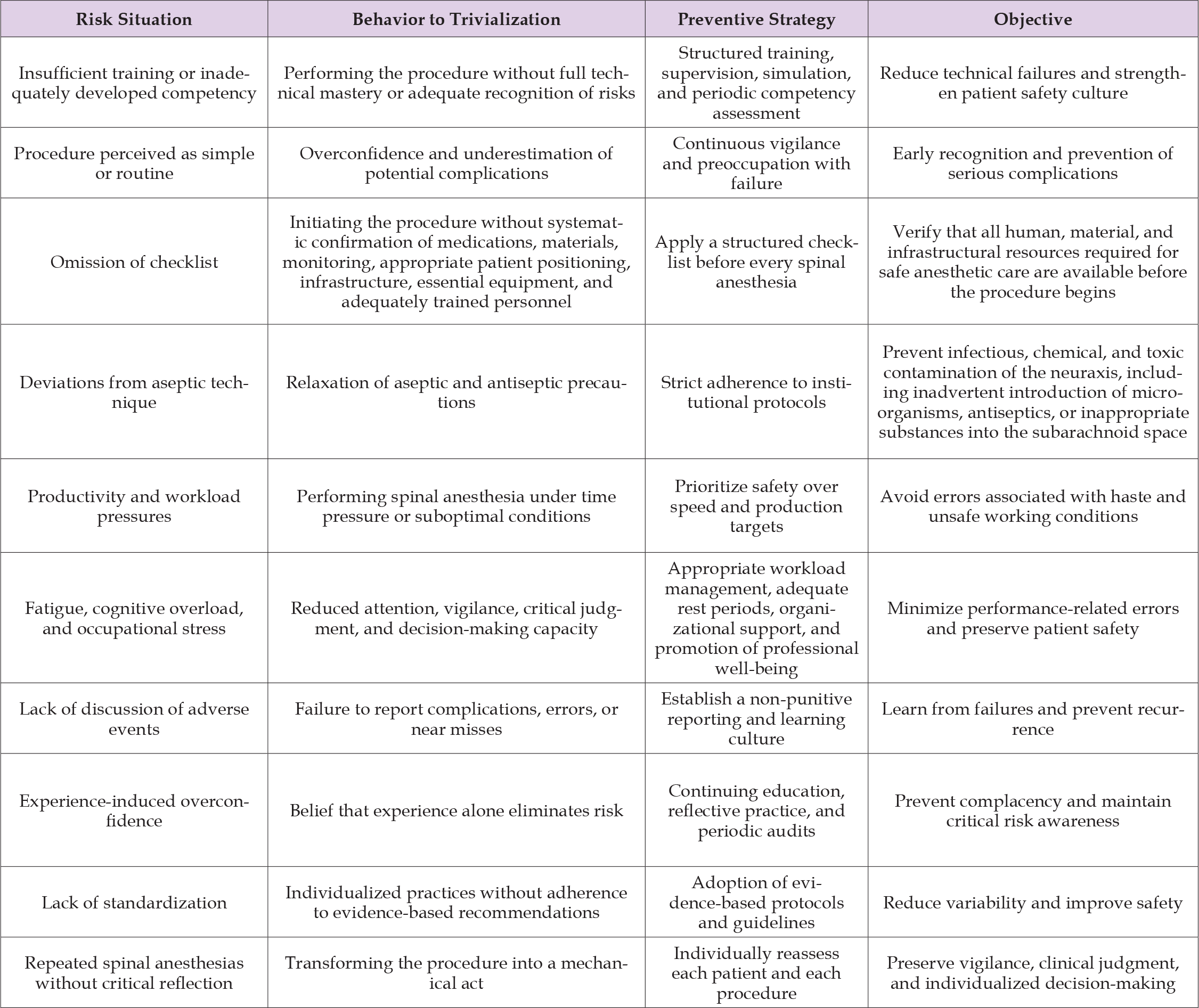
Several human factors, such as training, human resources, patient positioning, prevention of chemical contamination of the neuroaxis, safety culture, complacency resulting from experience and occupational fatigue, and infrastructure, contribute to routine action during spinal anesthesia. An attempt was made to maintain a logical progression covering the main factors associated with risk trivialization and to avoid redundancies, with the aim of achieving easy readability, scientific depth with modern safety concepts, and practical applicability with concrete actions shown in the text. If adverse events are underreported and never discussed with OR staff members, especially during spinal anesthesia, inadequate safety practices may never be identified or corrected. Finally, the pillars developed in the text were discussed and included in a table as follows: human factors, normalization of deviance, safety culture, situational awareness, competency- based practice, high reliability organizations, Swiss cheese model, vigilance, and critical thinking (Table 1).
Table 1: Strategies to prevent risk trivialization and normalization of deviance during spinal anesthesia with aid of AI.
Spinal anesthesia is one of the safest and most reliable techniques in modern anesthetic practice when performed according to established principles of training, patient assessment, monitoring, and safety. However, its excellent safety record should not lead to complacency. As in other high-reliability domains such as aviation and aerospace operations, safety depends not on the absence of risk, but on the continuous recognition and management of risk. The frequent and successful performance of spinal anesthesia may gradually reduce the subjective perception of risk, creating conditions that favor risk trivialization and the normalization of deviance. Although experience is essential, it does not eliminate the inherent uncertainties associated with patient variability, technical challenges, and unforeseen clinical events. Preventing complications requires more than technical proficiency. It depends on continuous vigilance, critical thinking, adherence to safety barriers, effective communication, and respect for established protocols.
Checklists, monitoring systems, and institutional safeguards are essential tools, but they support rather than replace the judgment and presence of the anesthesiologist. Finally, a phrase quoted at the end of the article as just as medicine understands more about disease than health, so the safety sciences know more about what causes adverse events than about how they can best be avoided [7]. Spinal anesthesia is a highly safe procedure when performed according to safety principles, training, and continuous monitoring. However, precisely because of its high success rate, there is a risk that some professionals may come to view it as a “simple” or “automatically safe” procedure. In this situation, a phenomenon like that described by Arendt can occur. In conclusion, discussion about the normalization of deviation needs to be part of spinal anesthesia, and research is necessary to uncover its hidden nature. As anesthesiologists, we need to be constantly aware of the enormous responsibility we must keep our patients safe and without complications while performing a routine procedure, one of the most frequently performed worldwide. We know that everyone demands increased productivity and efficiency, but we should never compromise patient safety. Furthermore, adverse events should not diminish our attention to risks.

International Association of Landscape Archaeology, Czech Glass Society, Czech Republic

Department of Chemistry, Semenov Institute of Chemical Physics, USSR Academy of Sciences, Moscow, Russia

Department of Educational Sciences, Research Centre Qualities of Teachers, School of Education – HAN, Nijmegen, Netherlands

Associate Professor at Department of Breast and Thyorid Surgey, Chongqing General Hospital, China

Neurology, LA BioMed Research Institute, USA





 Abstract
 PDF
PDF



























