info@biomedres.us
+1 (502) 904-2126
One Westbrook Corporate Center, Suite 300, Westchester, IL 60154, USA
Site Map
 ISSN: 2574 -1241
ISSN: 2574 -1241
ISSN: 2574 -1241
Received: May 22, 2026; Published: June 02, 2026
*Corresponding author: George B Stefano, Mind-Cell LLC, Baltimore, Distinguished Teaching Professor Emeritus, Distinguished Academy, State University of New York, USA
DOI: 10.26717/BJSTR.2026.65.010252
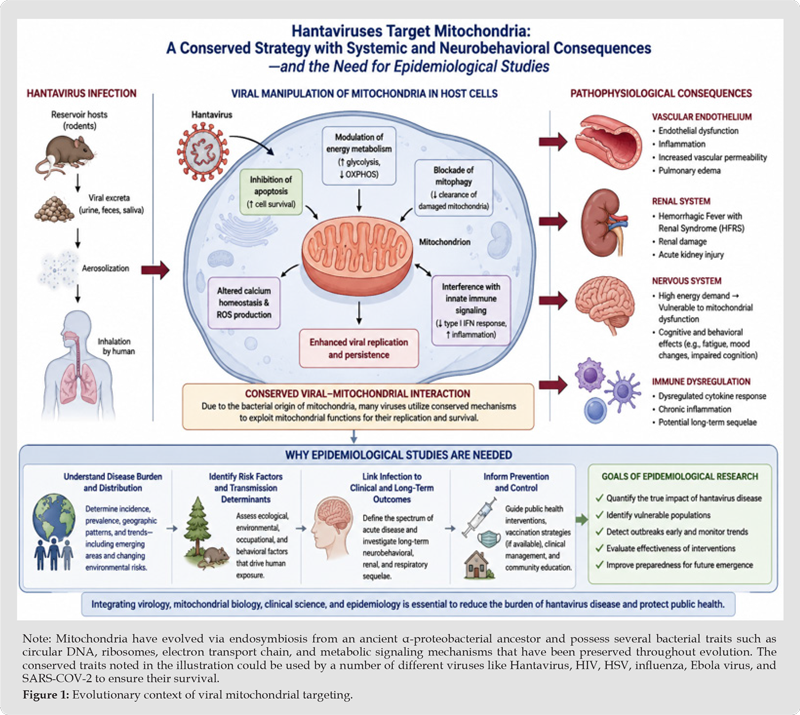
Another type of viruses that interfere with mitochondrial structure and energetics are hantaviruses. Similarly, to many pathogens, hantaviruses are known to interact with mitochondria to modulate energy homeostasis and metabolism, inhibit cell death through apoptosis, manipulate oxidative phosphorylation, inhibit mitophagy, and interfere with inflammation signaling pathways. In general, virus-mitochondria interaction is one of the mechanisms of evolutionarily conserved interaction of pathogens with mitochondria owing to their bacterial origin and preservation of bacterial characteristics. As mitochondria originated through endosymbiosis of ancestral bacteria, they have preserved certain biochemical and structural characteristics that could be used by viruses for their replication and spread. Modification of mitochondrial activity in infected cells leads to increased likelihood of virus replication. In particular, changes in mitochondria allow maintaining viability and adenosine triphosphate generation in host cells. However, the aforementioned alterations lead to a number of pathological manifestations including dysfunction of vascular endothelium, inflammation, enhanced vascular permeability, pulmonary edema, and damage to kidneys. The nervous system is very vulnerable to disturbances in mitochondrial function because of high metabolic requirements of neurons. In this context, virus-mitochondria interaction can influence not only the development of specific organ dysfunction but also the mental activity and behavior. In general, available evidence indicates that mitochondria are the central regulators coordinating processes involved in immunity, metabolism, inflammation, neurophysiology, and evolution. Study of evolutionarily conserved virus-mitochondria interaction can contribute to a better understanding of hantavirus pathology and molecular mechanisms of its impact on brain physiology.
Keywords: Entropy; Hantavirus; Mitochondria; Cognition; Virus; Matter; Pathogen; Ebola
Abbreviations: AKT: Protein Kinase B; ANDV: Andes Virus; ATP: Adenosine Triphosphate; BCL-2: B-Cell Lymphoma 2; COVID-19: Coronavirus Disease 2019; dsRNA: Double-Stranded Ribonucleic Acid; HFRS: Hemorrhagic Fever with Renal Syndrome; HIV: Human Immunodeficiency Virus; HPS: Hantavirus Pulmonary Syndrome; HSV: Herpes Simplex Virus; HTNV: Hantaan Virus; MAVS: Mitochondrial Antiviral Signaling Protein; mtDNA: Mitochondrial Deoxyribonucleic Acid; OXPHOS: Oxidative Phosphorylation; PNPT1: Polyribonucleotide Nucleotidyltransferase 1; ROSA: Reactive Oxygen Species; SARS-CoV-2: Severe Acute Respiratory Syndrome Coronavirus 2
Viruses evolved complex mechanisms of interactions with the cellular systems of hosts providing efficient reproduction, persistence, and dissemination. One of the cellular systems that viruses often target is mitochondria, organelles that originate from bacteria and are critical for energy homeostasis and metabolism in eukaryotic cells. Accumulating evidence demonstrates that many viruses including human immunodeficiency virus (HIV), herpes simplex virus (HSV), influenza viruses, Ebola virus, severe acute respiratory syndrome coronavirus 2 (SARS-CoV-2), and hantaviruses can manipulate mitochondrial dynamics, OXPHOS, apoptosis, mitophagy, and innate immune signaling (Figure 1) [1,2].
The above observations emphasize the principle of virus-mediated regulation of mitochondria as a conserved pathway connected with the bacterial origin of mitochondria. Having evolved as a result of the process of endosymbiosis of mitochondria from α-proteobacteria, mitochondria have conserved some features characteristic of bacteria, such as circular DNA, membranes involved in electron transport chains, bacteria-specific ribosomes, and conserved metabolic signaling cascades [3,4]. Hence, viruses that developed ways of interacting with bacterial metabolism might use these pathways in respect of mitochondria.
However, mitochondria do not perform exclusively the function of providing energy to cells. They control several processes related to apoptosis, ROS generation, Ca++ concentration, inflammation, and antiviral immunity. Thus, viruses’ manipulation of mitochondria can be considered essential for their pathogenicity, resulting in numerous serious conditions both on a cellular level and systemically. Neural tissue, being highly metabolic yet hardly able to regenerate, is especially vulnerable to viral manipulation. Therefore, apart from causing acute infection, mitochondrial dysfunction caused by viruses might lead to neurobehavioral effects, including impaired cognitive function, development of fatigue syndrome, problems with regulation of mood and behavior (Figure 1) [2,5]. In this regard, hantaviruses provide another example of viruses interacting with mitochondrial functions, resulting in harm to mammalian organisms.
Figure 1
Hantaviruses are enveloped negative-sense RNA viruses belonging to Hantaviridae family. The infection caused by these viruses results from inhaling contaminated air through exposure to the excretions of animals carrying hantaviruses. These viruses may lead either to Hemorrhagic Fever with Renal Syndrome (HFRS), caused by Eurasian hantaviruses, e.g., Hantaan virus (HTNV), or Hantavirus Pulmonary Syndrome (HPS) – caused by American hantaviruses such as Andes virus (ANDV) [6].
It should be noted that hantaviruses are different from viruses which establish chronic or latent infections, such as HIV or HSV. Still, it seems that the ways in which hantaviruses interact with mitochondria are rather similar to those characteristics of other viral families. To ensure its existence, a virus requires a viable host cell to be available until all viral particles replicate. This explains the use of many viruses of the same mechanisms to control mitochondria, preventing apoptosis, interfering with membrane permeability and functionality of respiratory chain, preventing cytochrome c release, influencing Mycosporine-like Amino Acids protein activity, and regulating cellular metabolism, which enables RNA replication [7,8].
Although hantaviruses do not produce any persistent infections and are known to cause acute syndromes (e.g., endothelial dysfunction, pulmonary edema, renal damage, and hyperinflammation), their interaction with mitochondria appears to be rather similar to the one of other viruses (Figure 1). Hantaviruses employ energy generating potential of mitochondria for replication purposes, interfere with the process of apoptosis, affect inflammation signaling, and prevent mitophagy [9,10].
Significant advances in understanding virus interactions with mitochondria have been achieved in the recent decades. In particular, earlier studies found that mitochondria targeted viruses primarily inhibited apoptotic processes, allowing the extended survival of infected cells. Recent investigations revealed the participation of mitochondria in many processes, among which mtDNA manipulation, ROS signaling, mitochondrial dynamics, calcium regulation, and autophagy [7].
Notably, mitochondria play not only an important role in the bioenergetic processes but also actively participate in the regulation of immune signaling against viral attacks. MAVS protein in mitochondria acts as the inducer of the interferon response, while dsRNA in mitochondria initiates signaling cascades associated with innate immunity [11]. Thus, mitochondria act not only as the bioenergetic centers of the cell but also as important modulators of the immune signaling system, providing additional support for the assumption that viral interactions with mitochondria are an evolutionary-conserved process related to the bacterial origin of mitochondria.
Recent findings further confirmed that mitochondrial targeting by viruses involves more processes than the use of energy. For instance, SARS-CoV-2 is able to infect neurons’ mitochondria; it can lead to neuropsychiatric symptoms due to disturbances in the energetic metabolism and immune signaling processes in mitochondria [5]. Other examples include mitochondrial-associated neurological disorders caused by HIV, HSV, Ebola virus, and COVID-19 complications [1,12].
Hantavirus-Associated Alteration of Mitochondria Functionality
New evidence shows that some viruses are capable of directly interfering with mitochondrial activity. Specifically, hantaviruses are known to regulate apoptosis by reprogramming the intrinsic pathway, where the viral infections are preventing membrane depolarization and cytochrome c release, ensuring the viability of the host cells [9]. The expression of pro-survival genes, such as BCL-2, ensures stability of mitochondrial membranes and prevents programmed cell death.
At the same time, hantaviruses actively target mitochondrial bioenergetic processes. It was reported that Hantaan virus stimulates OXPHOS and ATP synthesis via AKT-dependent mechanisms, during which AKT translocates to mitochondria and interacts with PNPT1, increasing mitochondrial respiration rates [10]. Also, inhibition of mitophagy caused by hantaviruses leads to the accumulation of dysfunctional mitochondria, producing higher amounts of ROS and inflammatory signaling mediators [13].
It should be noted that pathogen-mediated interference with the normal functioning of mitochondria has a high biological basis since mitochondria evolved from bacteria and act as bioenergetic centers of the cell. However, even though it allows for temporary increase in survival and replication of viruses, it cannot be considered beneficial for multicellular organisms, like humans, as it may cause pulmonary edema, renal failure, and strong inflammatory reactions in the body.
In addition, the viability of neurons is highly dependent on mitochondrial metabolism; therefore, damage of mitochondria can impact neurotransmission, synaptic physiology, calcium regulation, and neuroimmune interactions (Figure 1) [2]. Moreover, even in the absence of direct infection of neurons, systemic inflammation and disturbance of mitochondrial function can affect neurocognitive functions, fatigue levels, affective regulation, autonomic functions, and behavior [2].
The lack of an imminent hantavirus pandemic risk similar to that of respiratory viruses is related to the fact that these viruses are mostly zoonotic and their main form of infection transmission is contact with aerosolized excretions from rodents rather than effective human-to-human transmission [14]. Also, hantaviruses tend to have a relatively high case-fatality rate, which might historically hamper their extensive spread in populations because of the severe effects experienced by infected individuals (Figure 1) [15]. Nevertheless, further research is needed into the mechanisms used by these viruses to adapt and infect hosts.
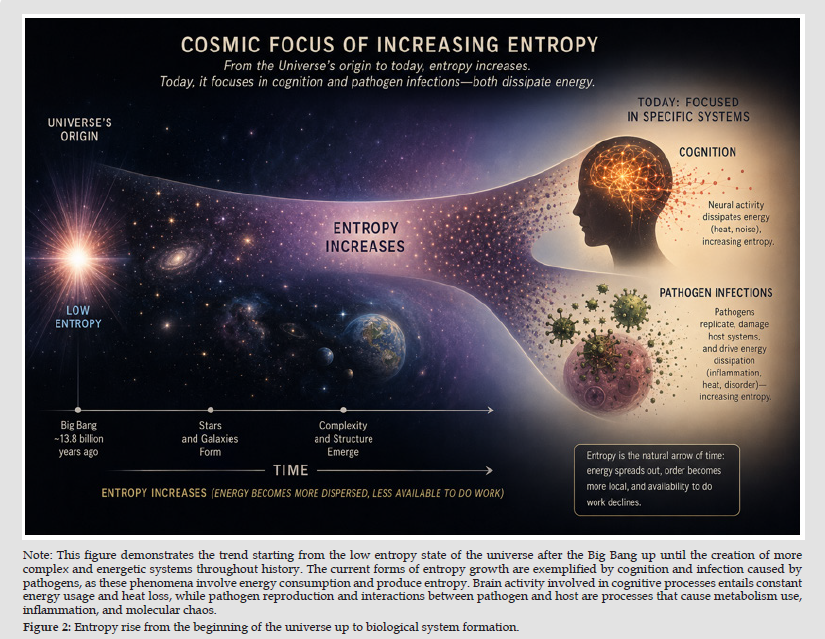
Thermodynamically and cosmologically, the sequence of events leading to cognition starting from the formation of the universe through the big bang (inflation) and the initial stage of rapid expansion followed by the creation of matter, biological structure, interaction and cognition can be seen as yet another step in increasing entropy and at the same time increasing levels of structural and information complexity of matter (Figure 2) [16,17,18]. Although entropy is conventionally considered as an indicator of increasing disorder of the system, modern non-equilibrium thermodynamics shows that energy flow through matter can create highly structured dissipative structures where increasing levels of complexity emerge while total entropy increases. From this perspective, the processes of virus infection, interactions between viruses and mitochondria, and cognition itself, as examples, can be regarded as a manifestation of further stages of evolution in which matter develops the ability of self-organization, communication, adaptation and, finally, self-awareness (Figure 2). In other words, cognitive abilities of matter to “become aware of its own existence” along with the highly sophisticated evolutionary process within pathogenic systems cannot be separated from the course of evolution in the universe because they represent a natural tendency towards higher energy dissipation, information exchange and biological complexity [16,17,18].
Figure 2
As a consequence, the study of hantaviruses demonstrates another good example of the use of mitochondrial functions for increasing replication capability, inhibition of apoptosis, alteration of energy production, and disruption of signaling pathways involved in immune response. Thus, all this information proves that the viruses have formed a conserved interaction with mitochondria due to their ancient bacterial origin. In general, it can be stated that through interaction with mitochondrial respiration, apoptosis, mitophagy, and other immune signaling pathways, viruses are capable of effectively controlling bioenergetic evolutionarily conserved mechanisms. Considering the significant involvement of mitochondria in brain energetics, mitochondrial abnormalities could lead to cognitive impairment despite not causing neuron death.
Not applicable.
This is meant to be a brief Opinion.
This research received no external funding.
The author declares no conflicts of interest.
During the preparation of this work, the author used ChatGPT 5.2 for organizational information, copyediting purposes as well as supervised figure generation. The author reviewed and edited the document and takes full responsibility for its content.

International Association of Landscape Archaeology, Czech Glass Society, Czech Republic

Department of Chemistry, Semenov Institute of Chemical Physics, USSR Academy of Sciences, Moscow, Russia

Neurology, LA BioMed Research Institute, USA

Associate Professor at Department of Breast and Thyorid Surgey, Chongqing General Hospital, China

Professor of Nuclear Medicine, Faculty of Medicine and Surgery, University of Milan, Milan, Italy





 Abstract
 PDF
PDF