info@biomedres.us
+1 (502) 904-2126
One Westbrook Corporate Center, Suite 300, Westchester, IL 60154, USA
Site Map
 ISSN: 2574 -1241
ISSN: 2574 -1241
ISSN: 2574 -1241
Received: May 14, 2026; Published: May 29, 2026
*Corresponding author: Urmanova Yu M, Doctor of Medical Sciences, Professor, Professor of the Department of Internal Medicine at Alfraganus University, Uzbekistan
DOI: 10.26717/BJSTR.2026.65.010248
The Aim of the Study: To study the characteristics of central hemodynamic parameters in patients with chronic
heart failure in type 2 diabetes mellitus during treatment with iSGLT2 inhibitors. Research materials and methods.
The study was based on a survey of 50 patients selected from among those treated at the Republican Scientific
and Practical Medical Center of Endocrinology, Ministry of Health of the Republic of Uzbekistan.
Research Results: Three months after treatment with Jardines 10 mg per day, significant changes in central
hemodynamic parameters were detected in the study groups of patients.
Conclusions: Drug of the groupSGLT2 inhibitors Jardines had an effective effect on the left ventricular ejection
fraction in both patients with type 2 diabetes mellitus and CHF and in patients with CHF without type 2 diabetes
mellitus.
Keywords: Diabetes Mellitus Type 2; Ejection Fraction; CHF; Treatment
Abbreviations: CVD: Cardiovascular Disease; DM: Diabetes Mellitus; ESC: European Society Cardiology; EF: Ejection Fraction; AHA: American Heart Association; ACC: American College of Cardiology; HFSA: Heart Failure Society of America; TC: Total Cholesterol, TG: Triglycerides; LVEF: Left Ventricular Ejection Fraction; Map: Mean Arterial Pressure
Type 2 diabetes mellitus (DM 2) is an independent risk factor that increases the risk of cardiovascular disease (CVD) by 2-4 times. Cardiovascular complications (CVD) are the leading cause of death among patients with diabetes (60-75% of cases). This review highlights the main types of complications and the results of studies that are changing approaches to treatment [1]. Type 2 diabetes affects more than 500 million people, and their risk of developing cardiovascular disease is 2–4 times higher than in individuals without diabetes. Cardiovascular complications are often diagnosed at the time of type 2 diabetes diagnosis or even before it [2]. Since the publication of the 2021 European Society of Cardiology (ESC) guidelines and the 2022 American Heart Association/American College of Cardiology/Heart Failure Society of America (AHA/ACC/HFSA) guidelines, an unprecedented body of evidence has accumulated, significantly expanding the therapeutic landscape across the ejection fraction (EF) spectrum. Key advances include the advent of non-steroidal mineralocorticoid receptor antagonists and incretin therapy for heart failure (HF) with moderately reduced and preserved EF, confirmation of the efficacy of rapid guideline-based drug therapy optimization strategies in acute HF, and new data supporting the efficacy of digitalis glycosides in patients with HF with reduced EF. Advances in implantable device- based treatments include transcatheter valve repair. These findings are likely to transform current clinical practice [1]. The presence of both HF and DM 2 significantly increases the risk of cardiovascular events such as myocardial infarction, stroke, and cardiovascular mortality. [2] The combination of these conditions results in a higher cardiovascular burden and worse outcomes than either condition alone [3]. Studies (such as DAPA-HF and EMPEROR-Reduced) have shown that reverse cardiac remodeling occurs with the use of iSGLT2 inhibitors. This means that the heart chambers may decrease slightly in size, and the LVEF may increase (on average by 2–5% depending on the baseline condition) [4]. In recent years, several successful treatments for heart failure have been developed. Among them areSGLT2 inhibitors (SGLT2i), including dapagliflozin and empagliflozin, have demonstrated the ability to reduce the risk of cardiovascular death and hospitalization in patients with HF. [5,6]. First, SGLT2i have proven effective in patients with HF and reduced ejection fraction [7,8]. In 2021, the results of the SOLOIST-WHF study showed benefit ssotagliflozin, doubleSGLT2 and SGLT1 inhibitor, in reducing cardiovascular mortality, hospitalizations, and emergency department visits for HF in patients with diabetes and recent worsening HF, regardless of ejection fraction. [9] Then, the EMPEROR-Preserved and DELIVER trials showed a benefit of SGLT2 inhibitors in patients with heart failure with intermediate and preserved ejection fraction, regardless of the presence of type 2 diabetes mellitus [10,11].
Furthermore, the DELIVER trial showed benefit for patients hospitalized or recently hospitalized with heart failure, as well as for patients with heart failure with improved ejection fraction left ventricle [12]. The aim of the study is to study the characteristics of central hemodynamic parameters in patients with chronic heart failure in type 2 diabetes mellitus during treatment with iSGLT2 inhibitors. Research materials and methods. The study was based on a survey of 50 patients selected from among those treated at the Republican Scientific and Practical Medical Center of Endocrinology, Ministry of Health of the Republic of Uzbekistan. The criteria for inclusion of patients in the study were the presence of type 2 diabetes, arterial hypertension of stage I, II, III, CHF I-III FC according to NYHA, LVEF from 40 to 49%. Exclusion criteria: age over 65 years, insulin therapy, heart rhythm disturbances, liver and kidney failure, cancer, LVEF more than 50% or less than 40%. The selected patients were divided into 2 groups, which underwentclinical and hormonal studies. Group 1 included 25 patients with DM 2 in association with CHF; Group 2 included 25 patients with CHF without DM 2.
All patients underwent general clinical, biochemical, hormonal, and functional studies. All patients in Groups 1 and 2 were prescribed Jardiance 10 mg daily for 3 months, in combination with other hypoglycemic agents in Group 1. The diagnosis of CHF and treatment were carried out on the basis of the Clinical Guidelines for CHF, Russia, 2016 [13]. In these recommendations, we used the classification of CHF, according to which CHF is distinguishedby LV ejection fraction, CHF by stages, by functional class. A comprehensive examination of the patient was carried out simultaneously; with the patient’s consent, a questionnaire was filled out using the anamnestic method, anthropometric measurements were taken, and functional examination methods were carried out; blood was also taken for laboratory tests. Biochemical tests included determination of uric acid, ALT, AST, bilirubin, total cholesterol (TC), triglycerides (TG), low-density lipoprotein cholesterol (LDL-C), and high-density lipoprotein cholesterol (HDL-C) using the Mindray automated analyzer. A glycated hemoglobin level (hemoglobin A1c, HbA1c) >6.5% (48 mmol/mol), blood glucose concentration, impaired glucose tolerance, and impaired fasting glucose are used as diagnostic criteria for type 2 diabetes. A 24-hour ambulatory blood pressure monitoring (ABPM-04, Meditech, Hungary) was performed, and the mean values of 24-hour systolic and diastolic blood pressure (SBP, DBP), pulse pressure (PP), and mean arterial pressure (MAP) were determined. The study was conducted on a Siemens ACUSON SC-2000 apparatus with color Doppler in pulsed 3D B+M mode. All M-mode measurements were performed in accordance with the recommendations of the American Society of Echocardiography.
HF is usually classified based on left ventricular ejection fraction (LVEF) into categories of HF with preserved (HFpEF, LVEF ≥ 50%), intermediate (HFpEF) from 40 to 49%, and low EF (HFrEF, LVEF < 40%) [14]. In all our patients, LVEF was on average intermediate, ranging from 40 to 49%. The obtained data were processed using Microsoft Excel and STATISTICA_6 software. The arithmetic mean (M), standard deviation of the arithmetic mean, and error of the arithmetic mean from all n replicates (m) were calculated. The significance of differences in levels between groups was assessed using the confidence interval and Student’s t-test (p). Differences were considered statistically significant at p < 0.05. Research results. Next, we studied the clinical and anamnestic characteristics of patients by groups (Table 1). As can be seen from (Table 1), he significance of differences in SBP, DBP, and BMI in the studied patients compared to the control group was established (p<0.05). It should be noted that of the 25 patients with type 2 diabetes, 12 (48%) had a family history of type 2 diabetes, while among the 50 examined patients, only 18 (36%) had a family history of CVD. 19 (38%) of the 50 patients had grade 1-2 obesity. Table 2 shows the results of echo-ECG of patients in group 1 before and 3 months after drug treatment.
Table 1: Clinical and anamnestic characteristics of patients included in the study (absolute numbers).
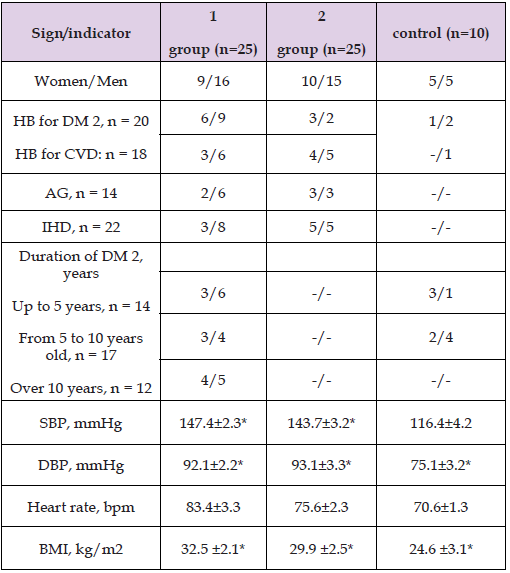
Note: AG - arterial hypertension, DBP – diastolic blood pressure, SBP – systolic blood pressure, - * – reliability criterion, where p < 0.05, CVD – cardiovascular diseases, HB – hereditary burden, AG – arterial hypertension; IHD- ischemic heart disease.
Table 2: Results of echo-ECG of patients in group 1 before and after treatment.
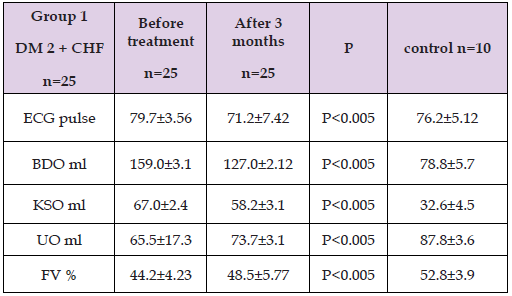
Note: p – criterion for the reliability of differences between indicators before and after ERCS, * p – criterion for the reliability of differences between the indicators before treatment and the control data, where * is p < 0.005, EDV (end diastolic volume) and ESV (end systolic volume).
Table 3: Results of Echo-ECG of patients in group 2 before and after 3 months of treatment.
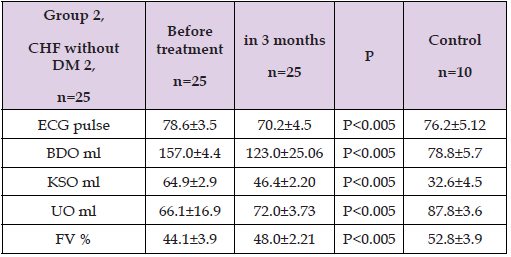
Note: p – criterion for the reliability of differences between indicators before
and after ERCS,
* p – criterion for the reliability of differences between the indicators before
treatment and the control data, where * is p < 0.005, EDV (end diastolic
volume) and ESV (end systolic volume).
As can be seen from (Table 2), in dynamics after 3 months, reliable changes in the ECG, EDV, ESV, EF, and SV parameters were observed in Group 1. Table 3 shows Echo-ECG results of patients in group 2 before and 3 months after Jardines therapy. As can be seen from Table 3, in dynamics after 3 months, reliable changes were observed in the ECG, EDV, ESV, EF, and SV parameters in the 2nd group of patients. Thus, 3 months after treatment with Jardines 10 mg per day, reliable changes in central hemodynamic parameters were identified in the study groups of patients. Left ventricular systolic dysfunction is characterized by decreased contractility of the heart muscle and a reduced volume of blood ejected into the aorta. Approximately 45% of individuals with CHF experience this type of dysfunction in the remaining cases, myocardial contractility is not impaired). Among our patients, left ventricular systolic dysfunction was observed in 50% of cases. The main criterion is decreased ejection fraction LV according to the results of cardiac ultrasound is less than 45%.
Drug of the groupSGLT2 inhibitors Jardines had an effective effect on the left ventricular ejection fraction in both patients with type 2 diabetes mellitus and CHF and in patients with CHF without type 2 diabetes mellitus.

International Association of Landscape Archaeology, Czech Glass Society, Czech Republic

Department of Chemistry, Semenov Institute of Chemical Physics, USSR Academy of Sciences, Moscow, Russia

Neurology, LA BioMed Research Institute, USA

Associate Professor at Department of Breast and Thyorid Surgey, Chongqing General Hospital, China

Professor of Nuclear Medicine, Faculty of Medicine and Surgery, University of Milan, Milan, Italy





 Abstract
 PDF
PDF



























