info@biomedres.us
+1 (502) 904-2126
One Westbrook Corporate Center, Suite 300, Westchester, IL 60154, USA
Site Map
 ISSN: 2574 -1241
ISSN: 2574 -1241
ISSN: 2574 -1241
Received: May 15, 2026; Published: May 25, 2026
*Corresponding author: Antonione Santos Bezerra Pinto, Afya Faculdade de Ciências Médicas Parnaíba, Piauí, Brazil
DOI: 10.26717/BJSTR.2026.65.010243
Breast cancer remains one of the major global public health challenges and is among the leading causes of mortality
among women. Early detection is essential to improve prognosis and reduce mortality, and mammography
is considered the gold standard method for population screening. However, this examination presents
limitations related to variability in image interpretation, the influence of breast density, and the occurrence of
false-positive and false-negative results. In this context, artificial intelligence (AI) has emerged as a promising
technology by enabling greater diagnostic accuracy, standardization of analyses, and identification of subtle patterns
in mammographic images.
This study aimed to analyze the application of artificial intelligence in the early detection of breast cancer through
mammography, evaluating the performance of machine learning and deep learning algorithms compared with
interpretation performed by radiologists. A systematic literature review was conducted following the Preferred
Reporting Items for Systematic Reviews and Meta-Analyses (PRISMA) guidelines. Searches were carried out in
the PubMed, IEEE Xplore Digital Library, and SciELO databases between July and December 2025, considering
articles published from 2018 to 2025 in Portuguese, English, and Spanish. Initially, 148 studies were identified;
after duplicate removal and application of eligibility criteria, ten articles were selected for final analysis.
The results demonstrated that AI-based systems showed superior or complementary diagnostic performance
compared with conventional interpretation methods, with increased sensitivity, reduction of false positives, and
improved identification of subtle radiological patterns. Furthermore, AI contributed to workflow optimization
and reduction of interobserver variability among radiologists. Despite these advances, limitations related to
external validation, methodological heterogeneity, and algorithmic bias were identified. Artificial intelligence
represents a promising strategy to strengthen mammographic screening and support clinical decision-making
in breast cancer diagnosis.
Keywords: Artificial Intelligence; Mammography; Breast Cancer; Early Diagnosis; Deep Learning
Abbreviations: AI: Artificial Intelligence; PRISMA: Preferred Reporting Items for Systematic Reviews and Meta- Analyses; CNN: Convolutional Neural Networks; BI-RADS: Breast Imaging Reporting and Data System; FDA: Food and Drug Administration
Breast cancer remains one of the major public health problems worldwide and represents the most prevalent malignancy among women as well as one of the leading causes of female mortality. According to the World Health Organization, approximately 2.3 million new cases and nearly 670,000 deaths were reported globally in 2022 [1]. In Brazil, data from the National Cancer Institute estimate approximately 73,000 new cases annually during the 2023–2025 triennium [2]. This epidemiological scenario reinforces the importance of effective screening strategies and early diagnosis. Early detection is recognized as one of the most important factors associated with reduced mortality, since diagnoses performed in initial stages allow more effective therapeutic interventions and better clinical outcomes [3]. Mammography has therefore become the gold standard imaging method for population screening programs. However, despite its clinical relevance, mammography still presents limitations associated with variability in image interpretation, difficulties in evaluating dense breasts, and the occurrence of false-positive and false-negative results. With recent technological advances, artificial intelligence (AI) has emerged as an innovative tool capable of supporting medical image interpretation and improving diagnostic accuracy. Machine learning algorithms and deep neural networks have demonstrated significant performance in recognizing subtle mammographic patterns, often imperceptible to the human eye [4]. These systems allow the analysis of large datasets, contributing to standardization of image interpretation and reduction in reading time.
AI-based systems can achieve sensitivity and specificity levels comparable or complementary to those obtained by experienced radiologists, especially in settings with high imaging demand or shortage of qualified professionals [5]. Nevertheless, despite technological progress, clinical implementation still faces important challenges, including ethical concerns, algorithmic bias, database variability, and regulatory limitations related to incorporation into routine medical practice. In addition to technological aspects, social, economic, and organizational impacts should also be considered. Integration of AI into mammography requires investments in digital infrastructure, professional training, and adaptation of healthcare workflows. At the same time, these technologies may expand diagnostic access, optimize healthcare resources, and reduce unnecessary complementary examinations [6]. Given this scenario of technological advances and emerging challenges, it is essential to systematically understand how artificial intelligence has been applied to mammography and its impact on early breast cancer detection. Therefore, this study aimed to analyze the application of artificial intelligence in early breast cancer diagnosis through mammography, emphasizing machine learning algorithms in pattern recognition and evaluating diagnostic outcomes such as sensitivity, specificity, reduction of false positives, and diagnostic time compared with traditional radiological interpretation.
Fundamental Concepts of Artificial Intelligence in Medicine
Artificial intelligence is a field of computer science focused on developing systems capable of performing tasks that normally require human intelligence, including pattern recognition, decision-making, learning, and adaptation [7]. In medicine, AI has been widely applied to improve diagnostic accuracy, optimize clinical processes, automate data analysis, and support therapeutic decision-making. Machine learning, an important AI subfield, involves training algorithms to identify patterns in large volumes of data, including images, text, and physiological signals [5]. Supervised learning algorithms are trained using labeled datasets, enabling predictions and classifications based on new inputs. In clinical practice, AI has been implemented in several medical specialties, particularly in radiology and diagnostic imaging [8]. AI systems support healthcare professionals by increasing speed, precision, and efficiency rather than replacing human expertise. Among the most frequently applied methods in mammography, supervised learning stands out because algorithms are trained using labeled mammographic images associated with known clinical outcomes. This allows identification of microcalcifications, nodules, and suspicious lesions with improved sensitivity and specificity [6]. Deep learning models, especially convolutional neural networks (CNNs), have shown remarkable performance in automatic image analysis and lesion classification. Despite the promising advances, AI integration into healthcare still faces challenges involving ethical concerns, data privacy, reliability of automated systems, and strict regulatory requirements [6]. Nonetheless, AI continues to demonstrate strong potential to transform modern medicine by facilitating early disease detection and improving healthcare quality.
Breast Cancer
Importance of Early Detection and Traditional Diagnostic Methods: Breast cancer remains one of the leading causes of cancer- related death among women worldwide and has a significant impact on healthcare systems [9]. Early detection is fundamental because it increases the chances of successful treatment and survival. Mammography is the primary screening tool for breast cancer and allows detection of tissue abnormalities such as nodules and microcalcifications before clinical symptoms appear [10]. However, mammography has limitations, particularly in women with dense breast tissue and in cases involving small lesions. Ultrasound is frequently used as a complementary examination to mammography, while biopsy remains the definitive diagnostic method for histopathological confirmation [9]. Additionally, the Breast Imaging Reporting and Data System (BI-RADS) standardizes mammographic interpretation and guides clinical management. Artificial intelligence can complement BI-RADS interpretation by reducing unnecessary additional examinations, improving lesion characterization, and minimizing interobserver variability [11]. AI-based systems provide more standardized and consistent evaluations, potentially increasing diagnostic reliability and improving early detection. Despite their importance, traditional diagnostic methods still present limitations related to false-positive and false-negative results, which may lead to unnecessary procedures or delayed diagnosis [10]. Consequently, the search for more accurate and efficient diagnostic methods remains a priority in medical research.
Integration of Artificial Intelligence in Breast Cancer Diagnosis
The integration of artificial intelligence into breast cancer diagnosis has become one of the most promising advances in radiology [12]. AI algorithms improve lesion detection in mammography and provide faster and more accurate image interpretation. Deep learning techniques, especially convolutional neural networks, have demonstrated substantial capability in identifying and classifying mammographic abnormalities automatically [13]. These models detect subtle radiological variations, including microcalcifications and architectural distortions, that may not be readily identified by radiologists. CNNs operate through convolution, pooling, and activation functions, enabling extraction of hierarchical image features [14]. Early layers identify basic structures such as edges and textures, whereas deeper layers recognize more complex patterns associated with malignancy. AI systems also contribute to workflow optimization by reducing radiologists’ workload and prioritizing suspicious examinations [15]. Nevertheless, successful implementation depends on access to large high-quality datasets, robust validation, and regulatory approval.
Ethical and Regulatory Aspects
The use of artificial intelligence in healthcare requires careful consideration of ethical and regulatory aspects. In Brazil, the National Health Surveillance Agency (ANVISA) evaluates AI-based medical devices regarding safety, effectiveness, and reliability. Similarly, the United States Food and Drug Administration (FDA) follows rigorous approval protocols for medical software utilizing machine learning technologies [16]. Patient privacy and data protection also represent critical concerns. The Brazilian General Data Protection Law (LGPD) establishes principles for processing sensitive health data, including consent, anonymization, and cybersecurity measures [17]. Another important issue involves algorithmic bias. AI models may reproduce inequalities present in training datasets, resulting in reduced diagnostic performance for certain ethnic or demographic populations [18]. Therefore, transparency, diverse validation datasets, and continuous auditing are essential to ensure fairness and equity in healthcare.
This study consisted of a systematic literature review on the application of artificial intelligence in mammography for early breast cancer diagnosis. The review followed the Preferred Reporting Items for Systematic Reviews and Meta-Analyses (PRISMA) guidelines to ensure methodological rigor and transparency. The search strategy was structured according to the PICO model. The target population included women undergoing mammography and mammographic image databases. The intervention involved the use of artificial intelligence algorithms, including machine learning and deep learning systems, applied to detection of suspicious lesions. Comparisons considered the diagnostic performance of AI systems versus radiologists’ interpretation, while evaluated outcomes included diagnostic accuracy, sensitivity, specificity, and early lesion detection. The search terms included “Breast Cancer” AND “Artificial Intelligence,” “Mammography” AND “Machine Learning,” and “Deep Learning” AND “Early Diagnosis.” Boolean operators AND and OR were applied to optimize sensitivity and specificity. Searches were conducted in PubMed, IEEE Xplore Digital Library, and SciELO databases between July and December 2025. The article selection process included title screening, abstract reading, and full-text analysis. Rayyan software was used to organize the review and reduce selection bias. Inclusion criteria comprised original clinical studies evaluating AI algorithms applied to mammography, including cohort studies, case-control studies, and clinical trials with at least 50 patients and objective diagnostic metrics. Studies without full-text availability, narrative reviews, duplicated articles, and in silico investigations without clinical validation were excluded. Methodological quality and risk of bias were assessed using the QUADAS-2 tool.
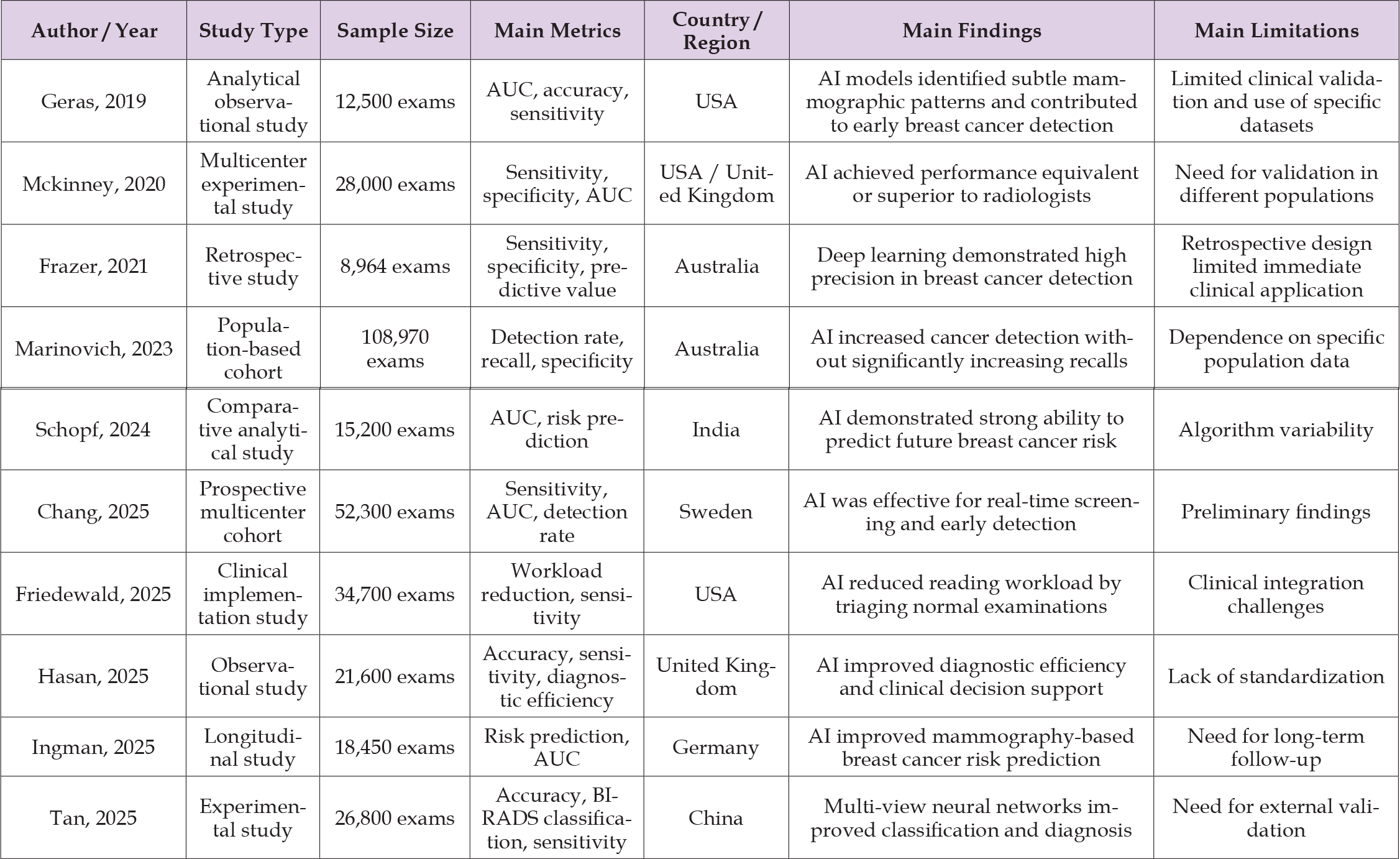
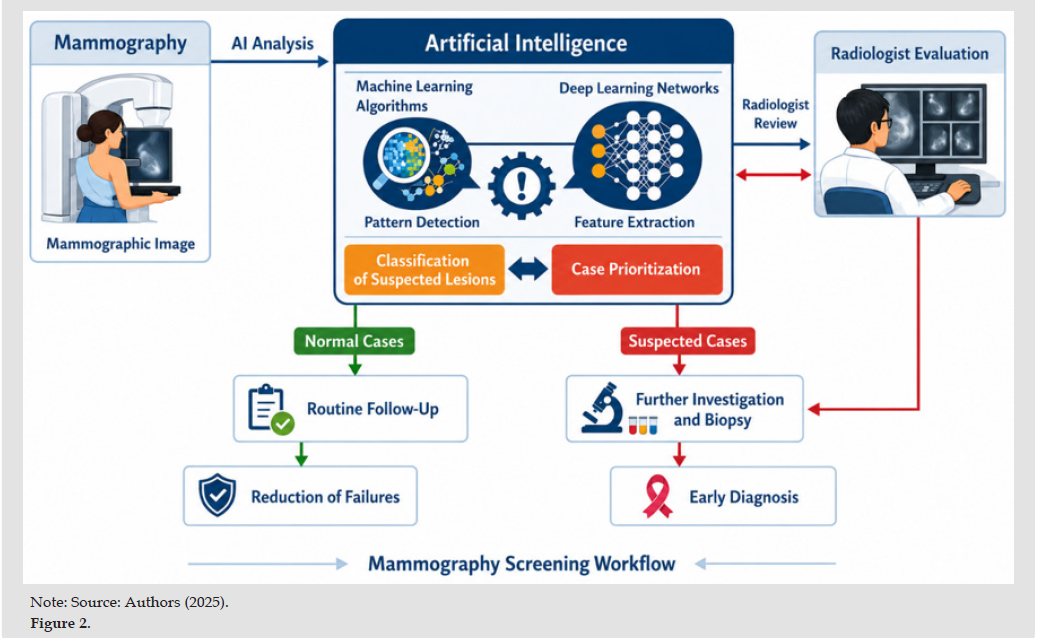
A total of 148 references were identified across the selected databases, including 95 articles from PubMed and 53 from SciELO. After duplicate removal and application of eligibility criteria, 10 studies were selected for the final systematic review (Figure 1). The selected studies are summarized in Table 1. The integration of artificial intelligence into diagnostic medicine has transformed breast cancer screening and mammographic interpretation. AI systems improve diagnostic precision, increase sensitivity, reduce false-negative results, and decrease interobserver variability among radiologists [19]. Deep learning algorithms demonstrated remarkable ability to identify subtle patterns, especially in dense breasts and early-stage lesions [20]. Several studies reported diagnostic performance comparable or superior to experienced radiologists, particularly in high-demand clinical environments. AI also contributed to workflow optimization by prioritizing suspicious examinations and reducing reading time [15]. In addition, the reduction of false-positive results minimized unnecessary biopsies and psychological distress among patients. Despite these advantages, important limitations remain. Many studies still lack external validation, and methodological heterogeneity limits direct comparison between findings [21]. Differences in datasets, imaging acquisition methods, and performance metrics remain significant challenges. Cost-effectiveness should also be considered. Although AI implementation requires investment in infrastructure and professional training, reduction of unnecessary procedures and improved workflow efficiency may generate long-term economic benefits [15- 20]. The patient perspective is equally relevant, since acceptance of AI influences trust and satisfaction with healthcare services. Transparency regarding the supportive role of AI and maintenance of human supervision remain essential for ethical and responsible implementation (Figure 2). Overall, the findings of this systematic review demonstrate that artificial intelligence constitutes a robust and efficient complementary tool for improving early breast cancer diagnosis through mammography.
Figure 1
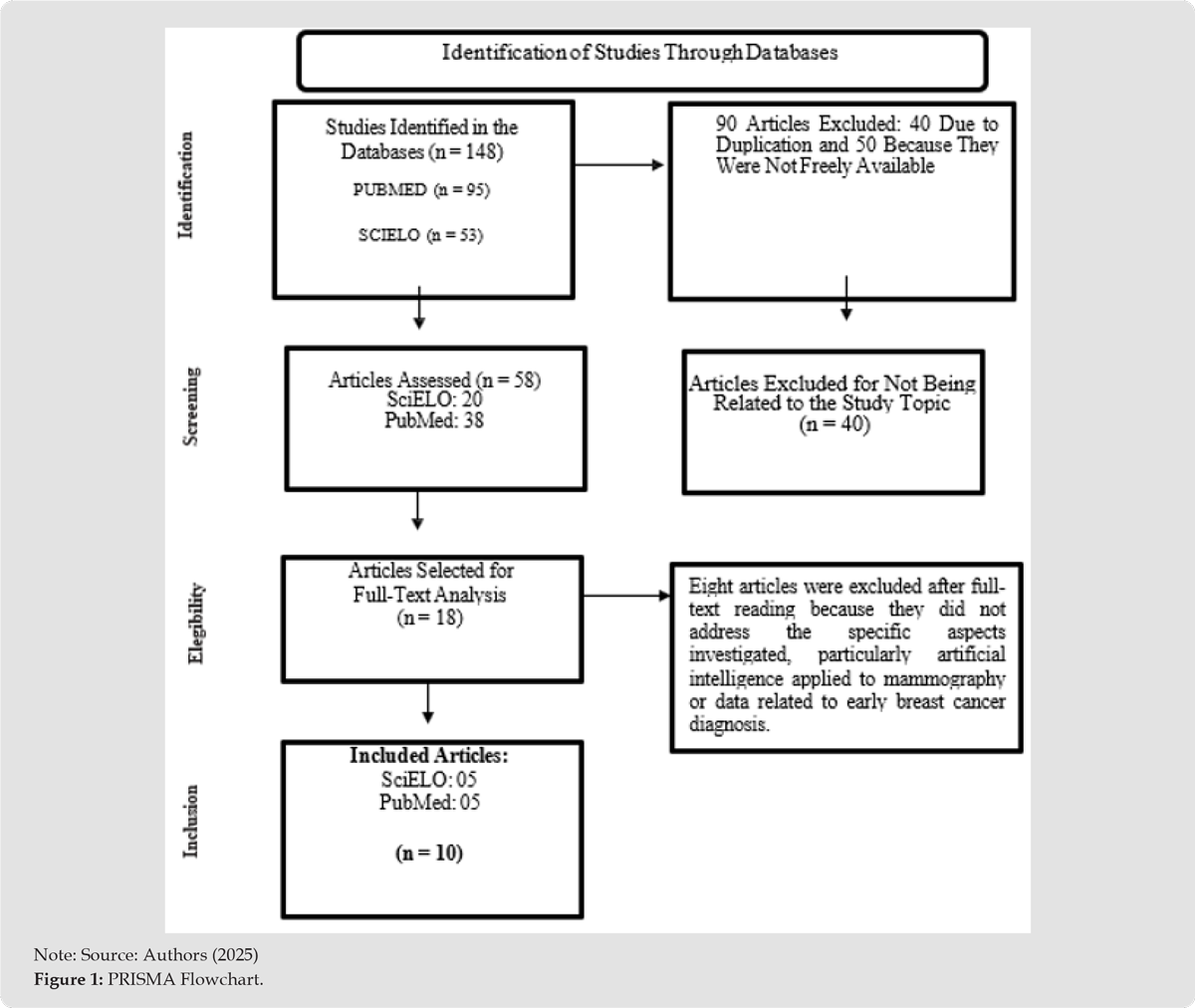
Table 1: Selected studies and main characteristics.
Note: Source: Authors (2025).
Figure 2
The integrated analysis of the selected studies demonstrated that artificial intelligence has become a strategic tool in breast cancer diagnosis by improving diagnostic precision, enhancing screening quality, and supporting prognostic assessment. Machine learning and deep learning algorithms showed increasing performance in early detection, risk stratification, and differentiation between benign and malignant lesions. Artificial intelligence reduces interpretative variability, supports healthcare professionals in high-demand settings, and optimizes clinical workflows. However, important challenges remain, including limited external validation, algorithmic bias, methodological heterogeneity, and the need for robust datasets. Future studies should prioritize external validation in diverse populations, development of standardized evaluation protocols, and investigation of long-term clinical outcomes associated with AI implementation. Despite current limitations, artificial intelligence represents a promising and innovative approach capable of strengthening mammographic screening and improving breast cancer diagnosis.
The authors declare no conflict of interest.
The authors would like to thank Afya Faculdade de Ciências Médicas for academic support during the development of this study. Overall, the findings of this systematic review demonstrate that artificial intelligence constitutes a robust and efficient complementary tool for improving early breast cancer diagnosis through mammography.

International Association of Landscape Archaeology, Czech Glass Society, Czech Republic

Department of Chemistry, Semenov Institute of Chemical Physics, USSR Academy of Sciences, Moscow, Russia

Neurology, LA BioMed Research Institute, USA

Associate Professor at Department of Breast and Thyorid Surgey, Chongqing General Hospital, China

Professor of Nuclear Medicine, Faculty of Medicine and Surgery, University of Milan, Milan, Italy





 Abstract
 PDF
PDF



























