info@biomedres.us
+1 (502) 904-2126
One Westbrook Corporate Center, Suite 300, Westchester, IL 60154, USA
Site Map
 ISSN: 2574 -1241
ISSN: 2574 -1241
ISSN: 2574 -1241
Received: April 15, 2026; Published: May 20, 2026
*Corresponding author: Tzenalis Anastasios, Nursing Dep. University of Patras Patra, Campus Koukouli 26334, Greece
DOI: 10.26717/BJSTR.2026.65.010235
Background: Evidence-based practice (EBP) plays a crucial role in improving the quality, safety, and effectiveness of healthcare services. Nursing protocols constitute structured clinical tools that support standardized patient care, reduce clinical variability, and promote evidence-based decision-making. Despite their recognized importance, the successful implementation of nursing protocols in clinical practice remains challenging due to organizational, educational, and professional barriers.
Aim: The aim of this study was to investigate the implementation process of nursing protocols in hospital settings and to explore expert consensus regarding effective strategies for their development and application in clinical practice.
Methods: A Delphi study design was employed to collect expert opinions and achieve consensus on best practices for the implementation of nursing protocols. A purposive sample of 100 healthcare professionals, including clinical nurses, clinical educators, ward managers, and nursing administrators, participated in two rounds of questionnaires. Data we analysed using descriptive statistics and correlation measures. Consensus levels were defined using predefined agreement thresholds.
Results: The findings demonstrated strong agreement among participants regarding the importance of structured and evidence-based nursing protocols in improving patient safety, reducing clinical errors, and enhancing interdisciplinary communication. Key facilitators of successful protocol implementation included leadership support, continuous professional education, clear organizational responsibilities, and the involvement of clinical staff in protocol development. The Delphi process resulted in a consensus-based framework consisting of 19 recommendations aimed at improving the implementation and sustainability of nursing protocols in hospital environments.
Conclusions: The study highlights the multifactorial nature of nursing protocol implementation and emphasizes the importance of organizational support, professional education, and participatory decision-making. The proposed framework may support healthcare organizations in strengthening evidence-based nursing practice and improving the quality and safety of patient care.
Keywords: Evidence-Based Practice; Nursing Protocols; Delphi Method; Nursing Management; Clinical Guidelines; Healthcare Quality
Evidence-based practice (EBP) has become a fundamental principle in modern healthcare systems, guiding clinical decision-making and improving the quality and safety of patient care. Within nursing practice, EBP integrates the best available research evidence with clinical expertise and patient preferences in order to support effective and individualized healthcare interventions [1]. The growing emphasis on evidence-based healthcare has significantly influenced the development of clinical guidelines and protocols designed to standardize care and reduce variability in clinical practice. Historically, the foundations of evidence-based nursing practice can be traced back to the work of Florence Nightingale, who used systematic observation and data analysis to improve patient care during the Crimean War. Her work demonstrated the importance of scientific evidence in clinical decision-making and laid the groundwork for modern nursing research and practice [2]. Today, nursing professionals represent one of the largest groups of healthcare providers globally, playing a crucial role in the implementation of evidence-based interventions and clinical protocols [3].
Clinical nursing protocols are structured sets of guidelines that describe standardized procedures for patient care in specific clinical situations. These protocols are developed based on scientific evidence, clinical expertise, and patient needs, aiming to enhance the quality, consistency, and safety of healthcare services [4]. Their implementation contributes to improved clinical outcomes, reduced medical errors, and more efficient coordination among healthcare professionals [5]. By providing clear instructions and standardized procedures, protocols support nurses in making informed clinical decisions and facilitate the delivery of consistent patient care across healthcare settings. Despite their recognized importance, the successful implementation of nursing protocols in clinical environments remains challenging. Several studies have identified barriers that may hinder their adoption, including resistance to change among healthcare professionals, insufficient training, organizational constraints, and limited administrative support [6,3]. These barriers can limit the integration of evidence-based guidelines into everyday clinical practice, thereby reducing the potential benefits of protocol-based care.
Continuous education and professional development are therefore essential components for the effective implementation of nursing protocols. Training programs, workshops, and digital learning platforms can enhance nurses’ understanding of evidence-based guidelines and improve their ability to apply these protocols in real clinical settings. Additionally, ongoing evaluation and feedback mechanisms allow healthcare organizations to monitor protocol implementation and adjust practices according to emerging scientific evidence and clinical needs [6]. In recent years, healthcare systems have increasingly recognized the importance of structured nursing protocols as tools for improving patient safety, healthcare quality, and organizational efficiency. These protocols not only support clinical decision-making but also contribute to the development of professional autonomy among nurses, strengthening their role within multidisciplinary healthcare teams. However, despite the documented advantages of protocol-based care, significant gaps remain regarding the practical implementation of nursing protocols within hospital environments. Differences between administrative planning and real-world clinical practice may create inconsistencies in protocol adoption and compliance. Therefore, the aim of the present study is to investigate the process of implementing nursing protocols in clinical practice, examining the relationship between nursing management, protocol design, and their practical application in hospital departments. In addition, the study seeks to evaluate the level of consensus among expert nurses regarding the effectiveness and applicability of these protocols. To achieve this objective, the Delphi method is used as a structured approach for collecting expert opinions and identifying best practices related to the implementation of nursing protocols in clinical settings.
The aim of the present study is twofold. First, it seeks to investigate the process of implementing nursing protocols in clinical practice, examining the transition from their initial development within nursing management to their practical application in hospital nursing departments. The study aims to identify the challenges, inconsistencies, and practical barriers that arise during the implementation process in real clinical environments. Second, the research aims to evaluate the level of consensus among expert nurses regarding the effective implementation of nursing protocols in clinical settings. The specific objectives of the study include the identification and analysis of the procedures used for the implementation of nursing protocols and their relationship with the quality of healthcare services provided. In addition, the study seeks to explore the challenges faced by clinical nurses and clinical educators during the application of these protocols in everyday clinical practice. Furthermore, the research aims to develop a practical framework or guide for the effective implementation of nursing protocols, which may support nursing management and clinical staff in achieving higher levels of compliance and acceptance in hospital settings.
To achieve these objectives, the Delphi method was employed in order to collect and synthesize expert opinions and to reach consensus regarding best practices for the implementation of nursing protocols. The Delphi method allows iterative feedback among experts, facilitating agreement on complex issues related to clinical practice [7]. Previous research has demonstrated that nursing protocols contribute significantly to improved clinical outcomes and the reduction of errors in nursing care [8]. However, despite their recognized importance, their implementation often encounters various barriers, including limited training opportunities, resistance to change, and insufficient administrative support [9].
Study Design
The present study employed the Delphi method, a widely recognized research technique used to achieve consensus among experts in areas where empirical evidence may be limited or where diverse professional opinions exist [10,11]. The Delphi method enables the systematic collection of both qualitative and quantitative data through successive rounds of questionnaires, allowing participants to reconsider their responses based on feedback from previous rounds [11- 13]. The main objective of applying the Delphi technique in this study was to develop an evidence-informed consensus regarding the implementation of nursing protocols in clinical practice. Specifically, the study explored healthcare professionals’ perceptions of the effectiveness, applicability, and challenges associated with nursing protocols, aiming to identify strategies that may improve their implementation in hospital settings [14]. The research process included two successive Delphi rounds. In the first round, participants completed a structured questionnaire designed to collect initial opinions regarding the use and implementation of nursing protocols. In the second round, participants were provided with summarized statistical results from the first round and were asked to review or reconsider their responses, enabling the gradual development of expert consensus [15].
Study Sample
Participant selection is a critical component of research methodology, as it directly influences the validity and generalizability of findings [16]. In the present study, purposive sampling was applied, which is considered appropriate for Delphi studies where expert knowledge is required [17]. The study participants were healthcare professionals with expertise in nursing practice and experience in the implementation of nursing protocols.
Inclusion Criteria: Participants were selected based on the following criteria:
• Professional role as clinical nurses, clinical educators, or members of nursing management.
• Minimum of five years of professional experience in clinical or administrative healthcare settings.
• Experience in the development, evaluation, or implementation of nursing protocols.
• Willingness to participate voluntarily and complete both Delphi rounds.
Exclusion Criteria: Participants were excluded if they:
• Lacked experience related to clinical protocol implementation.
• Were unable or unwilling to complete all stages of the Delphi process.
Previous research suggests that Delphi panels typically include between 10 and 50 experts [14,13]. In the present study, the initial panel consisted of 100 participants representing different roles within the hospital environment, including nursing administration, clinical education units, ward managers, clinical educators, and clinical nurses responsible for protocol implementation. Data collection was conducted through the distribution of printed questionnaires to participants. Anonymity was ensured in order to reduce potential bias and allow participants to express their views freely.
Data Collection Instrument
The primary research instrument used in the study was a structured Delphi questionnaire developed based on relevant literature and previous studies in the field of nursing protocol implementation [18]. The questionnaire consisted mainly of closed-ended questions using a five-point Likert scale ranging from 1 (strongly disagree) to 5 (strongly agree). The questions were designed to assess key aspects related to nursing protocols, including their structure, effectiveness, perceived benefits, limitations, and acceptance among healthcare professionals. The questionnaire was divided into thematic sections addressing:
• Clinical guidelines and nursing protocols • The role of nursing management in protocol design • Implementation of protocols in clinical departments • The role of clinical educators and nurses in protocol application
To ensure clarity and relevance, the questionnaire was reviewed by a panel of experts prior to distribution, including a university nursing professor, a director of nursing services, a nursing education coordinator, a ward manager, a clinical educator, and a clinical nurse [19]. A pilot study was conducted with five participants in order to test the clarity of the questions, estimate completion time, and identify potential ambiguities.
Reliability and Validity
The reliability of the questionnaire was evaluated using Cronbach’s alpha, which measures the internal consistency of questionnaire items [20]. Cronbach’s alpha values above 0.70 are generally considered acceptable indicators of reliability [19].In the present study, all questionnaire sections demonstrated acceptable to high internal consistency, confirming the reliability of the research instrument. Content validity was ensured through the development of questionnaire items based on existing literature and international healthcare guidelines, including recommendations from organizations such as the American Nurses Association and the World Health Organization [21].
Delphi Procedure
The Delphi process consisted of two sequential rounds. First Round: During the first round, participants completed the structured questionnaire using a five-point Likert scale. Responses were analyzed using descriptive statistical methods to assess trends in participants’ opinions.
Second Round: In the second round, participants were presented with summarized results from the first round. Questions that did not achieve sufficient consensus were reformulated and redistributed in dichotomous form (Yes/No), allowing participants to reconsider their responses based on group feedback [22]. Consensus levels were determined using predefined thresholds:
• Agreement >70% → accepted
• Agreement 50–69% → re-evaluated in the second round
• Agreement <50% → excluded from further analysis
Data Analysis
Data analysis was conducted using the statistical software Jamovi. Both descriptive and inferential statistical techniques were applied to evaluate participants’ responses. Descriptive statistics included:
• Mean Values
• Median Values
• Standard Deviation
To assess agreement between experts, correlation coefficients such as Kendall’s Tau-b and Pearson’s r were calculated. Higher values indicated stronger agreement among participants [23].
Ethical Considerations
The study was conducted in accordance with principles of research ethics and participant confidentiality. Participation was voluntary, and all participants were informed about the purpose and procedures of the study prior to data collection. The research protocol followed international ethical guidelines for biomedical research as outlined by the World Health Organization and bioethics frameworks [24,25]. Ethical approval for the study was obtained from the Scientific Council of Papageorgiou General Hospital in Thessaloniki (Approval number: ES 371/05-07-2023).
Participant Characteristics
A total of 100 healthcare professionals participated in the Delphi study. The participants included clinical nurses, clinical educators, ward managers, and members of nursing administration with extensive experience in nursing practice and protocol implementation. The demographic characteristics of the participants indicate that the majority were female (83%), with a high level of professional experience and advanced educational background. Most participants belonged to the age group above 50 years and held supervisory or managerial positions within hospital departments. The professional experience of the participants and their involvement in clinical decision-making processes strengthened the reliability of the collected responses.
Results of the First Delphi Round
The first round of the Delphi process aimed to explore the perceptions of healthcare professionals regarding the implementation of nursing protocols in clinical practice. Participants evaluated 28 questionnaire items using a five-point Likert scale. The analysis was conducted using descriptive statistics including mean values, median, and standard deviation. Additionally, correlation coefficients such as Pearson’s r and Kendall’s Tau-b were calculated to assess the degree of agreement among participants. Based on the predefined consensus criteria, the questionnaire items were classified into three categories:
• High consensus (>70%), which were accepted without modification
• Moderate consensus (50–69%), which were included in the second Delphi round
• Low consensus (<50%), which were excluded from further analysis
Several questions achieved high consensus, particularly those related to the importance of standardized nursing procedures, the benefits of nursing protocols in improving patient care, and the role of clinical nurses in protocol implementation. Conversely, lower levels of agreement were observed in questions concerning the specific roles of hospital administration and ward managers in the design of nursing protocols, indicating variations in participants’ perspectives regarding organizational responsibilities.
Results of the Second Delphi Round
The second round of the Delphi process aimed to confirm and refine the findings of the first round. Participants re-evaluated selected questionnaire items that had not reached sufficient consensus in the first round. In this stage, responses were collected using a dichotomous scale (Yes/No). Consensus was defined as agreement of at least 75% among participants. The results demonstrated that 10 out of the 28 evaluated items achieved the required level of consensus and were therefore retained for the development of the final recommendations regarding the implementation of nursing protocols. The highest agreement levels were observed in the following areas:
• The necessity of clearly defined nursing responsibilities within healthcare organizations
• The involvement of nursing administration in the development of nursing protocols
• The importance of university education and scientific standards in protocol development • The contribution of ward managers and clinical educators to the supervision and implementation of protocols
• The Importance of structured clinical interventions in nursing practice
Items that did not reach the required level of consensus were excluded from the final recommendations, as they demonstrated significant variability in participants’ responses.
Perceived Advantages and Disadvantages of Nursing Protocols Participants were also asked to evaluate the advantages and disadvantages associated with the implementation of nursing protocols in clinical practice.The results indicated strong agreement regarding the benefits of nursing protocols. The most frequently identified advantages included:
• Reduction of nursing errors and omissions (90%)
• Improvement in the quality of clinical work (88%)
• Enhanced interdisciplinary communication among healthcare professionals (84%)
• Reduction of patient length of stay (85%)
Moderate agreement was observed regarding the potential reduction of healthcare costs (61%) and the ability of protocols to address highly individualized patient needs (69%). In contrast, participants showed relatively low agreement regarding the disadvantages of nursing protocols. Reported concerns included increased workload due to documentation requirements, potential bureaucratic burden, and the risk of overly standardized care that may not fully accommodate individual patient needs. However, agreement on these disadvantages remained relatively low, ranging between 25% and 32%. Overall, the results suggest that healthcare professionals perceive nursing protocols as valuable tools for improving clinical practice, while acknowledging certain operational challenges associated with their implementation.
Agreement Analysis
The level of agreement among participants was evaluated using both correlation analysis in the first Delphi round and percentage consensus in the second round. The statistical analysis revealed strong convergence among expert opinions in several critical areas related to nursing protocol implementation. High Pearson’s r and Kendall’s Tau-b values in the first round indicated consistent responses across participants. In the second round, the percentage of positive responses (“Yes”) was used as the primary indicator of consensus. Items with agreement levels above 75% were considered valid and included in the final framework for the implementation of nursing protocols. This iterative consensus-building process allowed the identification of key principles for the development and implementation of nursing protocols in hospital environments.
The present study aimed to explore the implementation of nursing protocols in clinical practice and to reach expert consensus regarding the most effective processes for their development and application. Using the Delphi method, the study identified key factors influencing the successful integration of nursing protocols into hospital settings. The findings demonstrate a high level of agreement among healthcare professionals regarding the importance of nursing protocols as structured tools that enhance the quality and safety of patient care. Participants acknowledged that protocols contribute to the reduction of clinical variability, the prevention of errors, and the improvement of interdisciplinary collaboration. These findings are consistent with previous research suggesting that evidence-based protocols support clinical decision-making and promote standardized care practices [26].
A central finding of the study concerns the strong consensus regarding the necessity of clearly structured and evidence-based nursing protocols. Participants emphasized that protocols must be regularly updated, supported by educational resources, and aligned with both patient needs and clinical realities. Similar conclusions have been reported in recent literature, where protocol implementation is closely linked to organizational support, education, and leadership involvement [27,28]. The role of nursing leadership also emerged as a key determinant for the successful implementation of protocols. Ward managers, clinical educators, and nursing administrators were identified as essential facilitators who bridge the gap between organizational policy and clinical practice. Their involvement supports the dissemination of knowledge, enhances staff engagement, and contributes to the sustainability of protocol implementation. Previous studies highlight that leadership engagement significantly improves adherence to clinical guidelines and strengthens evidence-based practice within healthcare organizations [29]. The results also confirmed the perceived benefits of nursing protocols in improving clinical outcomes. Participants reported that protocols contribute to improved patient safety, enhanced quality of care, and greater clarity in nursing responsibilities. These findings align with research demonstrating that standardized clinical pathways reduce errors, support coordinated care, and strengthen communication between healthcare professionals [30].
Despite these advantages, several challenges associated with protocol implementation were identified. Participants expressed concerns regarding increased administrative workload, documentation requirements, and the potential bureaucratic burden associated with strict protocol adherence. Additionally, concerns were raised regarding the risk of overly standardized care, which may limit the flexibility required to address individualized patient needs. Similar concerns have been documented in previous studies examining the barriers to guideline implementation in healthcare environments [31]. These findings highlight the importance of achieving a balance between structure and flexibility in protocol implementation. Nursing protocols should provide clear guidance while allowing healthcare professionals to apply clinical judgment based on individual patient circumstances. Maintaining this balance is essential to ensure both adherence to evidence-based practice and the preservation of patient-centered care.
Another important finding of the study concerns the critical role of education and professional development in supporting protocol implementation. Participants emphasized that continuous training and access to educational resources significantly enhance the understanding and effective application of protocols. International studies similarly indicate that structured training programs and professional development initiatives improve staff compliance with clinical guidelines and enhance patient outcomes [32]. The integration of digital technologies was also identified as a promising strategy for improving the implementation and monitoring of nursing protocols. Digital platforms can facilitate access to updated clinical guidelines, support staff training, and allow real-time monitoring of protocol adherence. Previous research suggests that the integration of clinical decision support systems and electronic health records can significantly improve the effectiveness and consistency of protocol application [33,34].
Based on the consensus achieved through the Delphi process, the study proposes a framework of practical recommendations aimed at improving the implementation of nursing protocols within healthcare organizations. These recommendations include leadership engagement, structured education programs, systematic evaluation mechanisms, and the integration of digital tools that support protocol adherence. The study also emphasizes the importance of participatory approaches in protocol development. The involvement of clinical nurses, educators, and administrators in the design and evaluation of protocols increases acceptance and improves their applicability in real clinical environments. Research has demonstrated that participatory decision-making enhances professional commitment and reduces resistance to organizational changes [35]. Overall, the results of this study highlight the multifactorial nature of nursing protocol implementation. Successful implementation requires not only scientifically sound protocols but also organizational commitment, professional training, adequate resources, and continuous evaluation mechanisms. Based on the consensus achieved through the Delphi process, a set of practical recommendations for the effective implementation of nursing protocols was developed. These recommendations are summarized in Table 1.
Table 1: Consensus-based framework for the implementation of nursing protocols.
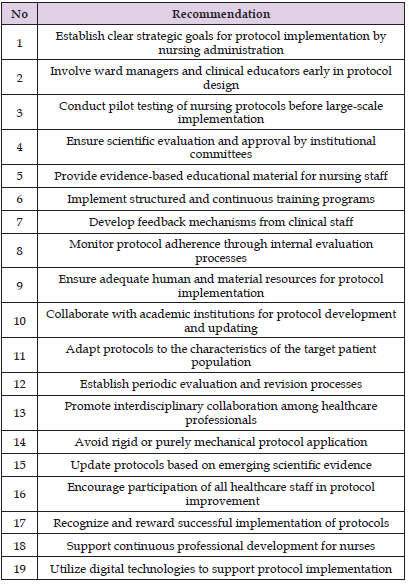
Note: Source: Delphi study findings of the present research.
The present study investigated the factors influencing the acceptance and implementation of nursing protocols within hospital settings using the Delphi method. The findings demonstrate a high level of consensus among healthcare professionals regarding the importance of structured and evidence-based nursing protocols for improving the quality and safety of patient care. The results highlight that the successful implementation of nursing protocols depends on several key factors, including strong leadership support, continuous professional education, interdisciplinary collaboration, and the active involvement of nurses in the design and evaluation of protocols. Participants emphasized that protocols should remain flexible and adaptable in order to accommodate the individualized needs of patients and the specific conditions of clinical environments.
Furthermore, the study produced a set of consensus-based recommendations aimed at improving the implementation of nursing protocols in healthcare organizations. These recommendations may serve as a practical framework for nursing administration and clinical teams seeking to enhance evidence-based practice and standardize clinical procedures. Overall, the findings contribute to the growing body of literature on evidence-based nursing practice and highlight the importance of participatory and organizational approaches for the sustainable integration of nursing protocols into everyday clinical practice. Future research should examine the implementation of these recommendations across diverse healthcare settings in order to further validate and refine the proposed framework.

International Association of Landscape Archaeology, Czech Glass Society, Czech Republic

Department of Chemistry, Semenov Institute of Chemical Physics, USSR Academy of Sciences, Moscow, Russia

Department of Educational Sciences, Research Centre Qualities of Teachers, School of Education – HAN, Nijmegen, Netherlands

Associate Professor at Department of Breast and Thyorid Surgey, Chongqing General Hospital, China

Neurology, LA BioMed Research Institute, USA





 Abstract
 PDF
PDF