info@biomedres.us
+1 (502) 904-2126
One Westbrook Corporate Center, Suite 300, Westchester, IL 60154, USA
Site Map
 ISSN: 2574 -1241
ISSN: 2574 -1241
ISSN: 2574 -1241
Received: May 06, 2026; Published: May 13, 2026
*Corresponding author: Anstasiia Mikhailova, Plekhanov Russian University оf Economics, 36, Stremyanny per, Moscow,117997, Russia
DOI: 10.26717/BJSTR.2026.65.010220
Human sialidases (neuraminidases) play a key role in the regulation of cellular processes, and their enzymatic activity is associated with inflammation, atherosclerosis, cancer, viral infections, lysosomal disorders. In this regard, a three-stage search for natural compounds that are potential inhibitors of human sialidase was conducted. At the first stage, the PubChem database was used, which helped to identify inhibitory activity in 36 compounds, 20 of which were flavonoids. At the second stage, these flavonoids were ranked using molecular docking according to their binding energy to the target (sialidase). Epicatechin-3-gallate demonstrated the best binding energy (−6.923 kcal/mol). At the third stage the four leading flavonoids were further subjected to PASS analysis in which their anti-inflammatory and other potential was verified. The structural features of the leading compounds and the prospects for identifying inhibitors among other classes of natural substances are discussed as well as the prospects for inclusion in the composition of nutraceuticals.
Keywords: Human Sialidase; Molecular docking; Inhibitors; Flavonoids; Virtual Screening; Epicatechin-3-Gallate
Sialidases are a family of glycosyl hydrolases that catalyze the cleavage of terminal sialic acid residues from glycoconjugates. In mammals, four isoforms of sialidases are known (NEU1, NEU2, NEU3, NEU4), differing in subcellular localization and substrate specificity. Dysregulation of sialidase activity is observed in a few pathological conditions, including atherosclerosis, tumor metastasis, inflammation, insulin resistance, and infectious processes [1-4]. In contrast to viral neuraminidases, whose inhibitors (oseltamivir, zanamivir) are widely used in clinical practice, the development of selective inhibitors of human sialidases is still at an active research stage. Therapeutic inhibition of human sialidases may open new avenues for the treatment of chronic inflammatory diseases. Natural compounds, particularly polyphenols and flavonoids, have historically served as a rich source of biologically active molecules. Their structural diversity allows effective interaction with enzyme binding pockets. However, sialidase inhibitors may also include compounds of other chemical classes, such as sialic acid analogs, cyclic amines, and terpenoids. The aim of this study is a three-stage identification of potential sialidase inhibitors, including the ranking of flavonoids using molecular docking, as well as the recommendation of the most effective flavonoids as ingredients for further nutraceutical development.
Protein Structure Preparation
A three-dimensional structure of human sialidase (NEU2 isoform) was obtained from the Protein Data Bank (PDB). Crystallographic water molecules and co-crystallized ligands were removed from the structure. Polar hydrogen atoms were added, and atomic charges were assigned according to the selected force field. The active site of the enzyme was defined based on the coordinates of the crystallographic substrate.
Identification of Potential Sialidase Inhibitors and Ligand Preparation
The PubChem database was used to identify compounds (ligands) with inhibitory activity (IC50) [5]. Compounds with IC50 < 100 nM were considered active. Flavonoids from the overall list of inhibitors were selected as ligands. For each compound, a 3D structure was obtained, followed by energy minimization and assignment of atom types. PubChem identifiers were used for unambiguous identification of the molecules.
Molecular Docking
Docking was performed using AutoDock Vina software [6]. The search parameters included a grid box large enough to cover the enzyme’s active site and an exhaustive search mode (exhaustiveness = 8). For each ligand, 10 conformations were generated, and the pose with the lowest binding energy was selected. Validation of the docking protocol was carried out by re-docking the co-crystallized ligand, which showed a root-mean-square deviation (RMSD) of less than 2.0 Å.
PASS Analysis: Biological Activity Predictions
The potential biological properties of the selected compounds were investigated through the PASS web server. The PASS tool allows us to explore the possible biological properties of compounds, based on their chemical formula. It uses 2D molecular fragments known as multilevel neighbors of atoms (MNA) descriptors which suggest that the biological activity of a chemical compound is the function of its molecular structure. It gives the prediction score for biological properties on the ratio of «probability to be active (Pa)» and «probability to be inactive (Pi)». A higher Pa means the biological property is having more probability for a compound.
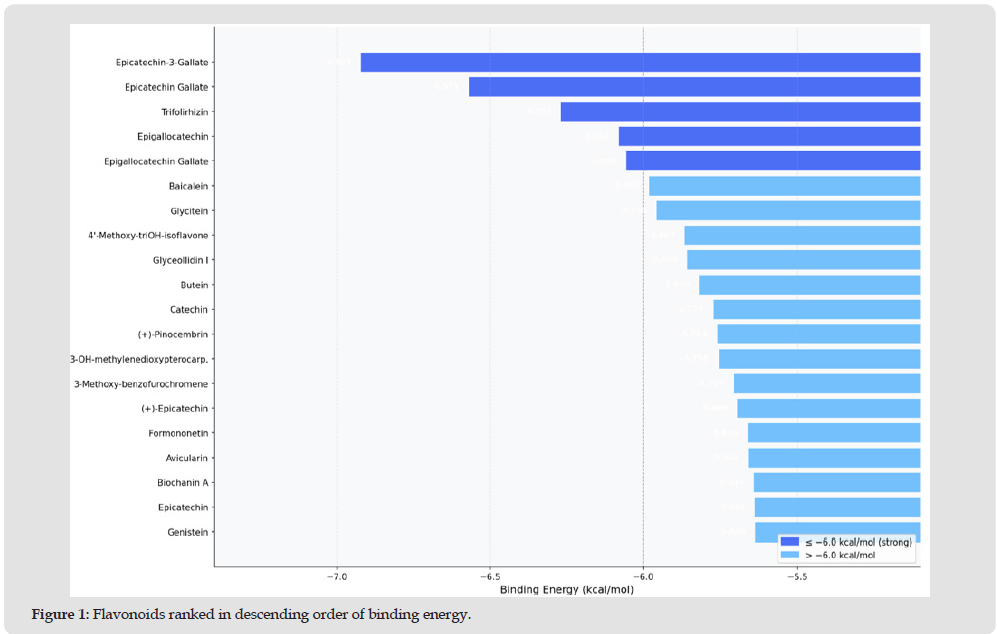
The first stage of the search for sialidase inhibitors, carried out using cheminformatics approaches based on the PubChem database, resulted in the identification of 36 natural compounds that met the selection criteria, 20 of which were flavonoids. The remaining compounds belonged to other classes of biologically active substances, including di- and triterpenoids, alkaloids, and lignans. Among the flavonoids, the most active were epigallocatechin, with an IC50 of 16.2 μM, and epicatechin-3-gallate (IC50 = 16.0 μM). For comparison, the IC50 value for 2,3-didehydro-2-deoxy-N-acetylneuraminic acid (DANA) is 49.6 μM. At the second stage of the study, the binding of the 20 selected flavonoids to the active site of sialidase was analyzed through virtual screening. Figure 1 presents the flavonoids ranked in descending order of their binding energy to the target, which corresponds to increasing thermodynamic affinity for sialidase. Data analysis shows that the top five compounds include four catechins (their gallate derivatives). Epicatechin-3-gallate (PubChem 65056) demonstrated the best result, with a binding energy of −6.923 kcal/mol. Compounds lacking a gallate group (for example, catechin or epicatechin) showed slightly worse results (around −5.7 kcal/mol), which indicates the importance of additional phenolic groups for interaction with the enzyme.
Figure 1
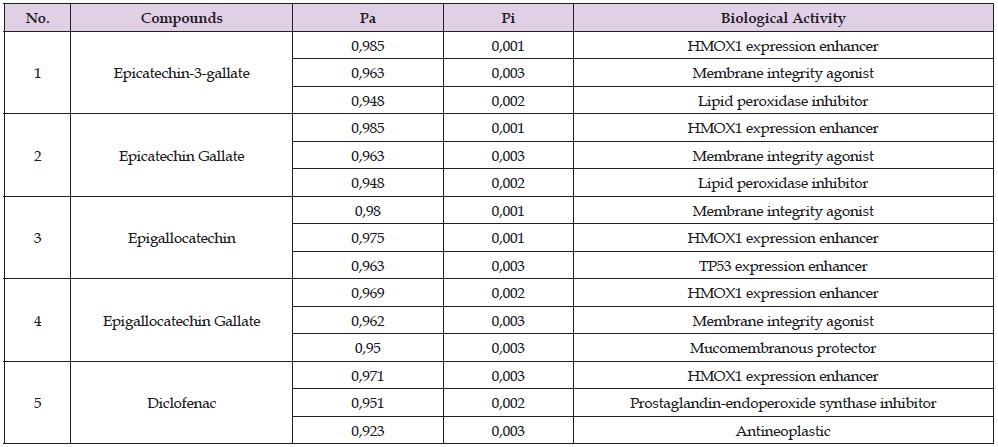
It is worth noting that in a study devoted to the interaction of oseltamivir (an inhibitor of viral neuraminidase) with neuraminidase, the binding energy was reported to be approximately −6.5 kcal/mol, indicating a sufficiently strong interaction between the ligand and the protein [7]. The identified compounds were further subjected to PASS analysis where we have selected the compounds bearing inhibitory (anti-inflammatory) potential. The exploration of biological activities of the selected compounds through the PASS analysis resulted in similar kinds of biological activities. The reference compound Diclofenac (N5) showed to have similar potential, validating the results predicted. The compounds Epicatechin-3-gallate, Epicatechin Gallate, Epigallocatechin, Epigallocatechin Gallate have shown predictions for anti-inflammatory, membrane integrity agonists, lipid peroxidase inhibitors, TP53 expression enhancers and mucomembranous protector potential, with Pa ranging from 0,985 to 0,969. Table 1 shows the biological properties of all four leading flavonoids with higher Pa. It’s obvious from PASS analysis that the identified most active flavonoids can be considered as ingredients for the creation of nutraceuticals with a range of therapeutic effects.
Table 1: Identified gallated catechins and their biological properties calculated through PASS webserver.
The obtained data indicates that the 20 flavonoids identified as potential sialidase inhibitors in the PubChem database also exhibit high binding potential towards human sialidase according to docking results. Finally, we have selected 4 flavonoids for PASS analysis. The group of gallated catechins is particularly prominent. The presence of a gallate moiety at position 3 (as in epicatechin-3-gallate and epigallocatechin gallate) leads to a decrease in binding energy of approximately 1.0–1.2 kcal/mol, compared with non-gallated analogues. This can be explained by additional hydrogen bonds and π–π stacking interactions formed by the gallate group with amino acid residues in the active site (for example, aromatic residues such as tyrosine or tryptophan, which are typical for the substrate-binding pocket of sialidases). However, it is important to note that sialidase inhibitors are not limited to flavonoids. The chemical space of potential inhibitors includes sialic acid derivatives (such as DANA), cyclic guanidines, and other heterocyclic systems, which often exhibit higher affinity due to strong electrostatic interactions with the catalytic triad of the enzyme [8]. The binding energies obtained in this study (ranging from −5.6 to −6.9 kcal/mol) can be considered moderate. For comparison, wellknown potent inhibitors of viral neuraminidases often show values below −8.0 kcal/mol under similar docking conditions, whereas oseltamivir has been reported to bind neuraminidase with an energy of about −6.5 kcal/mol and to form a hydrogen bond of 2.06 Å with residue GLU C:174.From the perspective of practical application of the obtained results, for example, the use of flavonoids as functional nutraceutical ingredients, the following can be highlighted.
The most active flavonoids toward sialidase, based on the combined results of the three-stage screening, were epicatechin-3-gallate and epigallocatechin. At the same time, foreign researchers most often focus on epigallocatechin-3-gallate (EGCG) as the most widespread and biologically active flavonoid [9-11]. which also occupies a high position in Figure 1. It is likely that all four gallated catechins can be considered promising functional ingredients. An advantage of the identified flavonoids is their natural origin, low toxicity, and good bioavailability compared to many synthetic analogues. At the same time, the relatively low selectivity of flavonoids may be a limiting factor, since they can interact with a wide range of protein targets. A limitation of this study is the use of only static docking. For a more accurate assessment of complex stability, molecular dynamics (MD) simulations and calculations of binding free energy (MM-GBSA/PBSA) are necessary. In addition to that, future studies should expand the chemical space of screening to include non-flavonoid classes of compounds (alkaloids, terpenoids, synthetic libraries) in order to minimize the risk of overlooking more effective inhibitory agents.
In this work, a three-stage screening of natural compounds for inhibition of human sialidase was carried out.
1. It was shown that among natural ligands, flavonoids, particularly gallated catechins, exhibit the highest affinity for the active site of the enzyme.
2. The leading compound was epicatechin-3-gallate, with a binding energy of −6.923 kcal/mol.
3. A structure–activity relationship was established: the presence of a gallate group significantly improves ligand–target binding.
4. Despite the high potential of flavonoids, the search for sialidase inhibitors should not be limited to this class of compounds.
The results obtained serve as the basis for further research, including in vitro testing of enzymatic activity and optimization of the structure of leading compounds to increase their selectivity and affinity. Ultimately, such compounds can be considered as functional ingredients included in nutraceuticals with a predicted health-improving effect.
None.
The authors declare no conflicts of interest.

International Association of Landscape Archaeology, Czech Glass Society, Czech Republic

Department of Chemistry, Semenov Institute of Chemical Physics, USSR Academy of Sciences, Moscow, Russia

Department of Educational Sciences, Research Centre Qualities of Teachers, School of Education – HAN, Nijmegen, Netherlands

Associate Professor at Department of Breast and Thyorid Surgey, Chongqing General Hospital, China

Neurology, LA BioMed Research Institute, USA





 Abstract
 PDF
PDF



























