info@biomedres.us
+1 (502) 904-2126
One Westbrook Corporate Center, Suite 300, Westchester, IL 60154, USA
Site Map
 ISSN: 2574 -1241
ISSN: 2574 -1241
ISSN: 2574 -1241
Received: April 22, 2026; Published: May 12, 2026
*Corresponding author: Jin Xu, Sanya Biosafety Center of Chinese Academy of Inspection and Quarantine, Sanya, 575025, China
DOI: 10.26717/BJSTR.2026.65.010218
A single nucleotide po]ymorphic sequence (SNP) in the matK gene of chloroplast DNA that discriminate Oryza officinalis and its related species has been found. The derived cleaved amplified polymorphic sequence (dCAPS) primers were designed based on the SNP and the genomic DNA was used for amplification. The amplicons were digested by restrict enzyme to convert the SNP into dCAPS markers which can be applied in genetic map construction, gene mapping, germplasm identification, genetic diversity research and other fields.
Keywords: SNP; Oryza Officinalis; dCAPS
Abbreviations: SNP: Single Nucleotide Polymorphic Sequence; dCAPS: Derived Cleaved Amplified Polymorphic Sequence; SNPs: Single Nucleotide Polymorphisms; bp: Base Pairs; PAGE: Polyacrylamide Gel Electrophoresis
Derived cleaved amplified polymorphic sequence (dCAPS) is a molecular labeling method produced by the combination of PCR reaction and enzyme digestion [1,2]. It is further improved on the basis of CAPS markers. The basic principle of CAPS technology is to firstdesign a set of specific PCR primers with the DNA sequence of known sites, and then amplify them, and then use a specific restriction enzyme to digest the amplified products and perform RFLP analysis; DCAPS technology is to introduce mismatched bases into amplification primers to generate new restriction endonuclease sites that can be combined with SNP sites. After endonuclease digestion, it produces polymorphisms similar to CAPS markers. DCAPS molecular marker technology is mainly applied to the research of plant gene location, map based cloning, typing and variety identification [3-6].
Oryza officinalis is a perennial herb of Oryza. As one of only three wild rice species native to China, it serves as a vital genetic reservoir, harboring valuable attributes such as resistance to pests and diseases, environmental stress tolerance, high photosynthetic efficiency, and superior yield and quality [7-8]. It is a perennial diploid plant with CC genome. It grows strongest among 22 species of Oryza genus, more than 20 times as high as common cultivated rice, and its growth height can reach 3 m. It is distributed in tropical and subtropical regions of Asia, Africa and Australia [9]. In China, it is mainly distributed in Yunnan, Guangdong, Hainan and Guangxi. In 1999, medicinal wild rice was listed as an endangered species under second- class national protection in the list of national key protected wild plants (the first batch). In 2013, it was included as a critically endangered plant in the red list of biodiversity in China. It has high academic status and scientific research value.
Accurate identification of O. officinalis is a prerequisite for its conservation, germplasm utilization, and molecular breeding. Traditional identification methods primarily rely on morphological characteristics, however, these are often influenced by environmental factors and developmental stages. Consequently, such methods suffer from low accuracy and make it difficult to distinguish O. officinalis from closely related Oryza species, particularly at the seedling stage or within mixed germplasm collections. Molecular markers have emerged as robust tools for species identification due to their stability, accuracy, and independence from environmental conditions. Among these, single nucleotide polymorphisms (SNPs) represent the most abundant and stable genetic variations in genomes, offering high resolution for distinguishing closely related species and genotypes. This study aims to address the lack of specific molecular markers for O. officinalis identification, thereby facilitatin the sustainable utilization of this valuable genetic resource and contributing to the genetic improvement of cultivated rice.
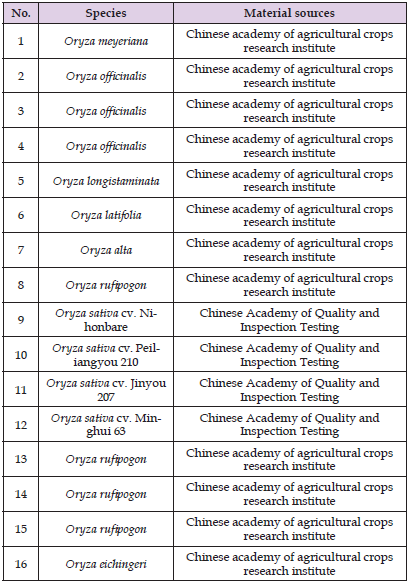
The plant materials and their sources are shown in Table 1.
Table 1: Plant materials and their sources.
The DNA was extracted from sample materials using DNA Quick Plant System (TIANGEN BIOTECH Co.; Ltd; Beijing; China). The extracted DNA was dissolved in 50μL sterile water and then was stored in -20℃ for further use.
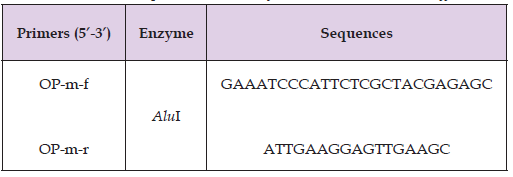
The matK gene of O. officinalis (Genebank accession No. KF359910.1, OX397922.1, MT726930.1, NC027463.1) were compared with its related species (Genebank accession No. MT731950.1, MF401450.1, KP121861.1, KP864527.1, KF359901.1, MT726928.1, NC034762.1, OV049801.1, HG996592.1, OV050001.1). To effectively distinguish the single sequence variation of ‘A/T’ between O. officinalis and related species, a dCAPS marker was developed. The upstream primer was designed by software the web version of dCAPS finder 2.0 (http://helix.wustl.edu/dcaps/), and the downstream primer was designed by primer 3 (Table 2).
Table 2: Primers sequences and enzyme for the matK of O. officinalis.
PCR reactions were performed using Pfu DNA Polymerase (TIANGEN BIOTECH Co.; Ltd; Beijing; China) in 25 μL of reaciton systems. After preheating at 94°C for 3 min, 35 PCR cycles (94°C for 30 sec, 56°C for 30 sec and 72°C for 30 sec) were performed. The last cycle was followed by a final 10 min extension at 72°C. The amplification products were verified by 1.0% agarose gel electrophoresis. For dCAPS markers, aliquots (10 μL) of the PCR products were digested for 3 h in 20 μL total volume with 5-15 units of the AluI restriction enzyme (New England Biolabs, USA). After restriction enzyme digestion, the digested products were separated by 4.0% agarose gel electrophoresis.
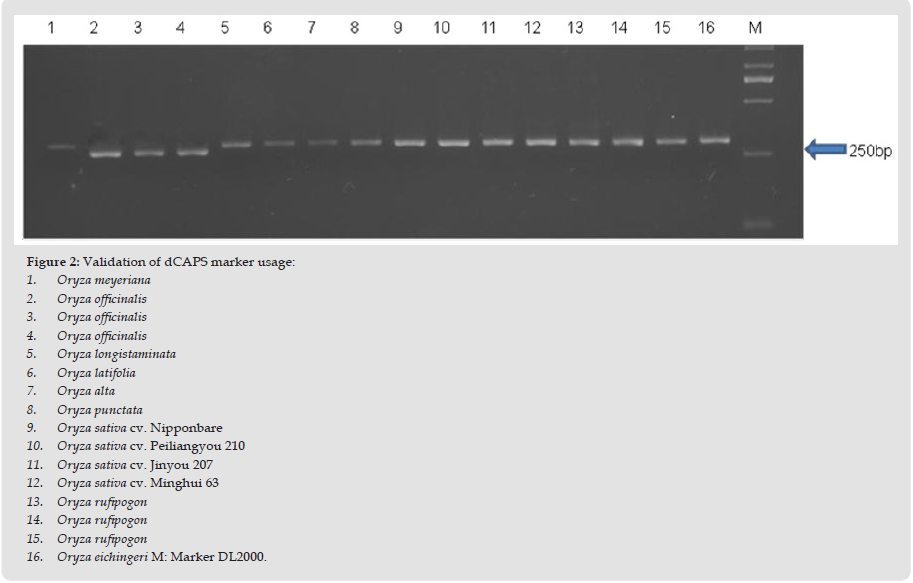
The CondonCode software was used to determine whether the SNP could be converted into a dCAPS marker. Finally we found a SNP to convert into a dCAPS marker (Figure 1). By adding 1 bp mutation (A-G) in the forward primer, a AluI recognition site (-AGCT-) was introduced into the forward primer OP-m-f to convert the SNP into dCAPS marker. As a result, only the PCR product from O. officinalis could be digested by AluI, whereas the related species of O. officinalis PCR products remained undigested. To confirm the specificity of dCAPS, sixteen previously collected Oryza species were subjected to PCR using the pairs of dCAPS marker primers. The PCR products were then digested with AluI according to previously established test steps. The products were detected by 4% agarose gel electrophoresis. All PCR products of O. officinalis were found to be cleaved by AluI (Figure 2). These results were completely consistent with our expectations.
Figure 1
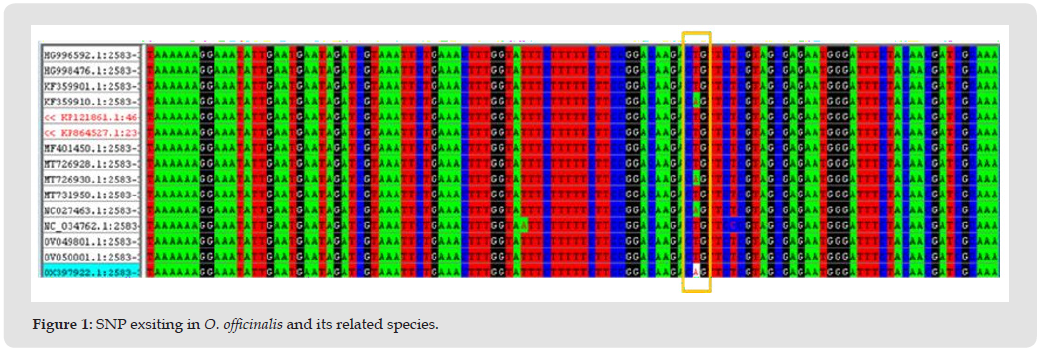
Figure 2
The matK gene, located within the chloroplast genome, is characterized by maternal inheritance and a lack of genetic recombination, rendering it a valuable marker for elucidating organismal evolutionary history [10-11]. This gene, which encodes the maturase K protein, spans approximately 1500 base pairs (bp) and is embedded within the intron of the trnK gene [12]. Due to its high efficacy, conserved mutation rate, and superior resolution compared to other loci, matK is extensively utilized for plant identification. [13]. Finally we found a SNP by comparing the matK gene sequences of O. officinalis and its related species, and developed a set of dCAPS markers. Additionally, the primer set used in this study was designed to make the fragment differences after enzymatic digestion significant and easy to observe. This enables the rapid identification of O. officinalis via 4% agarose gel electrophoresis, obviating the need for polyacrylamide gel electrophoresis (PAGE) or sequencing, thereby significantly enhancing detection efficiency.
In conclusion, we described the development of dCAPS markers based on singlc nucleotide polymorpbic scquence (SNP) of the matK gene to discriminate between O. officinalis and its related species. The dCAPS-based method developed in this study is simple, cost-effective, and capable od distinguish O. officinalis, making it a valuable tool for genetic map construction, gene mapping, germplasm identification, and genetic diversity studies.
No potential confilict of interest was reported by the authors.
This research was funded by Hainan Province Science and Technology Special Fund, grant number ZDYF2024SHFZ048 and Investigation of Technological Basic Resources, grant number 2023FY100402.

International Association of Landscape Archaeology, Czech Glass Society, Czech Republic

Department of Chemistry, Semenov Institute of Chemical Physics, USSR Academy of Sciences, Moscow, Russia

Department of Educational Sciences, Research Centre Qualities of Teachers, School of Education – HAN, Nijmegen, Netherlands

Associate Professor at Department of Breast and Thyorid Surgey, Chongqing General Hospital, China

Neurology, LA BioMed Research Institute, USA





 Abstract
 PDF
PDF



























