info@biomedres.us
+1 (502) 904-2126
One Westbrook Corporate Center, Suite 300, Westchester, IL 60154, USA
Site Map
 ISSN: 2574 -1241
ISSN: 2574 -1241
ISSN: 2574 -1241
Received: May 02, 2026; Published: May 12, 2026
*Corresponding author: José Antonio Velázquez Domíngue, Escuela Nacional de Medicina y Homeopatía del IPNFull Av. Guillermo Massieu Helguera 239, La Purísima Ticoman, Gustavo A. Madero, 07320 México, México CDMX
DOI: 10.26717/BJSTR.2026.65.010217
Introduction: Urinary tract infections (UTIs) during pregnancy pose significant risk for maternal and neonatal
health, particularly in resource-limited rural settings where diagnostic and treatment challenges persist. To
analyze the frequency of bacteriuria diagnosis in pregnant women attending a rural health center in Queretaro,
Mexico, and identify associated sociodemographic, clinical and obstetrict factors.
Methodology: This observational, cross-sectional, retrospective study analyzed clinical records of 90 pregnant
women (aged 15-44), receiving prenatal care al Alfacayucan Health Center from january 2022 to April 2023.
Bacteriuria was diagnosed using urinalysis (UA), and patients were categorized into bacteriuria-diagnosed n=57
and control (n=33) groups. Sociodemographic and clinical factors were compared between groups.
Results: Bacteriuria was diagnosed in 63.33% (57/90) of patients, with 56.14% being nulliparous compared to
33.33% in controls. Most diagnoses occurred in the second trimester of pregnancy (49.12%). Lower educational
attainment was more prevalent in the bacteriuria group (12.28%) with high school education vs. 24.24% in controls).
Nitrofurantoin monotherapy was prescribed in 80.70% of cases. Recurrence occurred in 26.32% (15/57)
of treated patients.
Conclusions: High bacteriuria frequency in this rural Mexican population highlights significant UTI burden
during pregnancy. Nulliparity and lower educational level emerged as important risk factors. Findings underscore
the need for targeted prenatal screening strategies and public health interventions addressing sociodemographic
determinants in resource-limited settings.
Keywords: Urinary Tract Infection; Bacteriuria; Pregnancy; Rural Health; Mexico; Prenatal Care; Sociodemographic Factors; Resource-Limited Settings
Abbreviations: UTIs: Urinary Tract Infections; AB: Asymptomatic Bacteriuria; UA: Urinalysis; BMI: Body Mass Index
Urinary tract infection (UTI) is a prevalent complication during pregnancy, significantly increasing maternal and fetal morbidity when left undiagnosed and untreated (Ruiz Salvador [1)). The prevalence of UTIs in pregnant women has been associated with various sociodemographic, reproductive, and medical history factors. Among these, pregnancy itself is a notable risk factor, as many women may present asymptomatically despite undergoing appropriate perinatal care (Balachandran, et al. [2,3]). Asymptomatic Bacteriuria (AB) screening is crucial during prenatal care, as it has been shown to reduce the risk of developing symptomatic UTIs, which can lead to severe complications such as preterm labor, low birth weight, and increased risk of pyelonephritis (Torres González, et al. [4,5]). Pregnancy induces significant anatomical and physiological changes in the urinary tract that predispose women to infection. International clinical practice guidelines consistently identify progesterone-mediated smooth muscle relaxation and mechanical compression by the gravid uterus as key mechanisms leading to urinary stasis and dilatation of the ureters and bladder.
These changes facilitate bacterial ascent and persistence in the urinary tract. Additionally, altered urinary biochemistry and vesicoureteric reflux during pregnancy further contribute to increased susceptibility to bacteriuria (Cornelia, et al. [6]). Due to these pregnancy- specific alterations, most obstetric and infectious disease guidelines recommend routine screening and treatment of asymptomatic bacteriuria in pregnant women to reduce the risk of progression to pyelonephritis and associated adverse maternal and fetal outcomes (Nicolle, et al. [7,8]). Beyond the physiological changes of pregnancy, several specific clinical and comorbid conditions significantly increase the risk of bacteriuria and UTI in pregnant women. Diabetes mellitus is consistently cited as a major risk factor, with higher prevalence and increased risk among women with diabetes and those with advanced maternal age (Nicolle, et al. [7,8]). Prior history of UTI or recurrent UTI is recognized as a predictor of recurrence and complications (de Rossi, et al. [9,10]). The prevalence of UTIs in pregnancy is notably higher in rural environments and among populations with low socioeconomic status, particularly in Latin America.
Multiple studies have reported prevalence rates exceeding 35% in Latin American populations (Cobas Planchez, et al. [11-13]). The correlation between educational level, socioeconomic status, and UTI prevalence is well characterized in epidemiological studies (Johnson, et al. [3]). yet international clinical practice guidelines do not provide rural versus urban risk comparisons or risk-factor profiles specific to rural pregnant populations in developing countries. This evidence gap is particularly concerning given that limited healthcare infrastructure in rural áreas-including lack of access to diagnostic resources-may delay diagnosis and treatment, leading to increased morbidity. A research gap remains in understanding the specific demographic and clinical characteristics that contribute to the high frequency of bacteriuria in pregnant women, especially in rural areas of developing countries. This study analyzed the frequency of diagnosed UTIs in pregnant women attending a rural health center in the state Querétaro, Mexico and associated sociodemographic, clinical, and obstetric factors. We aim to contribute to a better understanding of the multifactorial causes of UTIs in pregnancy in resource-limited rural settings, ultimately guiding the development of targeted strategies to enhance prenatal care and reduce the incidence of UTIs in this highrisk group.
This is an observational, cross-sectional and retrospective study in which demographic, clinical and obstetric factors were compared in a cohort of pregnant women. A population sample of pregnant patients treated at the Alfajayucan Health Center (El Marqués municipality, Querétaro state) was followed during the period from January 1, 2022 to April 30, 2023. Only patients who carried out their prenatal control and who were also registered in the digital database and had at least one consultation in the time period considered in this study were included. No exclusion was made by age or gestational trimester. The clinical records of the patients were evaluated with the help of the Medical Care Information System (SIAM) and the prenatal control card. The total sample of pregnant women during the referred period was 90.
From this total, 57 patients presented positive results in the Urinalysis (UA), that is, the presence of bacteria reported as either ‘moderate’ or ‘abundant’. Results from urine culture tests were not recorded for all bacteriuria-diagnosed patients mostly because of limited availability and higher cost than the UA. Despite the fact that urine culture is considered the definitive diagnostic test for urinary tract infections, and according to current recommendations by Mexican Guidelines (Centro Nacional de Excelencia Tecnológica en Salud: CENETEC 2016), the 57 patients received an antimicrobial therapeutic regimen. This can be a common scenario at rural contexts for practitioners in developing countries. The amount of patients with a urine culture confirmation was insufficient for setting a Case and Control design using statistical tests for inference. Instead, we compare the prevalence of several risk factors between the 57 patients who received treatment for infection against the remaining 33 untreated patients with no findings in the UA. Despite accounting only for a descriptive comparison, we refer to the group of patients without diagnosed bacteriuria as the ‘control’ group. The assessment of risk factors prevalences was carried out based on total frequency data. These were concentrated in an Excel format file for the subsequent preparation of contingency tables. The variables considered in this study were:
Sociodemographic
The community of origin, age, marital status and educational level.
Clinical
The trimester of pregnancy at the beginning of medical care, the Body Mass Index, the number of previous births and the outcome of delivery. As clinical treatment variables, the trimester of pregnancy at the time of diagnosis and the prescribed antibiotic regimen were considered.
All women reported being residents of the communities of: Alfajayucan, San Miguel Amazcala and El Lobo, municipality of El Marqués. The sociodemographic variables are listed in Table 1. Age ranged from 15 to 44 years in the entire population sample. The most frequently reported marital status was common-law union. 27.27% of women reported being married in the control group, in contrast to 21.05% of women in the group with suspected UTI. The most common maximum level of education in both groups was the secondary level. However, a higher level of education, high school education, was found reported with twice the frequency (24.24%) in the control group compared to the bacteriuria-diagnosed group (12.28%). Four women attended medical care even when they were already in the third trimester of pregnancy. Interestingly, all of them were found within the group with suspected bacteriuria. At the end of this observational study, 38 of the 90 women had completed their pregnancy (Table 2). Nutritional status, based on the Body Mass Index (BMI), did not reveal any association trend. However, 14% of patients in a state of malnutrition were identified in the group with suspected bacteriuria compared to 9% of women in this nutritional state in the control group.
Table 1: Sociodemographic Variables.
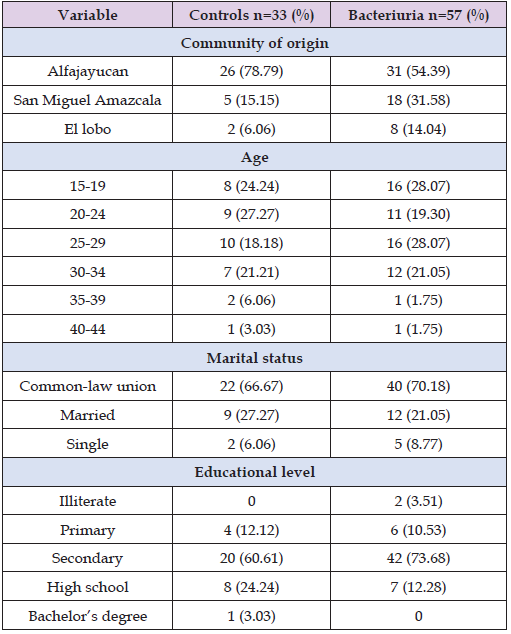
Table 2: Clinical Variables.
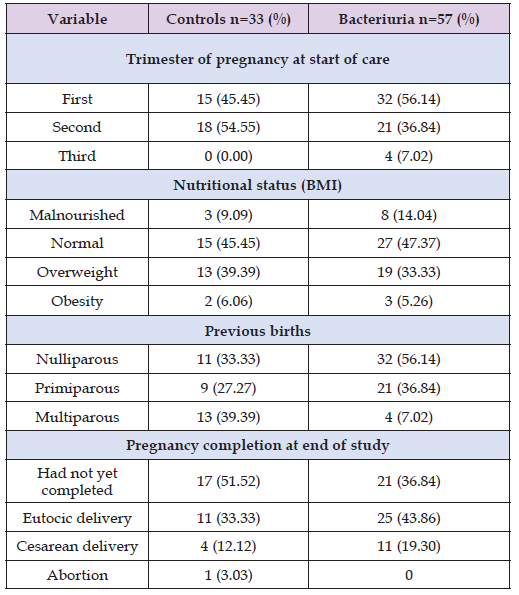
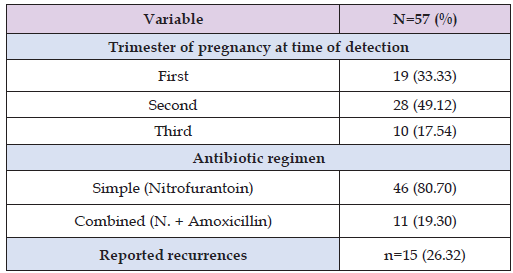
The number of previous births represented the variable with the greatest difference between groups in this study. The condition of nulliparity was identified as the most frequent in the group with suspected bacteriuria with 56.14% of the total as opposed to only 33.33% of women in this condition in the control group. Similarly, the condition of multiparity was identified as the most frequent in the control group (39.39%) which represented a drastic difference with respect to the group with suspected bacteriuria with only 7.02% of patients in said condition. In the bacteriuria-diagnosed group the detection occurred during the second trimester of gestation in 49.12% of women and during the third semester of gestation for 17.54% of women (Table 3). However, as mentioned before, four patients started their care until this third trimester, so it is likely that they presented the infection from a previous time period. The antimicrobial treatment prescribed was nitrofurantoin 500 mg every 6 hours for 7 days in 80.70% of cases. The combined treatment nitrofurantoin + amoxicillin (500 mg every 8 hours for 7 days) was prescribed in 19.3% of cases.
Table 3: Diagnosis, Treatment and Recurrence of Bacteriuria.
Bacteriuria in the context of pregnancy prescription of antibiotics is justified, since the potential for infection-related complications exceeds the risk profile associated with antibiotic administation. In the present study, 57 pregnant patients received antimicrobial treatment based on the presence of bacteria in the UA alone. Our study emphasizes that UA alone for the diagnosing UTIs continues to be the first line approach for pregnant women in certain regions of Latin America. However, UA by itself has been provides a poor predictive value for infection diagnosis (Advani, et al. [14]) as the number of false positives can be high (Whelan, et al. [15]). From the 57 women having received antibiotics, 21 patients were recorded with abundant presence of bacteria. Also, 56 from the 57 bacteriuria-diagnosed patients tested positive for white blood cells in the UA. Thus, if a urine culture had been reported for all 57 patients, the confirmed prevalence would have been anywhere between 23.3% and 62.2%.
In a meta-analysis, the prevalence of asymptomatic bacteriuria reported in pregnant women in Latin America is 18.45%, and up to 28.33% if symptomatic infections are also included (de Souza, et al. [16]). The highest rates of UTIs during pregnancy in Latin American populations have been found in women from rural environments or low socioeconomic status, with several reports exceeding even 35% (Cobas Planchez, et al. [11-13]). It is noteworthy that in these three very-high-prevalence studies only cases confirmed by urine culture were included which further suggests that very high prevalence rates of UTIs are not rare in pregnant women, even if the tendency to overdiagnose is considered. The correlation between educational level, socioeconomic level and the prevalence rate of UTIs is very strong and is well characterized (Johnson, et al. [3]). In the present study, this trend is also corroborated in rural women with low educational levels. The clinical variable with the greatest difference between groups in this study was the number of previous births with nulliparous women clearly overrepresented in the group with suspected bacteriuria. The role that this variable plays as a risk factor for bacteriuria is mostly debated. Some studies indicate that there is no association between both variables (Emiru, et al. [17]) while one of the largest observational studies in pregnant women found a clear association between nulliparity and the presence of UTIs (Johnson, et al. [3]). the same conclusion reached by other authors (Balachandran, et al. [2]).
While international clinical practice guidelines comprehensively address clinical and medical risk factors, they provide limited systematic guidance on sociodemographic determinants of UTI in pregnancy. Age and diabetes are explicitly discussed in guideline materials (Cornelia, et al. [6,7]). but formal education level, socioeconomic status, and rural versus urban residence are not systematically identified or quantified as guideline-listed risk factors. This represents a significant gap, as epidemiological studies have demonstrated strong correlations between low socioeconomic status, limited access to healthcare, and increased UTI prevalence, particularly in rural communities where healthcare infrastructure is often inadequate (Johnson, et al. [3,4]).
High bacteriuria frequency in this rural Mexican population highlights significant UTI burden during pregnancy. Nulliparity and lower educational level emerged as important risk factors. Findings underscore the need for targeted prenatal screening strategies and public health interventions addressing sociodemographic determinants in resource-limited settings. It is necessary to conduct more epidemiological studies to understand the multifactorial causes that explain these high prevalences, in order to design more effective public health interventions directed at these vulnerable populations.
We thank the Research Comittee from the State of Queretaro for providing the authorization to use the Protected Health Information 1670/05/06/2024/Jurisdicción sanitaria No1/CS. Alfajayucan/MPSS José Rubén Sánchez Osorio.
No conflict of interest is declared.

International Association of Landscape Archaeology, Czech Glass Society, Czech Republic

Department of Chemistry, Semenov Institute of Chemical Physics, USSR Academy of Sciences, Moscow, Russia

Department of Educational Sciences, Research Centre Qualities of Teachers, School of Education – HAN, Nijmegen, Netherlands

Associate Professor at Department of Breast and Thyorid Surgey, Chongqing General Hospital, China

Neurology, LA BioMed Research Institute, USA





 Abstract
 PDF
PDF



























