info@biomedres.us
+1 (502) 904-2126
One Westbrook Corporate Center, Suite 300, Westchester, IL 60154, USA
Site Map
 ISSN: 2574 -1241
ISSN: 2574 -1241
ISSN: 2574 -1241
Received: April 23, 2026; Published: May 05, 2026
*Corresponding author: Sebastien Farnaud, Centre for Discoveries in Life Sciences, Alison Gingell Building, Coventry University, Whitefriars Street, Coventry, Warwickshire, CV1 2DS, UK
DOI: 10.26717/BJSTR.2026.65.010205
The COVID-19 pandemic caused by SARS-CoV-2 highlighted major challenges related to sample storage and transportation, which contributed to high rates of false-negative diagnostic results. Toward the later stages of the pandemic, lysis buffers were introduced to reduce these false negatives; however, their use compromised host cell integrity, potentially affecting viral analysis when viral loads are low. These limitations raised concerns regarding both host cell viability and viral stability during sample transport. This study aimed to evaluate the viability of Human coronavirus OC43 (HCoV-OC43)-infected MRC-5 cells during transportation at ambient temperature (18-22 °C). Cell proliferation and metabolic activity were assessed using the Alamar Blue assay and the Agilent Seahorse Mito Stress Test, respectively. Cell-free viral titre during transport was measured using the TCID50 assay. Samples were transported using a range of media, including Eagle’s Minimum Essential Medium (EMEM) supplemented with 0%, 5%, or 10% fetal bovine serum (FBS), phosphate-buffered saline (PBS), 0.9% saline, Viral Transport Medium (VTM), as well as the commercial preservation systems CellShip® and TStore®. Results showed that EMEM-based media maintained reduced cell viability during transportation at ambient temperature and significantly decreased viral titre compared with the other media tested. VTM, CellShip®, and TStore® preserved limited cell viability at early time points, although this declined over time. Among these, VTM maintained the highest viral stability, while CellShip® and TStore® supported good viral stability at early time points. In contrast, PBS and 0.9% saline showed poor cell viability but maintained viral stability for up to 72 hours.
Keywords: Cell Transportation; Virus Transportation; Transport Media; Cell Viability; TCID50; Seahorse Mito-Stress Assay; HCoV-OC43; MRC-5
Abbreviations: EMEM: Eagle’s Minimum Essential Medium; FBS: Fetal Bovine Serum; PBS: Phosphate-Buffered Saline; VTM: Viral Transport Medium; OCR: Oxygen Consumption Rate; ECAR: Extracellular Acidification Rate
The COVID-19 pandemic caused by SARS-CoV-2 exposed significant challenges in diagnostic sample transport and testing. Rapid large-scale deployment of testing led to substantial variability in sample collection, storage, and transport protocols across assays (Davenport [1]). The resulting lack of standardisation contributed to inconsistent diagnostic performance and increased false-negative rates (Binnicker [2]). Several studies have examined how testing methodology, sampling site, and timing after infection influence diagnostic accuracy. Yang [3] analysed 837 samples and reported false-negative rates of 11% in sputum, 27% in nasal swabs, and 40% in throat swabs during days 1-7 of infection. Subsequent studies confirmed these discrepancies: Butler-Laporte [4] found nasal swab sensitivity ranged from 84.8% to 70% depending on sampling location, while Winichakoon [5] showed substantial differences in false-negative rates between nasopharyngeal and oropharyngeal swabs. Together, these findings demonstrate that sampling variability significantly affected the reliability of COVID-19 diagnostic testing.
Lysis buffers were later introduced to stabilise viral RNA during transport. These buffers improved viral load stability in infected cell samples stored at 2-8 °C and 22-28 °C for up to 48 h after collection, reducing suspected false-negative results compared with alternative media (Perumal [6]). However, guanidinium-based lysis buffers also present limitations, including higher cost and potential interference with downstream analyses, particularly when samples contain low viral loads and require sensitive quantitative PCR detection (Erster [7]). This study investigated the impact of transport media on the viability of Human coronavirus OC43 (HCoV-OC43)-infected MRC-5 cells and on the stability of cell-free HCoV-OC43. Transport conditions included Eagle’s Minimum Essential Medium (EMEM) supplemented with 0%, 5%, or 10% fetal bovine serum (FBS), as well as two buffers widely used during the SARS-CoV-2 pandemic: phosphate-buffered saline (PBS) and 0.9% saline. In addition, three commercial transport media were evaluated: Viral Transport Medium (VTM), CellShip®, and TStore®, two serum-free cell and tissue preservation media produced by Life Science Group.
The aim of this study was to evaluate both virus-infected cell viability and cell-free viral stability during transport at ambient temperature. HCoV-OC43-infected MRC-5 human lung fibroblasts were used as a model system and stored in the different transport media, with cell viability measured at 24-hour intervals. Cell-free viral titres were also monitored over time. Cellular health was assessed using the Alamar Blue assay for viability and the Agilent Seahorse Mito Stress Test for metabolic activity, while viral titre stability was determined using the TCID50 assay. It was hypothesised that VTM and complex commercial media would best preserve viral stability, whereas FBS-containing media would reduce viral viability and simple substitution buffers would be the least effective.
Commercially available media used in these experiments include Eagles Minimum Essential Media (EMEM) supplemented with 0%, 5% or 10% foetal bovine serum (FBS), Phosphate Buffered Saline (PBS), 0.9% Saline and cell transport media VTM (LSG), CellShip® (LSG) and T-Store® (LSG).
MRC-5 (CCL-171, ATCC) human lung fibroblast cells were grown in proliferation media EMEM-supplemented with 10% foetal bovine serum (FBS) (Biosera) and maintained at 37˚C, 5% CO2 unless otherwise stated. Following the removal of the inoculation medium, the medium was replaced with transport medium, and stored at ambient temperature, with a plate for each time point at 0h, 24h, 48h, 72h. The Seahorse Mito-stress assay was completed at each time point, and data were processed into a fold change with 0hr results as the base.
Stocks of Human coronavirus OC43 (HCoV-OC43) were generated by infecting MRC-5 cells with 100 μL of virus diluted in fetal bovine serum (FBS)-free Eagle’s Minimum Essential Medium (EMEM) and incubating for 90 minutes at 33 °C. Following adsorption, 7 mL of FBS-free EMEM was added and the cultures were returned to the incubator. To release virus particles, infected cells were placed at −80 °C for 4 hours to induce cell lysis. The culture medium was then collected, centrifuged to remove cellular debris, and the clarified supernatant was stored at −80 °C until use. Viral titres for experimental treatments were determined using the TCID50 assay.
The TCID50 assay was performed according to the method of Louis Reed and Herman Muench (1938). Briefly, 100 μL of cell-free viral stock of Human coronavirus OC43 (HCoV-OC43) was added to 400 μL of transport medium to generate a virus-transport medium stock. Viral titres were then determined at 24-hour intervals from 0 to 144 hours using pre-seeded MRC-5 cells cultured in 96-well plates at 75- 80% confluency. Changes in viral titre were expressed as log differences relative to the 0-hour time point.
MRC-5 cells were seeded into 96-well plates at a density of 1 × 10⁴ cells per well and incubated at 37 °C with 5% CO₂. Cells were then infected with Human coronavirus OC43 (HCoV-OC43). Following viral adsorption, the inoculation medium was removed and replaced with the designated transport media, and plates were incubated at ambient temperature until the specified time points. Cell viability was assessed using the Alamar Blue assay according to the manufacturer’s protocol (Dinh [8]; Bio-Rad protocol). Absorbance was measured at 570 nm and 600 nm using a BioTek Epoch 2 microplate reader with Gen5 Microplate Reader and Imager Software (version 2.07). Results were normalised to the 0-hour time point and expressed as fold change.
Cellular respiration was assessed by measuring oxygen consumption rate (OCR) and extracellular acidification rate (ECAR) using the Agilent Seahorse XFe96 Analyzer. MRC-5 cells were seeded at 1 × 10⁴ cells per well and cultured as described above. Following exposure to the experimental conditions, the culture medium was removed, and cells were washed with Seahorse XF Assay Medium (DMEM supplemented with 1 mM pyruvate, 2 mM glutamine, and 10 mM glucose). Cells were then incubated for 1 hour at 37 °C in a non-CO₂ incubator in fresh assay medium. A Seahorse XF Mito Stress Test was performed by sequential injection of 1.5 μM oligomycin, 2 μM FCCP, and 0.25 μM rotenone/antimycin A. All compounds were prepared in Seahorse assay medium prior to loading into the injection ports. The assay consisted of three measurement cycles following each injection, with 3 minutes of mixing between cycles (5 minutes for FCCP). After completion of the assay, cell numbers were determined using Hoechst 33342 staining and imaging with the BioTek Cytation V multi-mode imaging reader to normalise respiration data between conditions. Data were exported and analysed using the Agilent Seahorse Analytics online platform. The Agilent Seahorse XFe96/XF Pro FluxPak kit was used according to the manufacturer’s protocol, with optimisation to 2.0 μM FCCP and a seeding density of 10,000 MRC-5 cells per well. Kinetic profiles of cellular respiration were generated using Agilent Wave Controller Software. Following completion of the Seahorse XF Mito Stress Test, cells were stained with Hoechst 33342 and imaged using the BioTek Cytation V multi-mode imaging system to obtain cell counts for data normalisation. The normalised kinetic profiles were then used to calculate key mitochondrial respiration parameters, including basal respiration, maximal respiration, and ATP-linked respiration.
Alamar blue
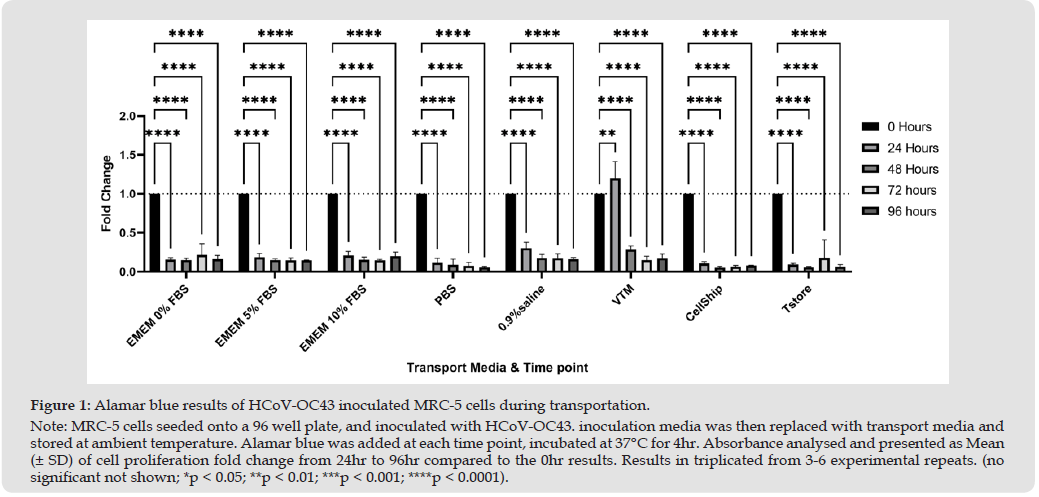
Human coronavirus OC43 (HCoV-OC43)-infected MRC-5 cells showed reduced viability in all transport conditions compared with the 0-hour control. In Eagle’s Minimum Essential Medium (EMEM) supplemented with 0%, 5%, or 10% fetal bovine serum (FBS), cell viability decreased by >0.8-fold at 24 hours (p < 0.0001) and remained consistently reduced from 24 to 96 hours (p < 0.0001 at all time points). In phosphate-buffered saline (PBS), a significant reduction in viability was observed at 24 hours (0.89-fold, p < 0.0001), followed by a progressive decline over time (p < 0.0001 at all time points). Cells maintained in 0.9% saline showed an initial decrease of 0.7-fold at 24 hours (p < 0.0001), with a further reduction at 48 hours (p < 0.0001) that remained stable at subsequent time points. In viral transport medium (VTM), cell viability increased slightly at 24 hours (p = 0.0011), followed by significant decreases at 48, 72, and 96 hours (p < 0.0001), reaching a maximum reduction of 0.85-fold. Cells maintained in Cell- Ship showed reduced proliferation (>0.9-fold) across all time points (p < 0.0001). A similar pattern was observed in TStore, where significant reductions in viability were also detected at all time points (p < 0.0001) Figure 1.
Figure 1
Human coronavirus OC43 (HCoV-OC43)-infected MRC-5 cells maintained the highest metabolic activity when transported in Eagle’s Minimum Essential Medium (EMEM), although cellular respiration declined over time across all conditions. Basal respiration, maximal respiration, and ATP-linked respiration progressively decreased, with the magnitude of decline varying according to medium composition and serum concentration. In EMEM without fetal bovine serum (FBS), basal respiration significantly decreased at 24, 48, and 72 hours (p = 0.0004 at later time points). Maximal respiration declined significantly from 24 hours onward (p < 0.0001), approaching undetectable levels by 72 hours. ATP-linked respiration followed a similar pattern, showing significant reductions at 24, 48, and 72 hours (p < 0.0001). In EMEM supplemented with 5% FBS, basal respiration showed a modest reduction at 24 hours followed by significant decreases at 48 hours (p = 0.0149) and 72 hours (p = 0.0061). Maximal respiration exhibited a similar trend but with greater reductions at 24 hours (p = 0.0023), 48 hours (p < 0.0001), and 72 hours (p < 0.0001). ATPlinked respiration mirrored this pattern, with significant decreases observed at 24 hours (p = 0.0165), 48 hours (p < 0.0001), and 72 hours (p = 0.0003) Figure 2.
Figure 2
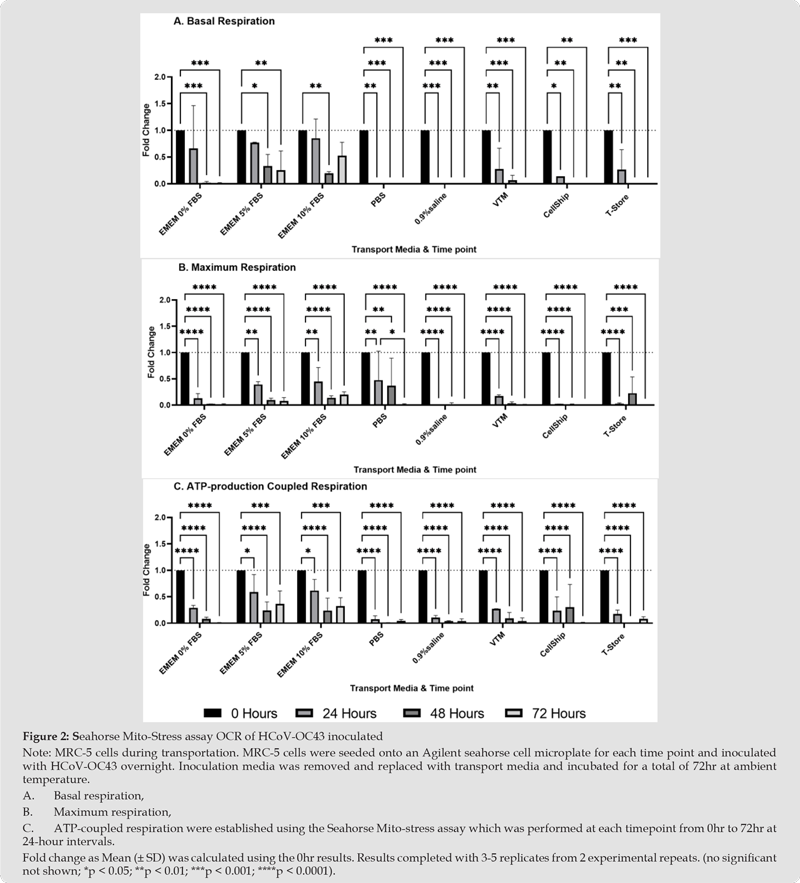
In EMEM supplemented with 10% FBS, all respiratory parameters declined during the first 48 hours, followed by a partial recovery at 72 hours. Basal respiration decreased at 24 hours and significantly at 48 hours (p = 0.0032), before increasing slightly at 72 hours. Maximal respiration showed a similar but more pronounced reduction at 24 hours (p = 0.0059), 48 hours (p < 0.0001), and 72 hours (p < 0.0001). ATP-linked respiration followed comparable trends, with significant decreases at 24 hours (p = 0.0277), 48 hours (p < 0.0001), and 72 hours (p < 0.0001). Cells transported in phosphate-buffered saline (PBS) or 0.9% saline displayed minimal or undetectable mitochondrial activity. In PBS, basal respiration declined to near zero by 24 hours (p = 0.0028) and remained minimal at 48 hours (p = 0.0003) and 72 hours (p = 0.0003). Maximal respiration decreased significantly at 24 hours (p = 0.0097) and 48 hours (p = 0.0016), reaching near-zero levels at 72 hours (p < 0.0001). ATP-linked respiration followed a similar trend, with significant reductions to near-zero levels from 24 hours onward (p < 0.0001 at all time points). Cells stored in viral transport medium (VTM) showed lower respiratory activity than those maintained in EMEM-based media. Basal respiration was significantly reduced at 24 hours (p = 0.0078), declined further at 48 hours (p = 0.0007), and became undetectable by 72 hours (p = 0.0003). Maximal respiration and ATP-linked respiration followed the same pattern, declining to near-zero levels by 72 hours (p < 0.0001 at all time points).
In CellShip, basal respiration decreased significantly at 24 hours (p = 0.0106), 48 hours (p = 0.0028), and 72 hours (p = 0.0028). Maximal respiration dropped to near-zero levels by 24 hours (p < 0.0001) and remained minimal at subsequent time points. ATP-linked respiration decreased by >0.7-fold at 24 and 48 hours (p < 0.0001) and was nearly undetectable at 72 hours (p < 0.0001). Similarly, in TStore, basal respiration declined rapidly at 24 hours (p = 0.0070) and approached zero by 48 hours (p = 0.0028) and 72 hours (p = 0.0003). Maximal respiration and ATP-linked respiration showed comparable reductions, with significant declines at 24 hours (p < 0.0001) and minimal activity at 48 and 72 hours (p < 0.0001).
TCID50
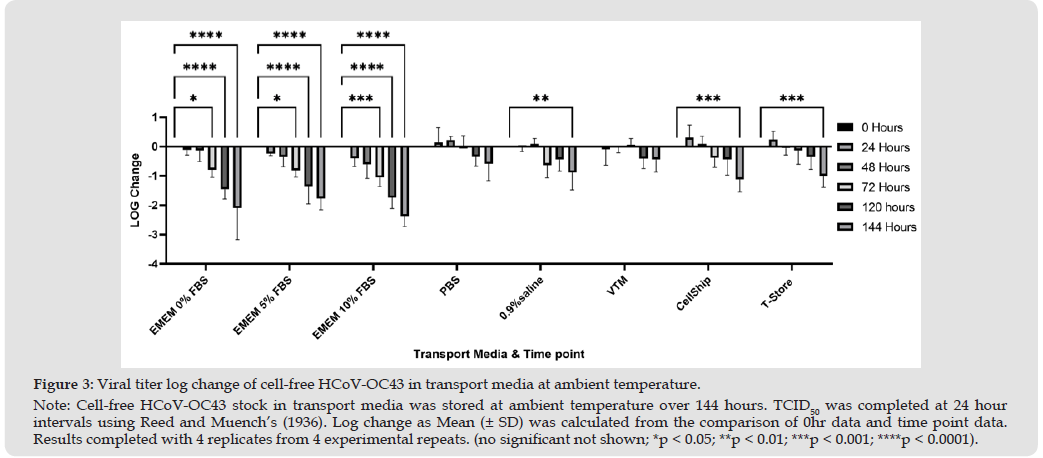
Cell-free Human coronavirus OC43 (HCoV-OC43) showed the greatest loss of viral titre over 144 hours when stored in EMEM supplemented with 0%, 5%, or 10% FBS. In EMEM without FBS, viral titre declined significantly from 96 hours (p = 0.0131), with further reductions at 120 hours (p < 0.0001) and 144 hours (p < 0.0001), resulting in a total decrease of 2.1 log. Figure 3 A similar trend was observed in EMEM with 5% FBS, where significant reductions occurred at 96 hours (p = 0.0107), 120 hours (p < 0.0001), and 144 hours (p < 0.0001), corresponding to a final decline of 1.77 log. The largest reduction was observed in EMEM supplemented with 10% FBS, with significant decreases beginning at 96 hours (p = 0.0004) and continuing at 120 hours and 144 hours (p < 0.0001), resulting in a total decline of 2.37 log [9,10,11]. In PBS, viral titre increased slightly at 24 and 48 hours, remained stable at 72 and 96 hours, and then declined gradually at 120 and 144 hours, resulting in a final reduction of 0.59 log. Similarly, in 0.9% saline, modest increases were observed at 24 and 48 hours before titres decreased over time, reaching a significant reduction at 144 hours (p = 0.0006) with an overall decline of 0.89 log. In VTM, viral titre remained relatively stable between 24 and 96 hours, followed by modest decreases at 120 and 144 hours, resulting in a final reduction of 0.44 log. In CellShip, an initial increase at 24 hours was followed by progressive declines at 96, 120, and 144 hours (p = 0.0006), yielding a total reduction of 1.12 log. A similar trend was observed in TStore, with an early increase at 24 hours followed by a continuous decline through 144 hours (p = 0.0010), corresponding to an overall reduction of approximately 1 log.
Figure 3
The evaluation of HCoV-OC43-infected MRC-5 cells in EMEMbased media revealed that serum concentration significantly influences both cellular integrity and viral stability. Proliferation remained uniformly low across EMEM 0%, 5%, and 10% FBS, with no major differences between conditions. However, metabolic activity declined more sharply: EMEM 0% FBS was least effective at sustaining cell metabolism, whereas EMEM 5% and 10% FBS maintained reduced but detectable metabolic function throughout the time course. FBS is known to inhibit viral growth and stability (Czuba et al., 2020), which is reflected in the viral titre data. EMEM 0% FBS maintained viral stability for approximately 48 hours before a pronounced decline, whereas EMEM 5% FBS exhibited a continuous decrease, reaching a 1.77-log reduction by 144 hours. EMEM 10% FBS showed the greatest loss of viral titre, with a 2.37-log reduction at 144 hours. This loss of infectivity in higher-serum conditions likely reflects both direct inhibitory effects of FBS and the altered cellular environment associated with reduced viability. Interestingly, despite low proliferation and metabolism, cells in EMEM 5% and 10% FBS performed better than most other media, suggesting a partial protective effect of serum during transport-a trend also observed in viral transport medium (VTM). Cells stored in PBS exhibited severely reduced proliferation and metabolic activity, with metabolism approaching zero early in the assay. Despite this, viral titre remained relatively stable, with a maximum decrease of only 0.59 log. Similarly, 0.9% saline supported minimal cellular activity but maintained viral stability for the first 24 hours, declining to a 0.89-log reduction by 144 hours. These findings align with previous reports of modest decreases in viral load in PBS or saline (Martin [12,13]).
Commercially produced media demonstrated more favourable viral preservation. VTM supported limited cellular metabolism and proliferation but maintained viral titre stability for up to 96 hours before a gradual decline, consistent with prior studies showing superior performance of VTM compared with PBS and 0.9% saline (Smith [14- 17]). CellShip® and T‑Store®, although not designed specifically for viral transport, showed promising results. Both supported minimal cellular activity while limiting viral titre reductions to <1.12 log for CellShip® and 1 log for T‑Store®. Viral stability in T‑Store® remained largely intact for the first 72 hours, with declines occurring only at later time points. These results suggest that both media may serve as viable viral transport solutions, outperforming PBS and 0.9% saline and, in some cases, approaching the viral stability observed in VTM.
In conclusion, EMEM-based media better preserve cell viability compared with other transport media, with higher FBS concentrations supporting increased cellular survival. However, EMEM demonstrated the lowest viral stability, with viral titre reductions becoming more pronounced as FBS concentration increased. PBS and 0.9% saline provided minimal or no cell viability but maintained viral stability during the first 48 hours before significant declines occurred. VTM supported both early-stage cell viability and viral stability, confirming its effectiveness as a transport medium. Commercial media such as CellShip® and TStore® showed promises in maintaining viral stability, although they supported minimal cellular activity. Given the limited literature on these media, further investigation is warranted to explore their potential as viral transport solutions. This study highlights that cell culture medium must be carefully chosen based on the intended use intended for these cells, because it acts as the primary, artificial environment that dictates cell growth, metabolism, and behaviour. Using the wrong medium can alter the phenotype, inhibit proliferation, cause apoptosis, or produce false results with potential dramatic effects as shown in false negative viral testing.
COVID-19 Funded PhD studentship at Coventry University.
The authors declare that there are no conflicts of interest in this study.

International Association of Landscape Archaeology, Czech Glass Society, Czech Republic

Department of Chemistry, Semenov Institute of Chemical Physics, USSR Academy of Sciences, Moscow, Russia

Associate Professor at Department of Breast and Thyorid Surgey, Chongqing General Hospital, China
Professor of Nuclear Medicine, Faculty of Medicine and Surgery, University of Milan, Milan, Italy

Department of Pharmaceutical Sciences, South University School of Pharmacy, USA





 Abstract
 PDF
PDF