info@biomedres.us
+1 (502) 904-2126
One Westbrook Corporate Center, Suite 300, Westchester, IL 60154, USA
Site Map
 ISSN: 2574 -1241
ISSN: 2574 -1241
ISSN: 2574 -1241
Received: April 11, 2026; Published: April 22, 2026
*Corresponding author: Yiqin Xia, Department of Emergency Medicine, West China Hospital, West China School of Medicine of Sichuan University, Chengdu 610041, China
DOI: 10.26717/BJSTR.2026.65.010183
Delayed diagnosis of foreign-body aspiration can lead to severe respiratory complications, including pneumonia and atelectasis, etc. We report a case of foreign-body reactive inflammation in the right lower lobe, indistinguishable from lung cancer, due to the aspiration of a chili peel one year prior. The patient presented with repeated cough and hemoptysis. A foreign body was incidentally discovered during a surgical resection of the lung lobe. This case highlights the importance of considering pulmonary foreign bodies in the differential diagnosis when faced with similar symptoms.
Keywords: Aspiration; Foreign Body; Lung Cancer
Aspiration is an extremely dangerous medical event with acute manifestations such as sudden choking and violent coughing. Fewer patients may have delayed diagnosis due to unspecific symptoms or other reasons. The long-term retention of foreign bodies in the lungs can cause inflammatory damage to the lung tissue. Therefore, this condition requires early recognition and prompt intervention to improve respiratory symptoms and prevent serious complications [1,2].
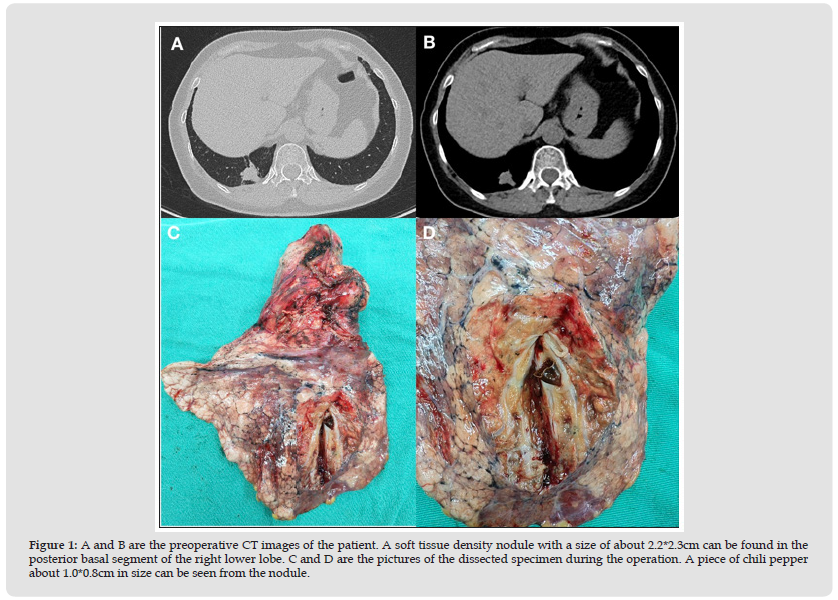
A 57-year-old woman presented with a one-year history of daily cough and occasional hemoptysis. She had no significant medical history and all examinations were unremarkable except for a chest computed tomography (CT). A chest CT scan ten days prior to admission revealed a soft tissue density nodule, measuring approximately 2.2 x 2.3 cm, in the posterior basal segment of the right lower lobe. The nodule encircled part of the bronchi, with surrounding cord-like shadows. Contrast-enhanced imaging showed heterogeneous enhancement, with no evidence of enlarged mediastinal lymph nodes. Given the radiological findings, a lung tumor could not be confidently excluded. Therefore, the patient underwent a VATS (video-assisted thoracoscopic surgery) right lower lobectomy under general anesthesia. During the operation, the right lower lobe was removed without evidence of visceral pleura shrinkage or parietal pleura invasion. Surprisingly, a piece of chili pepper was identified within the specimen post-resection (Figure 1). Postoperative pathological paraffin section results showed inflammation. Upon further review of her medical history, the patient carefully recalled that she had experienced severe coughing while eating a year ago.
Figure 1
This case underscores the significance of thorough medical history taking, as the presence of a malignant tumor cannot be ruled out based on symptoms and CT findings alone. The reported risk of aspiration in adults is around 25% [3,4]. Although foreign body aspiration is rare in adults, it must not be overlooked. A review of PubMed data over the past decade revealed cases where pulmonary foreign bodies were indistinguishable from tumors, often presenting with recurrent or intractable respiratory symptoms (Supplementary Table S1). Long-term retention of foreign bodies can lead to challenging lung inflammation and atelectasis, potentially resulting in secondary malignancies. Symptoms may present immediately or be delayed by months or years. The right lung appears more susceptible to foreign body retention due to anatomical positioning. The types of foreign bodies are typically small, touchable objects, such as food or toys, emphasizing the critical nature of early identification and treatment of pulmonary foreign bodies. Bronchoscopy is recommended for difficult cases to assess tracheal conditions.
Table S1: 25 cases of pulmonary foreign bodies suspected of being lung cancer

When patients have recurrent uncontrollable respiratory symptoms and imaging changes, doctors should be alert to the existence of factors (especially tumors or foreign bodies) that cause bronchial obstruction.
None declared.

International Association of Landscape Archaeology, Czech Glass Society, Czech Republic

Department of Chemistry, Semenov Institute of Chemical Physics, USSR Academy of Sciences, Moscow, Russia

Associate Professor at Department of Breast and Thyorid Surgey, Chongqing General Hospital, China

Professor of Nuclear Medicine, Faculty of Medicine and Surgery, University of Milan, Milan, Italy

Department of Pharmaceutical Sciences, South University School of Pharmacy, USA





 Abstract
 PDF
PDF



























