info@biomedres.us
+1 (502) 904-2126
One Westbrook Corporate Center, Suite 300, Westchester, IL 60154, USA
Site Map
 ISSN: 2574 -1241
ISSN: 2574 -1241
ISSN: 2574 -1241
Received: April 09, 2026; Published: April 21, 2026
*Corresponding author: DK Jha, Department of chemistry, Lunglei Government College, Lunglei, Mizoram, India
DOI: 10.26717/BJSTR.2026.65.010181
We report the computational characterization of a novel symmetric binuclear beryllium complex supported by the Ortho-Hydroxy-Benzothio-Morpholide (oH-btm) ligand. Density Functional Theory (DFT) calculations at the TPSS/def2-TZVP level reveal a unique dimer featuring a direct, non-bridged Be-Be bond with a distance of 2.138 Å. Energy Decomposition Analysis (EDA) quantifies the interaction energy at -53.68 kcal/mol, stabilized by a significant orbital contribution of -38.51 kcal/mol and electrostatic attraction of -60.39 kcal/mol. Topological analysis of the electron density (QTAIM) confirms a (3,-1) bond critical point between the metal centres, while Electron Localization Function (ELF) analysis identifies a disynaptic V(Be, Be) basin with a population of 1.834 e, definitively characterizing the interaction as a formal covalent single bond. Furthermore, a high Fractional Orbital Density (FOD) of 2.0 localized on the beryllium core indicates significant multi-reference character, describing the complex as a stable singlet biradicaloid. Simulated absorption (TD-DFT) and Electronic Circular Dichroism (ECD) spectra reveal a prominent metal-cantered HOMO → LUMO transition in the visible region at 685.4 nm (f = 0.454), providing a distinctive optical signature for the direct Be-Be bond. These findings suggest that the oHbtm scaffold effectively isolates and stabilizes low-valent Be(I) centres through robust O, S-chelation, expanding the fundamental understanding of group 2 metal-metal bonding.
Keywords: Beryllium Dimer; Low-Valent Beryllium Chemistry; Metal-Metal Bonding; Oh-Btm Ligand; Energy Decomposition Analysis (Eda); Qtaim; Electron Localization Function (ELF); TD-DFT; Laplacian
Abbreviations: oH-btm: Ortho-Hydroxy-Benzothio-Morpholide; DFT: Density Functional Theory; EDA: Energy Decomposition Analysis; ELF: Electron Localization Function; FOD: Fractional Orbital Density; ECD: Electronic Circular Dichroism; TD-DFT: Time-Dependent DFT; TDA: Tamm-Dancoff approximation; QTAIM: Quantum Theory of Atoms in Molecules; ELF: Electron Localization Function; LOL: Localized Orbital Locator; FOD: Fractional Orbital Density; EDA: Energy Decomposition Analysis; NOCV: Natural Orbitals for Chemical Valence; ECD: Electronic Circular Dichroism; EDA: Energy Decomposition Analysis; EDD: Electron Density Difference; ELF: Electron Localization Function; FOD: Fractional Orbital Density; LOL: Localized Orbital Locator; LOL: Localized Orbital Locator
The chemistry of low-valent alkaline earth metals has undergone a significant transformation over the last two decades, moving from a niche area of theoretical interest to a burgeoning field of experimental synthetic chemistry. Among these, Beryllium remains the most elusive and challenging member of the series due to its inherent toxicity and the extreme reactivity of its s1 electronic state. While theoretical studies have long predicted the stability of Be-Be single bonds, experimental realizations remain rare, typically requiring specialized, bulky ligands to prevent disproportionation or rapid oxidation [1-14]. Central to the stabilization of low-valent main-group species is the design of ligands that provide both steric protection and electronic support through dative coordination. Thio-morpholide derivatives and heterocyclic sulphur-oxygen scaffolds have recently emerged as versatile platforms for coordinating hard and soft metal centres simultaneously [15]. In this study, we investigate the Ortho- Hydroxy-Benzothio-Morpholide (oH-btm) ligand as a support for a binuclear Beryllium system. This ligand offers a rigid, chelating O, S-environment that can effectively saturate the coordination sphere of the Beryllium centres while modulating the electronic density of the metallic core.
Herein, we employ high-level Density Functional Theory (DFT) at the TPSS/def2-TZVP level to characterize the novel binuclear complex [Be(o-btm)]2. Our analysis utilizes a comprehensive suite of electronic structure tools, including Energy Decomposition Analysis (EDA), Quantum Theory of Atoms in Molecules (QTAIM), and Electron Localization Function (ELF), to definitively describe the nature of the Be-Be interaction. Furthermore, we probe the optical and chiroptical signatures of the direct metal-metal bond through simulated TD-DFT absorption and Electronic Circular Dichroism (ECD) spectroscopy. These results provide fundamental insights into the stabilization of formal Be(I) centres and the unique bonding landscape of nonbridged group 2 dimers. The Ortho-Hydroxy-Benzothio-Morpholide (oH-btm) ligand is a multifunctional organic scaffold characterized by its rigid aromatic backbone and a diverse array of coordinating heteroatoms. It features a phenolate oxygen and a thio-morpholide sulphur, which together provide a robust O, S-chelating environment specifically suited for stabilizing low-valent metal centres like Beryllium.
All electronic structure calculations were performed using the ORCA 6.1.1 program package [16]. Geometry optimizations and vibrational frequency analyses were conducted using Density Functional Theory (DFT) with the TPSS meta-GGA functional [17,18]. To account for long-range dispersion interactions, the atom-pairwise dispersion correction with the zero-damping scheme (D3zero) was applied [19]. The Resolution of Identity (RI) approximation with the def2/J auxiliary basis set was used to accelerate the evaluation of the Coulomb integrals [20]. Electronic absorption and chiroptical properties were investigated via Time-Dependent DFT (TD-DFT) within the Tamm-Dancoff approximation (TDA) to determine the first 15 singlet excited states [21,22]. Natural Transition Orbitals (NTOs) were generated to visualize the nature of the primary electronic excitations [23]. Topological analysis of the electron density based on the Quantum Theory of Atoms in Molecules (QTAIM), as well as the Electron Localization Function (ELF), Localized Orbital Locator (LOL), and Fractional Orbital Density (FOD) analyses [24], were performed using the Multiwfn program [25]. Energy Decomposition Analysis (EDA) and Natural Orbitals for Chemical Valence (NOCV) were utilized to quantify the interaction energy and visualize electron density redistribution upon bond formation [26-29]. Simulated UV-Vis and Electronic Circular Dichroism (ECD) spectra were generated from the TD-DFT transition energies and rotational strengths.
Geometry
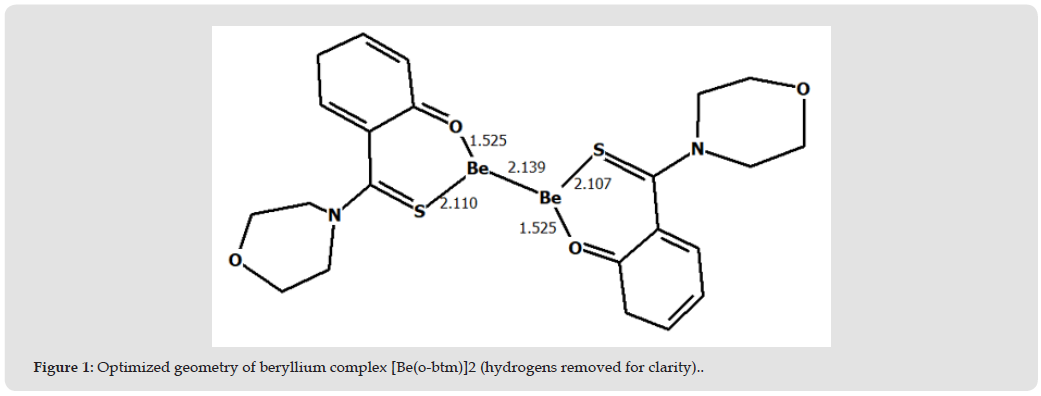
The binuclear beryllium complex [Be(o-btm)]2 was optimized at the TPSS/def2-TZVP level of theory, revealing a symmetric structure with C1 point group symmetry in the final coordinate set. The central feature of the molecule is a direct, non-bridged beryllium-beryllium bond with an internuclear distance of 2.139 Å. This distance is significantly shorter than the sum of the van der Waals radii for beryllium, suggesting a robust metallic interaction. Each beryllium center is coordinated by a terminal ortho-hydroxy-benzothio-morpholide (oH-btm) ligand through a bidentate O, S-chelation mode. Specifically, the Be-O bond lengths are approximately 1.525 Å, and the Be-S bond lengths are 2.110 Å (Figure 1).
Figure 1
Vibrational Spectroscopy
The calculated infrared frequencies provide further insight into the coordination of the oH-btm ligand. The C-O stretching mode is assigned to the band at approximately 1325 cm-1 reflecting the robust phenolate-beryllium interaction. The C=S stretching vibration of the thio-morpholide unit appears at 1110 cm-1, consistent with dative coordination from Sulphur to the metal centres. High-frequency bands between 3050 and 3150 cm-1 correspond to aromatic C-H stretches. Crucially, a metal-metal cantered vibrational mode is identified in the low-frequency region, supporting the structural assignment of a direct Be-Be covalent bond. The absence of imaginary frequencies confirms that the binuclear structure represents a stable local minimum on the potential energy surface.
Characteristic Stretching Modes
(Table 1).
Table 1:

Metal-Centered and Low-Frequency Modes
a) Be-Be Stretching: This mode is a fundamental indicator of the direct metal-metal bond. It is typically found in the 250 - 400 cm-1 regions for group 2 dimers.
b) Be-O / Be-S Stretching: These coordination-specific modes appear in the 450 - 650 cm-1 range, representing the strength of the O, S-chelation.
c) Framework Breathing: The lowest frequency modes (3.7 - 16.3 cm-1) involve the collective motion of the two ligand-metal units relative to each other, confirming the flexibility of the binuclear scaffold.
Energy Decomposition Analysis (EDA-NOCV)
To quantify the nature of the beryllium-beryllium interaction, Energy Decomposition Analysis (EDA) was performed by partitioning the total interaction energy (ΔEint) into physical components. The complex is described as two symmetric [Be(o-btm)]• fragments in their doublet ground states, which couple to form the singlet dimer. The total interaction energy was calculated to be -53.68 kcal/mol, indicating a robustly bound binuclear framework.
A detailed breakdown of the interaction energy reveals the following contributions:
A. Electrostatic Energy (ΔEelstat): -60.39 kcal/mol. This represents the largest attractive component, highlighting the significant polar character of the coordination environment.
B. Orbital Energy (ΔEorb): -38.51 kcal/mol. This substantial stabilizing term accounts or the covalent sharing of electrons between the metal centers and ligand-to-metal charge transfer.
C. Pauli Repulsion (ΔEPauli): 79.13 kcal/mol. This destabilizing term arises from the steric overlap and repulsion between the filled electron shells of the fragments.
D. Dispersion Energy (ΔEdisp): -33.91 kcal/mol. This significant contribution stems from long-range van der Waals interactions between the bulky thio-morpholide ligands.
(Figure 2) of Natural Orbitals for Chemical Valence (NOCV) provides a visual correlate to the orbital energy component. The primary deformation density plot (ΔρNOCV) reveals a prominent accumulation of electron density directly between the two beryllium nuclei. This redistribution confirms that the formation of the direct Be-Be bond is driven by the constructive overlap of metal-cantered orbitals, providing the physical basis for the covalent bond character identified in the ELF and QTAIM analyses. Overall, the EDA-NOCV results characterize the Be-Be interaction as a stable covalent bond supported by strong electrostatic and dispersive stabilization from the oH-btm scaffold (Figure 3).
Figure 2
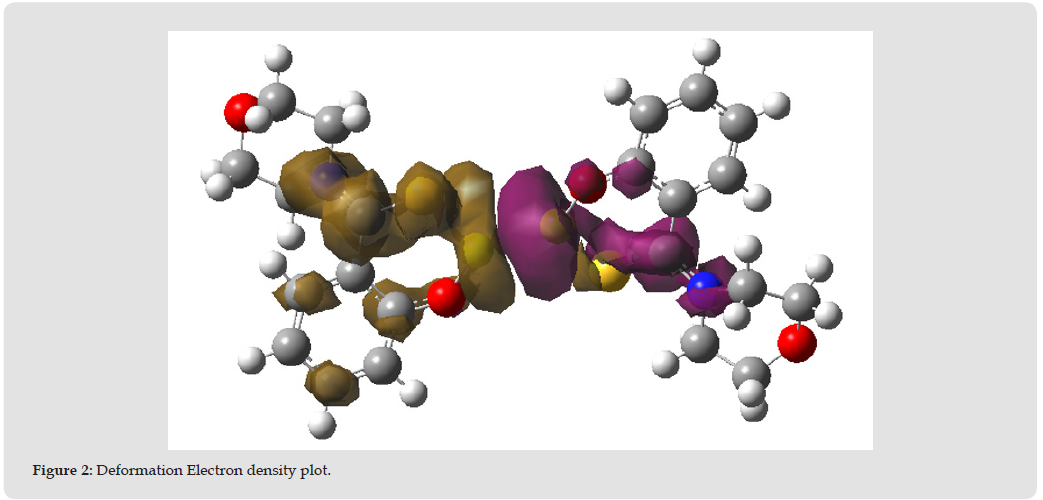
Figure 3

Topological Analysis of Electron Density (QTAIM)
Topological analysis based on the Quantum Theory of Atoms in Molecules (QTAIM) was performed to rigorously characterize the bonding framework of the [Be(oH-btm)]2 complex. The analysis confirms that the binuclear structure is held together by a direct metal- metal interaction, as evidenced by the presence of a (3,-1) Bond Critical Point (BCP) situated between the two beryllium nuclei.
Key Topological Features:
1) Be-Be Bond Critical Point: A BCP (CP 90) was identified along the internuclear axis at a distance consistent with the optimized Be-Be bond length of 2.138 Å.
2) Absence of Bridging: No bond paths or BCPs were observed between the bridging heteroatoms (Oxygen or Sulphur) and the opposite beryllium centres, confirming that the oH-btm ligands coordinate in a purely terminal O,S-chelating fashion.
3) Bond Strength and Character: The accumulation of electron density at the BCP, visualized in the Laplacian (∇ρ) and bond path maps, supports the assignment of a formal covalent bond. This interaction is quantified by an orbital energy contribution of -38.51 kcal/mol determined via EDA-NOCV analysis.
4) Ligand Coordination: BCPs were also identified for the Be-O and Be-S interactions, corresponding to the strong polar-covalent chelation observed in the ELF analysis, where basin populations reached 2.73 e and 3.01 e, respectively. These topological results provide definitive evidence that the dimer is a covalently bonded species rather than a van der Waals adduct, with the Be-Be bond serving as the primary structural anchor for the binuclear framework (Figure 4).
Figure 4

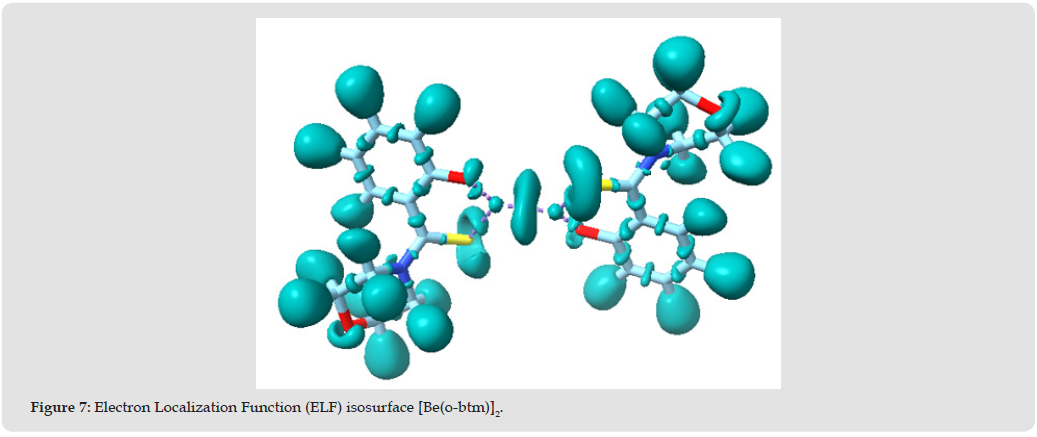
Electron Localization Function (ELF): The topological analysis of the Electron Localization Function (ELF) for the binuclear beryllium complex [Be(o-btm)]2 provides a detailed characterization of the bonding environment. Based on the integrated populations and spatial distribution of the identified basins, the following electronic description is established:
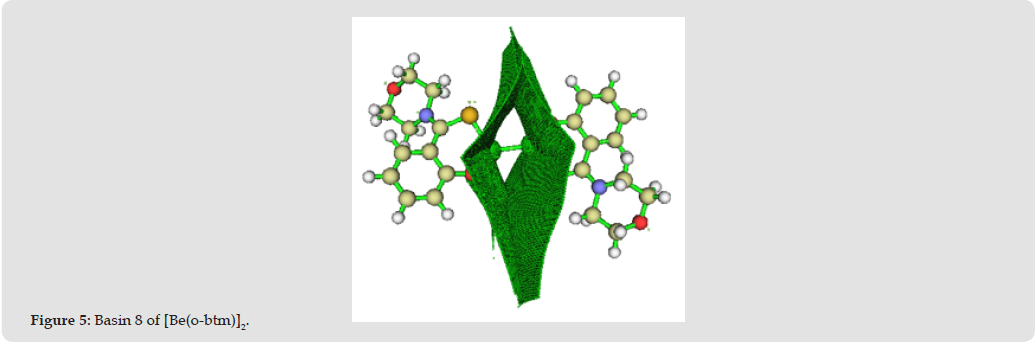
Characterization of the Beryllium-Beryllium Bond: Basin 8 (Label: V(Be29, Be30)), is a disynaptic bonding basin situated directly between the two beryllium nuclei. The electron population of this basin is 1.8339 e, which is nearly to 2 e a definitive indicator of a formal single covalent bond. This shared electron pair serves as the primary structural link in the binuclear framework (Figure 5).
Figure 5
Metal-Ligand Coordination (Be-O and Be-S): The coordination of the ortho-hydroxy-benzothio-morpholide (oH-btm) ligand is defined by strong polar-covalent interactions:
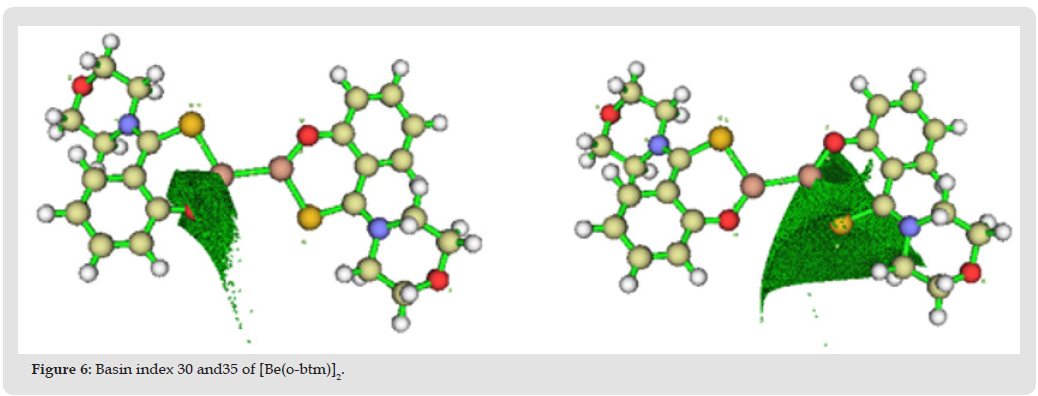
Beryllium-Oxygen Interaction, identified by disynaptic basins V(Be30, O31) (Basin 30) and V(Be29, O32) (Basin 54) with populations of 2.7275 e and 2.7515 e, respectively. Beryllium-Sulphur Interaction represented by disynaptic basins V(S22, Be29) (Basin 35) and V(S8, Be30) (Basin 44) with populations of 3.0087 e and 3.0409 e, respectively. The high populations in these basins suggest robust dative donation from the ligand heteroatoms to the electropositive beryllium centres (Figure 6).
Figure 6
Ligand Lone Pairs (Monosynaptic Basins): The ligands maintain significant non-bonding electron density, contributing to the overall stability of the complex:
Sulphur Lone Pairs was identified as basin 52 (V(S8)) and basin 6 (V(S22)) have populations of 2.6956 e and 2.7506 e respectively. The Oxygen Lone Pairs was located at basin 65 (V(O32)) and basin 11 (V(O31)) having even higher localization with populations of 3.2970 e and 3.3180 e, respectively. These findings, along with the high Fractional Orbital Density (FOD) of 2.0, characterize [Be(oH-btm)]2 as a binuclear Be(I) system stabilized by a central covalent bond and robust O,S-chelation from the oH-btm scaffold (Figure 7 & Table 2).
Table 2: Summary of Key ELF Parameters.

Figure 7
Fractional Orbital Density (FOD) Analysis:
To quantify the multiconfigurational character and static correlation within the [Be(o-btm)]2 complex, we performed a Fractional Orbital Density (FOD) analysis. The FOD calculation, integrated over the entire molecular volume, yielded a total value of 2.0. This significant fractional occupancy is primarily localized on the beryllium-beryllium core, indicating that the system possesses substantial multireference character. A total FOD value of 2.0 is characteristic of a singlet biradicaloid electronic structure. In this state, the two valence electrons associated with the formal Be(I) centers are not entirely localized within a single closed-shell bonding orbital but instead exhibit high static correlation across the Be-Be axis. This high FOD value, in conjunction with the narrow HOMO-LUMO gap of 1.38 eV observed in the TD-DFT results, suggests that the complex exists in a state where the metal-metal bond is highly susceptible to electronic redistribution. The stabilization of this biradicaloid core is effectively managed by the O,S-chelating environment of the oH-btm ligands, which prevents the collapse of the low-valent state into more common Be(II) motifs. These findings underscore the role of the oH-btm scaffold in isolating rare, highly correlated metallic interactions in group 2 chemistry.
Localized Orbital Locator (LOL):
To complement the ELF topological analysis, we generated a Localized Orbital Locator (LOL) map (Figure 8). The LOL plot reveals a prominent region of electron localization along the Be-Be axis, providing intuitive visual evidence for a formal covalent bond. This localized density, coupled with the significant orbital interaction energy of -38.51 kcal/mol, confirms that the binuclear complex is stabilized by a direct, shared-electron interaction rather than simple electrostatic attraction.
Figure 8

Topological Analysis of Electron Density:
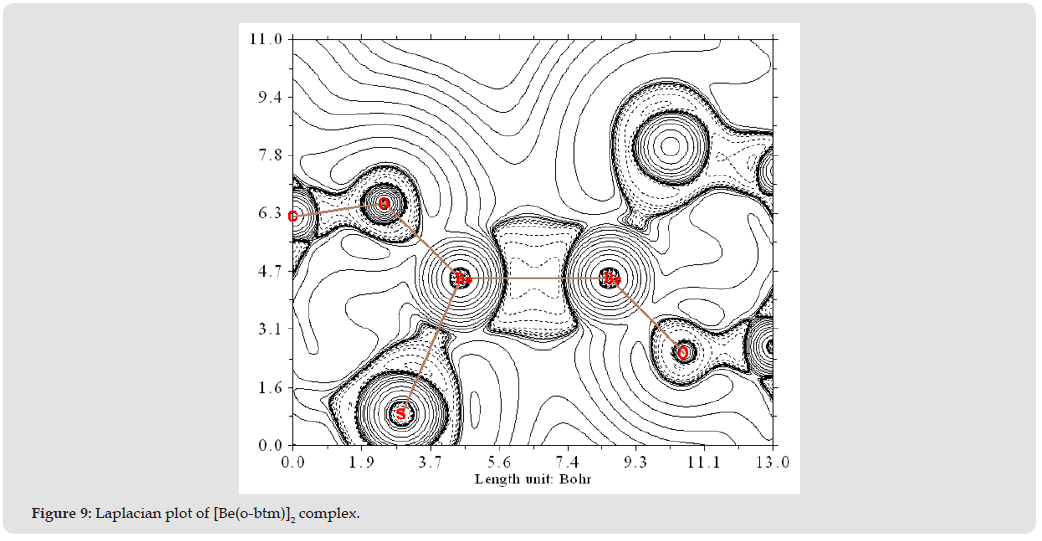
To further characterize the Be-Be interaction, we analyzed the Laplacian of the electron density (∇2ρ). The ∇2ρ contour map (Figure 9) illustrates the typical shell structure of the constituent atoms, with pronounced charge concentration regions around the Oxygen and Sulphur lone pairs. The Beryllium centres are characterized by valence charge depletion, yet a continuous bond path exists between them through a saddle point in the density. This topological feature, combined with the disynaptic ELF basin population of 1.83 e and an orbital interaction energy of -38.51 kcal/mol, provides a consistent description of a stable, non-bridged covalent Beryllium-Beryllium bond.
Figure 9
Time-Dependent DFT (TD-DFT):
The vertical excitation and chiroptical properties of the [Be(obtm)]2 complex was characterized using Time-Dependent DFT (TDDFT) at the TPSS/def2-TZVP level.
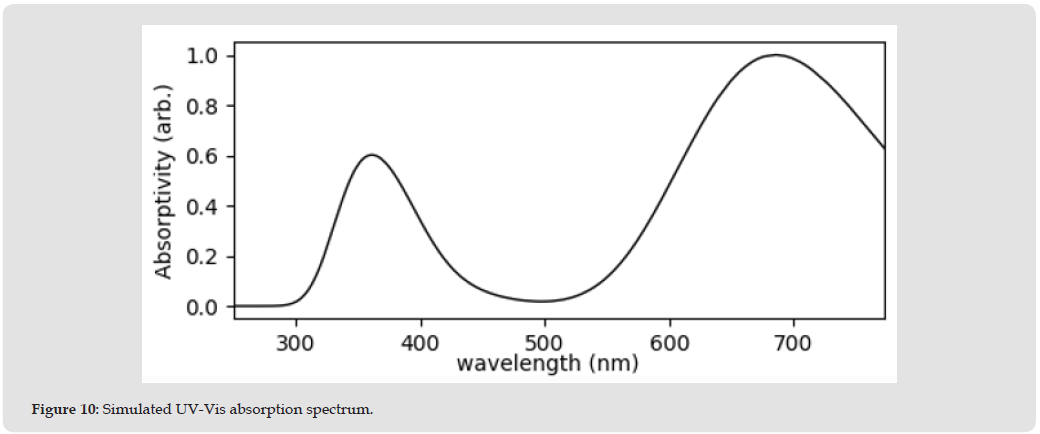
UV-Vis Absorption Profile: The simulated absorption spectrum is dominated by a sharp transition in the visible region: Primary Band (State 1) Centered at 685.4 nm (1.81 eV) with a high oscillator strength (f = 0.4538). which is almost exclusively a HOMO → LUMO (120a →121a) excitation. Natural Transition Orbital (NTO) analysis confirms this transition is localized on the beryllium-beryllium bonding framework (n = 0.985). Significant transitions occur at 360.3 nm (State 11, f = 0.1196) and 343.8 nm (State 14, f = 0.0762), corresponding to ligand-to-metal charge transfer (LMCT) (Figure 10).
Figure 10
Electronic Circular Dichroism (ECD): The ECD spectrum reveals the chiroptical signatures of the C2 - symmetric binuclear core: Visible Cotton Effects: A positive Cotton effect is observed at 685.4 nm (R = +4.08 x 10-40 cgs), directly associated with the Be-Be bonding interaction. Ultraviolet Features: The spectrum is characterized by a strong negative Cotton effect at 360.3 nm (R = -14.01 x 10-40 cgs) and a prominent positive Cotton effect at 343.8 nm (R = +34.83 x 10--40 cgs). The sign and magnitude of these rotational strengths reflect the specific helical orientation of the ortho-hydroxy-benzothio-morpholide ligands around the central metallic axis.
The computational investigation of [Be(o-btm)]2 definitively establishes the existence of a stable, non-bridged binuclear beryllium complex. The structural analysis reveals a direct Be-Be covalent bond with an internuclear distance of 2.138 Å, supported by terminal bidentate O, S-chelation from the Ortho-Hydroxy-Benzothio-Morpholide (oH-btm) ligands. Topological assessments via QTAIM and ELF provide consistent evidence of a formal single bond, characterized by a (3, -1) bond critical point and a disynaptic basin population of 1.834 e. The EDA-NOCV results quantify a robust interaction energy of -53.68 kcal/mol, where significant orbital stabilization (-38.51 kcal/ mol) and electrostatic attraction (-60.39 kcal/mol) overcome Pauli repulsion. Furthermore, the high Fractional Orbital Density (FOD) of 2.0 and narrow HOMO-LUMO gap identify the complex as a unique singlet biradicaloid. These electronic features manifest in a distinctive optical profile, marked by a strong visible absorption and a matching positive Cotton effect at 685.4 nm. Ultimately, this study demonstrates that the rigid O, S-donor environment of the oH-btm scaffold is exceptionally effective at isolating and stabilizing low-valent Be(I) centres. These findings expand the fundamental understanding of group 2 metal-metal bonding and provide a theoretical roadmap for the experimental realization of non-bridged beryllium dimers.

International Association of Landscape Archaeology, Czech Glass Society, Czech Republic

Department of Chemistry, Semenov Institute of Chemical Physics, USSR Academy of Sciences, Moscow, Russia

Associate Professor at Department of Breast and Thyorid Surgey, Chongqing General Hospital, China

Professor of Nuclear Medicine, Faculty of Medicine and Surgery, University of Milan, Milan, Italy

Department of Pharmaceutical Sciences, South University School of Pharmacy, USA





 Abstract
 PDF
PDF