info@biomedres.us
+1 (502) 904-2126
One Westbrook Corporate Center, Suite 300, Westchester, IL 60154, USA
Site Map
 ISSN: 2574 -1241
ISSN: 2574 -1241
ISSN: 2574 -1241
Received: April 02, 2026; Published: April 14, 2026
*Corresponding author: Urmanova Yu M, Alfraganus University, Department of Internal Medicine, Building B, Office No. 204, Republic of Uzbekistan, 100190, Tashkent, Yukori Karakamysh St. 2A, Uzbekistan
DOI: 10.26717/BJSTR.2026.65.010172
Purpose of the Study: To execute comparative discussion of the results of a study of polymorphisms of genetic markers in stage 3 diabetic nephropathy
Study Materials and Methods: The study included 75 patients with type 2 diabetes and stage 3 DN, who were divided into 2 groups:
• The first group included patients with stage 3 CKD with SCF from 59 to 45 ml/min/1.73 m2, n=40 patients (C3a)
• The second group included patients with stage 3 CKD with SCF from 44 to 30 ml/min/1.73 m2, n=35 patients (C3b).
The control group consisted of patients with type 2 diabetes, without CKD, n = 20 patients (12 men and 13 women of similar age). Patients underwent studies that included general clinical, biochemical, genetic, instrumental and statistical studies.
Research Results: Our results generally confirm existing global data on genetic markers of stage 3 diabetic nephropathy. Three polymorphisms (EDN1 Lys197Asn, COMT Val158Met, SOD2 C47T) have high prognostic value and can be used to develop a genetic panel to assess the risk of developing diabetic nephropathy.
Conclusion:
1. The most common risk factors for the development of CKD in our study were arterial hypertension, obesity, physical inactivity, and depression (p < 0.0001).
2. Three of the five analyzed polymorphisms (EDN1 Lys197Asn, COMT Val158Met, and SOD2 C47T) were found to exhibit significant prognostic value.
Keywords: Nephropathy; Diabetes Mellitus; Genetic Markers; Polymorphisms G262A in the CAT Gene; Lys197Asn in the EDN1 Gene; Val158Met in the COMT Gene; C47T in the SOD2 Gene; C718T in the GPX4 Gene; Prognosis
Abbreviations: SPB- Systolic Blood Pressure; DBP: Diastolic Blood Pressure; RF: Renal Failure; ESRD: End-Stage Renal Disease; DN: Diabetic Nephropathy; SNPs: Single Nucleotide Polymorphisms
The search for genetic markers (polymorphisms) in genes influencing the development of end-stage renal disease (ESRD) in individuals with type 2 diabetes mellitus is actively discussed in the scientific community [1-7]. Diabetic nephropathy (DN) is the main cause of ESRD, but the exact mechanisms of its transition to ESRD remain unclear. Regarding the CAT G262A (rs1001179) polymorphism and its association with the risk of ESRD in patients with DN, published studies provide conflicting results [1]. It is noteworthy that Góth L, et al. [3] in Free Radical Research found that the TT genotype (equivalent to AA in our terminology) is associated with elevated HbA1c and triglyceride levels in diabetes, which indirectly confirms the functional role of this polymorphism [2]. Pourvali K, et al. [8] published a review that showed that the V-allele (Val) of rs4880 is associated with an increased risk and progression of DN, with a more rapid decline in GFR in T1DM [8]. Renal nephropathy is a serious complication of diabetes and the leading cause of end-stage renal disease. Research confirms that both environmental factors and genetic predisposition contribute to the development and worsening of renal nephropathy. Specifically, epidemiological data indicate a hereditary predisposition to nephropathy among siblings with type 2 diabetes, highlighting the importance of genetic factors in the disease’s development. So, in 1989, Seaquist ER, Goetz FC, Rich S, and Barbosa J showed that diabetic siblings of patients with DN are at higher risk of developing DN compared to diabetic siblings of diabetic patients without proteinuria.
A common method in genetic research is the analysis of candidate gene polymorphisms using a case-control design, and many studies have focused on such genes. However, genome-wide approaches, such as microsatellite marker scanning, have been used significantly less frequently to assess genetic predisposition to DN [9]. The authors conducted a genome-wide study of single nucleotide polymorphisms (SNPs) in a large cohort of Japanese patients with type 2 diabetes to identify genetic factors contributing to the development of diabetic nephropathy. In a case-control study, we divided patients with type 2 diabetes into two groups: one included those with retinopathy and overt nephropathy, and the other (control) included patients with diabetic retinopathy but no evidence of kidney disease. Genotyping these participants at more than 80,000 SNP loci revealed several genetic regions that are strong candidates for susceptibility factors for DN. The findings demonstrate that genome-wide searches using SNPs as genetic markers are a valuable tool for identifying genes associated with susceptibility to common diseases such as DN [10]. In 2016, Italian authors conducted a systematic review of the most important studies examining genetic predisposition and specific transcriptomic, epigenetic, proteomic, and metabolomic patterns to summarize the most significant features associated with the onset and progression of the disease. They noted that the causes and molecular mechanisms mediating the development of chronic complications of T2DM remain unclear, and it is unclear why disease progression occurs only in some patients [11]. This study examined the relationship between five antioxidant gene polymorphisms and the occurrence and rate of progression of diabetic nephropathy in patients with type 2 diabetes mellitus.
To execute comparative discussion of the results of a study of polymorphisms of genetic markers in diabetic nephropathy
The study was conducted at the Republican Specialized Scientific and Practical Medical Center of Endocrinology of the Ministry of Health of the Republic of Uzbekistan, Tashkent. The study included 75 patients with type 2 diabetes and stage 3 DN, who were divided into 2 groups:
• The first group included patients with stage 3 CKD with SCF from 59 to 45 ml/min/1.73 m2, n=40 patients (C3a)
• The second group included patients with stage 3 CKD with SCF from 44 to 30 ml/min/1.73 m2, n=35 patients (C3b).
The control group consisted of patients with type 2 diabetes, without CKD, n = 20 patients (12 men and 13 women of similar age).
• Inclusion Criteria: type 2 diabetes mellitus, diabetic nephropathy stage 1-3, men and women
• Exclusion Criteria: type 1 diabetes mellitus, acute kidney and heart diseases, systemic cancer.
The patients underwent tests including general clinical (complete blood count, complete urine analysis and according to Nechiporenko), biochemical (blood sugar, glycemic profile, HbA1C, urea, creatinine, blood electrolytes, lipid spectrum, coagulogram, etc.), hormonal blood tests (C-peptide, insulin) in the research laboratory of the RSNPMC of Endocrinology of the Ministry of Health of the Republic of Uzbekistan, ECG, ultrasound of internal organs, consultation with a cardiologist, neurologist, nephrologist, ophthalmologist, surgeon, and other tests. The molecular genetic part of the work was carried out at the Research Institute of Hematology and Blood Transfusion of the Ministry of Health of the Republic of Uzbekistan, in the Department of Molecular Medicine and Cellular Technologies (head, Professor Kh. Ya. Karimov). PolymorphismsG262A in the CAT gene, Lys197Asn in the EDN1 gene, Val158Met in the COMT gene, C47T in the SOD2 gene and C718T in the GPX4 gene in patients with type 2 diabetes mellitus with chronic kidney disease stage 1-3. studied by the SNP method using the SPN express test systems of the Scientific and Production Company Litekh (or Synthol) Genotyping of these markers consisted of several stages: Statistical calculations were performed in the Microsoft Windows software environment using the Microsoft Excel-2007 and Statistica version 6.0, 2003 software packages. The reliability of differences between independent samples was determined using the Mann-Whitney and Student methods.
Table 1 provides a general description of patients with stage 1-3 DN included in the study. From the data presented in Table 1 it is clear that in patients of group 3 the SBP and DBP indicators were significantly higher than in the control group. In the next stage of the study, we examined the risk factors for the development of CKD in the studied cohort of patients (Table 2). As can be seen from Table 2, in the 2nd group of patients there was a significant difference compared to the 1st group in all parameters: average age, frequency of hypertension stage 1, 2 and 3 (arterial hypertension), HO for type 2 diabetes, for CVD, for GP, overweight, obesity, coronary heart disease, depression, physical inactivity, smoking, abuse of analgesics, dyslipidemia (p < 0.005). Thus, the most common risk factors for the development of CKD in our study were arterial hypertension, obesity, physical inactivity, and depression (p < 0.0001). And finally, our main task was to analyze the results of genetic studies with literature data (Table 3). In the present study, the CAT G262A polymorphism did not show a statistically significant association with diabetic nephropathy (p = 0.327 for allele frequency comparisons). However, a study by Horvat T, et al. [2], published in Personalized Medicine, found a strong association of this polymorphism with the risk of end-stage renal disease in type 2 diabetes (p = 0.005 after adjusting for diabetes duration).
Table 1: General characteristics of patients with stage 1-3 DN included in the study.

Note: SPB- systolic blood pressure; DBP – diastolic blood pressure.
Table 2: Risk factors for the development and progression of CKD.
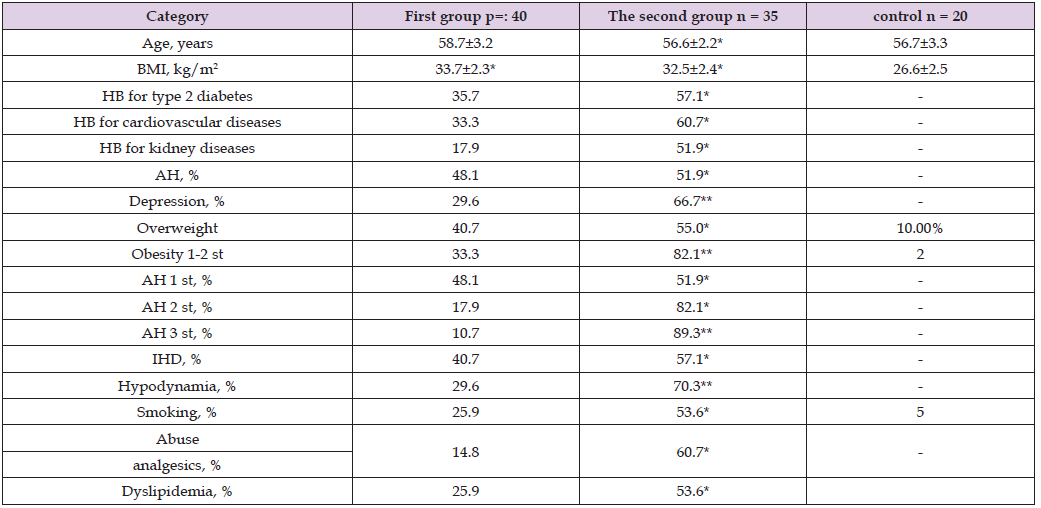
Note: * - significance of differences, where p < 0.005, HB for DM - hereditary burden of type 2 diabetes mellitus, HB for CVD - hereditary burden of cardiovascular diseases, HB for PD - hereditary burden of kidney diseases, IHD – ischemic heart disease, AH - Arterial Hypertension.
Table 3: Risk factors for the development and progression of CKD.

Note: RF - renal failure.
Population Differences
A study by Horvat T, et al. [2]. The study was conducted on a European population (n=181), which may indicate ethnic differences in the influence of the polymorphism. Differences in the studies may be related to the stage of the disease: for example, Horvat T, et al. [2] studied end-stage renal failure, while our sample included patients with stage 3 CKD, which may reflect different pathogenetic mechanisms at different stages of the disease. A study of the SOD2 gene polymorphism revealed its specific influence on the rate of disease progression. This polymorphism was found to significantly differentiate patients with rapid progression from those with slow progression (p = 0.017, OR = 0.46). The observed difference, bordering on statistical significance when comparing slow progression with controls (p = 0.056, OR = 1.69), suggests a potential protective function of the C allele, which encodes alanine. Our results are fully consistent with existing literature data indicating a protective role for the C allele (alanine) and an increased risk in the presence of the T allele (valine). It is important to emphasize that the SOD2 polymorphism is specifically associated with the rate of progression, which is confirmed by other studies demonstrating a more rapid decline in SCF in carriers of the Val allele. A significant association of EDN1 polymorphism with rapid progression of nephropathy was revealed: p = 0.011 for allele frequencies, p = 0.034 for genotype distribution, OR = 0.47 (95% CI: 0.27-0.82). Carriage of the Asn/Asn genotype increases the risk by 2.5 times according to the recessive model (p = 0.017). Alamry, SS et al. [12] showed that carriers of the TT/GT genotypes have a significantly higher incidence of nephropathy compared to GG carriers (p < 0.05) [12]. However, Šeruga M, et al. [13], Folia Medica: European Caucasian population did not show an association of rs5370 with nephropathy in type 2 diabetes [13]. Our study revealed a significant association between the COMT Val158Met polymorphism and the rate of disease progression. The strongest association was observed when comparing groups with rapid progression and the control group: p = 0.0003 for alleles and p = 0.001 for genotypes. Importantly, this polymorphism was able to differentiate patients with rapid and slow progression (p = 0.044). The Val allele demonstrated a pronounced protective effect: in carriers of the Val/Val genotype, the risk of rapid progression was reduced by 6.7 times (recessive model: OR = 0.15, p = 0.004). A number of authors came to the same result [14]. Analysis of GPX4 C718T polymorphism (rs713041) did not reveal a statistically significant correlation with either the risk of developing nephropathy (p = 0.158) or the dynamics of its progression (p = 1.000). Some authors agreed with this opinion [15]. A pooled analysis of 21 scientific studies revealed no statistically significant differences in the frequency of rs713041 genotypes between groups of patients with type 2 diabetes and healthy volunteers. Thus, our results generally confirm existing global data on genetic markers of stage 3 diabetic nephropathy. In particular:
• EDN1 Lys197Asn: High prognostic significance was confirmed, consistent with the study by Alamry, et al. [12], which found an association between the T allele (Asn) and nephropathy. Biochemical data support the mechanism of increased endothelin-1 levels.
• COMT Val158Met: Data consistent with the protective role of the Val allele were obtained. Despite the limited number of direct studies on nephropathy, associations with diabetes and known functional differences in enzyme activity (3-4- fold) support our conclusions. This marker proved to be the most valuable in our study.
• SOD2 C47T: The protective role of the C allele (Ala) in diabetic complications is fully confirmed by a large meta-analysis by Jia et al. (2011) and other studies. Our data on the effect on the rate of progression complement this overall picture.
• CAT G262A: Conflicting results were identified that require further study. Discrepancies with the study by Horvat et al. may be due to differences in disease stages and population characteristics.
• GPX4 C718T: The lack of association is confirmed by literary data, despite the known role of the GPX4 protein in pathogenesis. Thus, three polymorphisms (EDN1 Lys197Asn, COMT Val158Met, SOD2 C47T) have high prognostic value and can be used to develop a genetic panel to assess the risk of developing diabetic nephropathy.
1. The most common risk factors for the development of CKD in our study were arterial hypertension, obesity, physical inactivity, and depression (p < 0.0001).
2. Three of the five analyzed polymorphisms (EDN1 Lys197Asn, COMT Val158Met, and SOD2 C47T) were found to exhibit significant prognostic value.

International Association of Landscape Archaeology, Czech Glass Society, Czech Republic

Department of Chemistry, Semenov Institute of Chemical Physics, USSR Academy of Sciences, Moscow, Russia

Department of Educational Sciences, Research Centre Qualities of Teachers, School of Education – HAN, Nijmegen, Netherlands

Associate Professor at Department of Breast and Thyorid Surgey, Chongqing General Hospital, China

Neurology, LA BioMed Research Institute, USA





 Abstract
 PDF
PDF



























