info@biomedres.us
+1 (502) 904-2126
One Westbrook Corporate Center, Suite 300, Westchester, IL 60154, USA
Site Map
 ISSN: 2574 -1241
ISSN: 2574 -1241
ISSN: 2574 -1241
Received: March 23, 2026; Published: April 06, 2026
*Corresponding author: Florin Gaiseanu, Science and Technology of Information, University of Bucharest, and Centro Nacional de Microelectrónica, Barcelona, Spain
DOI: 10.26717/BJSTR.2026.65.010163
The current debate on the increase of the events of the juvenile delinquency, with negative effects on society in general and the local communities from which children and young people are engaged in such events, opens the topic of the importance of the balance between dependence and independence in the training and education of children and adolescents, to ensure their healthy physical and mental development. This paper proposes to discuss this issue, by assuming the Informational Model of Consciousness and explaining behavior based on the functioning of the seven cognitive centers that compose consciousness.
Lastly, we talk about future critical views, including the issue of data scarcity, the problem of black box interpretability in clinical translation, and the evolutionary route in the FDA regulation of AI-generated medical devices, highlighting the transformative opportunity of AI in bone regeneration.
Keywords: Informational Model of Consciousness; Juvenile delinquency; Decision-Making and Behavior; Dependence/ Independence of Children/Young People; Education; Influences of Internet and Groups
Abbreviations: CASI: Center of Acquisition and Storage of Information; CDC: Center of Decision and Command; IES: Info-Emotional System; MIS: Maintenance Information System; GTS: Genetic Transmission System; IGG: Info- Genetic Generator; IC: Info-Connection; EDU: Educational Factors
Recently, there were witnessed at national and international levels, an increased attention on reprehensible, and often abominable recrudescent acts committed by young people – thefts, threats, verbal and physical violence, reaching not only damage to those around them, but even crimes, their age falling even below the adult age, synthetically referred to as juvenile delinquency [1]. The difficulties induced in children’s behavior by indiscriminate exposure to the Internet and its negative effect, are also recognized and treated scientifically [2]. This situation raises two major questions and concerns for society, the competent authorities, and also for the families and parents of the children and young people involved:
1. To what extent independence can be granted to children and future adolescents and young people, in relation to the need to control their behavior and limit their access to independence, tempted to embark on risky adventures;
2. Which should be the lower age than the current one, at which the assumption of personal responsibility to occur, as well as access to information sources on the internet, in order to prevent antisocial acts and tendencies.
In this context, on the basis of the Informational Model of Consciousness, elaborated and presented recently extensively [3], as well as in a series of articles [4,5], showing the importance of the management and coordination of attention and will on a successful path, in accordance with personal and social order and progress [6], in this paper it is analyzed and commented the balance between independence – as a need for personal affirmation and expression – and dependence on parental control, school and society, for the framing and personal expression within the framework of social rules, of personal and general mental health.
The Informational Model of Consciousness highlights the existence of seven cognitive centers of Consciousness, processed by the brain in correlation with the body and its organs, as a result of the activity of the definitively different informational centers (Figure 1).
Figure 1
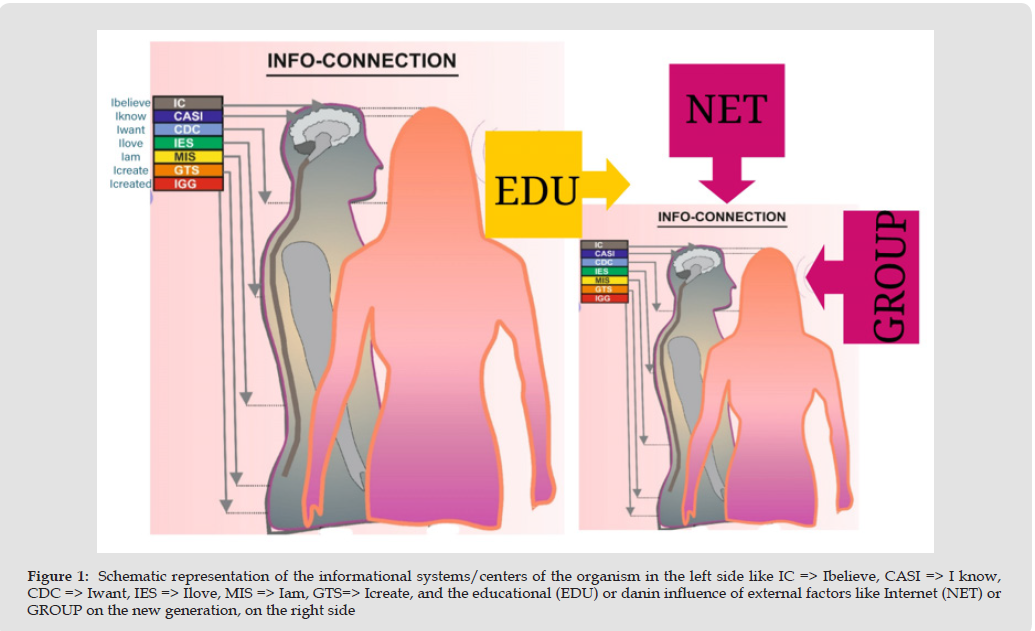
1. Center of Acquisition and Storage of Information (CASI) – the memory and informational connection components, ensuring the entry of Information (Info input), detected in consciousness as know (Figure 1 left side and its explaining text), defined as such because it represents the accumulation of data and experience resulting from interaction with the external and internal environment through informational sensors (Figure 1 left-upper side and the explanatory text of this Figure);
2. The Center of Decision and Command (CDC), processor of Decision and Command to the motor execution centers, as an informational output expression (Info Output), operational in consciousness as the cognitive center Iwant;
3. The Info-Emotional System (IES), operating the emotional reaction to Information, and detected in consciousness as Ilove cognitive center, highlighting that the natural state of consciousness is oriented towards harmonious functioning and contentment, in agreement with the body and the environment; 4. The Maintenance Information System (MIS), managing the matter processing circuit (food, air, water), and detected in consciousness through Iam, as an existential entity, with all physical (vigor, vigor) and mental (health) capabilities and characteristics;
5. The Genetic Transmission System (GTS) – the Info-Genetic Output, operating reproduction, and detected in consciousness as Icreate, referring to the biological creativity of the new generatio; this center is not limited (or should not be limited) only to reproduction, but also to the training and education of the younger generation;
6. The Info-Genetic Generator (IGG), responsible for the formation of the organism as a product of the genetic contribution of each parent, and its evolution over time, playing the role of individual genetic Info-Input and detected as Icreated.
7. Info-Connection (IC) establishes the limits within which consciousness operates with new information; it can be accepted, if it corresponds to previously acquired or inherited experience (impulses, temptations), or rejected (Yes/ No – Bit-type operation) in all other cases, detected in consciousness as the cognitive center Ibelieve. The fundamental mental substrate explored by this center is represented by mentality, as the foundation of orientation in life, continuation of acquired/inherited beliefs, of the way of thinking and judging in various situations, according to the decision criteria, transmitted by parents not only genetically, but also through training and education.
The above description recognizes that Attitude is actually the form of expression of the Iwant cognitive center, and its manifestation is reflected in behavior. Attitude is a function of Information, coming both from the external environment with which the organism connects, passing through the Iknow and Ilove centers, and from the automatic/ programmed centers, those representing the state of health, vigor/power Iam, from Icreate, focused on inter-social relationships and their validation, as well as from the Icreated center, signaling inherited or acquired characteristics, especially through education. The IC center selects information, monitoring it according to its nature, circumstances and personal experience, by acceptance or rejection.
The primary role in the physical and mental development of children falls to parents, taking into account not only the biological process of genetic transmission of information as such (Icreated), but also the educational one, of forming the knowledge base (Iknow) and judgment (Iwant), as well as the foundation/cementation of the way of looking at life, of relating to it in the family and society. This is because the human being is adaptable, its fundamental characteristic being the ability to adapt through learning [7], from the need to survive in the ever-changing environmental conditions. This property has allowed man to become what he is today, on the scale of species evolution, situated at the top of his development. In the information age that we live in today [8,9], as witnesses [8], creators [10,11] as well as beneficiaries [12,13] of the unprecedented development of microelectronics and informational mass-media devices [13], the abundance of information is overwhelming, which makes it increasingly difficult, and therefore all the more necessary, to carefully monitor the formation of the mentality of children and young people on the path of life. The role of the school is also obvious and decisive in the course of formation within education (EDU in the right side of Figure 1), planting in the consciousness of children (Iknow, Ibelieve) the sense of Duty and Responsibility, the difference between Good and Bad, allowing the selective choice of Yes/No of information, based on the formation of correct decision criteria (Iwant/Ibelieve). The dependence of children on the parents and then on educational factors (EDU), is therefore mandatory. At no time should children’s behavior be overlooked, and the causes of an inadequate manifestation discovered. This can be caused by reasons of physical or mental fatigue, which must be remedied by ensuring the operability/ health of the Maintenance system (Iam), but if it persists, tending to become chronic, external causes should be sought, which may be due to connection to sources of harmful information and influence. The independence of children and young people must be understood through the need to manifest their personality (Icreated, Iam, Iwant), in correlation/interaction with the environment and society. Independence, understood as the personal form of manifestation of one’s own qualities (Iwant/Ibelieve, Icreated, Iknow), from the perspective of perfecting and encouraging one’s own talents, predispositions and skills [14]. This independence granted by educational factors (EDU in Figure 1 right side) from the family, from society, develops a personal physical and mental personality of children and young people, allowing them the open path to a successful career [15]. This is the path to sports, creative performances [15] in the profession and in any field of activity.
Connecting to inadequate sources of training/information (NET, GROUP, Figure 1 right side) facilitated by the passivity/inaction of educational factors on Iknow, leads to an independence that is harmful to one’s own development and to society. The multitude of information sources today on the internet (NET in the right side of Figure 1), the harmful cohesion of some “terribly” groups formed on the internet or in reality (marked as GROUP in Figure 1 right side), potentiating the antisocial attitude through the courage and “strength”/approval emanating from the group, which suppresses the personal fear of repercussions and bearing the consequences, is the path to perdition. This path leads to abusive, aggressive, violent behavior, potentiated by alcohol, drug consumption and disengagement from social and moral rules, behavior that is intolerable. The unprecedented development of communication media that society enjoys today can therefore have both positive and negative effects. Positive examples, represented in the family by parents themselves, and later by role models, can have a strong influence on children. The first “heroes” serving as examples for children are parents. Later, such heroes are characters in films, famous figures in society such as artists, athletes, scientists, actors. But the media unfortunately also presents “evil” examples, in cartoons for children, sometimes abounding in “exotic” characters represented by ugly, prehistoric animals, or violent characters involved in fights, crimes, obscenity.
Children’s access to such products, as the only way to resolve conflicts, modifies the body’s/soul’s natural state of harmonious equilibrium [16], transforms/”educates” them in the spirit of violence, introducing them to an unreal, but also abnormal, virtual world, which through repetition, makes them believe that this is the world they live in, thus dramatically confusing the unreal with reality. This mental metamorphosis fabricated by uncontrolled access to the unreal world, leads to manifestations of mental illness, described by the medical literature as serious mental disorders (expressed by schizophrenic, bipolar and mood syndromes), characterized by persistent, extreme, and disruptive emotional states (Ilove) [17]. The natural emotional tendency of man represented by Ilove, then transforms into its antagonist – Ihate, translated into society and family through a hostile, antisocial attitude, leading to violence or even to crime, or to depression, personal and social abandonment, a serious form of the antipode of the Iwant decision-making center, converting it into Idon’tWant! This attitude can unfortunately lead to dramatic decisions against oneself, to suicide. Undesirable events can therefore appear in seemingly surprising ways, if parental, school, societal and educational factors descontrol the physical and mental development of children and adolescents. Measures to limit children’s access to some social media platforms on the Internet, as well as lowering the age of responsibility for premeditated acts, below the adult age, already proposed in some European countries and other continents (Australia), are thus justified.
As it was shown in a recent study [18], the limitations of children’s internet (NET, GROUP) access are also crucial to prevent addiction, exposure to inappropriate content (with beneficial effects on Iknow/I want) and physical health issues (Iam), like eye strain or poor posture, with 18.4% of children showing signs of problematic internet use [18].
The analysis of the balance of dependence vs. independence in the education/training of children/adolescents and their integration into society, is a current topic of particular interest for monitoring/ controlling young people for disengagement in juvenile delinquency events. The involvement of concepts associated with the Informational Model of Consciousness, specifically represented by the functioning of the body’s information systems and the corresponding cognitive centers, allows for the explicit description of the mechanisms of correct or reprehensible manifestation. The influence of personal examples from family and society, of prolonged connection and exposure to some inadequate information sources, association in delinquent groups, through the attraction of group power, the influence of mass-media and social media platforms on the Internet, increase the danger of delinquency, and therefore the obligation of the family, of the education and training factors in society to curb and stop this phenomenon.
Timely recognition of apathetic behavior, opposed to integration into the current community, or that dedicated to the influence of harmful factors, usually associated with aggression, violence, potentiated by drug and alcohol use, with effects on mental alienation, must be immediately combated. Stimulation of independence committed to the personal development of predilections, talents and predispositions, paves the way for physical and mental performance, as well as personal and professional success.
To Maria Gaiseanu with Love, for her dedication in Profession, Family and Life.

International Association of Landscape Archaeology, Czech Glass Society, Czech Republic

Department of Chemistry, Semenov Institute of Chemical Physics, USSR Academy of Sciences, Moscow, Russia

Department of Educational Sciences, Research Centre Qualities of Teachers, School of Education – HAN, Nijmegen, Netherlands

Associate Professor at Department of Breast and Thyorid Surgey, Chongqing General Hospital, China

Neurology, LA BioMed Research Institute, USA





 Abstract
 PDF
PDF



























