info@biomedres.us
+1 (502) 904-2126
One Westbrook Corporate Center, Suite 300, Westchester, IL 60154, USA
Site Map
 ISSN: 2574 -1241
ISSN: 2574 -1241
ISSN: 2574 -1241
Received: March 03, 2026; Published: March 18, 2026
*Corresponding author: Yachao Liu, Department of Nuclear Medicine, The First Medical Center, Chinese PLA General Hospital, Beijing,
China
Hui Zhou, Department of Nuclear Medicine, The First Medical Center, Chinese PLA General Hospital, Beijing, China
DOI: 10.26717/BJSTR.2026.65.010139
Prostate-specific membrane antigen (PSMA) is intensely overexpressed in most prostate cancers (PCa) [1]. AGluurea- Lys motif has been identified to bind with high affinity to the catalytic domain of PSMA [2]. After its conjugation to the chelator HBED-CC, a 68Ga-labelled PSMA ligand (68Ga-PSMA-11) has been developed as a novel PET tracer [3-4]. Given that PSMA undergoes internalization upon ligand binding, it also serves as an excellent target for systemic radionuclide therapy [5]. On March 23, 2022, 177Lu-PSMA-617 was first approved by the US Food and Drug Administration (FDA) for patients with prostate-specific membrane antigen (PSMA)-positive metastatic castration-resistant prostate cancer (mCRPC) prior to chemotherapy and ADT treatment. This approval represents a major RDC breakthrough in the field of prostate cancer treatment. There are some compounds, such as 177Lu-PSMA I&T and 177Lu-J591 that are already in the clinical trial development stage. 177Lu-PSMA I&T is one of the most widely used PSMA RLT drugs at present. It was first synthesized by the Technical University of Munich [6] and has demonstrated significant efficacy and good safety in patients with mCRPC. Therefore, we are developing a novel theragnostic drug 177Lu-TR0471 development, which is an optimized based on the structure of 177Lu-PSMA I&T aiming at better efficiency and safety. Here, we report a case of prostate cancer with lung and multiple bone metastases treated by 177Lu-TR0471.
Abbreviations: PSMA: Prostate-Specific Membrane Antigen; PCa: Prostate Cancers; FDA: Food and Drug Administration; mCRPC: Metastatic Castration-Resistant Prostate Cancer; ADT: Androgen Deprivation Therapy; OS: Overall Survival; TEAEs: Treatment-Emergent Adverse Events
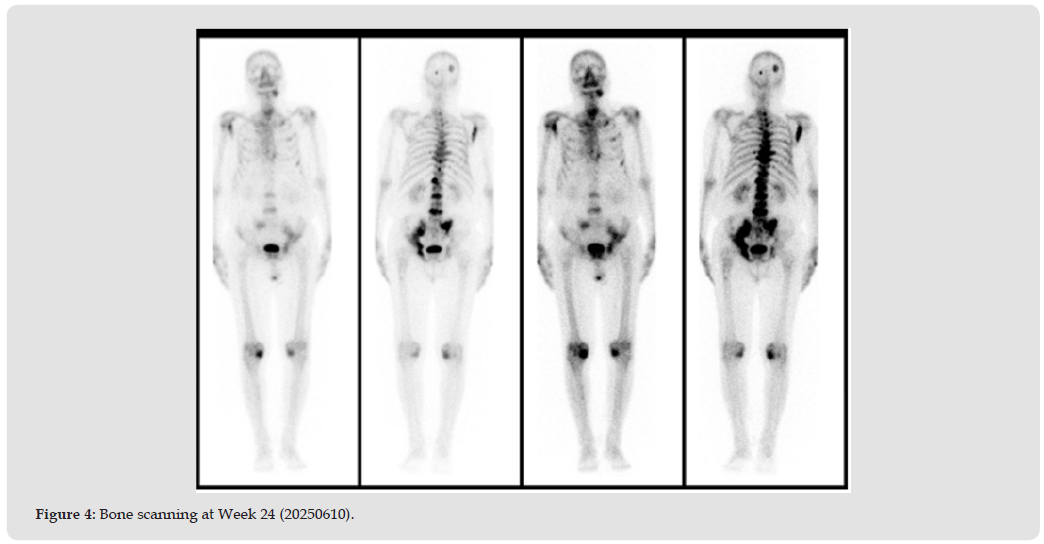
A 73-year-old Asian male who was diagnosed with prostate cancer (with lung and bone metastases) and a Gleason score of 4+4 on May 25, 2023. On May 26, 2023, Androgen Receptor Targeted Agents (ARDT, including enzalutamide, bicalutamide,) was initiated; on June 14, abiraterone and prednisone were used until C1D1 and then stopped; zoledronic acid 5 mg has been continuously used since May 26, 2023.During this period, androgen deprivation therapy (ADT) was continuously carried out. The image presented here showed the patient of prostate cancer with multiple bone metastases (>20 lesions) throughout the body at baseline (Figure 1). PSMA PET/CT demonstrated a tumor phenotype with strong PSMA expression. The patient was treated with an activity of 7.4 GBq 177Lu-TR0471 once every 6 weeks, for a total of 6 administrations. PSMA PET/CT (Figures 2-4) revealed a very good radiological response with bone metastasis lesion until week 24. In addition, The PSA level is 104.20 ng/mL at baseline. It started to decline from week 4 with 78.92 ng/ml and achieved PSA50 response at week 12 and reached its lowest point at week 24 with 31.76ng/ml. Adverse events were reported using Common Terminology Criteria for Adverse Events v5.0. Treatment-related adverse events include dry mouth (grade1) and dry eyes (grade1) assessed by the investigator as definitely, probably, or possibly related to treatment. Patients diagnosed by PSMA imaging, followed by treatment with a therapeutic PSMA-targeted agents, showed significant potential for improving the clinical management of advanced prostate cancer (PCa).
Figure 1
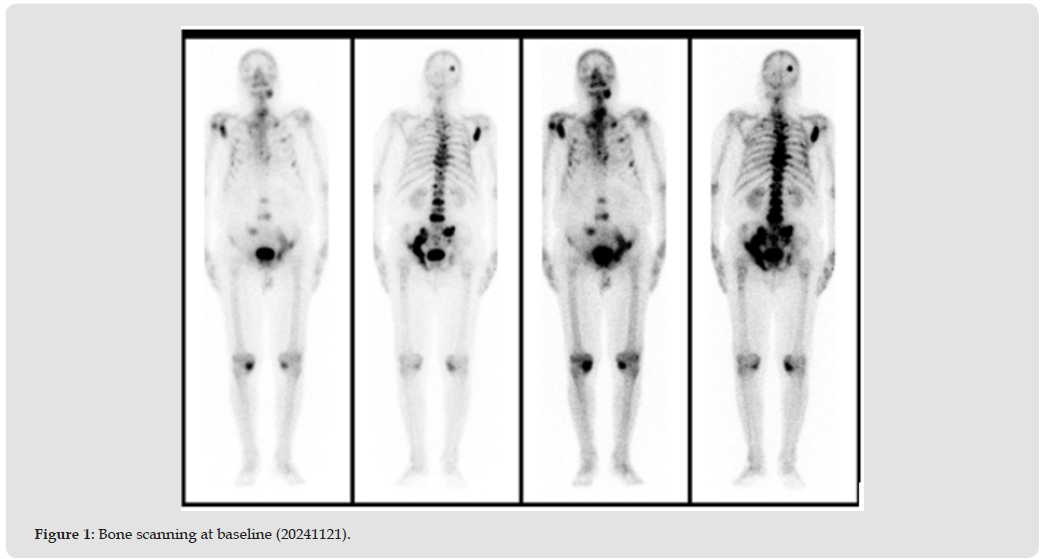
Figure 2
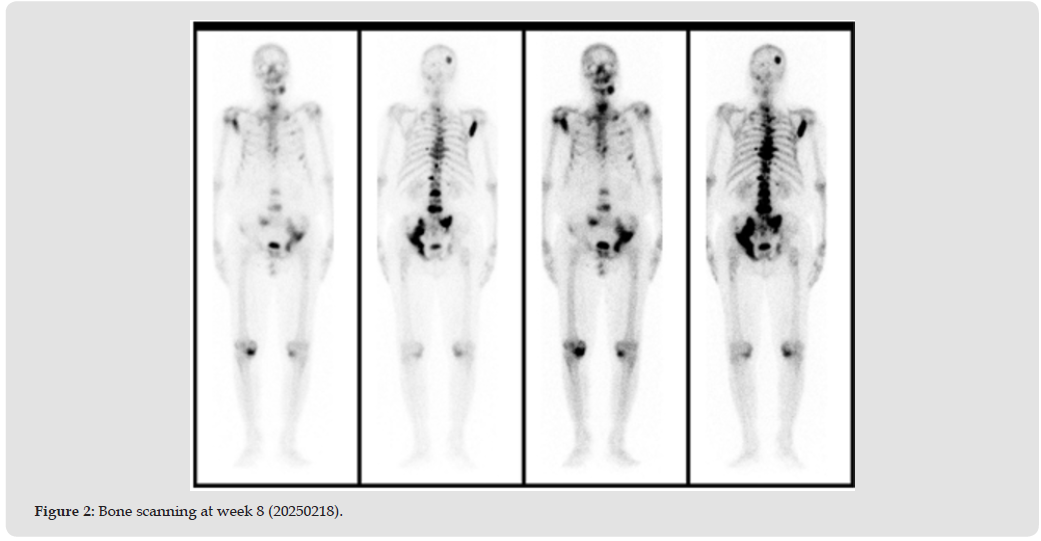
Figure 3
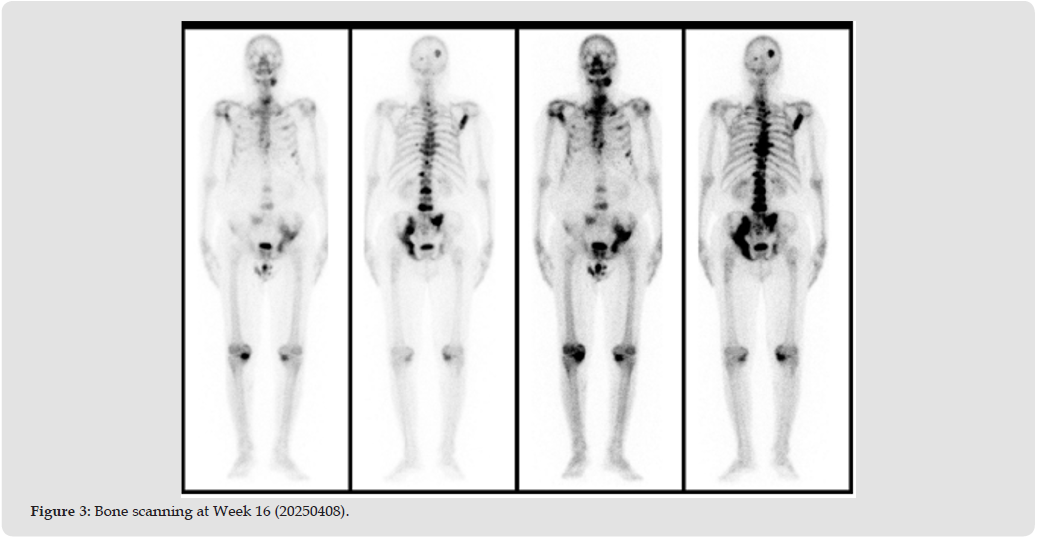
Figure 4
Prostate cancer (PCa) is one of the most common cancers in men. 5% of patients are diagnosed with metastatic disease and 30- 40% of patients will develop biochemical recurrence after treatment (surgery and/or radiotherapy) [7]. A substantial proportion of these patients will develop metastatic castration-resistant prostate cancer (mCRPC). The long-term prognosis for patients with mCRPC is poor, with a relatively short overall survival (OS). Since the introduction of docetaxel in 2004, there has been a surge in novel treatments for mCRPC, including new cytostatic agents, second-generation antiandrogens, bone-targeted therapies, immunotherapy, poly (adenosine diphosphate-ribose) polymerase (PARP) inhibitors, Akt inhibitors, and radioisotopes, such as 177Lu-PSMA-617 [8].
For metastatic castration-resistant prostate cancer, 177Lu-PSMA I&T is a targeted PSMA radioligand therapy drug with good safety and efficacy. Currently, there is no similar product approved for clinical trials in China. Overseas, companies such as POINT Biopharma have completed a multicenter, open-label, randomized controlled phase 3 clinical trial (SPLASH study, NCT04647526) in patients with PSMA-positive mCRPC who have progressed after one ARDT treatment and have not received chemotherapy. The dose of 177Lu-PSMA I&T used was 6.8 GBq, administered once every 8 weeks, for a maximum of 4 cycles. 27 met all eligibility criteria. Median (95% CI) rPFS was 11.5 (9.2-19.1) months, a PSA decline of ≥50% occurred in 42.3% (11/26) of participants, and confirmed ORR for evaluable disease was 50% (5/10). 177Lu-PSMA I&T was associated with no treatment-related deaths, few treatment-related grade≥3 treatment-emergent adverse events (TEAEs), and no discontinuations for unacceptable toxicity. TEAEs occurring in ≥10% of participants included dry mouth (22.2%; all grade 1), fatigue (18.5%; grades 1-2), nausea (18.5%; grades 1-2), and anemia (14.8%; grades 1-3). [9]. In the ECLIPSE study (NCT04647526), the dose of 177Lu-PSMA I&T used was 7.4 GBq, administered once every 6 weeks, for a maximum of 6 cycles. The study design is like the SPLASH study, which was initiated in the first half of 2022 and is still ongoing until 2029.
In conclusion we reported a case of metastatic castration-resistant prostate cancer with multiple bone metastases (>20 lesions) throughout the body at baseline. The dose of 177Lu-TRD0471 used was 7.4 GBq, administered once every 6 weeks, for a maximum of 6 cycles and is like ECLIPSE study and it also shows [177Lu] Lutetium-labelled PSMA ligand-induced tumor remission at multiple bone metastases (>20 lesions) throughout the body. We are currently planning a prospective multi-center trial to evaluate the clinical potential of 177Lu- TR0471.

International Association of Landscape Archaeology, Czech Glass Society, Czech Republic

Department of Chemistry, Semenov Institute of Chemical Physics, USSR Academy of Sciences, Moscow, Russia

Neurology, LA BioMed Research Institute, USA

Associate Professor at Department of Breast and Thyorid Surgey, Chongqing General Hospital, China

Professor of Nuclear Medicine, Faculty of Medicine and Surgery, University of Milan, Milan, Italy





 Abstract
 PDF
PDF



























