info@biomedres.us
+1 (502) 904-2126
One Westbrook Corporate Center, Suite 300, Westchester, IL 60154, USA
Site Map
 ISSN: 2574 -1241
Received: February 18, 2026; Published: February 26, 2026
*Corresponding author: Ryszard Kłos, Diving Gear and Underwater Work Technology, The Polish Naval Academy, 69 Śmidowicza Str., 81- 127 Gdynia, Poland
DOI: 10.26717/BJSTR.2026.64.010114
The result of the research carried out and described in this cycle of articles is the development and verification
of the approach to modelling of the ventilation processes. The presented approach is a return to deterministic
modelling, abandoned due to the lack of good methods to assess the volume of ventilated space. Finding a way
to measure this value was the key element in the carried-out research. Search for mathematical models is a commonly
used procedure. When dealing with complex issues, methods to search for empirical or semi-empirical
models are used. With regard to less complicated problems, attempts are made to develop analytical models that
have physical interpretation. The presented approach can completely change the current approach to ventilation
processes by replacing semi-empirical models with more accurate analytical models. Validating the latter
is often unnecessary because they are based on the verified laws of nature. The research carried out was aimed
at developing and verifying a general analytical mathematical model of the ventilation process, both for objects
with semi-closed and closed circulation of breathing gas, for hyperbaric and norm baric conditions.
This cycle of articles will be useful for engineers designing devices in which ventilation processes take place, in
particular designers: breathing apparatus, submarines, mines, safety chambers, industrial buildings and other
closed or semi-closed compartments.
Keywords: Ventilation; Diving Apparatus; Decompression Chamber; Mining Cave; Submarine
The mathematical models of ventilation in diving apparatuses have been presented in the cycle of articles deal with ventilation of the hyperbaric chambers, the submarines and the mining excavation. The mathematical models of ventilation for Semi-Closed-Circuit Rebreather (SCR) are based on the mass balance of oxygen in a respiratory mixture inhaled by a diver. For time approaching infinity t→∞, the mathematical models proposed here became the same as the models proposed by the other authors (Haux G [1]). The full time-dependent models are useful during design of the diving apparatus and suitable decompression. In many cases they are good enough to be useful for illustrating the important phenomena occurring in the diving apparatus. Frequently conclusions concerning the composition stabilization rate of the diving apparatus atmosphere following disturbances caused by a change in the oxygen consumption level or caused by periodical ventilation can be drawn based on that model (Kłos R [2,3]). The most important problem associated with the modelling of ventilation refers to a semi-closed rebreather SCR. In SCRs a relative decrease in the oxygen concentration in the inhaled breathing medium is observed compared to the oxygen content in the stored fresh mixture or gas mixture dynamically prepared from gases stored in bottles integrated with the SCRs. The results of the research carried out and described in this cycle of articles are the development and verification of the approach to modelling of the ventilation processes.
The presented approach is a return to deterministic modelling, abandoned due to the lack of good methods to assess the volume of ventilated space. Finding a way to measure this value was the key element in the carried-out research. The classical models are not precise enough as regards the presented here introduction of Semiclosed Circuit Self-container Underwater Breathing Apparatus CRABE - SCR CRABE SCUBA (Kłos R [3-7]). The experiments concerning the mathematical ventilation models were performed during manned and unmanned experimental diving aimed at verification of the decompression procedure proposed. The experiments were carried out for semi-closed rebreathers SCRs. The tested SCRs should feature the same parameters as the parameters assumed to derive the mathematical model. Traditionally the ventilation modelling assessment has been conducted using semi-empirical methods like dimensional analysis (Kłos R [8]). The classic approach is based on experiments with physical models in increased or decreased scale. The experiments concerning the mathematical ventilation models were performed during manned and unmanned experimental diving through more than 40 years (Kłos R [9,10]).
Implementation of newly developed structural solutions applied in SCR is inseparable with carrying out experiments involving people who are exposed to risks associated with the inherent necessity to test new or modernized diving technologies. Firstly, in the new cycle of scientific investigations there were performed the unmanned experiments by means of a combined respiratory, metabolic and hyperbaric simulator. Its use should reduce risk in such research. The aim of the design should be to develop a pressure attachment that enables oxygen uptake from the breathing atmosphere, then humidifying and replacing oxygen taken from the atmosphere by a suitable amount of carbon dioxide emitted. Solution to this problem will enable modelling the processes occurring in SCR. This will enable saving time, costs of diving equipment design and costs of developing decompression schedules. As there was no verified mathematical model available, it was necessary to reconstruct the SCR prototype after each series of the preliminary investigations. Moreover, the model to be and verified model will make it possible to evaluate the diving systems in use. To simulate the respiratory process a mechanical representation of pulmonary ventilation and gas exchange in the course of breathing are needed. The processes should be precisely and repeatedly represented, however there is no need for each detail of the real respiratory cycle is to be represented. Usually, it is assumed that an approximated shape of respiration should be sinusoidal.
When the body gas exchange is simulated, attention should be focused on oxygen consumption and its replacement by the carbon dioxide emitted. A respiratory quotient defines the volumetric ratio for the emitted carbon dioxide that replaces the oxygen consumed.
Construction
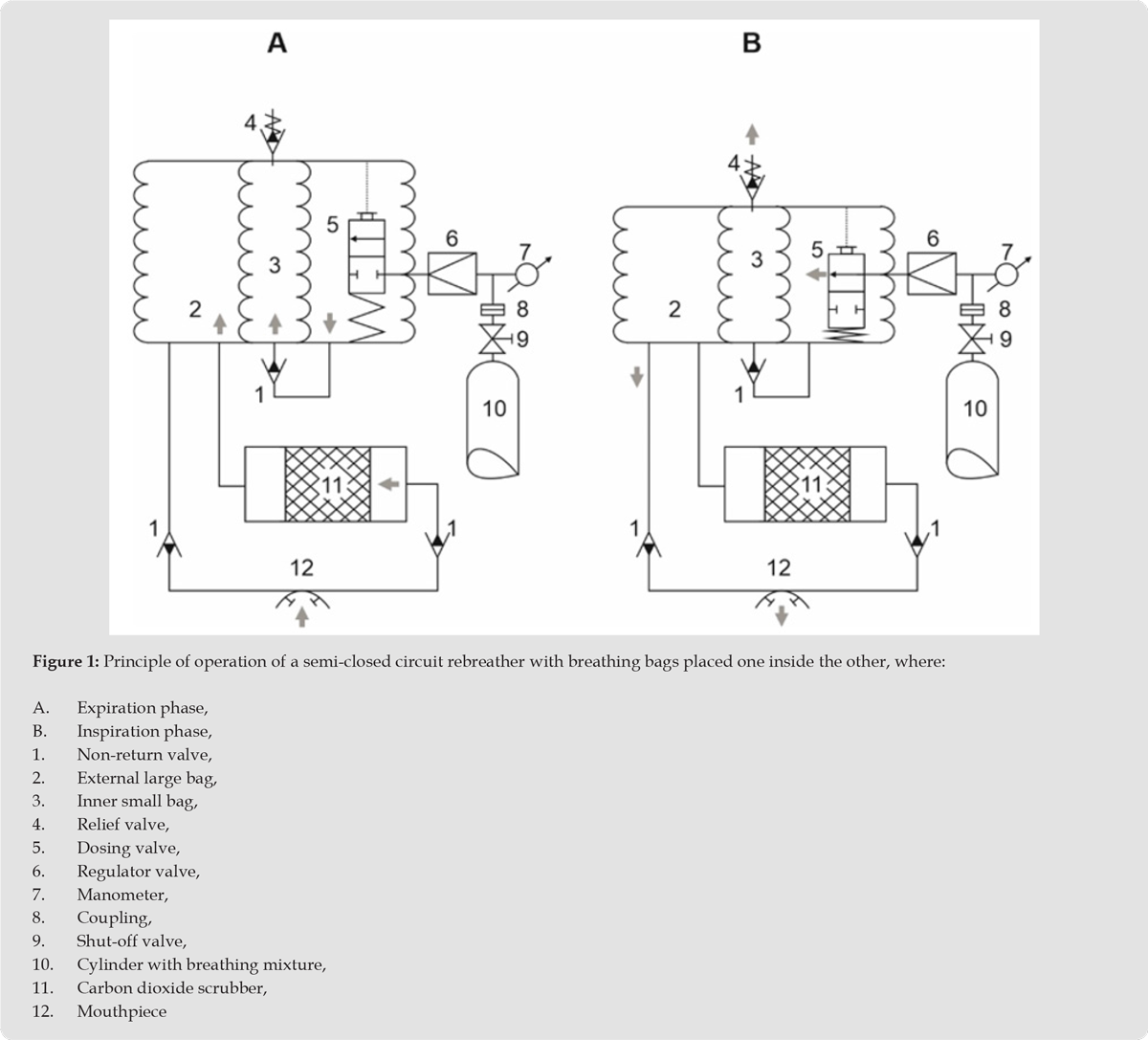
The CRABE (Complete Range Autonomous Breathing Equipment) is a SCR with two breathing bags placed one inside the other. It is powered by gas mixture as premix or pure oxygen. The proper circulation of the breathing mixture is maintained by the directional valves 1 – Figure 1. During the expiration phase, the exhaust valve of the mouthpiece opens – Figure 1A. The breathing mixture exhaled through the mouthpiece 12, the exhalation hose, and the exhaust valve, passes through a carbon dioxide scrubber 11 into to the large breathing bag 2, and from there through the non-return valve into the small breathing bag 2. When the diver inhales, the exhaust valve closes, and the inlet valve opens – Figure 1B. The breathing mixture is inhaled into the lungs from the large bag 2, through the inlet valve, inhalation hose and mouthpiece 12. This causes the large bag 2 to shrink, along with the small bag 3, from which the gas escapes through a relief valve 4 to ambient water. As the large bag 2 is shrinking, it triggers the dosing valve 5 by pressing its lever. Opening the valve 5 causes fresh breathing mixture to be inhaled from cylinder 10 through the valve 9, coupler 8, regulator valve 6, and dosing valve 5 to the large bag 2, where it is mixed with regenerated breathing mixture. From here, the breathing mixture is inhaled by the diver through the non-return valve, inhalation hose and mouthpiece 12. The demand for breathing mixture is regulated by breathing and the ratio of the volume of the large bag to the small one.
Figure 1
Ventilation Model
In a SCR construction with a metering bellows dispenser, like previously,
there is a relative decrease in the oxygen content to the stable
value xs in the breathing space in relation to the oxygen content in the
premix delivered to this space xw . The breathing gas that remains in
circulation is always a breathing mixture, because even during oxygen
decompression the diver does not breathe pure oxygen as in the
circuit there is always some circulating nitrogen N2 and/or helium He
left from the breathing gas, which comes from places that are not ventilated
sufficiently in the breathing space of the apparatus and from
the diver’s tissue wash out with oxygen. The assessment of the effectiveness
of cleansing of the breathing space and the diver’s body with
oxygen is crucial for the correct design of safe decompression. During
inspiration part of the breathing mixture is taken: −V1 . The elementary
volume of inspiration 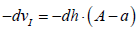 will be the product of the
elementary change in the height of bags -dh multiplied by the area of
the base of the large bag A minus the area of the small bag’s base area
-a - Figure 2. At this time, the elementary drop in the height of bags
−dh will cause a release of the content of the small bag dvu to water,
equal to the product of the elementary drop in height −dh and surface
area of the small bag a:
 . The ratio of elementary volume
of the gas released from the small sack to water −dvu to the elementary
volume of inspiration −dv1 will be:
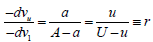 , where u
represents the volume of the small bag and U the volume of the large
bag. It follows from the above considerations that the released number
of moles of the breathing mixture, and as a consequence of oxygen
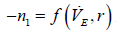 , is associated with lung ventilation E V by means of the
volume ratio of small bag u and large bag
 . Thus, the molar
stream of oxygen escaping through the small bag relief valve 1 −n
can be estimated using the Clapeyron equation as:
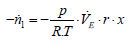 , where p represents the pressure at the diving depth H: Ρ = f (H ) .The
same number of moles
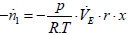 ⋅ decreases during inspiration
from the large bag to the small bag Figure 2.
Figure 2
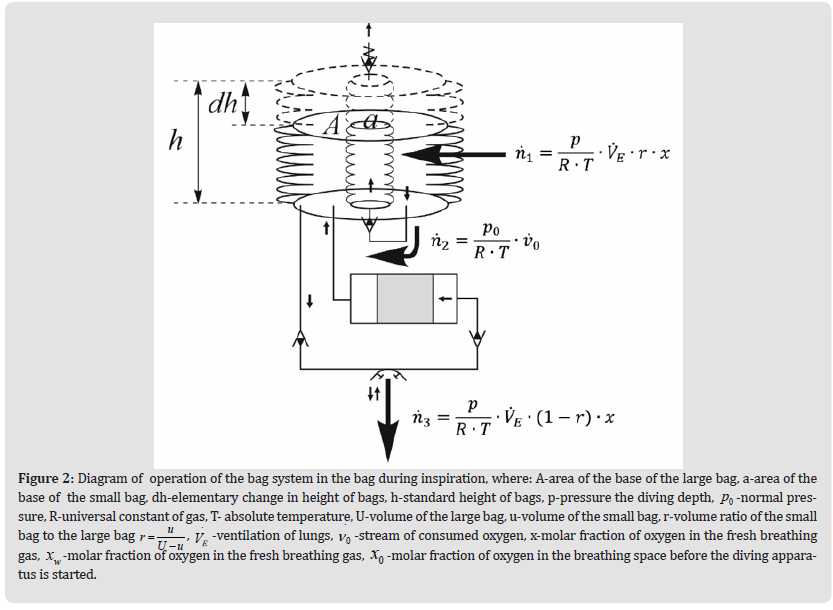
During inspiration, the oxygen stream having value 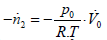 is consumed from the breathing mixture drawn in. In the same phase
the dosing system resupplies the volume of the large bag with fresh
premix, delivering oxygen having the value:
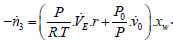 .
Thus, the elementary change in oxygen content ∂x in volume of the
large bag (U-u) at time ∂t can be written as:
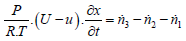 Figure 2. After setting the values of streams, the ordinary first order
differential equation can be written:

where:  elementary change in oxygen content 𝜕𝑥 in the large bag for elementary time change 𝜕𝑡, other designations as in Figure 2.
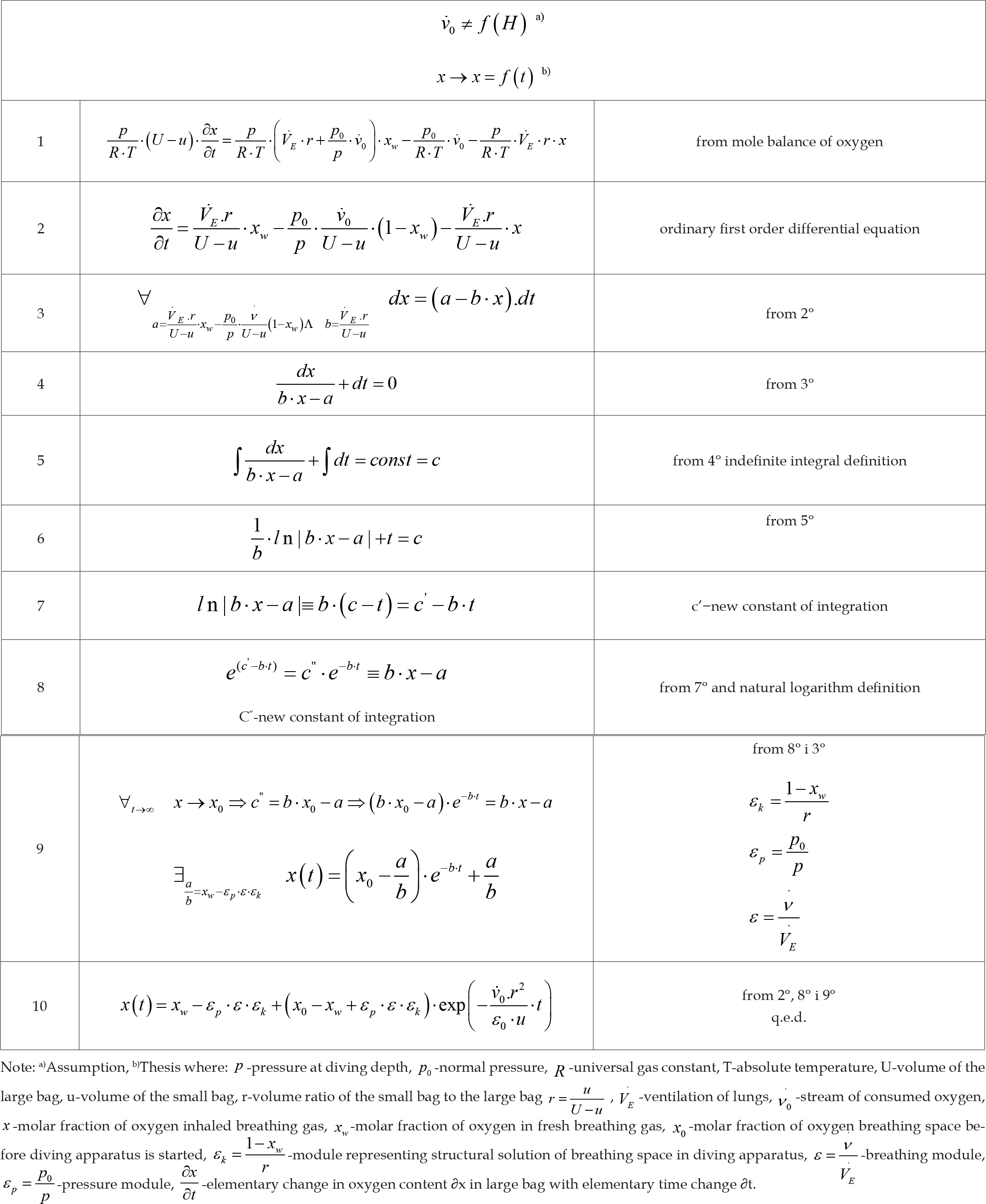
The solution of Equation 1 in the form of mathematical proof is
presented in Table 1:

where: x0- molar fraction of oxygen in the breathing space before
the diving apparatus is started,
 module representing the
structural solution of the breathing space in the diving apparatus,
 breathing module represents ventilatory equivalent for oxygen
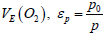 pressure module; here the module is referred
to as a formally dimensionless quantity; the modules will also be referred
to as criterion numbers.
Table 1: Derivation of the ventilation model related to oxygen content x in function of time x = f (t) for a semi-closed-circuit rebreather with a system of bags placed in above another.
Criterial Numbers
In Equation 1, the coefficient is a formally dimensionless
ratio constituting a criterion number describing the structural
solution of the breathing space in the diving apparatus, whose
value for a given solution is constant during the diving process
 , where time t refers to time of dive. It will be referred
here as structural module εk . The ratio
 is called here
the pressure module which is the criterion number of external conditions.
It decreases with diving depth . With the increase
of depth H , the pressure module εp has less and less effect
on the decrease in the stable oxygen content in the breathing gas,
which is breathed by the diver xs , due to its inverse proportionality
to pressure :
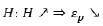 . For the constant depth H=idem the pressure
module p ε is constant value:
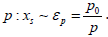 . The module
 is called here the breathing module, for standard pressure P0
it will be marked as ε0 , connecting oxygen consumption ν0 ⋅
and ventilation
of lungs VE ⋅
with work W0 done by a man on surface
 . The use of the breathing module related to normal conditions gives
an opportunity to develop a draft design of a diving apparatus, because
these values are determined with good accuracy, but in general
it should be assumed that the breathing module can be dependent on
the pressure ε = f (P) . This assumption must, however, be verified
experimentally, as the workload under water W consists of additional
types of physical work which do not occur on the surface. For example,
work done to overcome greater than in the air resistance associated
with an increased pressure difference between the pulmonary
centroid and the center of buoyancy of the breathing space in the apparatus
in immersion. Expending extra effort to overcome the resistance
associated with the higher density of breathing gas ρ , causing
an increase in flow resistance Δρ posed by elements of the breathing
space in the apparatus is also significant. In the breathing space of
the diving apparatus there are also spatial obstructions that decrease
the ventilation in some spaces, so-called dead spaces, whose impact
on the safety of decompression should also be taken into account.
Another condition that is difficult to determine unequivocally is an
individual person-dependent phenomenon known as bradycardia.
Associated with this slowed down breathing frequency occurring in
immersion, reducing ventilation of lungs
VE
⋅ . Hence, the assumption
that the breathing module ε should depend on pressure ε = f (εp) . It
follows from the many years of experience that the breathing module
εi
is also an individualized function of morphology of a diver i .
Stabilization
An important factor is the speed of the system’s response to the stepwise forced change in the partial pressure of oxygen ρ (t ) in the circulating breathing gas. For this purpose, the ventilation model (Equation 2) can be multiplied by pressure p present at diving depth H : p (t ) = p ⋅ x (t ) . After ordering, the following can be written:
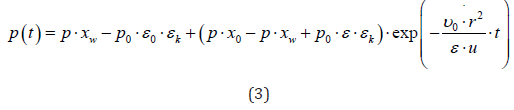
where: p(t) -partial pressure of oxygen in function of time t , p -pressure present at diving depth H
Using Equation 3 it is possible to estimate stabilization times
 needed to achieve the stable value of oxygen partial pressure
ps in the breathing space of the diving apparatus with accuracy up
to the specified critical pressure difference:
 .
The stabilization times calculated in this way are close to stabilization
times
 in SCR with a nozzle constant dosing system. The
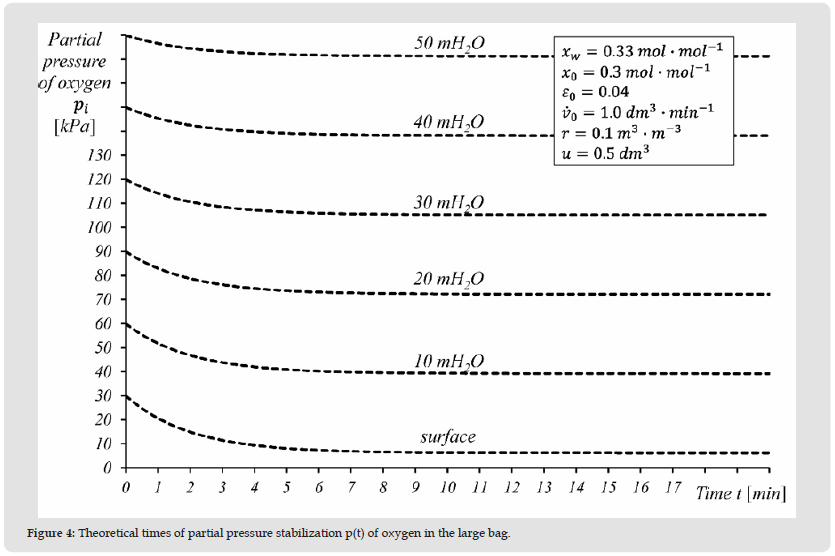
theoretical process of oxygen partial pressure stabilization p(t) in the
breathing space of the SCR CRABE SCUBA is shown in Figure 3 and an
example of real stabilization is shown in Figure 4.
Figure 3
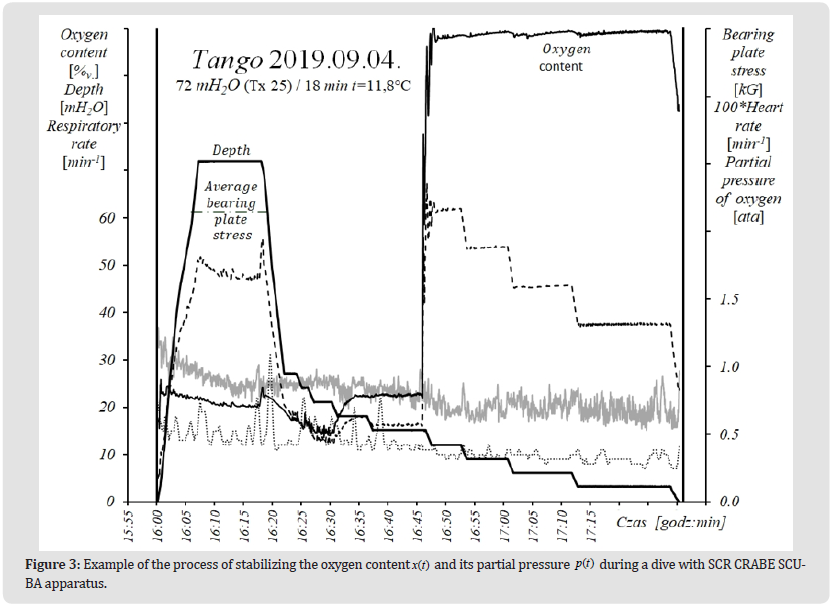
Figure 4
Stable Content
Equation  derived from an analysis
of the model (2):

For the assumption ε=idem, dependence 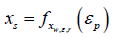 is equation
of straight-line y =α ⋅ x +β with negative directional coefficient
For the assumption ε=idem, dependence  . Thus, for the domain of positive nmbers it is a monotonically
decreasing function. The transformed Equation 4 leads to dependence
For the assumption ε=idem, dependence  , which is the hyperbolic power function
decreasing together with depth H, always greater than zero , because
For the assumption ε=idem, dependence 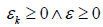
Modeling
Transforming boundary mathematical model t → ∞ (Equation
4) the following equation can be obtained: 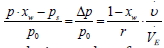 . This equation can be further transformed into the form:
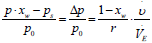 , where p represents the pressure at diving
depth H , ps is the actual partial pressure of oxygen in the breathing
gas inhaled by the diver for determined structural conditions εk
=idem and diving conditions ,
 is the difference
in partial pressure of oxygen in the premix and the breathing
gas inhaled by the diver. For different depths H, the breathing module
 of oxygen consumption for lung ventilation V E
is function of
diving depth ε = f (H ) :

where: ε-the breathing module being the ratio of oxygen consumption
to lung ventilation
 at diving depth H
Interesting from the point of view of applications used for predicting
safe decompression is a model combining total pressure p at
diving depth H with oxygen partial pressure ps which can be obtained
by multiplying stable content xs from dependence (Equation 4) by hydrostatic
pressure p at diving depth H :

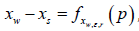
For 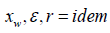 , dependence (Equation 6) is equation of
straight-line y =α ⋅ x +β having positive directional coefficient
α = xw . Therefore, it should be a monotonically increasing function,
with positive values for positive arguments, which is confirmed by the
results of our own research, as shown in Figure 3.
Apparatus Design Module
The diving apparatus design module
 can be determined
from direct measurement of the volume ratio of the small bag
and the large bag
 and oxygen content in premix w x . The
volume of breathing bags in these apparatuses was made using a vial
having volume V = (500 ± 5)cm3 . As it was necessary to use the vial six
times to measure the maximum volume, the minimum systematic
error of the volume measurement was not lower than ΔV > 30cm3 .
On the basis of the measurements, the volume of the small bag was
assumed at the level of: u = (0.50 ± 0.01)dm3 and of the large sack
u = (5.30 ± 0.03)dm3 . Hence, the ratio of sack volumes can be assumed
at the level
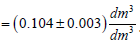 .
Breathing Module
Figure 3 presents an example of the experimental diving result for
premix xw = 0.325 Nx . The dives were used to determine the stable oxygen
content s x and total pressure p , constituting the basis for calculating
stable value of oxygen partial pressure s p . Using the known
values of the structural module  , the pressure module
 , the mean value of the breathing module 0.065 ε −
≅ and using
dependence (6), the theoretical dependence can be drawn of the stable
oxygen partial pressure ps in the function of pressure p present
at the maximum diving depth H . It should be noted, however, that
the value of total pressure p recorded during the experiments was the
pressure exerted by the atmosphere of the hyperbaric chamber, and
the diving apparatus was additionally placed in the pool at the depth
of approx. h ≅ 0.5mH2O . A satisfactory compatibility can be achieved
between the measurement results and the theoretical model of ventilation
(Equation 6) when recorded total pressure p is increased by the
value of p+ = 5kPa associated with immersion of the apparatus below
the surface of water in the pool - Figure 5. The results of measurements
were used to estimate the volume ratio of the bags in the apparatus:
r = (0.104 ± 0.003)m3 ⋅m−3 . The value of the structural module k ε
during tests for the oxygen content in the premix
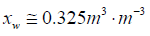 did not change
 . The recorded
stable values of oxygen partial pressures ps for n=26 experimental
dives from different years were showing high value of the determination
coefficient R2 ≅ 0.9785 , relatively rarely recorded in biological
studies. It can be assumed that a good agreement between the theoretical
and experimental results is obtained, despite the fact that
the amount of work done by the divers was not constant W ≠ idem ,
hence for the investigations the effect of the pressure applied to the
underwater ergometer plate F on the stable oxygen content s p did
not seem significant - Figure 6.
Figure 5
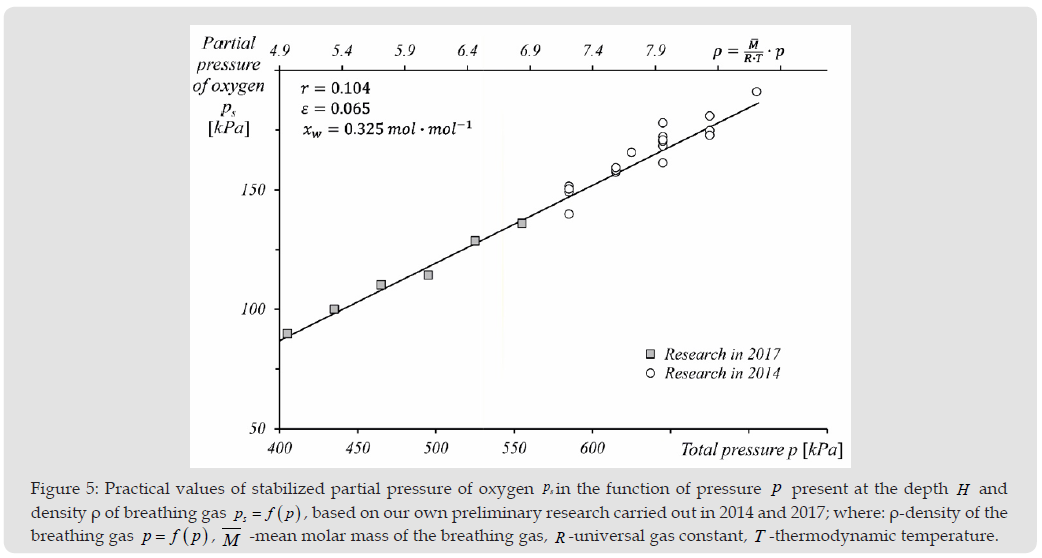
Figure 6

Simulator
The basis for modeling diving technologies is checking decompression
distributions. For modeling decomposition distributions, it
is important to check changes in the breathing module ε in function
of depth: ε = f (H ) . On this basis, the accuracy of ventilation model of
the breathing space in the diving apparatus can be determined. The
ventilation model can be used to determine stable oxygen content s x
for individual depths H:xs = f (H) . When the fluctuation of stable oxygen
content xs is taken into account for individual depths H, this model
contributes to planning adequate decompression together with the
central nervous syndrome model, determining the risk of oxygen toxicity
in planned exposures. By grouping the premises derived from the
ventilation and central nervous syndrome models and using the decompression
model, exposure distributions can be determined in the
form of decompression tables that are verified through experiments
with participation of human beings. Use of a breathing simulation
stand together with metabolic gas exchange in hyperbaric conditions
can reduce the risk of big errors in the initial phase of investigations,
by providing answers to a number of important problems related
to stability of composition of a breathing gas in the breathing
space of a diving apparatus before experiments involving humans are
commenced - Figure 7. Simulation of gas exchange in the process of
breathing in hyperbaric conditions, in addition to mechanical simulation
of the breathing cycle, should allow for intake of oxygen O2 from
the breathing space of the UBA and emission of carbon dioxide CO2
and water vapor H2O in the required ratio with the required accuracy
and precision. A metabolic simulator coupled with a breathing simulation
stand and a hyperbaric simulator can be used for the study
and validation of mathematical models of the ventilation process in
the underwater breathing apparatus. In simple metabolic simulators,
controlled dosing of carbon dioxide CO2 is used, disregarding the resultant
increase in gas mass in the hyperbaric breathing space. Such
a procedure is justified when mass stream CO2 m of carbon dioxide CO2
is so small in relation to mass flow of the ventilation medium m and
the whole mass in the ventilated breathing space o m exchange, that
the carbon dioxide CO2 metering CO2 m does not disturb the ventilation
process to a significant extent. Oxygen can be removed by catalytic oxidation
of various chemical compounds added to the breathing space.
Such oxygen intake may be accompanied by simultaneous emission
of carbon dioxide CO2and water H2O. This is currently one of the best
methods for simulating gas exchange. As has been mentioned, the
mapping of the breathing process in hyperbaric conditions is connected
not only with the possibility to carry out investigations under
increased pressure and mechanical simulation of lung ventilation, but
also with mapping of gas exchange. These processes should be reproduced
with reproducibility, accuracy and precision required by the
scientific research method. However, they cannot simulate all the details
of the real human-machine ergonomic interaction, offering only
a simplified model, but adequate to the research project undertaken.
In the case of simulation of gas exchange taking place in the body, the
most important is oxygen consumption of  and the emission of carbon
dioxide
 in its place. The most common are the following two
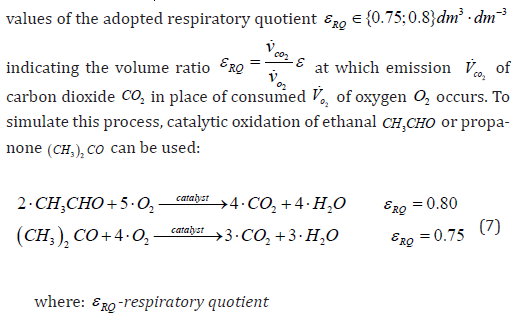
Figure 7
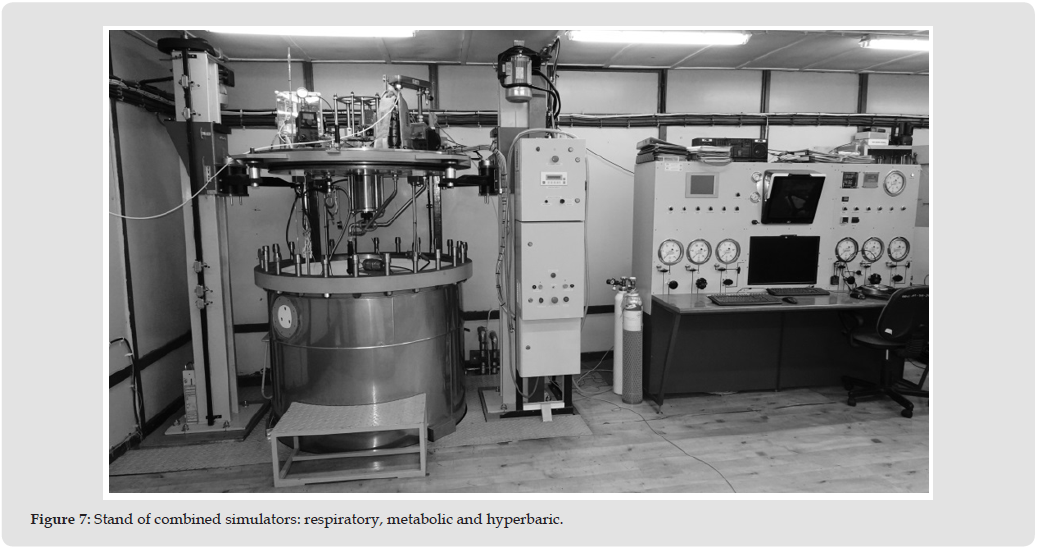
The catalyst in reactions (Equation 7) can be platinum Pt on a
ceramic carrier, diatomaceous earth, alumina, etc. The reaction takes
place in the volume of the breathing gas drawn in by the breathing
simulator in the reactor and then the gas is returned together with
combustion products to the breathing space in the SCR placed in the
hyperbaric chamber. In the reaction (Equation 7) the volume of liquid
substrates is so small in relation to the volume of the gaseous products
formed and the entire breathing space of the SCR that most often
it does not cause any serious disturbances, significant for the balance
of the volume of the breathing space. In addition, the gas is humidified,
which makes the simulation process more real and creates good
chemisorption conditions on the filling of the carbon dioxide 2 CO absorber
used in the SCR. The significant exothermic effect of the oxidation
process may generate some problems, the hence reaction products
should be cooled once they leave the reactor, before the breathing
gas returns to the breathing space of the SCR. Implementation-oriented
studies on the currently used metabolic simulator was presented
earlier (Kłos R [2]). The catalytic oxidation of propanone was
selected for simulation of metabolic processes. Propanone (CH3)2 CO
was metered to the reactor by means of SMART Digital S pump DDA
made by Danish company Grundfos Holding A/S, which offers dosing
with accuracy required for the counterpressure occurring during the
investigations. The reactor was filled with 0.5%m Pt catalyst bed on
alumina type 73 made by Johnson Matthey from Great Britain in the
form of cylinders, having about 3.25mm in diameter and 3.48mm in
height. The research was based on volumetric measurements, which
for liquid such as propanone (CH3)2 CO are dependent on temperature
t and for oxygen O2 also from pressure p . Most often the measurements
were made at temperature of approx. t ≅ 250C . During the
measurements constant pressure value p = const was maintained.
Oxygen consumption calculations were referenced to the temperature
and pressure present at level of inhalation from the mouthpiece
of the dive apparatus {t, p}, and referenced to standard conditions
T0 ≅ 273.15K; p0 ≅ 101.325kPa . For each measurement, the molar
volume of oxygen was determined depending on the temperature
present in the respiratory circuit of the diving apparatus. Propanone
(CH3)2 CO is characterized by molar mass  ,
density
 . It follows from reaction (Equation 7)
that 1mol of Me2 CO reacts with 4 moles of oxygen CO2 . It follows from
the above considerations that the breathing module ε will be:
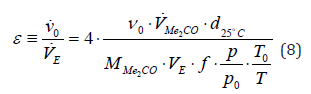
where: ν0 -molar volume of oxygen under normal conditions, VMe2CO -volume flow of propanone,VE ⋅ -ventilation flow referred to standard conditions, d250C -density of propanone at temperature t = 250C , Me2CO M -molar mass of propanone, VE -cylinder capacity of the piston breathing device, f-piston frequency of the respiratory device, p-pressure under measurement conditions, T-temperature under measurement conditions, T0 ≅ 273.15K and P0 ≅ 101.325kPa
The experiments concerning the mathematical ventilation models were performed during manned and unmanned experimental diving aimed at verification of the mathematical model of ventilation. The experiments were carried out for semi-closed rebreather SCR CRABR SCUBA.
Unmanned Investigations
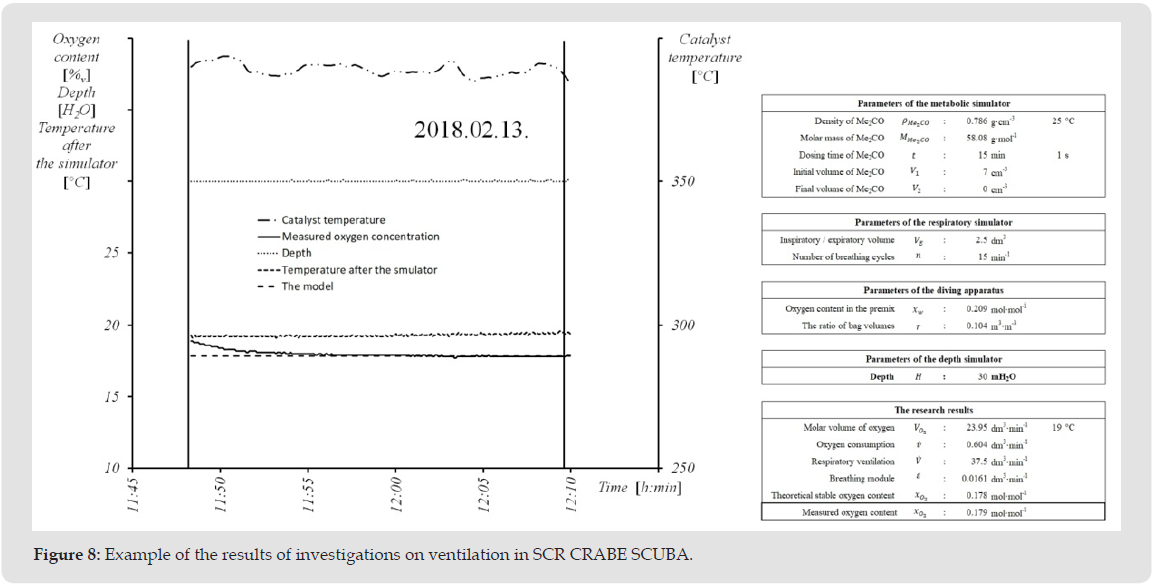
Air was used for supply the SCR CRABE SCUBA. The results of some simulation tests are shown in Table 2 together with the comparison of the theoretical values derived from the model (Equation 8). Figure 8 shows examples of the results from a single study.
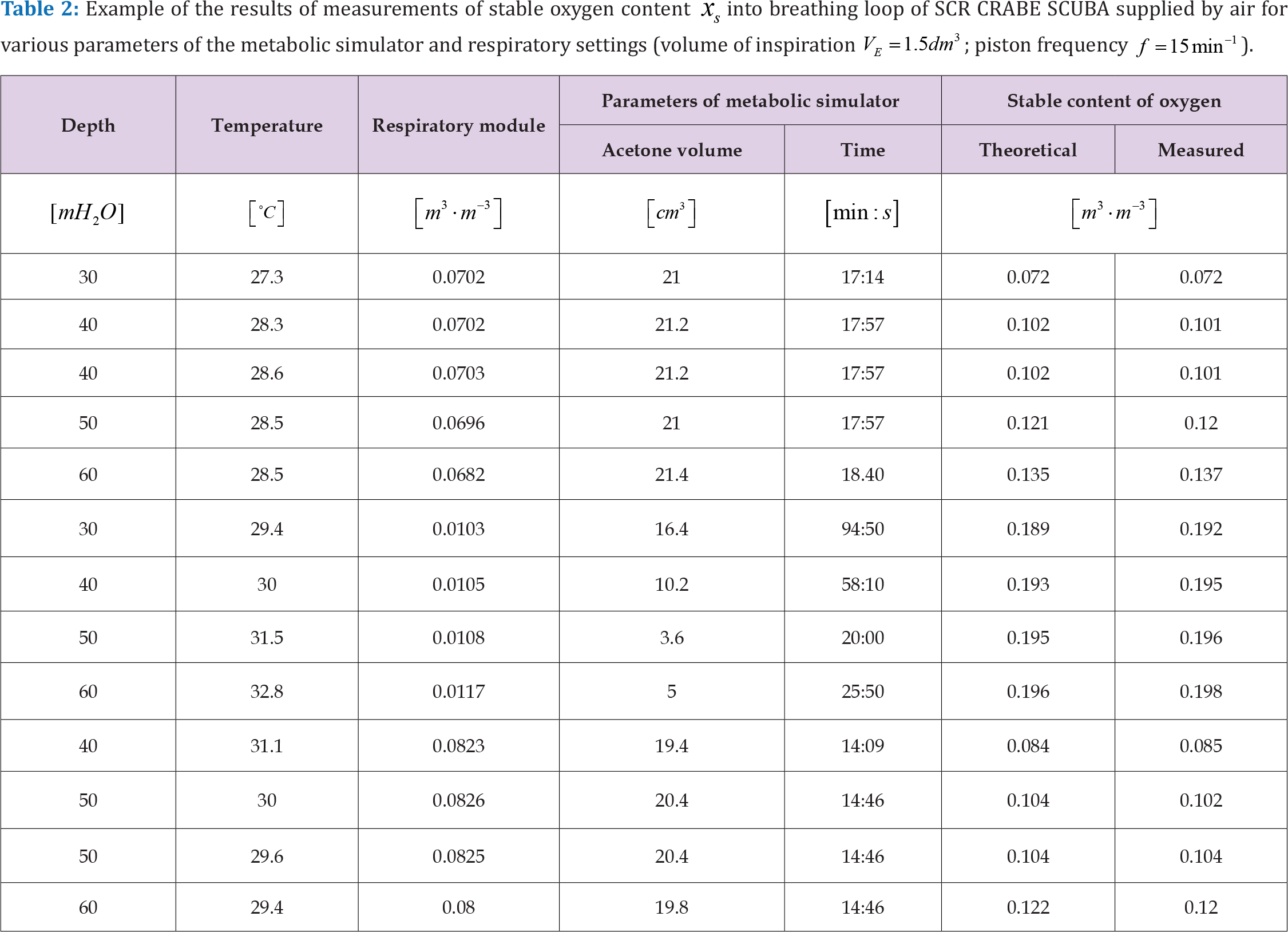
Figure 8
The Pressure Tests in Immersion
The pressure tests carried out in the swimming pool inside the land-based diving complex were the next stage of research carried out to verify the design assumptions - Figure 9. The divers swam with the average work rate. The divers tried to maintain work rate at the level that did not produce breathing disturbances, if this was not the case the experiment was to be interrupted. The subjects started swimming after pressurisation of the chamber. During the experiments, the divers were equipped with the SCR CRABE SCUBA diving apparatus. The diving apparatus was hose supplied with nitrogen-oxygen or nitrogen- helium-oxygen gas mixture containing differ contents of oxygen and helium. The experiments were carried out at different depths of diving [0; 80] mH2 O .
Figure 9

As shown by the research data presented in Table 2, it can be expected that the model (Equation 3) is a sufficiently accurate approximation of the ventilation process of the diving apparatus and can be used to infer the parameters needed to plan the subsequent decompression. In this way the mathematical model of the process of ventilation of a SCR CRABE SCUBA has been proposed and validate it a special simulator of gas exchange in the breathing process. Developing this model with the required accuracy provides the opportunity to work out data for the assumed decompression model. The proposed model has been adapted to the process of ventilation in hyperbaric chambers and generalized of the adopted method for the submarine ventilation process. The research on ventilation of a mining excavation constituted the validation of the adopted research approach with the success. These experimental work results will be presented in next articles in this series.
This article is the result of the work and research projects conducted by the author:
1. The mathematical models of diving apparatus atmosphere ventilation with partial regeneration of the breathing medium – research sponsored by State Committee for Research project № 0T00A 072 18 carried out in 2000–2002
2. A new generation of breathing simulator – grant № O N504 497734 sponsored by the State Committee for Research carried out in 2007–2010
3. Decompression design of in combat missions – project № O R00 001 08 sponsored by the State Committee for Research carried out in 2009–2011
4. Decompression design for MCM dives – project agreement № DOBR/0047/R/ ID1/2012/03 sponsored by the State Committee for Research carried out in 2012–2015
5. Decompression design for MCM/EOD dives II – project agreement № DOB-BIO8/09/01/2016 sponsored by the State Committee for Research in progress
6. The impact of combat effort and air transport on the safety of divers during underwater military operations – project agreement № DOB-BIO-12-03-001-2022 sponsored by the State Committee for Research in progress
7. Modernization of air diving/decompression technology for military purposes – project agreement № DOBBIO- 12-06-008-2023 sponsored by the State Committee for Research in progress
Apart from financing, the presented research required access to unique combat equipment. I express my gratitude to the Navy Command of the Republic of Poland and the 3rd Ship Flotilla for the trust that I received. I would also like to thank the staff and civilian employees of the Polish Navy and Naval Academy for their help in preparing such extensive experiments.

International Association of Landscape Archaeology, Czech Glass Society, Czech Republic

Department of Chemistry, Semenov Institute of Chemical Physics, USSR Academy of Sciences, Moscow, Russia

Neurology, LA BioMed Research Institute, USA

Associate Professor at Department of Breast and Thyorid Surgey, Chongqing General Hospital, China

Professor of Nuclear Medicine, Faculty of Medicine and Surgery, University of Milan, Milan, Italy





 Abstract
 PDF