info@biomedres.us
+1 (502) 904-2126
One Westbrook Corporate Center, Suite 300, Westchester, IL 60154, USA
Site Map
 ISSN: 2574 -1241
ISSN: 2574 -1241
ISSN: 2574 -1241
Received: September 23, 2025; Published: October 07, 2025
*Corresponding author: Tameer Sawaid, Department of Urology, Ziv medical center, Safed, Israel
DOI: 10.26717/BJSTR.2025.63.009901
Purpose: We compared the complication and success rate of patients undergoing meatototmy in Local Anesthesia
or General Anesthesia.
Materials and Methods: A Retrospective Study, a data of patients who underwent meatotomy between january
2016 and march 2025 was retrospectively gathered and reviewed. The study included 150 patients, these patients
were divided into two groups, Group A – Meatotomy with local anesthesia, Group B – Meatotomy under
general anesthesia. All procedures were performed with the same method by the same surgeon. Meatotomy
was performed after applying EMLA 5% cream and covering it with a Tegaderm dressing, waiting for 30 minutes.
Complications and success rate were assessed in patients during follow up, and a comparison was made
between the two groups.
Results: Group A (Local Anesthesia), 95% success rate, 3 (3.7%) patients had bleeding that stops with compression.
Group B (General Anesthesia) The success rate was 92%, Moreover the complication rate was 15% (bleeding
in 11 patients which managed with meatoplasty). 4 patients had Persistent Symptoms in group A compared
to 6 patients in group B (5% to 8%).
Conclusions: Meatotomy performed using local anesthesia and sedation has better outcome to meatotomy performed
using general anesthesia.
Meatal stenosis characterized by the narrowing of the urethra at the external meatus. A small urethral meatus in a newborn probably would not be called to a urologist’s attention unless the stenosis is associated with other congenital deformities (e.g., hypospadias) or causes voiding difficulties or urinary tract infection. Usually meatal stenosis in children occurs as a complication after newborn circumcision, with incidence quoted between 3%-8% of children after circumcision [1] and meatotomy is the standard of care for treating meatal stenosis. A meatotomy can sometimes be accomplished with the use of local anesthesia or general anesthesia [2]. n a young child, general anesthesia is the preferred approach, avoiding trauma to the child, the parents, and the urologist. In our medical center, meatotomy is performed under general anesthesia, according to surgeon preference or in the pediatric clinic under local anesthesia. The decision for meatotomy under general or local anesthesia was taken according to the parent’s preference and if the child cooperative, because many parents were concerned about the risks of general anesthesia. The advantage of meatotomy under local anesthesia is cheaper than general anesthesia, fewer nurse stuff, and no need for anesthesiologist, moreover less time compared to general anesthesia and do not require operation room availability. In this study we compare the complication and success rate of patients undergoing meatototmy in Local Anesthesia or General Anesthesia.
This was an institutional review board approved retrospective chart review of data that were collected from January 2016 and March 2025. The study included 150 children, age between 2 to 10 years old who presented with meatal stenosis. children with no previous history of hypospadias surgery or penile surgery other than routine circumcision, and with symptomatic meatal stenosis were evaluated in pediatric urologic clinic. These patients were divided into two groups, Group A – Meatotomy with local anesthesia, Group B – Meatotomy under general anesthesia. All meatotomies were performed at our medical center by a single pediatric urologist using a single technique. Patients in group A underwent Meatotomy after applying EMLA 5% cream and covering it with a Tegaderm dressing and waiting for 30 minutes. One of the parents was asked to sit near the patient during the procedure. Patients in group B underwent meatotomy under general anesthesia using Ketamine, midazolam and fentanyl 30 minutes before the procedure. The meatotomy was performed in all the patients in two groups using straight mosquito clamp for 2 minute to crush the meatal membrane and an incision was then made along the crushed line. After the procedure all the parents get an explanation and instruction how to open the meatus and apply chloramphenicol 5% ointment to the meatus 3 times daily for 10 days. Patients were typically observed for 30 min before discharge. Patients were in follow- up for 3 months to assess for symptoms resolution. the family was asked if symptoms were persistent or completely resolved. For patients with persistent symptoms a uroflometry study was recommended. Excel was used to calculate descriptive statistics.
Among 150 patients, 79 had meatotomy under local anesthesia and 71 had Meatotomy under general anesthesia. The median age in both groups was 6 years, the average follow up period was approximately 3 months. Group A (Local Anesthesia), 95% success rate, 3 (3.7%) patients had bleeding that stops with compression. Group B (General Anesthesia) The success rate was 92%, Moreover the complication rate was 15% (bleeding in 11 patients which managed with meatoplasty) (Table 1). 4 patients had Persistent Symptoms in group A compared to 6 patients in group B (5% to 8%). Those patients had to do a uroflometry study, after 2 months of their last visit to the pediatric urology clinic (Table 2).
Table 1:
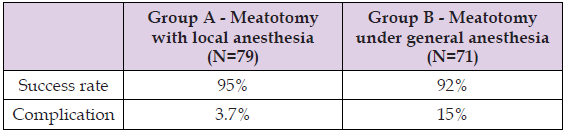
Table 2:

Most common cause of meatal stenosis is Circumcision, and is relatively common issue in Israel, where most of the patients are Jewish or Muslim, and most children are ritually circumcised [3]. And the diagnosis of meatal stenosis according to physical examination and taking patients anamnesis, usually the children with meatal stenosis had difficulty directing the voiding stream into the toilet. The definitive treatment for symptomatic meatal stenosis is meatotomy. According to the studies of meatotomy and the reported benefits of local anesthesia. we attempted this method at our medical center, and we found that this method was very successful and cost effective especially in third world countries where the operating room not always available [4]. Our results indicated lower complication rate with meatotomy under local anesthesia compared to meatotomy under general anesthesia and with higher success rate. A systemic review by Maren C. Locke MD found Local anesthesia techniques provide outcomes equal to or better than general anesthesia and with significantly lower costs. And this finding support our results [5]. Finally, we did not capture detailed quality-of-life data or pain scale, which is particularly important in patient who underwent meatotomy in local anesthesia, given the differing tolerability in children.
Meatotomy performed under local anesthesia has higher success rate and fewer compliation rate without the need for general anesthesia including complications and implications of the anesthesia and this method may be considered in patients who required surgery for meatal stenosis.

International Association of Landscape Archaeology, Czech Glass Society, Czech Republic

Department of Chemistry, Semenov Institute of Chemical Physics, USSR Academy of Sciences, Moscow, Russia

Associate Professor at Department of Breast and Thyorid Surgey, Chongqing General Hospital, China

Professor of Nuclear Medicine, Faculty of Medicine and Surgery, University of Milan, Milan, Italy

Department of Pharmaceutical Sciences, South University School of Pharmacy, USA





 Abstract
 PDF
PDF



























