info@biomedres.us
+1 (502) 904-2126
One Westbrook Corporate Center, Suite 300, Westchester, IL 60154, USA
Site Map
 ISSN: 2574 -1241
Received: August 22, 2025; Published: September 02, 2025
*Corresponding author: Mourtzikou Antonia, Mantouvalou 3, “Agios Panteleimon”, GHNP, Piraeus, 18454, Greece
DOI: 10.26717/BJSTR.2025.63.009849
Objective: Providencia alcalifaciens is a gram-negative bacterium implicated in infections of the gastrointestinal
tract in humans and animals, as well as in septicemia and less commonly in urinary tract infections. This study
presents the case of a urinary tract infection caused by P. alcalifaciens in a male patient with diabetes mellitus,
balanoposthitis, phimosis, recurrent UTIs, and incipient renal insufficiency, underlying conditions that favor the
colonization of the urinary tract by the bacterium, who was referred for routine check-up at the Outpatient Adult
Clinic of the Nikea Prime Care Center, 2nd YPE Piraeus, Greece.
Results: Laboratory tests showed mild leukocytosis, slightly increased erythrocyte sedimentation rate, elevated
glucose and total cholesterol concentrations, high glycated hemoglobin, decreased HDL. Urinalysis and microscopy
of the urine sample revealed bacteriuria by nitrite test and pyuria, thus urine cultures were performed. The
urine culture grew monomicrobial Providencia alcalifaciens >105 CFU/ml. Antimicrobial susceptibility testing
revealed susceptibility to Norfloxacin and Ciprofloxacin, intermediate susceptibility to Gentamycin, Amikacin,
Ceftriaxone and Cefotaxime, and resistance to Ampicillin, Amoxicillin/ Clavulanic acid, Cefaclor, Tetracycline,
Nitrofurantoin and Colistin. The patient received treatment with Ciprofloxacin 1000 mg daily per os for 2 weeks
and recovered.
Keywords: Providencia Alcalifaciens; Urinary Tract Infections (UTIs); Diabetic Patient; Underlying Diseases; Antimicrobial Treatment; Susceptibility Test
Providencia alcalifaciens is a rod-shaped gram-negative bacterium that belongs to the family of Enterobacteriaceae. Its genome was sequenced in 2008, isolated from human feces. The bacterium is found in many different human and animal reservoirs, mainly in the gut and in the digestive tract [1,2]. It has been commonly implicated as a causative agent of diarrheal infection in humans and animals, as well as in urinary tract infections (UTIs) and septicemia [1-3]. Its presence in a variety of medical conditions, such as burns, pneumonia, neonatal sepsis and infections of the nervous system, has been increasingly reported. Moreover, its isolation is strongly associated with the presence of long-term indwelling urinary catheters in critically ill patients, as well as with diabetic and immuno-compromised patients [4,5]. Young children and the elderly are more susceptible to infections by P. alcalifaciens. UTIs are the most common infections in both the community (accounting for 10–30% of infections in primary care) and in hospital settings. In primary care, UTIs account for 10-30% of infections. However, UTIs from P. alcalifaciens are uncommon. The aim of this study is to present a case of UTI caused by P. alcalifaciens.
A 57 year old male patient visited the Nikea Primary Healthcare Center, Piraeus, Greece, referred by the family doctor. Patient history revealed diabetes mellitus type 2 under insulin therapy, hypercholesterolemia under treatment, hyperuricemia, urolithiasis since 10 years, balanoposthitis since two years due to phimosis, recurrent UTIs, with 6 reported cases in the last 2 years, and incipient renal insufficiency. Patient symptoms included redness and swelling of the distal penis and prepuce, dysuria, bleeding from the foreskin, glans ulceration, as well as urinary retention. Symptoms from the gastrointestinal tract were not detected. During the last 2 years the patient was treated with antimicrobial and antifungal medication according to the instructions of the urologist, for Escherichia coli, Candida albicans and Staphylococcus epidermidis, without specifying which antibiotic treatment he received. Although the urologist had suggested circumcision, in order to prevent severe complications, the patient did not comply with his suggestion. Routine laboratory tests, such as complete blood count, biochemical tests, urinalysis and urine culture were performed.
The complete blood count was measured on the NIHON KOHDEN CelltacG hematology analyzer, biochemical tests were measured on the KONELAB 60 biochemistry analyzer, urinalysis was performed by the Multistix 10 SG Reagent Strips (Siemens Healthineers), and the urine cultures were performed on Columbia blood agar, MacConkey agar and Sabouraud Dextrose agar (incubation at 37oC for 24 hours). For microbial identification, RapIDTM ONE REMEL (Thermo Scientific System), Gram stains were applied. In addition, the drug susceptibility testing of the urine culture was performed by the Kirby Bauer disk diffusion susceptibility test, by implementing the EUCAST (European Committee on Antimicrobial Susceptibility Testing) 2024 criteria.
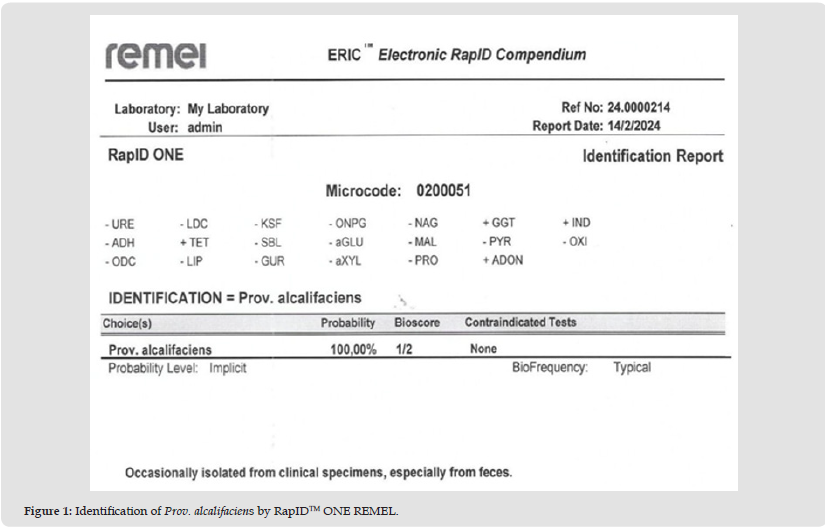
Laboratory tests revealed mild leukocytosis (WBC 11.000/mm3 with 70% neutrophils), slightly increased erythrocyte sedimentation rate (28 mm/h), glucose 186 mg/dL, urea 57.5 mg/dL, uric acid 8.23 mg/dL, creatinine 1.58 mg/dL, GGT 20 U/L, SGOT 19 U/L, SGPT 23 U/L, total cholesterol 249 mg/dl, HDL 27 mg/dl, LDL 151 mg/dl, potassium 5,0 mmol/l, sodium 140 mmol/l and glycated hemoglobin 8,70 % . Urinalysis and microscopical examination of the urine sample revealed bacteriuria, pyuria and nitrite presence. Urine culture revealed monomicrobial Providencia alcalifaciens >105 CFU/ml (Figure 1). The isolated bacteria were susceptible to Norfloxacin and Ciprofloxacin, intermediate to Gentamycin, Amikacin, Ceftriaxone and Cefotaxime, and resistant to Ampicillin, Amoxicillin/ Clavulanic acid, Cefaclor, Tetracycline, Nitrofurantoin and Colistin. The patient received treatment with Ciprofloxacin 1000 mg daily per os for 2 weeks and recovered.
Figure 1
Providencia is an emerging opportunistic pathogen and its species are commonly found in soil, water, and sewage. In humans, Providencia spp. have been isolated from urine, throat, perineum, axillae, stool, blood and wound specimens. Their isolation is strongly associated with the presence of indwelling catheters, diabetes mellitus and immunosuppression [4,5]. UTIs caused by Providencia spp. are reported in the literature. P. alcalifaciens can produce UTIs and is associated with staghorn calculi, just as the other species within its genus [6]. The 57 year old patient, described in this case report, was at higher risk of UTIs, due to his medical history (diabetes, urolithiasis, balanoposthitis, phimosis, recurrent UTIs, and incipient renal insufficiency). The patient was treated with Ciprofloxacin 1000 mg daily per os for 2 weeks and recovered. P. alcalifaciens has an inherent ability to survive prolonged starvation and develop resistance to multiple antibiotics, thus it poses a threat to the general population [7,8].
The bacteria of Providencia, earlier considered as a rare pathogen, nowadays is increasingly recognized as a noted opportunistic pathogen capable of causing serious nosocomial infections, predominantly urinary tract infections (UTIs). Treating this kind of infection is a demanding task due to the resistance that is seen in clinical strains, in common antimicrobial treatment. The need to develop a robust system for its early detection and treatment is of utmost importance. The case presented in this study constitutes a rare case of UTI caused by P. alcalifaciens, detected in a primary health care center.

International Association of Landscape Archaeology, Czech Glass Society, Czech Republic

Department of Chemistry, Semenov Institute of Chemical Physics, USSR Academy of Sciences, Moscow, Russia

Neurology, LA BioMed Research Institute, USA

Associate Professor at Department of Breast and Thyorid Surgey, Chongqing General Hospital, China

Professor of Nuclear Medicine, Faculty of Medicine and Surgery, University of Milan, Milan, Italy





 Abstract
 PDF