info@biomedres.us
+1 (502) 904-2126
One Westbrook Corporate Center, Suite 300, Westchester, IL 60154, USA
Site Map
 ISSN: 2574 -1241
Received: August 04, 2025; Published: August 22, 2025
*Corresponding author: Murthaina Yussuf Ali, Department of Natural Sciences, the State University of Zanzibar (SUZA), Tanzania
DOI: 10.26717/BJSTR.2025.63.009832
This study investigated the occurrence of selected phytochemicals and antibacterial properties of four seagrass species collected from Chwaka Bay, Zanzibar. Methanol extracts of Halophila ovalis, Enhalus acoroides, Cymodocea rotundata, and Thalassia hemprichii were subjected to phytochemical screening and antibacterial testing against Escherichia coli, Staphylococcus aureus, and Salmonella typhi. Antibacterial activity was assessed using the agar well diffusion method, where 100 µL of each extract (1.0 mg/mL) was introduced into wells on Mueller-Hinton Agar inoculated with the test bacteria, followed by incubation at 37°C for 24 hours. Alkaloids, flavonoids, and phenols were detected in all species, while saponins were present only in H. ovalis and T. hemprichii. H. ovalis exhibited the highest antibacterial activity, with inhibition zones of 16 mm (E. coli), 24 mm (S. aureus), and 12 mm (S. typhi). E. acoroides showed strong activity against S. aureus (18 mm) and moderate activity against E. coli (13 mm). C. rotundata showed mild inhibition, while T. hemprichii had limited or no effect. These findings suggest that selected seagrass species from Chwaka Bay possess promising antibacterial potential and bioactive phytochemicals. Among them, Halophila ovalis stands out as the most effective species, this species may serve as a valuable natural source of antibacterial agents.
Keywords: Halophila Ovalis; Seagrass Antibacterial Activity; Chwaka Bay; Phytochemical Screening; Methanol Extract; Zanzibar
Seagrasses are flowering marine angiosperms that help to create critical ecosystems in shallow coastal seas [1]. These submerged plants are essential for sediment stabilization, nutrient cycling, and providing shelter and feeding grounds for a diverse range of marine organisms [2]. In recent years, there has been a rise in curiosity in their potential as a source of new bioactive substances, such as phytochemicals with antibacterial, antifungal, and antioxidant effects [3]. Secondary metabolites that provide defense against microbial invasion and environmental stress include flavonoids, alkaloids, tannins, phenols, and saponins [4]. Marine plants, especially seagrasses, are rapidly being recognized for their medicinal use [5]. Unlike terrestrial plants, marine flora is subjected to distinct environmental circumstances such as salinity changes, high UV exposure, and interactions with various marine microorganisms [6]. These factors aid in the production of structurally distinct and potent bioactive compounds [7]. Notably, numerous species of seagrasses have been shown to have antibacterial properties, implying that they could be used as alternative treatments to battle antibiotic-resistant bacteria [8]. However, there have been few systematic investigations on the phytochemical composition and antibacterial activity of seagrasses, particularly those from underrepresented places such as Zanzibar. Chwaka Bay, located on the east coast of Zanzibar, Tanzania, hosts a diverse range of seagrass species supported by the region’s rich intertidal and subtidal zones [9]. Local communities depend on marine resources for food, medicine, and income; however, there is limited scientific information on the biochemical and antimicrobial properties of native seagrasses [10]. Investigating the phytochemical composition and biological activities of these plants could aid in the development of marine-derived therapeutic agents and support long-term bioprospecting efforts in the region [11]. Alkaloids are among the recognized phytochemicals that have been linked to strong antibacterial and anticancer effects [12]. Flavonoids contain bacteriostatic and antioxidant properties [13]. While saponins disrupt microbial membranes and boost immune responses, phenolic chemicals are known to denature proteins and disrupt microbial cell walls [14].
These chemicals’ existence in seagrasses may account for the antibacterial action that has been noted in a number of investigations [15]. When seagrass extracts were tested against pathogens like Escherichia coli, Staphylococcus aureus, and Pseudomonas aeruginosa, prior studies from other tropical regions have documented inhibition zones [16]. Few studies have assessed the bioactive potential of seagrasses found in the western Indian Ocean region, despite the growing interest on a global scale [17]. There is little information available about the phytochemical makeup and therapeutic uses of seagrasses in Tanzania, especially in Zanzibar. By examining the presence of important phytochemicals and evaluating the antibacterial properties of methanolic extracts of four seagrass species (Halophila ovalis, Enhalus acoroides, Cymodocea rotundata, and Thalassia hemprichii) collected from Chwaka Bay, this study seeks to close that knowledge gap. This study is significant because it explores underutilized marine plants for possible antibacterial compounds, which will benefit both marine pharmacognosy and marine biodiversity conservation. The study’s findings may inform future research on medicine development from marine sources, as well as promote the ethical utilization of marine resources in Zanzibar and other coastal communities.
Sample Collection
Seagrass specimens of Enhalus acoroides, Halophila ovalis, Cymodocea rotundata, and Thalassia hemprichii were randomly gathered from the intertidal zone of Chwaka Bay, situated on the eastern coast of Unguja Island, Zanzibar (GPS coordinates: 6°10'05.7"S, 39°26'34.5"E). Collection was conducted during low tide to facilitate access to the seagrass beds. Each specimen was carefully handpicked to avoid contamination and environmental disturbance. Identification was based on morphological characteristics described in A Field Guide to the Seashores of Eastern Africa and the Western Indian Ocean Islands (Richmond, 2011). Samples were placed in labeled bags, maintained in ice-cooled containers, and transported promptly to the Chemistry Laboratory at the State University of Zanzibar for further analysis.
Sample Preparation
Upon arrival in the laboratory, seagrass materials were rinsed thoroughly with distilled water to remove sediments, epiphytes, and debris. The cleaned plant material was then sorted by species and laid out on clean benches to air dry. To preserve phytochemicals, drying occurred under shade for 10 days. Once fully dried, the materials were ground into fine powder using an electric grinder. The powdered specimens were stored in airtight, labeled containers to prevent moisture absorption and contamination before chemical assays.
Extraction Procedure
Methanol was selected as the extraction solvent due to its polarity and efficacy in extracting various phytochemicals including alkaloids, flavonoids, phenols, and saponin [18]. Ten grams of powdered sample from each species were macerated in 100 mL methanol within conical flasks wrapped in aluminum foil to reduce light exposure. The mixtures were agitated continuously on a mechanical shaker for 24 hours. Following extraction, the samples were centrifuged at 3000 rpm for 5 minutes, and the supernatants filtered through Whatman No. 42 filter paper. The procedure was performed in triplicate to ensure reproducibility. The combined filtrates were concentrated using a Büchner rotary evaporator at 55°C to obtain crude extracts.
Preparation of Reagents and Preliminary Phytochemical Screening
Reagent Preparation:
Qualitative Phytochemical Screening
Preliminary screening of the methanolic extracts was conducted using standard colorimetric tests adapted from [19].
Antibacterial Activity Assay
The antibacterial potential of four seagrass species (Enhalus acoroides, Halophila ovalis, Cymodocea rotundata, and Thalassia hemprichii) was assessed against three bacterial strains using the agar well diffusion technique. The assay was performed at the Microbiology Laboratory of the Zanzibar Food and Drug Authority (ZFDA). The tested bacterial strains included:
Preparation of Bacterial Inoculum
Pure cultures of S. aureus, E. coli, and S. typhi were sub-cultured on blood agar plates and incubated at 37°C for 24 hours to obtain isolated colonies. Bacterial suspensions were then prepared in sterile normal saline and adjusted to match the turbidity of a 0.5 McFarland standard, equivalent to approximately 1.5 × 10⁸ CFU/mL.
Preparation of Mueller-Hinton Agar (MHA)
Mueller-Hinton Agar was prepared by dissolving 11.4 g of MHA powder in 300 mL distilled water with constant stirring and heating until completely dissolved. The medium was sterilized by autoclaving at 121°C for 15 minutes, then poured into sterile Petri dishes and allowed to solidify.
Screening of Seagrass Extracts for Antibacterial Activity
The antibacterial activity was evaluated following the agar well diffusion method described by [20]. MHA plates were inoculated uniformly with bacterial suspensions using sterile swabs. Wells were created in the agar using sterile micropipette tips, and 100 µL of each seagrass extract (prepared at 100 mg/mL by dissolving 0.1 g crude extract in 1 mL methanol) was added to the wells. Spectinomycin (1.0 mg/mL) served as the positive control, while methanol was used as the negative control. Plates were incubated at 37°C for 24 hours. The Inhibition Zone Diameter (IZD), representing the clear area surrounding the wells where bacterial growth was inhibited, was measured in millimeters using a ruler. The IZD indicated the antibacterial effectiveness of each seagrass extract.
Statistical Analysis
Data from the antibacterial activity assay were organized and presented using graphs to illustrate the inhibition zones of different seagrass extracts against bacterial strains. IBM SPSS version 25 was used for data management and graphical visualization.
Phytochemical Analysis
The phytochemical screening of methanolic extracts from four seagrass species revealed the presence of alkaloids, flavonoids, phenols, and saponins as shown in Table 1. Halophila ovalis and Thalassia hemprichii exhibited the highest phytochemical diversity, containing all four compounds. Saponins were species-specific, absent in Enhalus acoroides and Cymodocea rotundata, but present in Halophila ovalis and Thalassia hemprichii. This variation suggests differences in secondary metabolite production among species.
Table 1: Phytochemical Analysis of Seagrass Species Using Methanol Extracts.
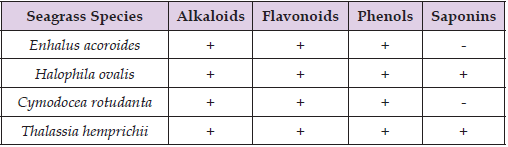
Note: Key: + = Presence of phytochemical, - = Absence of phytochemical
Analysis of Antibacterial Activity
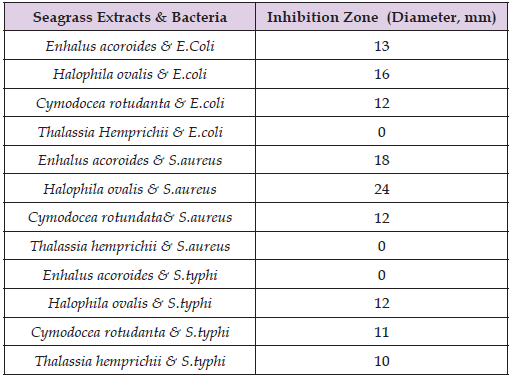
Antibacterial activity of seagrass extracts was evaluated against Escherichia coli, Staphylococcus aureus, and Salmonella typhi by measuring the inhibition zone diameter (Table 2). All seagrass species exhibited antibacterial properties, with varying degrees of effectiveness against different bacterial strains. Gram-negative bacteria (E. coli and S. typhi) showed higher susceptibility compared to the Gram-positive (S. aureus). These differences suggest the influence of bioactive compounds such as alkaloids, flavonoids, phenols, and saponins. Inhibition zones were categorized as inactive (<7 mm), weak (7–10 mm), moderate (11–14 mm), strong (15–19 mm), and very strong (≥20 mm) [21].
Table 2: CT Exam Protocol.
Comparative Visualization of Inhibition Zones
For better illustration of antibacterial activity differences, the inhibition zone values are presented in the bar chart below (Figure 1). This graph highlights the relative effectiveness of each extract against the tested bacterial strains. By comparing the heights of the bars, it is easy to observe that the seagrass extracts produced larger zones of inhibition, indicating stronger antibacterial activity. Compared to text or tables alone, this visual format makes it easier to interpret the differences in antibacterial effectiveness among species and bacterial strains, providing a clearer understanding of the extracts’ relative efficacy.
Visual Evidence of Antibacterial Activity
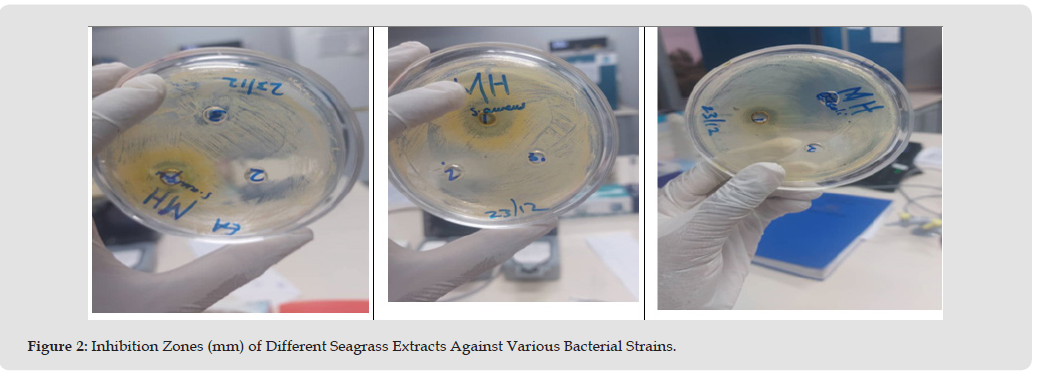
Photographs of inhibition zones observed on Mueller-Hinton Agar plates provide further confirmation of antibacterial activity. Clear zones around the wells indicate areas where bacterial growth was inhibited by the seagrass extracts (Figure 2).
Figure 1
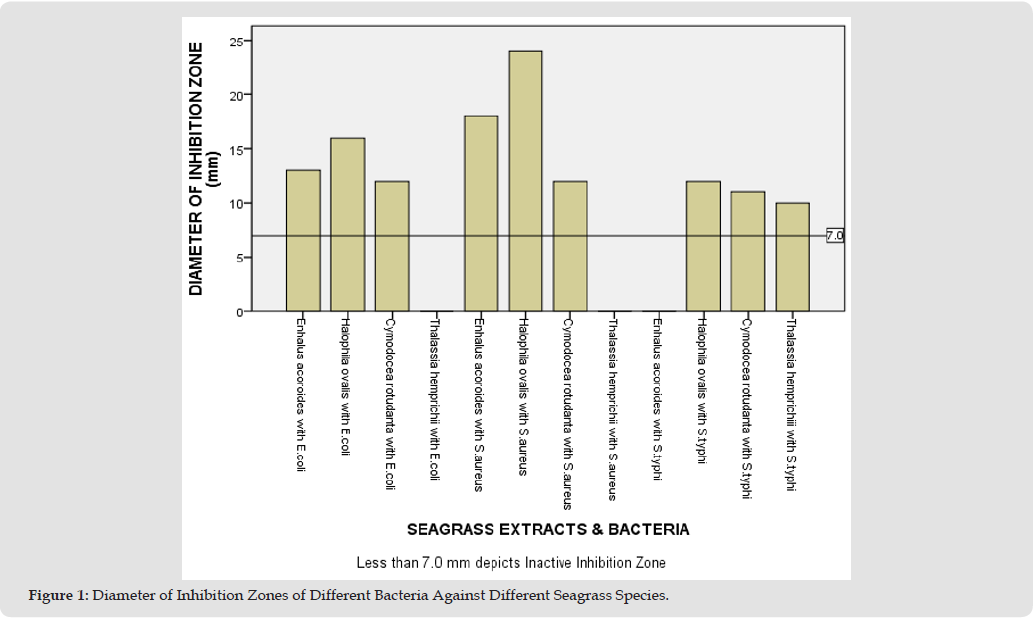
Figure 2
Phytochemical analysis of four seagrass species was performed using methanolic extracts. The results indicated that Halophila ovalis and Thalassia hemprichii had the highest phytochemical diversity, containing all four tested compounds (alkaloids, flavonoids, phenols, and saponins). All species contained alkaloids, flavonoids, and phenols, consistent with previous studies reporting these compounds in seagrasses [18,22,23]. Saponins were species-specific, absent in Enhalus acoroides and Cymodocea rotundata, but present in Halophila ovalis and Thalassia hemprichii. This observation suggests variation in secondary metabolite production among species. Such variation is supported by prior research indicating that phytochemical composition among seagrass species can be influenced by geographic factors such as water temperature, salinity, nutrient availability, and environmental stressors [24]. The antibacterial assay demonstrated that all seagrass extracts exhibited inhibitory effects against the tested bacterial strains, though effectiveness varied. Gram-positive bacteria (S. aureus) showed higher susceptibility to the seagrass extracts than the Gram-negative strains (E. coli and S. typhi), as indicated by larger zones of inhibition.The bioactive compounds such as alkaloids, flavonoids, phenols, and saponins likely contributed to the antimicrobial effects observed. Among the tested extracts, Halophila ovalis exhibited the strongest antibacterial activity, especially against S. aureus, followed by E. coli and S. typhi. Enhalus acoroides also showed considerable activity against S. aureus and E. coli, but was ineffective against S. typhi. Conversely, Thalassia hemprichii showed minimal to no inhibition against E. coli and S. aureus, and only weak inhibition against S. typhi. Cymodocea rotundata showed moderate activity against all bacterial strains. These findings align with previous research highlighting the potent antibacterial properties of methanol extracts of seagrasses, particularly Halophila ovalis, attributed to its rich phytochemical content such as flavonoids, tannins, and alkaloids [25-27]. The variation in antibacterial efficacy among species suggests their potential as sources of novel antibacterial agents, with Halophila ovalis being a promising candidate for further study.
This study successfully demonstrated that the four seagrass species collected from Chwaka Bay (Enhalus acoroides, Halophila ovalis, Cymodocea rotundata, and Thalassia hemprichii) contain important phytochemicals such as alkaloids, flavonoids, phenols, and saponins. Remarkably, Halophila ovalis and Thalassia hemprichii exhibited greatest phytochemical diversity. Nevertheless, with respect to antibacterial activity using the methanolic extracts show that these seagrasses have varying degrees of antibacterial activity against Escherichia coli, Staphylococcus aureus, and Salmonella typhi. The analysis depicted that Halophila ovalis had the strongest inhibitory effect, especially against S. aureus indicating its potential antibacterial properties.
Further research should focus on isolating and characterizing the specific bioactive compounds responsible for the antibacterial activity observed in Halophila ovalis and other seagrass species. Studies assessing the toxicity and safety profiles of these seagrass extracts are recommended before considering any pharmaceutical or therapeutic applications. Investigation into the effects of environmental factors on phytochemical production in seagrasses could provide insights into optimizing their bioactive potential. Exploring the potential of seagrass extracts against a broader range of microbial pathogens, including resistant strains, could help in developing novel antimicrobial agents. Conduct quantitative analyses of phytochemical constituents in seagrass species to determine the concentration and variability of bioactive compounds such as alkaloids, flavonoids, phenols, and saponins.

International Association of Landscape Archaeology, Czech Glass Society, Czech Republic

Department of Chemistry, Semenov Institute of Chemical Physics, USSR Academy of Sciences, Moscow, Russia

Neurology, LA BioMed Research Institute, USA

Associate Professor at Department of Breast and Thyorid Surgey, Chongqing General Hospital, China

Professor of Nuclear Medicine, Faculty of Medicine and Surgery, University of Milan, Milan, Italy





 Abstract
 PDF