info@biomedres.us
+1 (502) 904-2126
One Westbrook Corporate Center, Suite 300, Westchester, IL 60154, USA
Site Map
 ISSN: 2574 -1241
Received: August 12, 2025; Published: August 21, 2025
*Corresponding author: Alexander Kofman, Human Biology Variations Computational Genomics Research, Marazliivska St. 2, Odessa, Ukraine
DOI: 10.26717/BJSTR.2025.63.009830
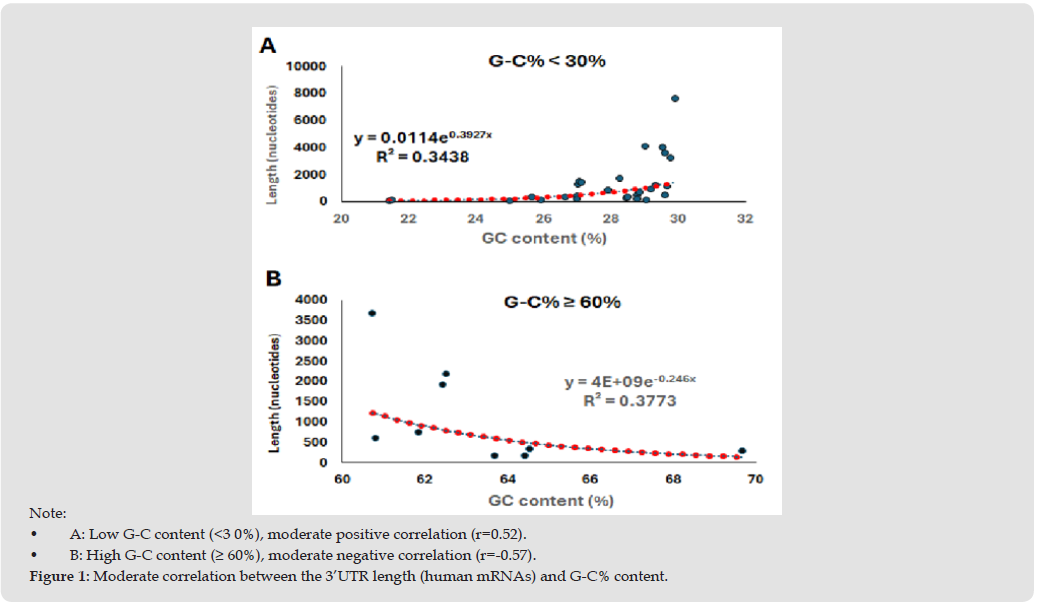
We report the moderate positive correlation (r=0.52), between low G-C% content and the length of the 3’UTRs, as well as moderate negative correlation (r=-0.57) between high G-C% content and the 3’UTR length. The results corroborate our previous data on the asymmetric distribution of microRNA target sites along the 3’UTR and point to the possible influence of nucleotide composition on the cis-acting regulatory elements within the 3’UTR.
Keywords: mRNA; 3’UTR; Nucleotide
Abbreviations: mRNA: messenger RNA; 3UTR: Untranslated Region
The growing number of reports indicate that codon usage bias and nucleotide content are among the important regulatory factors influencing gene expression at various levels. They may impact the nuclear mRNA concentration [1] and mRNA stability [2,3] and alter the expression of the heterologous genes in bacteria, plants, yeast, mammalian cells, and transgenic animals [4]. Previously we reported the moderate negative correlation between the 3’UTR length and the G-C% content in the 3’UTRs of 38 human mRNAs (in press). In this study we used the larger dataset of the prevailing transcripts of 824 human genes (RefSeq database [5]). We found the moderate positive correlation (r=0.52), between the low G-C% content (less than 30%) and the length of the 3’UTRs, as well as moderate negative correlation (r=-0.57) between the high G-C% content (more than 60%) and the 3’UTR length (Figure 1). The results indicate some similarity with the previously obtained data on asymmetric distribution of microRNA- target sites along the 3’UTR and suggest a complex interplay between the nucleotide composition and the 3’UTR regulatory functions, which remain to be elucidated.
Figure 1
International Association of Landscape Archaeology, Czech Glass Society, Czech Republic
Department of Chemistry, Semenov Institute of Chemical Physics, USSR Academy of Sciences, Moscow, Russia
Neurology, LA BioMed Research Institute, USA
Associate Professor at Department of Breast and Thyorid Surgey, Chongqing General Hospital, China

Professor of Nuclear Medicine, Faculty of Medicine and Surgery, University of Milan, Milan, Italy





 Abstract
 PDF