info@biomedres.us
+1 (502) 904-2126
One Westbrook Corporate Center, Suite 300, Westchester, IL 60154, USA
Site Map
 ISSN: 2574 -1241
Received: July 30, 2025; Published: August 20, 2025
*Corresponding author: Fernando Cassinda Quissanga, José Eduardo dos Santos University, Directorate of Scientific Research, Innovation, Entrepreneurship and Postgraduate, Angola
DOI: 10.26717/BJSTR.2025.63.009826
Context and Objective: The aforementioned topic addresses the future of artificial intelligence in its applicability
in medicine, being able to find mechanisms that will allow changes in various domains, in the area of medicine
that we see undergoing alterations, specifically in telemedicine and robotics. Artificial intelligence (AI) in the
field of medicine will make a big difference, in this context we will address the positive and non-negative point
of view that exists, for not being the focus of our research, meanwhile, we have a vision of being able to awaken
some future reflections and advantages that AI can draw in the medical or health field.
Method: qualitative research, based on bibliographic references, data collected on internet sites, books, scientific
articles, journals, specialized magazines, as well as the knowledge of two authors in the area of research,
documentary research.
Result: the future of IA the paradigm is changing in society, radical changes in the way of lidar with health, greater
applicability of technologies in telemedicine, robotics and rapid diagnosis time, efficient surgeries with zero
error margin and efficient treatment avoiding deaths.
Conclusion: AI has an impact on preventive medicine and curative medicine, with its applicability in various sectors
of the health sector, in the future it will evolve for implants and monitoring of diseases or pathologies, being
able to prevent heart attacks, cancerous diseases or awaken any signs of cancer whether malignant or benign.
Keywords: Artificial Intelligence; Medicine; Future; Telemedicine
Artificial Intelligence (AI) represents changes in several domains, in the area of medicine we also see alterations, specifically in telemedicine, or in terms of respect for distant applications of technology, applied in telecommunications, such as virtual operations, using various sensors and robotic engineering, or metaverse , virtual reality, among other techniques developed to address the field of health, or the aforementioned topic, we see to trace some new things that may happen in the future of AI in the field of medicine, we still see many problems because we are behind with traditional methods, since there is no need to adapt with modern, sophisticated methods, there are very basic quests that we are not going to be able to give answers, we understand that each nation has its own protocol to follow, it is known that the human being does not have another chance of life on earth, it is necessary to make a lot of investment in this sector to avoid many deaths due to negligence, another major concern is the education and ethics of professionals, or the handling of electromedicine machines combined with robotics, no Meanwhile, where can AI take us in the context of the future? With just several questions, how precise can we make a precise IA diagnosis? Is the future promising or illusory? We ask various questions with AI.
The aforementioned topic focuses on the characterization of the future of artificial intelligence applied in the field of medicine, in qualitative research, based on bibliographical references, data collected on internet sites, in books, scientific articles, in journals, specialized magazines, as well as the knowledge of two authors in the area of research, documentary research. Suggestions on technologies linked to medicine, to be able to use this field of study. Segundo Batista, et al. [1]: “As its function, qualitative research is proposed to investigate descriptive data of a situation or phenomenon, involving the direct contact of the researcher with the studied situation.” However, qualitative research is different from documentary research that is generally confused, for this particular case the experience, knowledge and experience of two authors are fundamental for the research. Because it is a topic that requires future study on AI in the field of medicine and thematic domain is necessary for all bibliographic sources, the documents are also necessary. “This emphasizes the process or the way the phenomenon occurs and is concerned with capturing the perspective of those who participate in the research” (Calil, et al. [2]). This approach has also emerged from bibliographic research.
Artificial intelligence (AI) in the field of medicine will make a big difference, in this context we will address the positive and non-negative point of view that exists, for not being the focus of our research, meanwhile, we have a vision of being able to awaken some future reflections and advantages that AI can draw in the medical or health field. Consequently: Khan [3] “The advent of artificial intelligence (AI) in the health area is redefining the limits of medicine and offering new paths to improve the results for patients around the world.” Given this statement, it is notable to realize that AI will have a bright future for society when approached rationally, given that there are still great challenges, despite some limitations. More or his future promise, as mentioned: Ortega, et al. [4]
Artificial intelligence (AI) promises significant transformation in health in all medical areas, potentially representing a “Gutenberg moment” for medicine. The future of medical specialties will depend largely on human interaction and creativity, forcing doctors to evolve and employ AI as a tool in the care provided to doctors. AI will offer doctors security, autonomy and the possibility of controlled medical care in areas of difficult access, in addition to helping doctors reduce administrative burden, or recovery time and exhaustion.
This quote from the author shows some clear reflections that there must be radical changes in the life of the doctor who wants to take into account academic and scientific training and improvement in order to be able to adapt to new technologies, to be able to serve with greater safety to his patients so as not to be overlooked in the current and vindouro context. This will require a professional form of health to accompany all transformations in medicine. For this very important topic for the field of medicine, we have contacts with many researches linked to telemedicine, the doctor can perform a surgery even if it is geographically distant, allowing the software machines to respond or operate as a professional accompanied on-line.
Figure 1
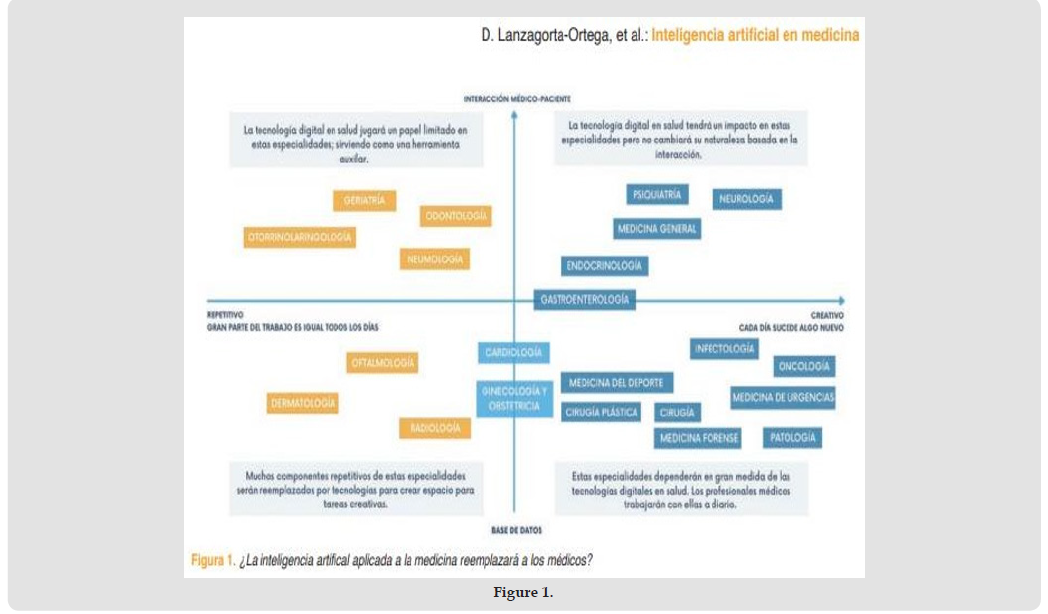
Fonte: Ortega, et al. [4]
In Figure 1 the mention of artificial intelligence applied in medicine, as well as the responsibility of doctors, states that doctors must be creative and create spaces for these technologies. Notably, several areas or specialties that will have radical changes as the advent of artificial intelligence. The work concludes with a vision of the future of AI in medicine, outlining possible technological advances, impact on medical practice and ethical and social considerations. The importance of interdisciplinary collaboration is highlighted in the crucial role of health professionals in the ethical and effective use of AI to improve health care. (Franco [5]). Meanwhile, it is necessary to perform a contextualization of artificial intelligence (AI), for a certain prescription or doctor goes through AI, reducing costs, otherwise the doctor to diagnose leva little time and the least lack of medical error, however, there are several indicators that we will carry out for further investigations and consequently in the future Promising for AI and teachers, it produces greater medical response, greater assistance, quick and accurate diagnoses, fewer human resources and logistics and efficiencies in medical services, we think that artificial intelligence is changing the paradigm in our society, we just need to use it correctly. However, in the future of AI, there is also a small insert for some questions about professional ethics and deontology that are fundamental for medicine.
As the time passes, we can evolve to monitor implants for diseases, heart attack, hypertension, various allergies, which will awaken any signs of cancer that are malignant or benign or some pathology, information that can be received by our doctor or some database of control of a clinic, to the sensors that alert us. Smartphone has information, you will also be able to provide quick response solutions with precision about our state of health, as we previously mentioned that robotics are part of the future of AI, as Matos, et al. [6]
[…] the use of robô in surgical procedures has benefits, such as less surgical trauma, shorter operative and recovery time, less risk of infection and high patient safety, because it is also assisted by highly trained doctors qualified to operate the machine and guide the procedure. However, it is possible to note that the future of artificial intelligence (AI) will have many benefits for modern medicine:
1. Implementation of (AI) in Allopathic (Conventional) Medicine
2. Implementation of (AI) in Integrative Medicine;
3. Implementation of (AI) in Phytotherapeutic Medicine;
4. Implementation of (AI) in Biological Medicine;
5. Implementation of (AI) in Orthomolecular Medicine;
6. Implementation of (AI) in Integrative Medicine.
After use it may result:
a. Specific diagnoses;
b. Accurate monitoring of pathologies (cancer diseases, malignant and benign tumors);
c. Heart attack monitoring;
d. Monitoring of depressive symptoms;
e. Robotic surgeries with zero error margins;
f. Chip implants for pathology monitoring;
g. Advanced low and high intensity laser healing treatment, combined with robotic systems;
h. Advanced cellular regeneration;
i. Artificial Neurais Networks (RNA) coupled with stratified genetic algorithms of our DNA genetic code;
j. Safe transplants;
k. Advanced medical support, patient management and medication management software.
Looking at the future of artificial intelligence medicine, after a methodological approach, analysis and treatment of data from various bibliographic sources, we can conclude that AI is changing every day, its impact on preventive medicine and curative medicine, its applicability in various sectors of the health sector, the future of artificial intelligence technology will evolve for implants and monitoring of diseases or pathologies, being able to prevent heart attacks, cancerous diseases or awaken any signs of cancer whether malignant or benign. Artificial intelligence applied to the operating or surgical blocks can be used without error, it will make the rapid refueling services more efficient and will bring several benefits.

International Association of Landscape Archaeology, Czech Glass Society, Czech Republic

Department of Chemistry, Semenov Institute of Chemical Physics, USSR Academy of Sciences, Moscow, Russia

Neurology, LA BioMed Research Institute, USA
Associate Professor at Department of Breast and Thyorid Surgey, Chongqing General Hospital, China

Professor of Nuclear Medicine, Faculty of Medicine and Surgery, University of Milan, Milan, Italy





 Abstract
 PDF