info@biomedres.us
+1 (502) 904-2126
One Westbrook Corporate Center, Suite 300, Westchester, IL 60154, USA
Site Map
 ISSN: 2574 -1241
Received: August 04, 2025; Published: August 18, 2025
*Corresponding author: Alusine Boys Conteh, Ernest Bai Koroma University of Science & Technology, Sierra Leone, Beijing Normal University, China
DOI: 10.26717/BJSTR.2025.62.009822
This study examines the effectiveness of own-source revenue generation at nine local councils in Sierra Leone as a means to foster development in their localities. The research focuses on councils such as Port Loko City Council, Freetown City Council, and Kenema City Council, among others, analysing nine common revenue streams, including business licenses, property taxes, and sand mining. Key challenges identified include corruption, lack of transparency, insufficient technical skills, and delayed central government disbursements. The study concludes that while own-source revenue is critical for local development, most councils struggle to generate adequate funds, highlighting the need for improved capacity-building, accountability mechanisms, and policy reforms. The results are limited to the nine councils studied and underscore the broader implications for fiscal decentralisation and sustainable local governance in Sierra Leone. In the process of generating revenues, some Local councils are effective in some revenue streams, while others are ineffective. This is a result of their capacity or technical ability to identify.
Keywords: Local Councils; Own Source Revenue; Generation; Development
Abbreviations: ASSET: Almost Always Cash or Accounts Receivables; FASB: Financial Accounting Standard Board; LGFC: Local Government Finance Committee
Before the establishment of Local governance or decentralisation of governance in Sierra Leone began, the central government was the only one responsible for generating revenue from different sources across the country, and the central government used that generated revenue to develop the country in different ways. In recent years, the concept towards decentralisation and local governance has been taking significant growth in most developing countries as democracy is taking a greater step forward throughout the world. This establishment of local governance has opened room for local indigenes, stakeholders, and political process to enhance and provide absolute autonomy and authorities notably, monetary and developmental autonomy of local authorities to enhance and provide development. The process of decentralization in Sierra Leone as stated or prescribed in the constitution requires the establishment of a system of local government and administration that has to be decentralized of its structures. The Local Government Act [1] (Part 2 Section 2) among others established for the establishment of Local Cities and District Councils as the highest body in their localities be it city or district. The councils are mainly charge with the direct responsibility to bring development to their localities with all autonomous power and authority with little or no central government interference. The central government only supervises the local councils.
However, in their operations the central government devolved certain functions of development known as the devolved sectors. Areas like Electricity is not devolved to council as a function which simply means councils do not have the mandate to control electricity in their areas of operations. Local government operates in a single tier with 15 district councils and seven city councils. All 22 local councils are governed by the Local Government Act [1], which gives councils legislative, financial and administrative powers The Local Government Act of [1], (Part 5 Section 20, subsection 1 and 2a-k) stipulates the functions of the Local Government. It states that the local councils shall be responsible for the entire development of the districts and cities including the preparation and submission of developmental plans and budget of the districts and cities related to the approved national development plans. Besides, the local Councils formulate and implement development plans, programs and strategies for the effective mobilization of the resources known as own source revenue and ensure the continuous spread of resources necessary for the development of their districts and cities.
To ensure that the Local councils are able to perform their mandate or primary responsibility of developing their local areas, the central government transfers some funds quaterly to them which in turn councils transfer to the various devolved sectors For this purpose, the Local Government Finance Committee (L G F C) was constitutionally established by government to provide for each local government department and agencies, a sound financial base with enough and reliable sources of revenue. However, it is eminent that the LGFC is more eminent and robust for its several functions that help to eradicate or combat some challenges gone through by many councils in their quest to bring development to their communities or localities. Meanwhile, the problem of late disbursement of funds to the councils from central government is still a big and disturbing challenge faced by councils. Thus retard or hinder the progress of development the council’s localities. Sometimes the funds disbursed by the central government are not enough as opposed to the development plans drafted by the development planning office and committee members the locality Because of the late disbursement and insufficient disbursement of funds to local councils from the central government, a whole department to generate revenue within it locality is established headed by the valuator.
This primary responsibility of this unit in local councils is to identify, mobilize and generate revenue from its own sources to foster development rather waiting for central government to transfer funds for implementation. Local councils, central government and partners like European union, World bank, China aid, USAid etc all see own source revenue generation is very key to enhance development, in lieu of this, donor partners have funded project towards revenue generation to local councils more especially, the European union delegation in Sierra Leone and World Bank. The central government has given the Local councils the power and authority to generate revenue for themselves within the confines of the law because very soon government is proposing to stop the disbursement of funds to local councils.
Before the establishment of the National Revenue Authority, revenue collection was at a level of 20% and as such, the NRA, together with other proposed new tax laws, was expected to improve the country’s revenue collection. In a bid to address the economic challenges that the country was faced with at the time, the government of Sierra Leone, under the leadership of President Kabba (h), through an Act of parliament, created the NRA to ‘formulate and implement plans for developing and maintaining effective, fair and efficient revenue collection system….’ among other functions, as prescribed in section 12 of the NRA Act, 2002. This saw the merger of the Income Tax Department and the Customs and Excise Department into one centralised body, known as the National Revenue Authority. Section 27 of the NRA Act mandates that all revenue collected be placed into the Consolidated Revenue Fund. At the height of the civil war, Sierra Leone became over-dependent on foreign sources for even its budgetary needs to run the government. It derived up to 60% of its national revenue from donor partners. However, with the advent of the NRA in 2003, this dependency was reduced to 40% by 2009, with the remaining 60% provided by the National Revenue Authority. This primary function of revenue collection has been of great achievement for the authority since it was created a decade ago (Pa Baimba Sesay).
Revenue refers is that monetary event of asset valves increasing in the organization because of the physical event of production or sales of products or services of the organization Pany, (2004). Rittenberg and Schwieger (2005) define revenue as the inflows or enhancements of assets of a firm or settlements of its liabilities during a period from delivery or producing goods, rendering service or other activities that constitutes the entity’s ongoing major or central operations. In addition, described revenue as inflows of asset (almost always cash or accounts receivables) received for products or services provided to customers. Organizational performance is in terms of revenue generation portrayed by the levels of assets accumulation, wealth created, and the quality services by customer level of satisfaction and customer complaints Kloot, et al. For better revenue generation, organizations should critically look at customers and other stakeholders in business and establish how best they are satisfying their needs. Organizations should continuously improve their revenue and have an internal control system that is intervened with organizations operating activities and it is most effective when controls are built into the organizations infrastructure in terms of continued improvement on performance standards as part of the competitive advantage of the organization. Awitta [2] stated that revenue collection is the amount of money that a company receives during a specific period. It is the “top line” or “gross income” figure from which costs are subtracted to determine net income.
Revenue collection can be defined as income that a company receives from its normal business activities, usually from the sale of goods and services to customers. Revenue is referred to as turnover. Some companies receive revenue from interest, dividends or royalties paid to them by other companies. The Financial Accounting Standard Board (FASB) Concept Statement 6, Elements of Financial Statements (December 1985) have defines revenue as inflows or other enhancements of assets of an entity or settlements of its liabilities (or combination of both) during a period from delivery or producing goods, rendering service or other activities that constitutes the entity’s ongoing major or central operations. In addition, Hongreen (2002) described revenue as inflows of asset (almost always cash or accounts receivables) received for products or services provided to customers. However, NRA have referred revenue to means taxes, duties, fees, levies, charges, penalties, fines or other monies collected or imposed under the written laws set out in the First Schedule. Internal control has to do with a lot with revenue collection. The study actually look at the impact internal control on revenue collection. However, many researchers tend to ignore this research topic. The research will give a clear cut on the relationship on the independent and dependent variable. The study is needed both government and the Authority to solve problem of revenue leakages and the study will be used to develop policies.
Besides that, according to Julius (2008) stated that if the methods of revenue generations are effectively used, there will be no relationship between internal control and revenue mobilization, he further say internal control only comes into existence after revenue have generated ,in other words the outflow of money is to be controlled by putting effective internal control systems. The Local Government Act 2004 gives the local councils the power and authority to identify, mobilize and generate revenue from sources including local taxes, property rates, Business licenses, sand mining, fees and charges, and to receive mining revenue, interest and dividends. Own source Revenue is the revenue collected within the local councils operations and this has seen may councils effective in service delivery.
There are 22 local councils: six city councils and one municipal council in the urban areas, and 15 district councils in the predominantly rural areas. Councils must establish a budgeting and finance committee, a development planning committee and a local technical planning committee to oversee the preparation and review of their local development plan. The Local Government Act 2004 confers discretion to establish other committees, which may also co-opt non-voting members K Maligie [3]. Elected representatives Wards return councilors on a single member-per-ward basis in the 15 district councils (which have between 18 and 29 wards each) and in Freetown City Council (which has 48 wards). The other city and municipal councils have multi-member wards. Paramount chiefs may not stand for office as elected councilors. In local council areas where there is a paramount chieftaincy system (namely the four provinces), the paramount chiefs in the council’s area select between one and three of their number to represent their interests on the local council. The term of office for elected councilors and paramount chief councilors is four years. The political head of a local council is the mayor (city council) or chairperson (district council). The 2008 local government elections introduced direct election for mayors and chairpersons.
Mayors and chairpersons are also elected for a fouryear term and are eligible for re-election once. The deputy mayor or chairperson is elected by the councilors from among their number. Councils have two wings of leadership in their operations, the administrative wing which is headed by the Chief Administrator and the Political Wing which is headed by the Mayor for City councils and Chairperson for District councils.
The Longman dictionary of contemporary English (1995) defined revenue as money that a business or an organization receives over a period of time especially from selling goods or services. It also described revenue as money that government received from tax. Fayemi sees revenue as ‘all tool, taxes, impress, rates, fees, duties, fines, penalties, fortunes and all other receipt of government from whatever source arising over a period either one year or six months Revenue generation in local government is principally derived from tax. Tax is a compulsory levy imposed by government on individuals and companies for the various legitimate function of the State (Olaoye, et al.). Tax is a charge imposed by government authority upon property, individuals, or transactions to raise money for public purposes. This definition is however imperfect. The study of the teachings of Christianity, Islamic and other prominent religions in the world shows that tax is a religious duty based on social and civil responsibilities (Agbetunde, et al. Over the years, the Local councils have seen own source revenue generation as key tool to enhance development in their respective localities. All locals have common own source revenue generation streams. However, some Local councils have greater own source revenue generation streams than others. Local councils put own source revenue as top priority because it is through own source revenue councils would be able to develop their localities.
It is also eminent that some councils do not put more emphasis on revenue generation due to limited sources of revenue in their localities. Councils seek support from donor partners like European Union, WorldBank to capacitate their staff with various revenue generation strategies. The own source revenue generation is more effective in the urban city councils and District councils where there are mining companies to pay royalties.
The study is also anchored on the postulates of the efficiency theory. The central point by this theory is that the primary purpose of the local government systems is to provide social services such as law and order, local roads, primary education, sanitation and others efficiently. William Machenzie, et al. the leading advocate of the efficiency service school, quoted in Adeyemo, et al. notes that service delivery to the local people is expected to pre-occupy the resources, power and time of the local government. Kafle, et al. notes that the core argument of the efficient-service delivery school is that local government exists to help to ensure efficient-service delivery.
The problems for Ineffective Revenue Generation for Local Councils in Sierra Leone
1. Lack of Fiscal Sustainability and Economic Mismanagement: Despite the growth in the large amount of revenue available to local councils in Sierra Leone, its economic and Gross domestic product is still underprivileged comparative to the delivery of services it is expected to carry out.
2. Corruption and Lack of Monitoring and Evaluation: Arguably the problem that is killing development in Sierra Leone both central and Local Government in particular, corruption remains a major challenge on the effectiveness of Local councils service delivery. Public funds meant for developmental service delivery purposes are embezzled for only personal consumption. Generally, conruption by officials of public offices has made revenue generation as a big problem in all local councils
3. Lack of Transparency and Accountability: Transparency and accountability is a key element when it comes to revenue generation. The problem of transparency has led to the ineffective and inefficiency in generating revenue by the local councils, people lack the confidence to pay their taxes because they are opined that the local councils are not transparent to clearly show the total revenue generated and how those revenues are to be used thus brings the resistance to pay.
4. Lack of Skills and Strategies for Effective Revenue Generation: Local Councils in Sierra Leone arguably lack the skills and the technical know-how to identify, mobilize and generate revenue from own source revenue streams. The inabilities of councils to identify revenue have rended the ineffectiveness of revenue generation from Local councils. However, some donor partners capacitate some councils on cadre system to improve revenue generation councils like, Port Loko city council, Kenema city council, Portloko District council, Kailahun District council etc.
The study employed a mixed-methods approach to assess the effectiveness of their source revenue generation at the nine selected local councils in Sierra Leone. The methodology combined both qualitative and quantitative techniques to provide a comprehensive analysis of the revenue generation processes and their impact on local development. A descriptive research design was adopted to systematically evaluate the revenue generation strategies and their outcomes across the selected councils. This design was chosen for its ability to provide detailed insights into the current state of revenue generation while identifying gaps and challenges. The study utilized a random sampling technique to select nine local councils out of the 22 in Sierra Leone. The selected councils included three city councils (Port Loko City Council, Freetown City Council, Kenema City Council) and six district councils (Port Loko District Council, Kambia District Council, Kailahun District Council, Bombali District Council, Western Area Rural District Council, and Makeni City Council). This sampling ensured representation from both urban and rural areas, capturing diverse revenue generation contexts.
Primary Data
Field surveys were conducted to gather firsthand information from council officials, revenue collection units, and local stakeholders. Structured interviews were held with key personnel, including chief administrators, valuators, and finance officers, to understand the operational challenges and successes in revenue generation.
Secondary Data
Published reports, council financial statements, and revenue records were reviewed to quantify revenue streams and assess trends. Policy documents, such as the Local Government Act 2004 and amendments, were analysed to contextualise the legal framework for revenue generation.
Quantitative Analysis
Revenue data from the nine councils were tabulated and analyzed to compare the effectiveness of different revenue streams (e.g., business licenses, property taxes, sand mining). Performance was categorized as “effective” or “ineffective” based on predefined benchmarks, such as revenue targets and consistency in collection.
Qualitative Analysis
Thematic analysis was applied to interview transcripts and policy documents to identify recurring challenges (e.g., corruption, lack of transparency) and best practices [4-23].
The findings are limited to the nine councils studied and may not be generalizable to all 22 local councils in Sierra Leone. Reliance on self-reported data from council officials may introduce biases.
Port Loko City Council
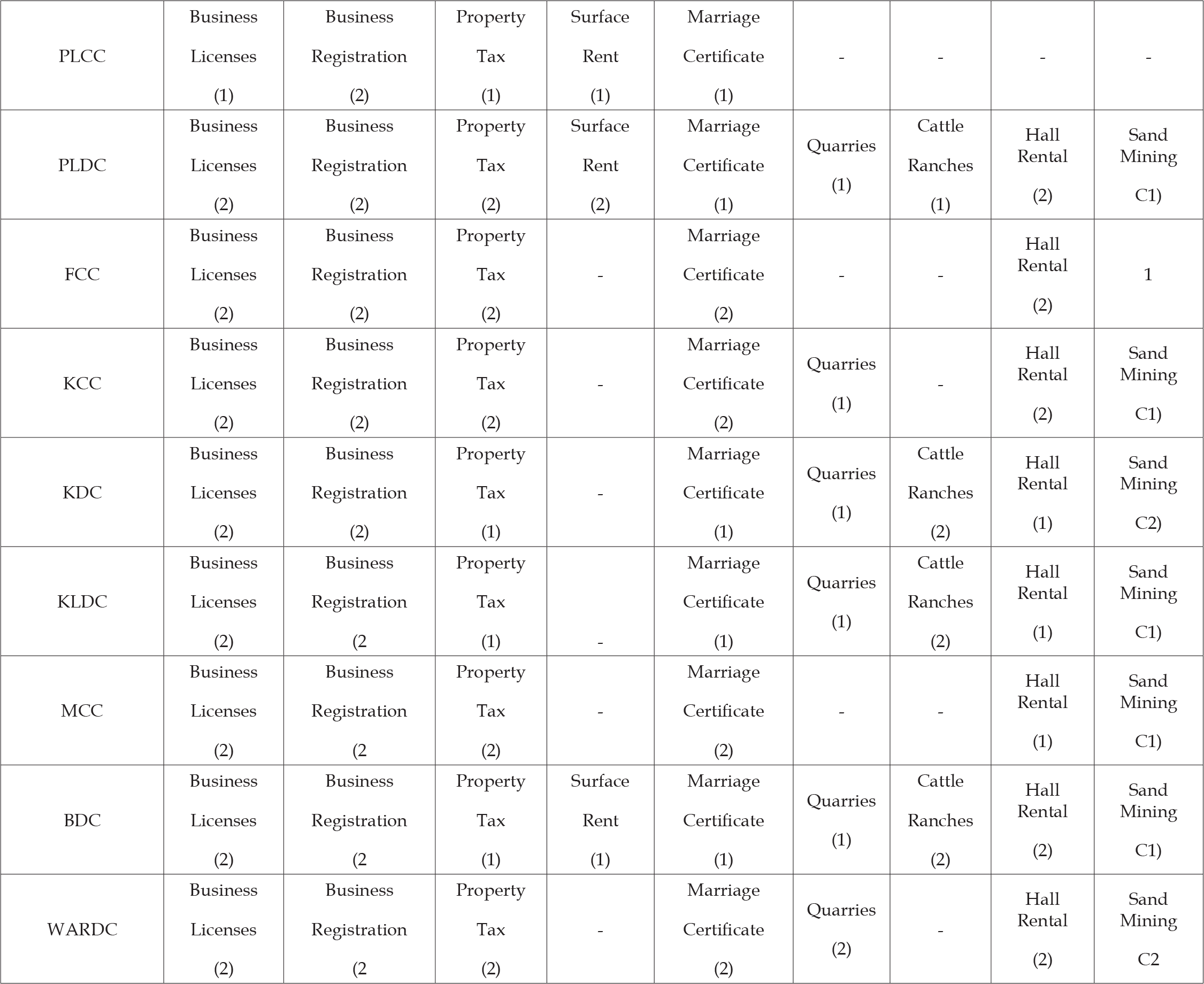
The Port Loko City council is hosted in the City of Port Loko, which is located in the north-west part of Sierra Leone. This council was established in 2017 alongside Karene District council and Falaba District Council, Port Loko City Council is a baby council generating revenue in the city is a new phenomenal in the city of port Loko since the city is new, However, the city has revenue streams as stated in the table above but the capacity and technical know-how to identify, mobilize and generate own source revenue is a key factor to the hindrance of the council also the willingness of people within the city to pay taxes is a major problem. The study look at 9 revenue streams and amongst the 9 streams only 1 own revenue stream is effective which is Business registration thus, this area is not enough to generate revenue to foster development within the city. Conclusively, Own source revenue generation in the port Loko City Council is Ineffective (Table 1).
Table 1:
Port Loko District Council
Port Loko District council is located in Port Loko District in the North West region and the council is hosted in the Port Loko City. this councils is considered as one of the leading councils in Sierra Leone in terms of own Source revenue streams it has major revenue source within it area of operations. Amongst the 9 revenue streams under review PortLoko District council revenue Generation is more effective in 5 key areas which are, Business License, Business Registration, Surface rent, Property rate, Hall Rental. The council get large funds from surface rent from mini ng companies and Business license from big towns within the District such as Lungi, Lunsar, Masiaka etc.
Kambia District Council
Kambia District council is located in Kambia town in the Northwest part of Sierra Leone According this research and amongst the 9 revenue sources under review only 4 revenue sources are effective in terms of own source revenue generation which are Business License, Business Registration, Cattle ranches and Sand Mining. Their major sources of revenue are from Business Licenses.
Kailahun District Council
Kailahun District council is located in the township of Kailahun in the Eastern Part of Sierra Leone. This council is also vulnerable in terms of revenue generation strategies amongst the 9 sources of revenue under review only two are effective which are Business License, Business Registration. All the other sources are ineffective in terms of generating revenue for the development of the District.
Bombali District Council
Bombali District Council is located in Makeni City and in the North-eastern Part of Sierra Leone. This council has a lot of own source generation sources but the effective once in generating revenue are Business License, Business Registration, Cattle ranches and quarries. This council would have generated enough property rate but they are always in contention with Makeni city council in terms of Boundary delimitation.
Western Area Rural District Council
This council is located in the rural Part of western Area in Waterloo. This is the second biggest Local council in Sierra Leone in terms of revenue generation sources. This council has major generation sources and its generating strategies has been effective and efficient amongst the nine (9) generation streams, 7 sources are very effective as stated in the table. The major sources of revenue are from Business License and Property tax.
Freetown City Council
This council is in the capital city of Sierra Leone and it hosted almost all the important government offices and major businesses in Sierra Leone. This Local Council is the Premier Council in Sierra Leone, it is the biggest council of all the councils base on it revenue generation streams and strategies. Amongst the 9 revenue sources under review, 5 revenue streams are effective in revenue generation and its major revenue comes from Business License, Business Registration, and Property rate.
Kenema City Council
Kenema city is considered as the 3rd largest city in Sierra Leone and the city host the local council. Kenema is populated with a lot of businesses since it is the closet city to the 2nd City which is Bo city. Kenema city has many sources of revenue amongst the 9 revenue streams under review, 5 revenue sources are effectively generated by Kenema City Council. Amongst the 5 Business Licenses and Property rate are the sources generated more revenue for the council
Makeni City Council
Makeni city council is hosted in Makeni City in the North-Eastern part of Sierra Leone. When it comes to property tax and business license revenue generation processes, the council is always at log ahead with the Bombali District council because of boundary delimitation. Amongst the 9 revenue sources under review, 4 sources are generated effectively and property rate and Business License are the sources the council generates more revenue. Conclusively, the nine (9) revenue sources under review are the common sources amongst the Local councils and the project used 9 local councils to do the review process. On that note the result of data would not be generalized rather limited to only the 9 Local councils under review. The study pointed that revenue generation processes is not effective and the little generated is not enough to foster greater developmental projects within their areas of operations.
Conclusively, the nine (9) revenue sources under review are the common sources amongst the Local councils, and the project used 9 local councils to do the review process. On that note, the result of the data would not be generalised rather limited to only the 9 Local councils under review. The study concludes that councils are unable to foster development in their various localities due to the ineffectiveness of their revenue generation. The reasons for the ineffectiveness cut across all the local councils.

International Association of Landscape Archaeology, Czech Glass Society, Czech Republic

Department of Chemistry, Semenov Institute of Chemical Physics, USSR Academy of Sciences, Moscow, Russia

Neurology, LA BioMed Research Institute, USA

Associate Professor at Department of Breast and Thyorid Surgey, Chongqing General Hospital, China

Professor of Nuclear Medicine, Faculty of Medicine and Surgery, University of Milan, Milan, Italy





 Abstract
 PDF