info@biomedres.us
+1 (502) 904-2126
One Westbrook Corporate Center, Suite 300, Westchester, IL 60154, USA
Site Map
 ISSN: 2574 -1241
ISSN: 2574 -1241
ISSN: 2574 -1241
Received: July 29, 2025; Published: August 12, 2025
*Corresponding author: S N Martyushov, Computer Science and Applied Mathematics Faculty, Moscow Aviation Institute - National Research University, Russia
DOI: 10.26717/BJSTR.2025.62.009818
In the paper numerically investigated flows of hydrogen-air gas mixes in channels with obstacles with purpose to define conditions of deflagration initiation. Preference of hydrogen as a fuel is detonation fuel cycle which is more energetic preferable in comparison with ordinary fuel cycle. In laboratory experiments deflagration initiation appears as result of energy and temperature grows by successive triggering of electric discharges or near obstacles in channels. Numerical simulation was provided on the basis of k −ε model of turbulent viscous flows. For numerical simulation of kinetic process two algorithms where used: the first one is based on numerical decision of fool system of kinetic equations. The second one consists of dividing fool system of kinetic equations into three subsystems. This algorithm is based on theory of branching chain reactions, introduced by Semenov. Results of two examples of flows calculations demonstrate reliability of branching chain reactions algorithm for numerical simulation of deflagration initiation in hydrogen-air mixes fluxes.
Keywords: Artificial Intelligence; Clinical Laboratories; Diagnostic Pathology; Automation; Machine Learning; Healthcare
For many years idea of detonation engine was in center of attention of researchers. The detonation fuel cycle is more energetic preferable than the Briton cycle used in aviation and rocket engines. So, simplicity of construction and energetic effectiveness make the development of detonation engine constructions very perspective. Detonation initiation can be achieved by different ways, namely by focusing of pulse jet inside sphere-shape resonator (Fujiwara, et al. [1]) or spin detonation engine, in which detonation waves propagate inside axis -symmetrical region in radial direction (Zhdan, et al. [2]), by electric discharges or by specification of region inside engine: channels with obstacles, ring or U-tube form of channels (Frolov, et al. [3]). Progress in the construction of detonation engines partly consists of developing numerical algorithms of high order of accuracy which can produce precisely results of numerical simulation of gas flow inside the engine. This numerical algorithm demands also using of sophisticated mathematical models.
During numerical simulation of deflagration appearance, it is necessary to take into account influence of viscous turbulence effects, dissipation of energy and diffusion between mix components. In this work k −ε model of turbulence was used for viscous flows with taking into account dissipation effects and diffusion. The system of the equations of viscous turbulent gas mix in the integral form for two dimensional flows with source terms can be presented as follows:
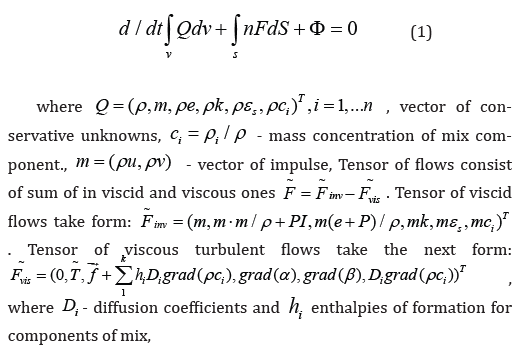
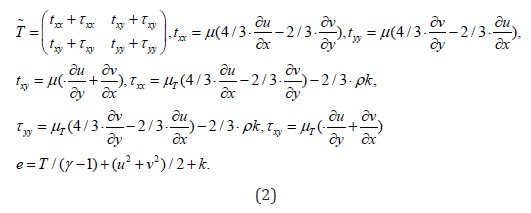
Here k is the kinetic energy of turbulence and s ε
is the solenoidal
dissipation of turbulence kinetic energy. The dissipation rate is decomposed
as follows: 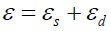 , where εd is the dilatation dissipation
of turbulence kinetic energy. Sarkar’s model is employed to take
into account the effects of compressible:
, where εd is the dilatation dissipation
of turbulence kinetic energy. Sarkar’s model is employed to take
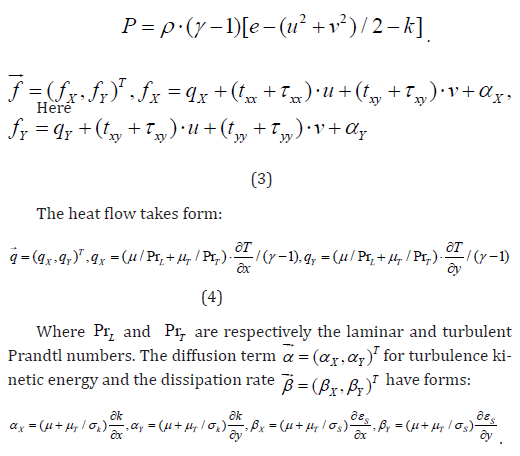
into account the effects of compressible:  . The system of equations is closed by the equation of state for a perfect
gas:
. The system of equations is closed by the equation of state for a perfect
gas:
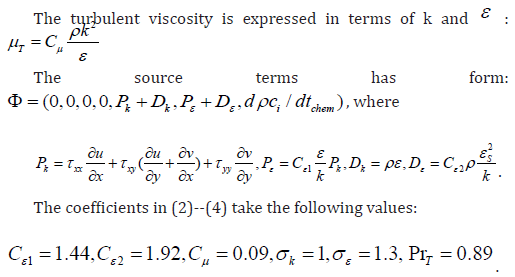
Common feature of non-linear difference methods is calculation of the in-viscid flows on the border of finite volume on the basis of approximate-state Riemann solvers. In this paper those approximate- state Riemann solvers where defined (initially find in [4]) for arbitrary number of gas mix components (and ρk ,ρε unknowns) on the basis of Roe-Pike method. TVD difference scheme of Chacravarthy - Osher [5] of third order of accuracy was used. Modification of numerical method [5] consist of using pure upwind variant of this scheme. This variant of scheme made it possible to avoid oscillations of values of radicals concentration.
For calculation of the derivatives on the boundaries of grid cells for terms of viscous flows calculations Gauss theorem was used:
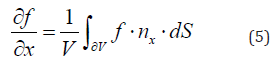
The calculations of those integrals can be done by introducing additional volume based on centers and vortex of cells. In this paper the other way was choose for integrals (5) evaluation. During calculation of in--viscid flows with using Roe-Pike procedure we already found all unknowns on the bound of the cells, so derivatives in (5) for viscous flows can be found in the centers of cell. After that we use simple upwind choice for defining viscous flows on the boundary of the cells.
Process of deflagration appearance in hydrogen-air mixes can be treated as transition from slow chemical reactions to fast branching chain reactions. Theory of these reactions was developed by Semenov [6]. Equations of chemical reactions can be presented as follows:

Where M, n –number of reactions and components of the mix, αij , βij - coefficients of direct and inverse reactions. Arrhenius low is predicted for calculating of speeds of changing of mix components concentration ci :
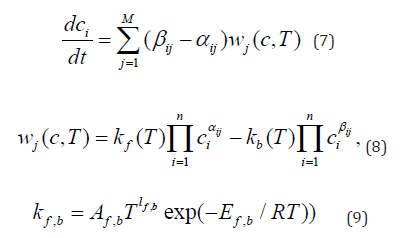
In present paper gas mix of 9 component: Н2, О2, Н, О, Н2О, ОН, НО2, Н2О2, N2 was treated. For present investigation the next 11 the most widespread reactions where choose:
Two algorithms were used for numerical solving of system (7)- (9). The first one was solving of fool system of stiff ODE (7)-(9) on the basis of numerical Gear method. The family of implicit Gear methods is one of the BDF methods (backward differential function), which use meanings of unknowns from m previous time steps. In connection with number m of previous time steps one defines the Gear method of m accuracy. Every method of m accuracy poses its own area of stability. For m greater than 7 area of stability is empty. In this paper the next modification of Gear method for solving system of stiff ODE
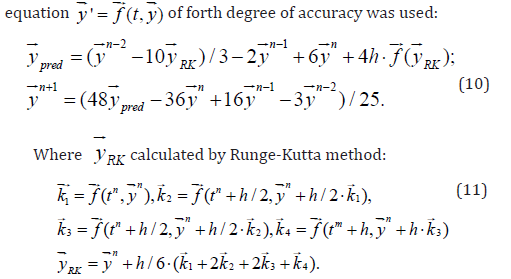
The meanings of on the first three-time steps calculated by explicit Runge-Kutta method (11), This predictor-corrector algorithm allows one to avoid iteration procedure on every time step as necessary for initial implicit Gear method. Additional improvement of method convergence achieved by Runge procedure for defining value of time step (by defining maximum error on every time step):
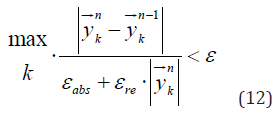
where εabs , εre are absolute and relative error respetively. If inequality (12) is not valid value of time step h should be reduced. Idea of the second one [6] is the next. Deflagration in hydrogen-air gas mix appears as sudden explosion after long period of induction (for more low initial temperature the period of induction is longer). In this induction period concentrations of radicals Н, О and ОН are grows. Mass of radicals, nevertheless stay small and velocity of their changing are negligible, and one radical component transverse to the others. This explosion mechanism is branching chain reaction introduced by Semenov [6]. In this case system of kinetic equations is divided into three subsystems. Systems of two differential equations for concentration of H2 and H2O2 are solved separately. The concentrations of radicals H, O, OH and HO2 are found from algebraic system with assumption of “quasi stationary” concentration, and for “large unknowns” system of three differential equations is solved after some time steps of solving first and second subsystem with bigger time step.
Numerical simulation of two-dimensional flows of hydrogen-air mixes with deflagration appearance were provided for two configurations of asymmetrical channels.
Flow in Channel with Parabolic Form Obstacles
Axe- symmetrical calculation region consists of channel with parabolic form obstacles. Shock wave of intensity Msh.w.=1.5 spreading from the left boundary of the region. Initiation of deflagration appears at the ferst corner boundary point near axe of symmetry. After this moment intensity of deflagration grows in this area. On Figures 1a- 1d level lines of temperature and meanings of temperature (in write column, multiplied by 0.01) in consequent time moments are drown. On Figures 1e & 1f graphics of temperature (e) and concentration of 2 H (f) along bottom boundary of the channel in consequent time moments are drown.
Flow in Channel with Central Body
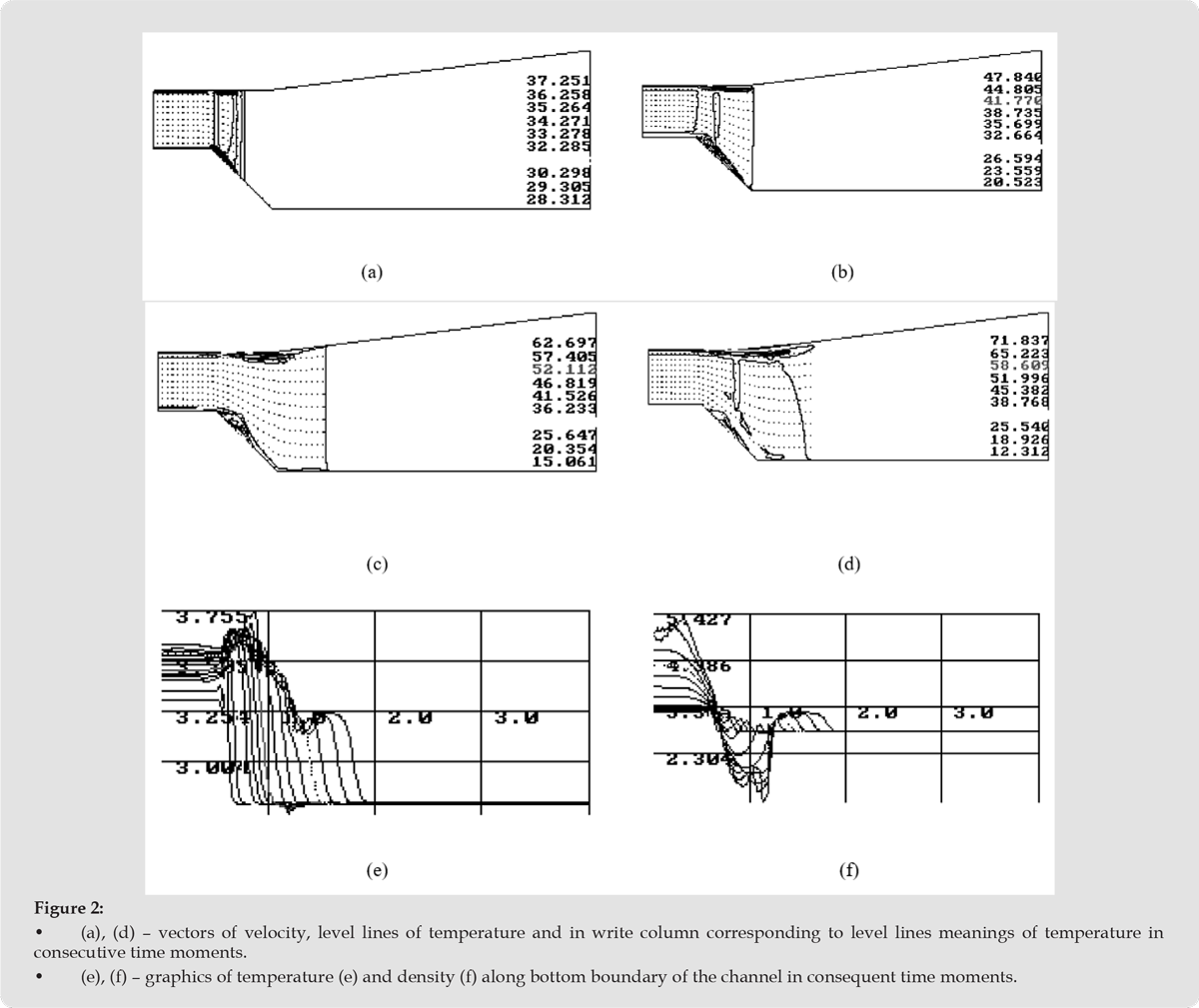
Axe- symmetrical calculation region consists of channel with central body. Formulation of the problem is similar to the previous one. Shock wave of intensity Msh.w.=1.5 spreading from the left boundary of the region. Initiation of deflagration appears at the corner boundary points on up and down border. After this moment intensity of deflagration grows in these areas. On Figures 2a-2d level lines of temperature and meanings of temperature (in write column, multiplied by 0.01) in consequent time moments are drown. On Figures 2e & 2f graphics of temperature (e) and concentration of H2 (f) along bottom boundary of the channel in consequent time moments are drawn. For calculation performing structured curvilinear calculation grids were constructed by author’s algorithm, based on decision of system of PDE equation of parabolic type [7].
Figure 1
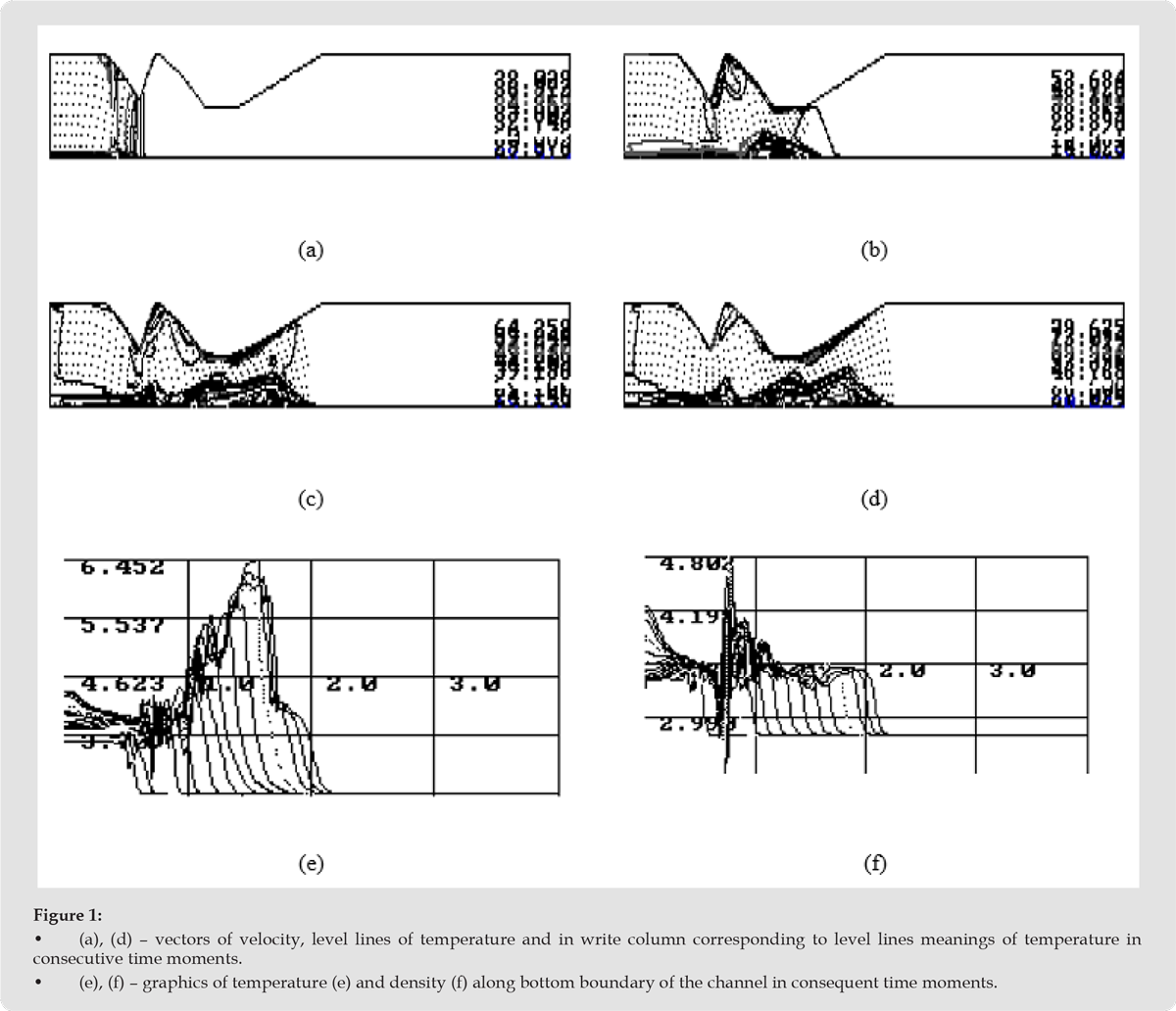
Figure 2
Flow in Non-Reflecting Nozzle
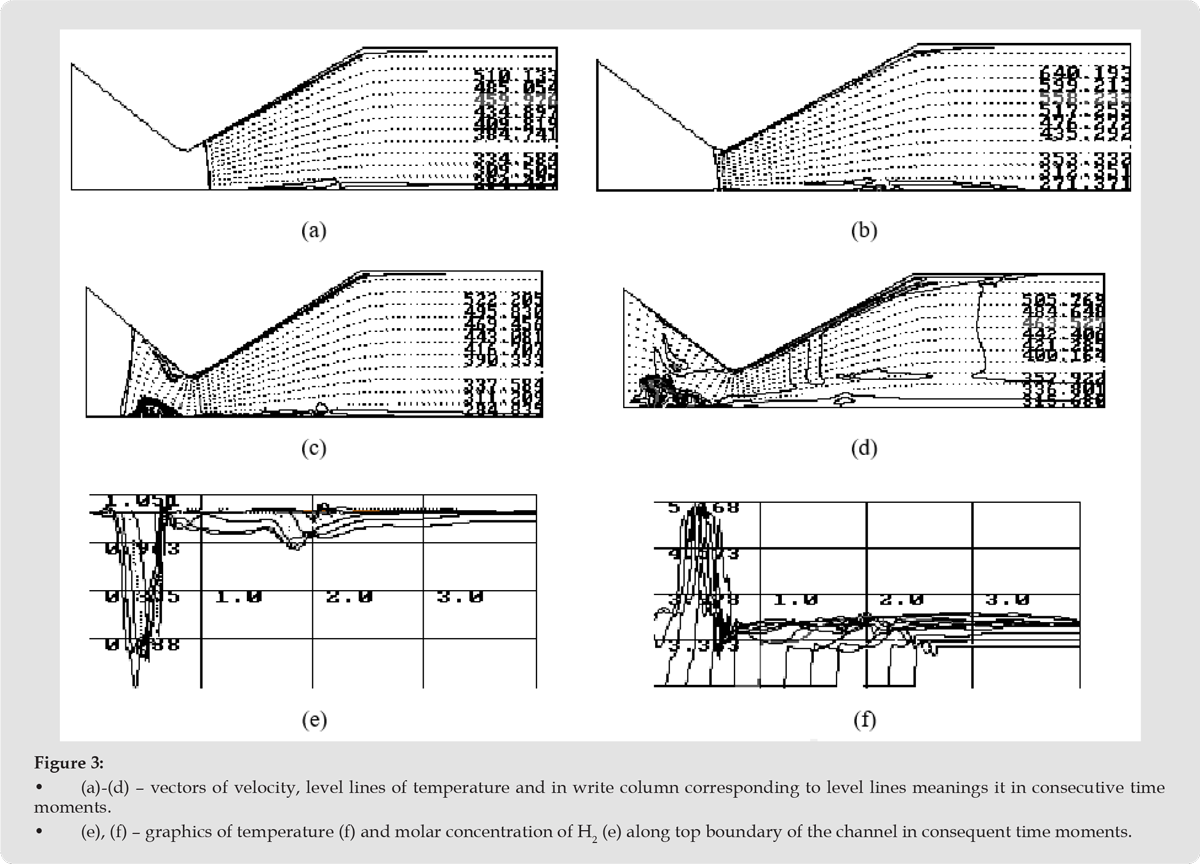
Axe symmetrical channel with non-reflecting nozzle (calculation grid drown in Figure 1) initially filled with hydrogen-air mix with little amount of water (it involved as collision partner in reaction 5 and 7 of Table 1) with atmosphere meanings of gas dynamics values. At the initial moment shock wave of intensity Msh.w.=1.9 began to move from the right side of the region. During the spreading of shock waves on the top and bottom bounds of the region deflagration of gas mix appears. On Figures 3a-3d level lines of temperature and meanings of it (in write column) in consequent time moments are drown. Change of H2 concentration inside the flow demonstrates deflagration appearance. On Figures 3e & 3f graphics of concentration of hydrogen H2 (e) and temperature (f) along bottom boundary of the channel in consequent time moments are drown.
Table 1: Chemical reactions.
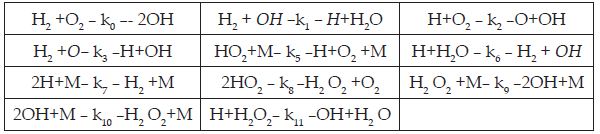
Figure 3
Flow in Channel Consist of Combination of Cylinders and Cones
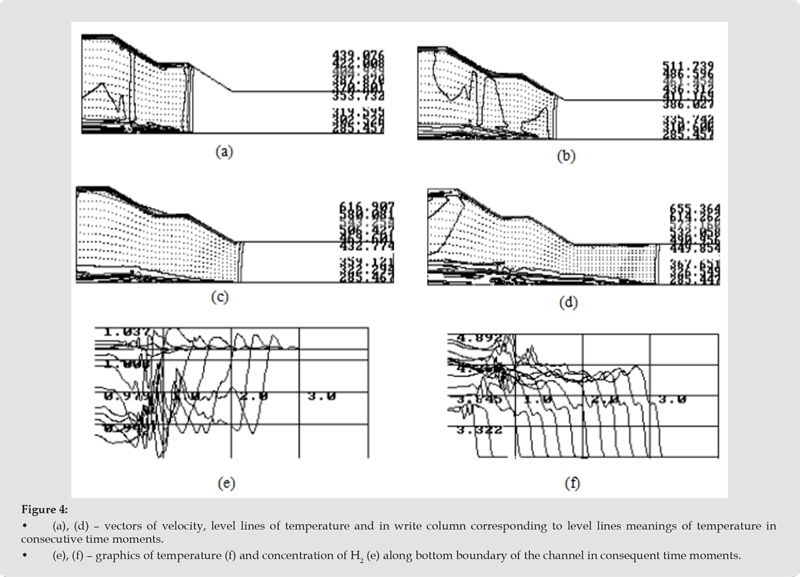
Axe- symmetrical calculation region consists of combination of cylinders and cones. Formulation of the problem is similar to the previous one. Shock wave of intensity Msh.w.=2.7 spreading from the left boundary of the region. Initiation of deflagration appears at the boundary point between secondary cone and secondary cylinder. On Figures 4a-4d level lines of temperature and meanings of temperature (in write column) in consequent time moments are drown. On Figures 4e & 4f graphics of temperature (f) and concentration of H2 (e) along bottom boundary of the channel in consequent time moments are drown.
Figure 4
Axial Flow in Channel Between Two Coaxial Cylinders
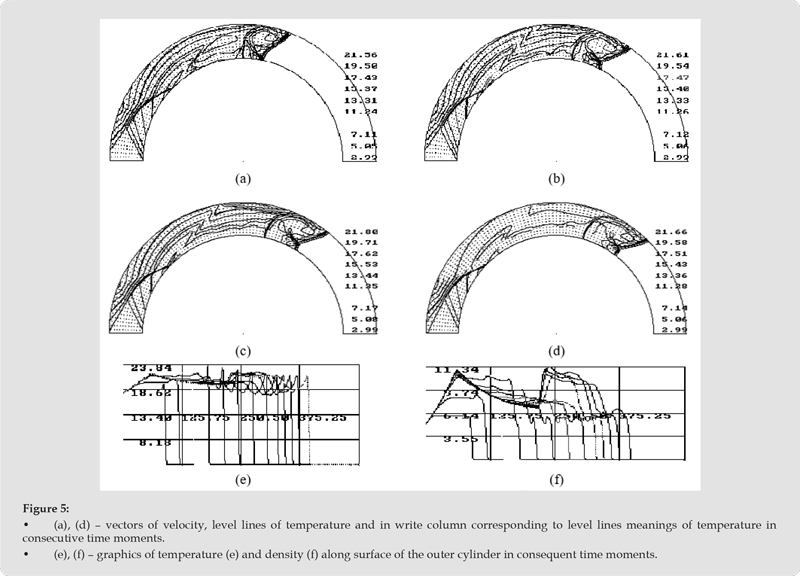
Calculation region is situated between two coaxial cylinders. Formulation of the problem in main is similar to the previous ones. Shock wave of intensity Msh.w.=5. spreading along the cylinders surfaces from the left boundary of the region. Initiation of deflagration appears near outside surface at the beginning of shock spreading and later near upper point of the graphic. On Figures 5a-5d level lines of temperature and density and meanings of temperature (in write column) in consequent time moments are drown. On Figures 5e & 5f graphics of temperature (f) and density (e) along outside bottom boundary of the channel in consequent time moments are drown. This flow in some aspects similar to flow on rotating detonation region.
Figure 5
Algorithm for calculation of deflagration initiation for viscous turbulent flows of hydrogen-air mixes was provided. In--viscid flows were calculated by using pure upwind variants of Chakravarthy-Osher difference scheme This variant of scheme made it possible to avoid oscillations of values of radicals concentration near points of deflagration appearance. Calculations of viscous turbulent flows in the center of cells were made with using values of supplementary unknowns defined on the border of cells as part of Roe-Pike method of approximation of Riemann problem for in--viscid flows calculations. After that pure upwind meanings of viscous turbulent flows where used. So, in-viscid and viscous flows are calculated from the same meanings of supplementary unknowns. Calculations of some examples of flows with initiation of deflagration in hydrogen-air mixes in two-dimensional channels by this algorithm were provided. For decision of system of kinetic equation two algorithms where used: the first one is decision of fool system of kinetic equation for multistage hydrogen-air reaction, and the second is algorithm based on Semenov’s theory of branching chain reaction. Both algorithms used non iterative variant of Goer methods for solving stiff system of ordinary differential equations. For calculation performing structured curvilinear calculation grids were constructed by author’s algorithm, based on decision of system of PDE equation of parabolic type [7].

International Association of Landscape Archaeology, Czech Glass Society, Czech Republic

Department of Chemistry, Semenov Institute of Chemical Physics, USSR Academy of Sciences, Moscow, Russia

Neurology, LA BioMed Research Institute, USA

Associate Professor at Department of Breast and Thyorid Surgey, Chongqing General Hospital, China

Professor of Nuclear Medicine, Faculty of Medicine and Surgery, University of Milan, Milan, Italy





 Abstract
 PDF
PDF