info@biomedres.us
+1 (502) 904-2126
One Westbrook Corporate Center, Suite 300, Westchester, IL 60154, USA
Site Map
 ISSN: 2574 -1241
ISSN: 2574 -1241
ISSN: 2574 -1241
Received: July 14, 2025; Published: July 29, 2025
*Corresponding author: Jihad Zallat, Remote Sensing and Optical Imaging Team - ICube Laboratory, France
DOI: 10.26717/BJSTR.2025.62.009798
Mueller polarimetry is emerging as a valuable tool for distinguishing benign from malignant skin lesions due to its sensitivity to microstructural tissue differences. This article presents preliminary findings from a clinical study conducted at the University Hospital of Strasbourg, where 34 lesions were imaged using a custom-built Mueller spectro-polarimeter. Distinct responses in depolarization, retardance, diattenuation, and crossed-polarization intensity were observed across lesion types. Notably, melanomas exhibited specific polarimetric signatures that enabled differentiation even within pigmented lesions.
Keywords: Skin; Dermal Collagen; Polarimetry; Optical Biopsy; Cancer Diagnosis
Skin cancer is one of the most diagnosed cancers globally. While non-melanoma types usually carry low mortality, melanoma remains aggressive and deadly, with a steadily increasing incidence. Early detection greatly improves prognosis, yet reliable diagnosis remains difficult due to the visual similarity between melanomas and benign nevi. Various optical techniques, such as Optical Coherence Tomography (OCT), fluorescence imaging, and Raman spectroscopy [1,2], have been explored to improve diagnostic accuracy. Among them, polarimetric imaging stands out for its non-invasive nature and its sensitivity to tissue composition and microarchitecture [3-7]. Since biological tissues alter light polarization in a manner reflective of their structural and biochemical makeup [8], we developed a Mueller spectropolarimeter tailored for dermatological imaging. This device captures complete Mueller matrices, offering a detailed polarimetric fingerprint of the tissue. The aim of our clinical study was to determine whether such data could help differentiate benign from malignant lesions before biopsy.
We designed a stable optical imaging system using polarized light to evaluate skin lesions. It requires no frequent recalibration or thermal compensation [9]. The setup consists of a polarization state generator before the light source and an analyzer before the camera, enabling precise measurement of tissue-induced polarization changes [10]. After successful validation on small animal models [11], the system was employed in a clinical study at the Dermatology Department of Strasbourg University Hospital. The objective was to collect polarization- resolved data on various lesions prior to biopsy. Thirty-one patients (34 lesions) were included. Among these, 18 were malignant (16 carcinomas, 2 melanomas) and 16 were benign (e.g., keratoses and naevi). Polarimetric responses were analyzed to identify characteristic features linked to each lesion type. This article presents the preliminary findings.
Mueller polarimetric imaging is an optical technique that measures how a biological sample modifies the polarization state of light across an extended field of view. It provides a complete description of light–tissue interactions through the reconstruction of the Mueller matrix, a 4×4 matrix that characterizes the transformation of incident polarization states by the sample. From this matrix, several quantitative descriptors can be derived—namely, depolarization (loss of polarization), diattenuation (differential attenuation of polarized light), and retardance (phase delay related to birefringence). These parameters are sensitive to microstructural changes in tissue architecture and may serve as non-invasive optical biomarkers of pathological alterations such as cancer. In this study, the Mueller matrix was reconstructed for each lesion at 680 nm from sixteen polarization- resolved intensity images. The Lu-Chipman decomposition method was applied to extract the depolarization, diattenuation, and retardance components for each pixel of the lesion [12,13]. In addition, we computed surrogate contrast metrics based on crossed and co-polarized illumination and detection configurations. Specifically, the intensities corresponding to horizontal–vertical and vertical–horizontal crossed polarizer pairs (denoted IHV and IVH ), as well as horizontal–horizontal and vertical–vertical co-polarized configurations ( IHH and IVV ). From these, we defined the average crossed-polarization signal as IXPOL = IHV + IVH and the co-polarization signal as ICOPOL = IHH + IVV
Benign lesions showed varied polarimetric patterns depending on pigmentation:
• Pigmented benign lesions: High diattenuation compared to healthy skin, but low retardance and depolarization. Crossed and co-polarized intensities were also low.
• Non-pigmented benign lesions: Three typical profiles emerged:
1. Low diattenuation, with elevated retardance and depolarization, low IXPOL and ICOPOL .
2. High diattenuation with low retardance and depolarization, high IXPOL and ICOPOL .
3. All parameters low except IXPOL and ICOPOL , which were high.
Among malignant pigmented lesions, one melanoma displayed a profile like benign types. However, orientation-based metrics [retarder and diattenuation axis maps] revealed its distinct nature: the lesion was not visible in these orientation maps, unlike benign lesions. This invisibility in directional maps, particularly among pigmented lesions, may serve as a specific marker for melanoma. Each node represents a binary test, and the final classification [benign or malignant] is based on a combination of these criteria. Variables in red indicate values higher than those of healthy tissue, and variables in green indicate values lower than those of healthy tissue Figure 1 illustrates this decision process through a diagnostic decision tree, where successive thresholds applied to polarimetric parameters lead to a final classification. The first level of discrimination is based on the combined evaluation of IXPOL and ICOPOL : if exactly one of them is elevated, the lesion is considered malignant. Otherwise, further classification integrates lesion pigmentation and the values of diattenuation, retardance, and depolarization. This tree-based strategy enables differentiation between melanomas, carcinomas, and benign lesions, as demonstrated in this preliminary dataset. All carcinomas included in the study appear clearly in the orientation maps of both the retarder axis and the diattenuation axis, as shown in Figure 2c.
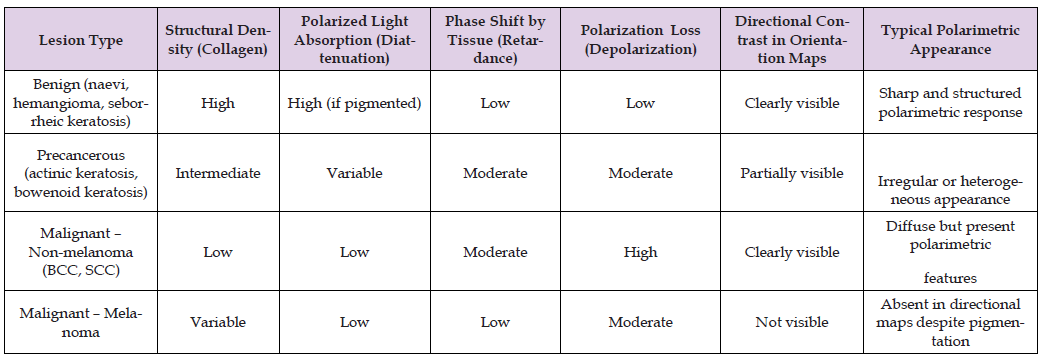
These directional patterns highlight the tumour structure and are particularly prominent in the diattenuation orientation map. In contrast, the two melanomas imaged (Figure 2a & 2b) exhibit a markedly different behaviour: their contours are not visible at all in the orientation maps, suggesting a structural or scattering configuration that fails to produce anisotropic polarization effects. This specific polarimetric invisibility was not observed in any benign lesion, reinforcing its potential as a distinctive marker for melanoma. To better interpret the variety of polarimetric responses observed across the dataset, we synthesized the main This summary reflects the typical values and behaviours of key parameters such as diattenuation, retardance, depolarization, and visibility in orientation-based maps across the different histological categories of lesions. Derived from the systematic analysis of the clinical data, this table highlights how distinct polarimetric profiles can be associated with benign, precancerous, and malignant lesions. It underscores the potential of directional polarimetric features to discriminate melanomas from other pigmented lesions, despite occasional similarities in global intensity metrics (Table 1).
Figure 1
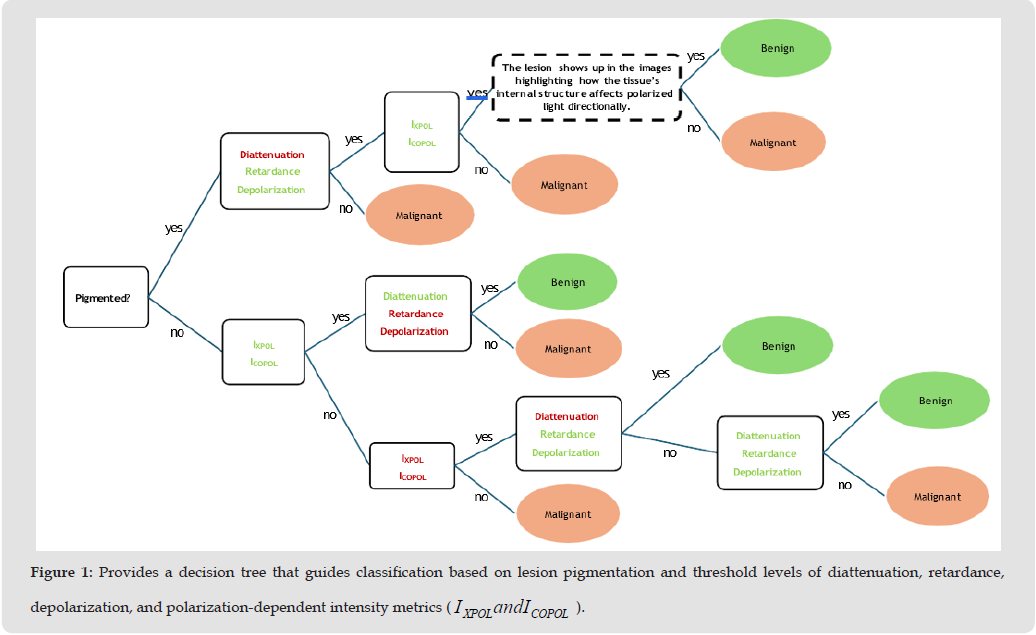
Figure 2
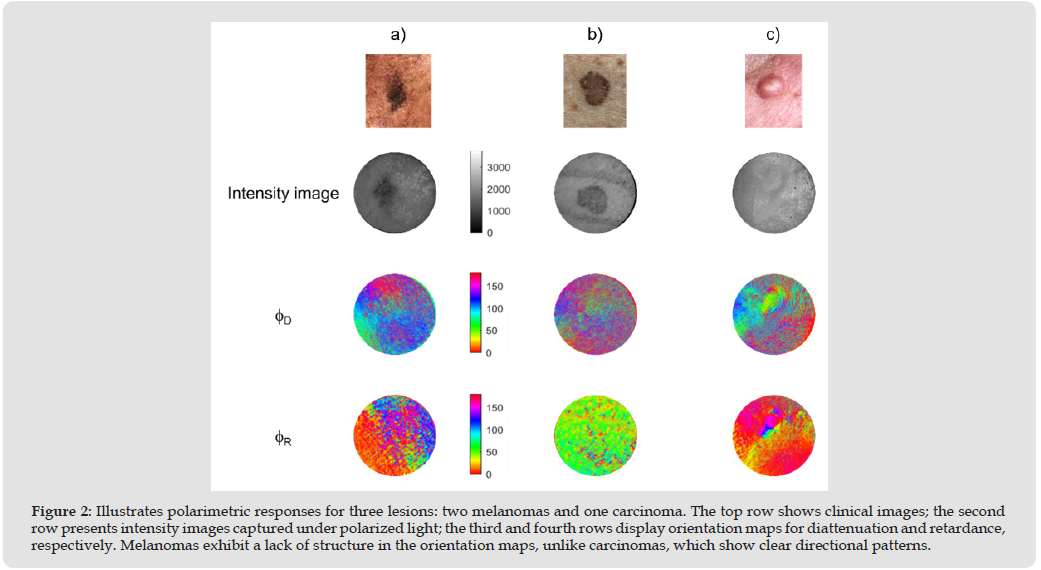
Table 1: Summary of typical optical and polarimetric features observed in different categories of skin lesions.
This preliminary clinical study demonstrates the potential of Mueller polarimetry as a non-invasive diagnostic tool for skin lesions. Analysis of polarimetric parameters—derived from Mueller matrices and interpreted through Lu-Chipman decomposition—enabled the differentiation between malignant and benign lesions. Notably, unique signatures were identified for melanomas, which could not be mimicked by any of the benign lesions in the study. These promising results highlight the capability of Mueller polarimetry to complement traditional diagnostic methods. However, further validation with larger patient cohorts is necessary to confirm its clinical relevance and robustness. Continued development of this technique may contribute to earlier, more accurate skin cancer diagnoses, ultimately improving patient outcomes.
The author declares no conflict of interest.
The authors would like to thank the Société d’Accélération du Transfert de Technologies Conectus Alsace for its funding of the Dermapol project.
Data underlying the results presented in this paper are not publicly available at this time but may be obtained from the authors upon reasonable request.

International Association of Landscape Archaeology, Czech Glass Society, Czech Republic

Department of Chemistry, Semenov Institute of Chemical Physics, USSR Academy of Sciences, Moscow, Russia

Neurology, LA BioMed Research Institute, USA

Associate Professor at Department of Breast and Thyorid Surgey, Chongqing General Hospital, China

Professor of Nuclear Medicine, Faculty of Medicine and Surgery, University of Milan, Milan, Italy





 Abstract
 PDF
PDF



























