info@biomedres.us
+1 (502) 904-2126
One Westbrook Corporate Center, Suite 300, Westchester, IL 60154, USA
Site Map
 ISSN: 2574 -1241
ISSN: 2574 -1241
ISSN: 2574 -1241
Received: July 18, 2025; Published: July 29, 2025
*Corresponding author: Aftimichuk Olga, Department of Combat Sports and Gymnastics, Institute of Physical Education and Sports, State University of Moldova, Moldova
DOI: 10.26717/BJSTR.2025.62.009796
The article presents an experimental fitness program that includes complexes of exercises using one’s own weight, exercises with weights, exercises with fit ball, exercises using a step platform, relaxation exercises and stretching exercises. Based on the results obtained during the conducted research, the effectiveness of the developed methodology, using dosed sets of exercises of different directions in the structure of complex trainings with a general strengthening effect, was experimentally confirmed.
Keywords: Women Over 40 Women Over 40; Physiological and Physical Capabilities; Fitness; Multidirectional Exercises
In everyday life and modern conditions for the development of the largest possible volume of scientific and technical information, new types of professions are characterized by physical exertion. In this regard, the problem of the influence of the application of physical exercises on the level of physical fitness and the functional state of the body, which is the physiological basis of the physical and mental well-being of women aged 35-45, has attracted much attention of many researchers. By definition E.G. Milner [1] explains that only through special physical exercises of intensive threshold performed during non-working hours, can significantly slow down the progression of age-related changes and physiological functions, as well as degenerative changes in various organs and systems that are already manifested in women aged 35-45 years. It is known that in various fields of scientific and industrial activities constitute a large percentage of women engaged in intellectual and creative work. A contingent of women of mature age is the most active in production. However, if the first period (21-35 years) is characterized by stability and relative prosperity of the functions of the body, becoming a professional qualification in production, family formation, the second period (36-55 years) is associated with significant changes in physiological functions, neuroendocrine changes, signs of age and occupational diseases.
According to the theory of adaptation of the body to constantly changing internal and external environmental conditions [2], there are 6 main positions of physiological activity [3] and the theory of physical education [4], the process of involutional development can be prevented by effective regimes of physical activity. During the recent years, a number of studies have been conducted on the development of methodological foundations for conducting fitness training with people of different ages [5-7]. However, to date, there are no generally accepted approaches to determining the rational combination of general means of physical training and regulating efforts taking into account gender, age and level of physical training. For the programs of classes with middle-aged people, the authors propose to use a wider complex of physical exercises from the arsenal of basic, hygienic, rhythmic, athletic, aerobic gymnastics, stretching, etc. [8-10]. The adoption of new technologies of strengthening in the practice of physical culture allows to satisfy the needs of a person in choosing accessible and effective forms of physical activity depending on the physical condition, their motivational requirements and social premises.
However, the new technological forms of complex training at the present time have not received scientific and methodological justification. Therefore, the application in practice of scientifically substantiated technologies of complex combined training, means of physical education of various types, allows to satisfy the needs of women in choosing accessible and effective forms of physical activity with the aim of maintaining the optimal level of the body’s activity capacity, correcting the state of health, separate retarding functions, preventing the involution of physical qualities. In connection with the mentioned above, the current situation is appreciated in that up to the present time, the content and peculiarities of the dosage of efforts in complicated lessons, combining fitness means of different directions and ensuring a sufficient strengthening effect, are not sufficiently known.
The purpose of the given research is to improve the technology of using complex training, which combines the means of aerobics, stretching and strength tests of fitness with women aged over 40. To achieve this goal, the following methods of testing the participants of the experiment were used:
Methods of Testing Physical Capabilities
1) Flexibility is presented with the following tests: spinal mobility, hip joint mobility, shoulder joint mobility.
2) Strength indicators were determined by the resistance force of the abdominal muscles, back, legs and arms.
Methods of testing physiological possibilities were determined by the chest excursion, heart rate, Stanghe’s Test, Ghenchi’s Test, Rufe Index.
Experimental Methodology
The experimental methodology was developed in accordance with the morpho-functional peculiarities of the female body over 40. This age period is characterized by various hormonal changes, which can be expressed in poor health, an uncomfortable state, mental imbalance, etc. A feature of the program was the fact that the three training lessons per week are organized according to different programs:
• Monday – fitball;
• Wednesday – aerobic gymnastics + callanetics;
• Friday – pilates + stretching.
The mixed programs assumed a change in physical activity, because the age of the examined women, as mentioned above, is very vulnerable to stress and physical efforts. The preparatory part included various variations of steps to prepare the talocrural joint for performing more complex exercises; a complex of exercises for general physical development; exercises for training vestibular stability. In the case of fitball, all exercises were performed with fitness balls in the hands, performing the function of weight, as well as for the development of women’s coordination. In the mixed type of training “aerobic gymnastics + callanetics” the preparatory part of the training was carried out in the form of aerobic gymnastics performed at a moderate tempo (120 b/min). The third program involved dynamic stretching with elements of local muscle loading from a standing position. The duration of the preparatory part was 10-12 minutes.
The basic part of the training (30-35 min) was carried out in the positions of kneeling, standing in the support of the knees, sitting and lying down. In the first program, the basic part began with exercises performed from a sitting position on a fitness ball without support and with the support of the feet on the floor. The work included both the large muscle groups of the legs, the abdominal muscles, and the skeletal muscles that hold the spine in an upright position, and are slightly involved in performing high-amplitude exercises. Then the exercises performed in a lying position on the ball: on the abdomen, back and side. In these positions, almost all muscles and muscle groups work very well, given that when performing the exercises, the body must maintain balance on the ball. A wide selection of exercises is presented in various positions lying on the floor. Here, the ball can be caught with the feet, both with the soles and with the knees; held by the hands. The positions of the feet on the ball, as well as the support of the upper body on the ball are not excluded. The most part of the second program provided for a second half – callanetics.
In general, the exercises of the basic part are of a strength nature. The basic complex of exercises includes exercises to strengthen the back muscles, abdominal muscles and stretching the muscles of the upper and lower extremities of the neck. Exercises are performed from various positions on the floor. As mentioned above, callanetics called “gymnastics of awkward positions”. However, when performing exercises in this kind of positions, all the basic muscles of the body work. Working within the third program – Pilates + stretching, the core exercises were aimed at strengthening the muscular corset, meaning that the abdominal and back muscles will be worked. The first few exercises were aimed at developing the back muscles, stretching and warming them up, in order to avoid excessive tension and stretching during the performance of more difficult exercises. Next, they performed exercises to strengthen the abdominal muscles and stretch the waist muscles, which improve circulation, strengthen and tone these areas. Then followed exercises to relax the spine. The basic part was completed with the work of the trunk muscles in all its planes in terms of balance and coordination of the muscles and also the mobility of these areas. The final part of the training lasted 12-15 minutes and was aimed at educating elasticity, restoring respiratory functions.
For all types of programs, stretching exercises were performed. In the case of fitball, some exercises were performed both sitting on the ball and sitting on the floor with the support of the legs/foot on the ball. Elasticity and relaxation exercises were performed in the static mode in sitting and lying positions, that is, with fixing the pose taken for a certain period of time (from 10 to 20 seconds). The emphasis was placed on the muscles that received the greatest load. Performing exercises accompanied by deep breathing allows for deep stretching and relaxation. Breathing exercises included a small self-training. For the final part, we used slow-tempo music, which contributes to calming and relaxing the entire body.
The experiment involved 17 women aged between 40 and 55, who were attending the “Energy Fitness” fitness club.
Analysis of the Dynamics of the indices of the Physical Abilities’ Development in the Examined Women
To confirm the effectiveness of the developed methodology, we conducted testing of the physical abilities of the examined women. All parameters demonstrated the authenticity of the initial and final data (Table 1). Out of the twelve parameters, three are at the significantly higher threshold (p < 0.001): the resistance force of the abdominal muscles (t = 3.99), the back ones (t = 4.21), the hands (t = 4.18). This can be an argument that our experimental methodology includes programs that are approximately mostly oriented to strengthening the muscles of the upper body. Two parameters from the block of resistance force of the muscles: the right leg (t = 2.72) and the left leg (t = 2.52), confirmed the significantly lower threshold (p < 0.05), which does not indicate a good impression of the results obtained. The Mobility block presents seven parameters, four of which demonstrated statistical authenticity at the p < 0.01 threshold: mobility of the spine by bending forward (t = 3.73), to the right (t = 3.27); right hip joint (t = 3.65), left hip joint (t = 3.55). Three others – at the p < 0.05 threshold: mobility of the spine by applying to the left (t = 2.55), right shoulder joint (t = 2.17) and left (t = 2.81). In our opinion, the results obtained are positive for women over 40, because they are in the period of physiological transformation of the body and physical training for them cannot always be performed.
Table 1: Dynamics of average group indices of physical capacities in examined women.
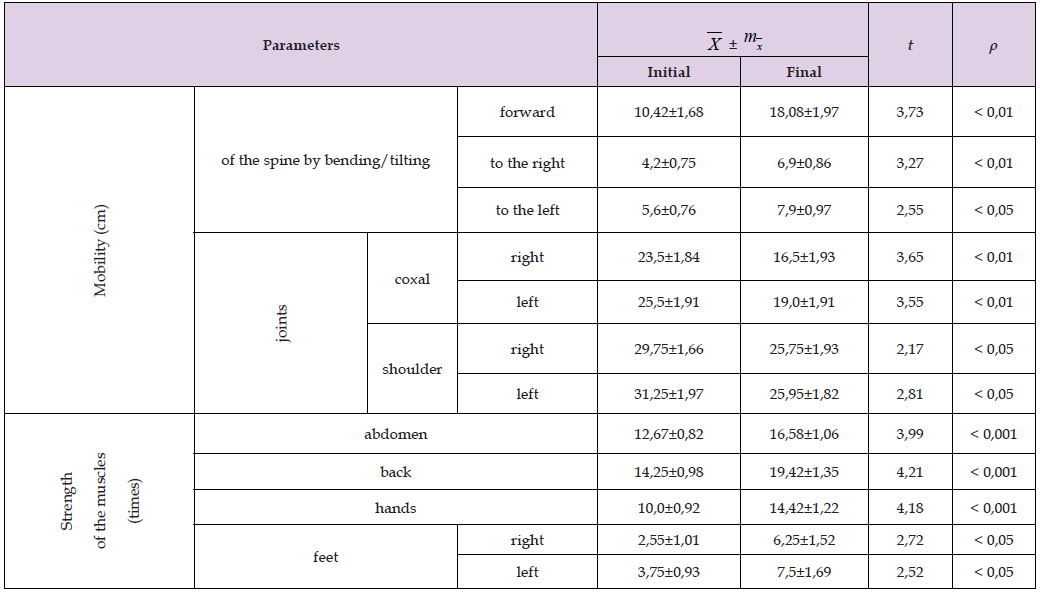
Note: n = 17 (f = 16) at ρ < 0,05, t = 2.119; ρ < 0,01, t = 2.920; ρ < 0,001, t = 4.015.
Analysis of the Dynamics of the Development Indices of Physiological Possibilities in the Examined Women
To assess the influence of training carried out according to the developed methodology on the female body after 40 years of age, we tested physiological parameters. The analysis of the obtained results confirms the positive effect of the developed methodology through all parameters (Table 2). The best result is shown by Ghenchi’s test (t = 4.33; p < 0.001). Stanghe’s test (t = 3.69) the same, showed a good significant threshold (p < 0.01), and a little lower. At this significant level is also the heart rate at rest (t = 3.56). Three parameters demonstrated statistical authenticity at the p < 0.05 threshold: heart rate after loads (t = 2.66), chest excursion (t = 2.72) and Rufe’s test (t = 2.15). The results obtained allow us to conclude that the developed methodology argues for the direction of strengthening fitness training, within which not only physical capabilities but also functional systems are improved. This allows us to retain the speed of involutional changes in women who need to express themselves by improving their physical condition indices. Successfully researched training programs can also be used in medical physical culture, but only with the doctor’s recommendations.
Table 2: Dynamics of average group indices of development of physiological possibilities in examined women.
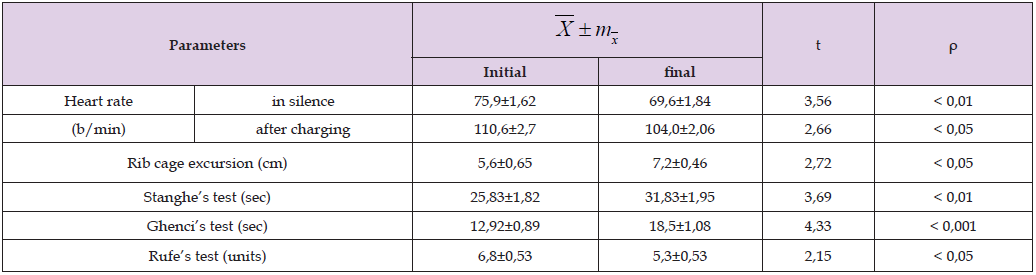
Note: n = 17 (f = 16) at ρ < 0,05, t = 2.119; ρ < 0,01, t = 2.920; ρ < 0,001, t = 4.015.
The developed methodology can be used for different contingents of practitioners to strengthen the body, both in physical training and functional training. The training system can be applied in psychological rehabilitation programs for mature people, because the execution of many exercises, especially on balls, is carried out at a high emotional level. The use of musical-rhythmic material can contribute to the enrichment of coaches, both in terms of increasing their own culture and the culture of those involved in fitness, and in terms of a creative approach to their profession.

International Association of Landscape Archaeology, Czech Glass Society, Czech Republic

Department of Chemistry, Semenov Institute of Chemical Physics, USSR Academy of Sciences, Moscow, Russia

Neurology, LA BioMed Research Institute, USA

Associate Professor at Department of Breast and Thyorid Surgey, Chongqing General Hospital, China
Professor of Nuclear Medicine, Faculty of Medicine and Surgery, University of Milan, Milan, Italy





 Abstract
 PDF
PDF



























