info@biomedres.us
+1 (502) 904-2126
One Westbrook Corporate Center, Suite 300, Westchester, IL 60154, USA
Site Map
 ISSN: 2574 -1241
ISSN: 2574 -1241
ISSN: 2574 -1241
Received: July 14, 2025; Published: July 23, 2025
*Corresponding author: Marie Fusella Giuntini, SPE Laboratory, University of Corsica, Corte, France
DOI: 10.26717/BJSTR.2025.62.009789
Abbreviations: RAI: Radioactive Iodine; AI: Artificial Intelligence; NLP: Natural Language Processing
Radioactive iodine (RAI) therapy remains a pillar in the treatment of differentiated thyroid cancer, particularly in metastatic or high-risk cases. However, inter-individual variability in therapeutic response and the risk of overtreatment poses enduring clinical challenges. In parallel, a growing body of research seeks to optimize RAI protocols through computational modeling, artificial intelligence (AI), and personalized simulation tools. To assess this emerging field, a natural language processing (NLP) pipeline that aggregates and analyzes bibliographic data (from Scopus, CrossRef, and OpenAlex) was developped. The system filters publications based on conceptual relevance using MiniLM embeddings and thematic keyword detection, enabling structured classification by methodology, geographic origin, and modeling framework.
Out of 78 rigorously selected publications spanning from 2001 to 2025, bibliometric analysis reveals statistically significant growth in publication volume over time (linear regression: slope = 0.40, p = 0.0011, R² = 0.45). After a relatively flat period, the literature shows acceleration after 2020, culminating in a peak of 18 articles in 2024, representing 23 % of the corpus. The cumulative citation count across the dataset reaches 951, with a mean of 12.2 and median of 7 citations per article, indicating moderate but uneven impact. A small number of influential works dominate the field, most notably the study by Prideaux, et al. [1] on 3D radiobiologic dosimetry (116 citations), illustrating the field’s reliance on foundational modeling contributions. Two dominant methodological streams emerge from literature. Approximately 35.9 % of the studies incorporate machine learning or AI-based approaches, primarily aimed at prognostic classification or optimization of dosimetric parameters. In contrast, 11.5 % of the publications rely on differential equation-based models, reflecting a mechanistic and physiologically grounded perspective. These two paradigms, however, rarely converge within individual studies, highlighting a clear methodological fragmentation. This lack of integration may hinder the development of unified frameworks that are both computationally robust and directly applicable in clinical practice.
While affiliation metadata was partially incomplete, geographic origin was recoverable for approximately 70 % of the dataset. Among these, North America accounted for about 38 % of the publications, contributing foundational work on AI-aided decision support systems. Europe represented roughly 33 %, with countries like France and Germany frequently engaging in formal mathematical and mechanistic modeling. Brazil contributed around 15 %, often through simulation- based studies with a public health orientation. Despite these regional patterns, no single institution accounted for more than 3 % of the total output, highlighting a diffuse and decentralized research network. This structural dispersion, while reflective of diverse academic engagement, may hinder the emergence of consolidated frameworks and slow the clinical translation of computational approaches in RAI therapy.
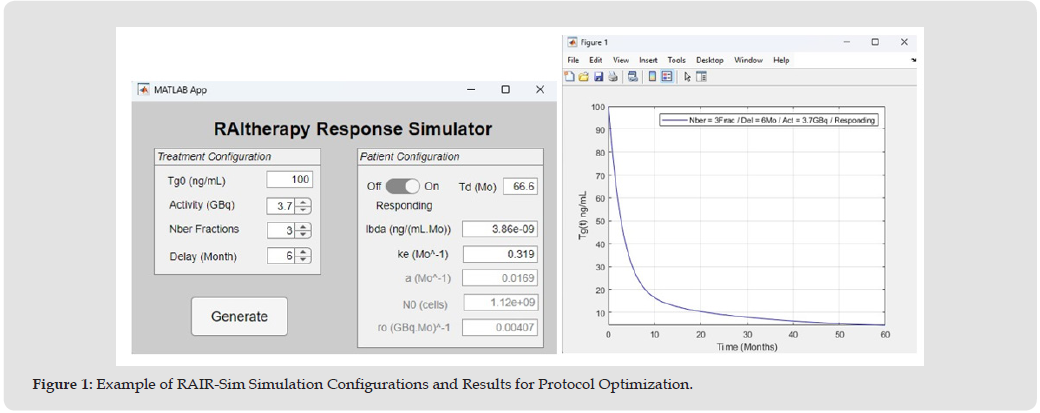
Considering this fragmented yet promising landscape, we developed RAIR-Sim, a freely accessible software platform designed to support clinicians in optimizing radioactive iodine (RAI) therapy (https://github.com/MarieFG49/CTD_SIMU_RAI). The tool integrates a mechanistic model based on three coupled differential equations, capturing the dynamics of iodine decay, tumor cell population, and thyroglobulin kinetics. Model parameters were calibrated using a cohort of 50 patients through the MCMC-SAEM algorithm implemented in Monolix®. The simulation engine is embedded within a MATLAB- based graphical user interface, allowing clinicians to explore various treatment configurations involving dosing, fractionation, and inter-session intervals. RAIR-Sim enables the early classification of patients as responders or non-responders based on initial thyroglobulin trajectories. It also supports dose adjustment strategies that aim to preserve therapeutic efficacy while limiting toxicity. Simulation runtimes remain under 30 seconds, even on standard hardware, ensuring operational feasibility in clinical settings. The model highlights tumor doubling time as a central predictive biomarker, making it possible to individualize therapeutic protocols even in contexts where imaging or molecular profiling is unavailable.
This interface then allows, by setting a therapeutic protocol (number of iratherapy sessions, interval between two sessions and dose of activities to be administered) and the individual physiological parameters of our mathematical model estimated for each patient, to simulate personalized therapeutic responses to optimize the treatment. (Figure 1) For patients identified as responding to iratherapy, this involves limiting toxicity by retaining the best therapeutic protocol which can be obtained either by reducing the number of iratherapy sessions or the dose of activity, or by increasing the interval between two sessions to allow for a longer recovery time. For patients not responding to iratherapy, the simulator makes it possible to attempt to guarantee effectiveness by simulating optimal configurations either by increasing the dose or the number of sessions, or by reducing the interval between two sessions, before proposing, due to the absence of favorable results, a more invasive alternative therapy. Our approach combines mathematical tools (mathematical model of differential equations) and computer science (matlab graphical interface) to offer an operational decision support tool for clinicians.
Figure 1
This study reveals a steadily growing interest in computational approaches to RAI therapy, marked by methodological diversity but limited institutional coordination. Despite the emergence of AI-driven and mechanistic models, the lack of integrated frameworks hinders clinical translation. In this context, we developed RAIR-Sim, a dedicated simulation tool combining analytical modeling and practical usability. Calibrated on real patient data and equipped with a clinician-friendly interface, it enables personalized protocol design and early response classification. RAIR-Sim represents a step forward toward bridging the gap between theoretical modeling and routine nuclear medicine practice.

International Association of Landscape Archaeology, Czech Glass Society, Czech Republic

Department of Chemistry, Semenov Institute of Chemical Physics, USSR Academy of Sciences, Moscow, Russia

Department of Educational Sciences, Research Centre Qualities of Teachers, School of Education – HAN, Nijmegen, Netherlands

Associate Professor at Department of Breast and Thyorid Surgey, Chongqing General Hospital, China

Neurology, LA BioMed Research Institute, USA





 Abstract
 PDF
PDF



























