info@biomedres.us
+1 (502) 904-2126
One Westbrook Corporate Center, Suite 300, Westchester, IL 60154, USA
Site Map
 ISSN: 2574 -1241
ISSN: 2574 -1241
ISSN: 2574 -1241
Received: July 09, 2025; Published: July 16, 2025
*Corresponding author: Sergei Grishaev, Department of Naval Therapy of S.M. Kirov Military Medical Academy, Saint-Petersburg, Russia
DOI: 10.26717/BJSTR.2025.62.009778
Aims: Revealing subclinical atherosclerosis of arteries is important for the prognosis of CVD risk. It is apparent
that preventive measures should start long before the clinical manifestations develop. The possibility to deliberately
reduce the absolute and relative value of CVD risk by influencing the risk factors, which affect atherosclerosis
and the development of its complications is understood as total CVD risk management. The main aim of
the study was to assess the effect of drug therapy on both the value of total risk measured by statusmetry and on
certain indicators contributing a lot to its structure.
Methods and Results: The study included 207 people of the male homogeneous group who have been in follow
up for 10 years. There was no sign of atherosclerosis in the group according to the initial examination. The
average age was 45,6±2,94. The data analysis was carried out with the help of statusmetry. At the core of this
method is linear discriminative Fisher analysis. Classification functionality of statusmetry in dividing the studied
men of initially homogeneous group into alternative subgroups according to combined final findings surpasses
significantly functionality of stratification according to SCORE model for European countries with high risk (sensitivity
– 73.9%, specificity – 74.7%) with assessment of dynamic status-metrical risk value allowing to increase
test-sensitivity to 90-95%.
Conclusion: The result obtained made it possible to suggest an easy-to-use in clinical practice algorithm of assessment
of the risk of atherosclerosis clinical manifestations for a certain sample.
Keywords: Subclinical Atherosclerosis; Risk Factor; Score Model; Statusmetrical Risk; Cardiovascular Diseases (Cvds); Discriminative Analysis
Significant facts about the pathogenesis of atherosclerosis have been obtained in recent years. In the practical aspect, increasing attention has been paid to earlier, subclinical stages of the disease. Sudden heart death or non-fatal myocardial infarction occur without any previous clinical signs in 25% of patients with atherosclerosis of coronary artery [1]. There are more and more facts that revealing asymptomatic atherosclerosis of arteries may be a potent tool for prognosis of CVD risk and its treatment, it is a much more successful method to fight cardiovascular complications than treatment of advanced stages of atherosclerosis [2,3]. A Swedish study performed proved that making a prognosis of traditional risk factors and additional factors, short (0-10 years) and long-term accumulated risk of IHD and IS (0-35 years) differ widely [4]. About 610,000 people die of heart disease every year in the United States, which is one of every four deaths. About 735,000 Americans have a heart attack every year, and 525,000 have an initial attack, and 210,000 have a recurrent attack coronary heart disease is the leading cause of death in the Western world killing over 370,000 people annually [5,6].
At the same time, atherosclerosis is never considered as a disease itself [7]. Although the whole section is devoted to atherosclerosis in the ICD-10 (170) it is usually not mentioned in medical disease and death statistics. Modern clinical recommendations are not aimed at the diagnosis and treatment of atherosclerosis itself. Its presence and intensity are assessed in connection with cardiovascular pathology [8]. This is excused to a degree by basic needs of practical medicine. But such an approach has the flip side – in diagnosing, treatment and prevention the physician deals with developed clinical manifestations of cardiovascular pathology not taking into consideration the period of subclinical atherosclerosis [9]. However, it is during the period of subclinical atherosclerosis that those processes take place that signal the transition from reversible vascular abnormalities to organic abnormality with inevitable target organs disease, involvement of other pathogenetic mechanisms, arterial hypertension development, chronic myocardial ischemia, nephropathy, dyscirculatory diseases of the brain, amphiblestrodes and other organs and tissues. It is evident that prevention should start long before appearance of clinical manifestations of the disease [10].
European model SCORE - Systematic Coronary Risk Evaluation – has been worked out for the European population on the basis of its study. The SCORE model identifies the 10-year fatal risk of all complications connected with atherosclerosis: MI, cerebral stroke, peripheral arterial diseases. The cardiovascular death rate is chosen as the main outcome measure due to its availability in some countries and regions. Since the model makes the prognosis of death risk only, the threshold of high risk is defined as more than 5% for 10 years which is equivalent to 20% according to the Framingham risk score. The SCORE model became included in European recommendations (2003) on CVD prevention and into its last version, too, which marks the transition from the strategy of IHD prevention applied earlier to that of preventing all diseases associated with atherosclerosis. However, the SCORE scale has significant drawbacks associated with the use of a regression model, which is rigid and therefore has a high percentage of error in practice. This fact makes us look for new, more dynamic criteria for predicting the development of atherosclerosis [11- 13]. The term “total CVD risk management” means the possibility to deliberately reduce its absolute and relative value by affecting the RF, reliably influencing the atherosclerosis progress and the development of its clinical complications. The list of the most significant “high” risk factors found in patients participating in the study included dislipoproteinemia and arterial hypertension. Considering that all of them are modifiable factors it was very interesting to assess the effect of drug therapy on both the value of total risk measured by statusmetry and on certain indicators contributing a lot to its structure. The main aim of this study was the creation of a model for a long-term forecast of the development of outcomes of the atherosclerotic process in men of working age was. In order to achieve this the authors attempted to search for significant factors in the development of atherosclerosis, separation of groups according to significant factors, and construct the optimal mathematical model.
Study Group
The work is based on the results of complete physical examination of the socially homogeneous male group (n=207) who live in the town of Kirishi in Leningrad region, Russia, and have been followed up for 10 years, terms stipulated by the study record. They had no clinical manifestations of atherosclerosis according to the initial examination. The average age was 45.6±2.94. All the men under the study signed the informed consent form. The study was carried out in compliance with the regulations of the Helsinki Declaration (1975) and has observational, non- interventional character.
Mathematical Tool
All statistic calculations were based on the method of statusmetry allowing to make an analysis and evaluate man’s health by a set of genetic, immunologic, physiologic, social-hygienic and other indicators [14]. Statusmetry is a method of automatic quantitative estimation and analysis of multiparameter objects by minimized sets of informative indicators chosen from a large number of their characteristics. Statusmetry aim is to gain the decision rule which, using values of a minimized set of indicators, gives the quantitative estimation of the system condition, as to the probability of having one of the alternative states (“health” or “clinical stage”). Fisher linear discriminant analysis (LDA) is the core of the method. The risk assessment of the development of clinical manifestations of atherosclerosis based on linear models is a function from integral health index which is calculated as linear combination of indicators measured with weight indexes obtained on the preliminary stage. Such analysis results in the following possibility:
a. To find out risk value (correspondence of a definite individual with typical aspects of a disease shown quantitatively in percent).
b. To estimate which indicators and in what way are most responsible for the formation of this risk value.
c. To work out individual recommendations on how to treat and prevent this condition.
d. To monitor the dynamics of risk within the period of time given.
Risk evaluation by means of the status-metrical method may be split into two stages. At the first stage the core of the analysis is the functional model which is linear discriminant function:
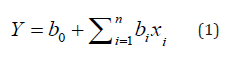
where Y is the function of integral quantitative evaluation of the body state; i — 1, 2... n is the number of the indicator, and bί — indexes of the indicator. At the second stage of status-metrical analysis belonging of the object to one of the two groups (e.g. healthy/ill) shown, for example, in percent is estimated. This estimation is obtained from assessing the object distance to separating plane via qualimetric transformation by Harrington [11]. Risk value in % is calculated according to the formula:
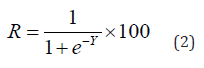
where R is integral indicator of the risk (in %).
The main group consisted of 207 people according to inclusion and exclusion criteria. The sample power is 80%, the value of significant differences is 0.16, the significance level is 5%. The number of necessary observations was calculated using the formula n = [1.96 + 0.84] 2 * [(0.5 * 0.5 + (0.34 * 0.66)] / [0.16] 2 = 146.
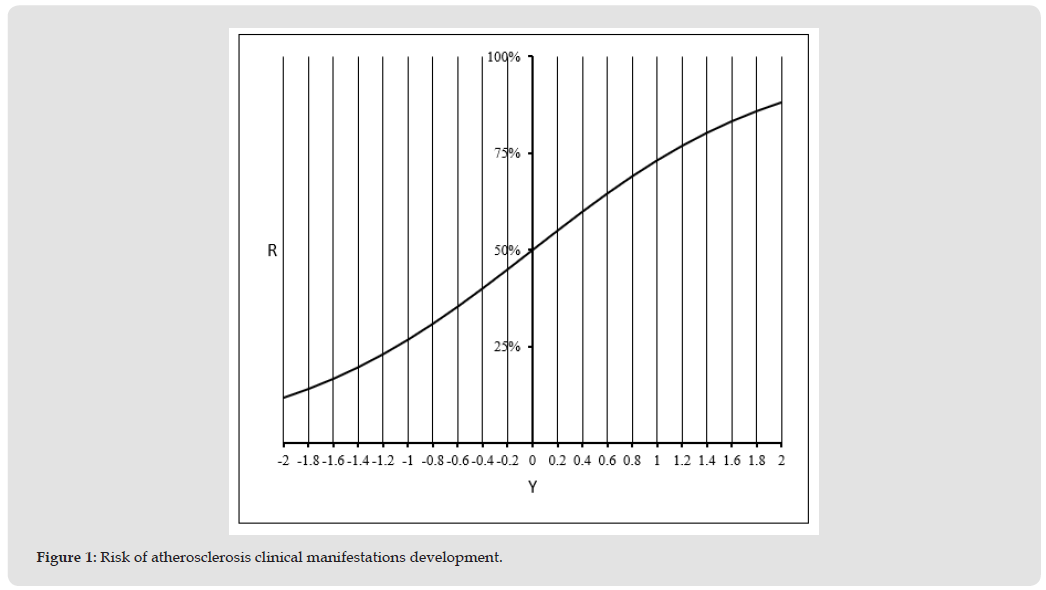
The reference group (comparison group) consisted of 195 men with clinical forms of atherosclerosis Figure 1 Presents the diagram of relationship between risk R and integral quantitative evaluation of the body state Y.
Figure 1
The analysis of the data shows that the status-metrical model referred more patients to that cohort than the conventional systems of risk stratification: from 38% to 26.7% (excluding the last year). Unlike the Framingham risk score and the SCORE model, the frequency of case finding reduced up to 17.8% (p<0.05) at the end of the investigation. We associate the results with active therapeutic and preventive measures performed in the last two years. Despite obvious and significant difference (p<0.01), these data do not contradict to each other for the time being, because the methodologies of risk estimation differ. For that stage of investigation, the following statement seems most correct: there are many patients with clinical manifestations of atherosclerosis (more than 30.2% according to the status-metrical algorithm), high probability of cardiac disorders developing within the 10-year period is expected in from 8.6% to 18.8% male patients (the Framingham risk score and SCORE model algorithm, respectively). A mean quantity of the risk in a model was also defined in a different way (Figure 2). The SCORE model and the Framingham risk score estimation of the quantity during the initial examination and for the following 10 years were relatively similar (8.5-10.8%, p>0.05). According to metric algorithm, the average risk of the patients varied from 52.8% to 45.3% (95% CI = 49.8%-56.1% and 42.4%-48.1%, respectively).
Figure 2
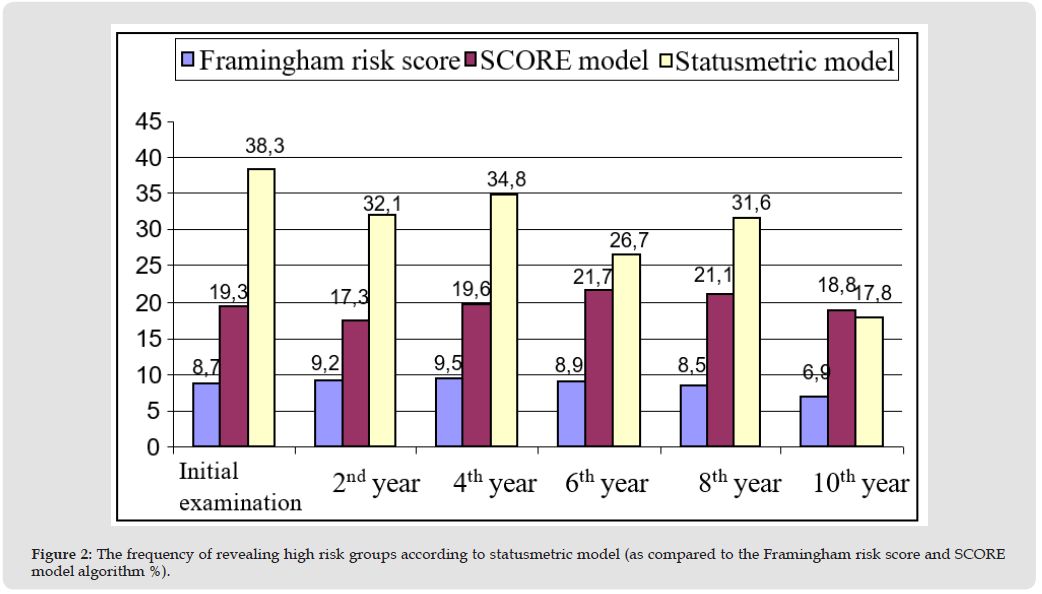
Despite the risk defined by SCORE/Framingham algorithms, the differences in their quantity at the moment of the initial examination and the last one were significant (p<0.05). We would like to emphasize that according to classical model’s risk estimation we evaluate a 10-year follow up period absolute value. In the case of the status-metrical estimation method, it is expressed in per cents. The comparison at this stage of study is given only to underline the presence of risk dynamics when measured by the status-metrical model and its absence when the risk was estimated by the SCORE/Framingham model during a certain time interval. The detailed analysis of the progress of the status-metrical risk performed by us in heterogeneous by the level of risk subgroups of men demonstrated that practically all complications of atherosclerosis (19 out of 20, or 95%) developed in individuals with initially high status-metrical risk (subgroups 1 and 3), or at the stage of transition from low to high risk. The fact allows us to believe that the status-metrical algorithm gives an opportunity to solve one of the most difficult problems of risk assessment – the problem of correspondence between a group and an individual risk [15-17]. The approach combines low expense to be spent for the process of risk assessment by means of the SCORE model and additional economic advantages coming from the status-metrical model. The limitations of the study were a small sample, a study of only males, a study of people of limited age. All this limits the application of the proposed method to a wider group of patients [18-29].
1. Statusmetry is an objective method of assessing atherosclerosis extent. Increased status-metrical risk is accompanied by unidirectional changes in vessels of muscular-elastic type – by thickening of the intima-media, atherosclerotic plaques growth, endothelial dysfunction, increase of systolic and diastolic arterial blood pressure, dyslipidemia, atherogenically modified lipoproteins of low density, enlarged concentration of circulating autoimmune complexes containing cholesterol, as well as by certain change in the findings of carbohydrate and purine metabolism and raised systolic blood pressure. All of these, apart from other well-known risk factors, create conditions for the clinical realization of atherosclerosis by the age of 45-50.
2. The status-metrical algorithm, in contrast to conventional systems of risk stratification, significantly more often ascribes individuals to group at high risk, and significantly rarer – to the group at low risk. The status-metrical risk value significantly less depends on age, particularly in the subgroup of individuals under 50. The classifying potential of the statusmetry is much larger than that of traditional systems of risk stratification as to dividing men of a distinct sample examined into subgroups alternative according to combined target points (sensitiveness is 73.9%, specificity – 74.7%). At the same time, assessment of the status-metrical risk in progress contributes to intensifying the sensitiveness of the method up to 90-95%.
Author declare they do not have anything to disclose regarding conflict of interest with respect to this manuscript.


 Abstract
 PDF
PDF