info@biomedres.us
+1 (502) 904-2126
One Westbrook Corporate Center, Suite 300, Westchester, IL 60154, USA
Site Map
 ISSN: 2574 -1241
ISSN: 2574 -1241
ISSN: 2574 -1241
Received: July 07, 2025; Published: July 14, 2025
*Corresponding author: Nan Yu, Department of Dermatology, General Hospital of Ningxia Medical University, Yinchuan 750004, China
DOI: 10.26717/BJSTR.2025.62.009775
Generalized pustular psoriasis (GPP) during pregnancy is a rare and severe condition that poses a serious threat to the life and safety of both the mother and the fetus. Due to the limited use of drugs during pregnancy, the selection of treatments for gestational GPP (GPPP) is extremely challenging, as options are scarce and often contraindicated. The IL-36 signaling pathway plays a central role in the pathogenesis of GPP. Spesolimab, a humanized anti-IL-36R monoclonal antibody, exerts its therapeutic effect by inhibiting the key IL-36 inflammatory pathway in GPP and blocking the activation of downstream inflammatory factors. This case report describes a successful treatment outcome achieved with Spesolimab injection in a pregnant patient with GPP, offering valuable clinical insights for the use of Spesolimab in managing GPP in Chinese patients.
Keywords: Generalized Pustular Psoriasis During Pregnancy; Spesolimab; IL-36
Case Characteristics
The patient was a 35-year-old female diagnosed with “generalized pustules for more than 1 month, 23+6 weeks of pregnant”. Her medical history dated back to 1 month prior, when she developed red rashes on her hands following a swim in Sanya. These rashes were accompanied by numbness and swelling, but the patient did not seek attention for them at the time. Subsequently, the rash spread to involve the trunk and limbs, with scattered yellow-white superficial pustules ranging in size from needle tips to millet grains appearing on the erythematous base. She was admitted to our hospital and diagnosed with generalized pustular psoriasis. Initial treatment included methylprednisolone sodium succinate (40 mg) and vitamin C injections via intravenous drip, along with topical calamine lotion; however, the therapeutic response was unsatisfactory. The patient was then switched to cyclosporine (3 mg/kg/day), but her symptoms did not show significant improvement, prompting her to revisit our clinic. She reported no family history of psoriasis, but had a 20-year history of chronic hepatitis B without prior drug therapy.
Specialist Physical Examination
Extensive edematous erythema was observed on the trunk and limbs, with some erythematous lesions coalescing into large patches. Scattered yellow-white superficial pustules were noted on the erythematous base. The Generalized Pustular Psoriasis Area and Severity Score (GPPAS) was 31.4, and the Generalized Pustular Psoriasis Physician Global Assessment (GPPPGA) score was 3.
Auxiliary Examination
Blood tests revealed leukocytosis (WBC: 17.32 × 10⁹/L), neutrophilia (NEUT%: 84.9%, NEUT#: 14.71 × 10⁹/L), and positive results for hepatitis B surface antigen (HBsAg > 1000.00 index), hepatitis B e-antibody (HBeAb > 4.50 index), and hepatitis B core antibody (HBcAb > 8.00 index). The Tspot test was negative. Urinalysis, liver and kidney function tests, electrolyte levels, and chest CT scans showed no abnormalities. Notably, HBV-DNA levels were measured at 4.93 × 10² IU/mL, and the drug safety profile was deemed acceptable for administration.
The patient initially received a 5-day course of intravenous methylprednisolone sodium succinate (40 mg daily). However, the treatment showed no significant improvement, as evidenced by the persistence of systemic pustulae. Due to concerns regarding potential fetal adverse effects, such as teratogenesis, associated with oral cyclosporine, the treatment was switched to oral administration of cyclosporine (3 mg/kg/day). Despite this adjustment, the patient’s symptoms remained unresolved after 4 days. Following the termination of pregnancy through induced labor, the patient continued on oral cyclosporine (3 mg/kg/day) for an additional week, yet the disease remained poorly controlled. Upon comprehensive evaluation, which confirmed the absence of contraindications for biological agents, the patient was administered a single intravenous infusion of spesolimab (900 mg) over 90 minutes, after obtaining informed consent.
Clinical Efficacy
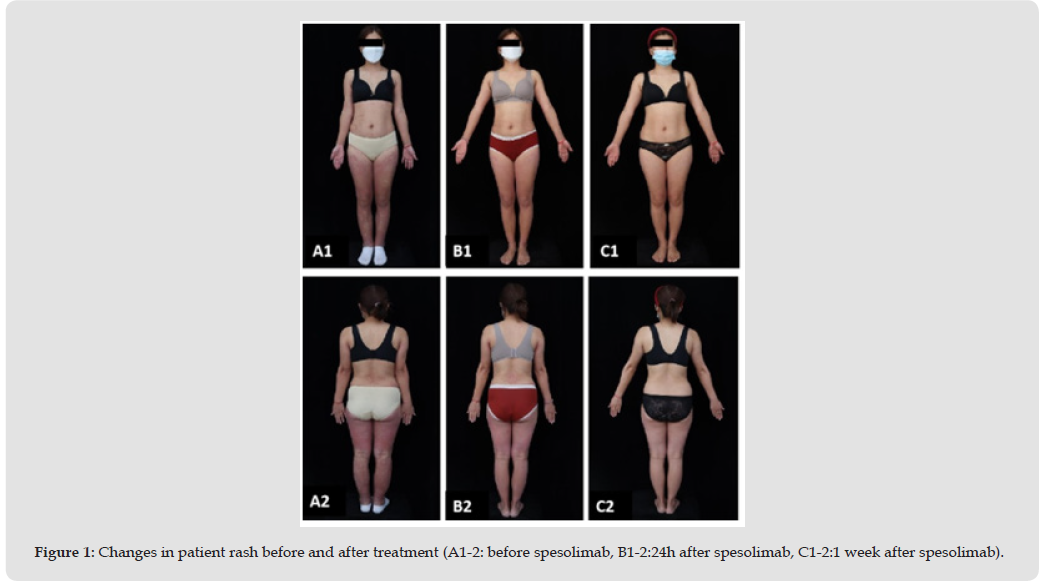
Prior to treatment, the patient exhibited widespread erythema across the trunk and limbs, with erythema being particularly pronounced in the lower limbs. Superficial pustules of varying sizes, ranging from needle tip to miliary, were observed on the erythematous areas. The GPPASI and GPPGA scores were 31.4 and 3, respectively. Within 24 hours of spesolimab administration, all pustules had resolved, erythema was notably reduced, and scaling had almost completely subsided, with GPPASI and GPPGA scores improving to 20.9 and 2. By oneweek post-treatment, the patient demonstrated complete resolution of erythema and scaling, with no new pustules appearing. The GPPASI and GPPGA scores further decreased to 5.2 and 1 (see Figure 1). The patient’s condition remained stable and well-controlled following the single intravenous infusion of spesolimab, with no recurrence of erythema or pustules observed.
Figure 1
Observation of Adverse Reactions
Throughout the treatment regimen, the patient did not experience any allergic reactions at the infusion site or report common side effects such as headache, nausea, vomiting, or fatigue. Furthermore, at the 5-month follow-up, no adverse effects were noted, indicating a favorable safety profile.
Genetic Testing
Whole-genome sequencing was conducted to investigate potential genetic causes of the condition. No mutations in IL-36RN-related genes were identified, suggesting that the disease was not associated with known genetic predispositions. This revised version enhances clarity, precision, and formality while maintaining scientific accuracy, ensuring a logical and smooth flow of information.
GPP is a rare, life-threatening dermatosis characterized by widespread sterile pustules and systemic inflammation. When occurring during pregnancy (GPPP), it typically manifests in the second or third trimester (as in this case at 23⁺⁶ weeks) and can lead to severe complications such as placental dysfunction, fetal distress, or even stillbirth due to fluid/electrolyte imbalances [1-3]. The pathogenesis of GPP is strongly linked to dysregulation of the IL-36 signaling pathway, with approximately 24% of cases harboring mutations in IL36RN [4]. Although our patient tested negative for IL36RN mutations, aberrant IL-36 cytokine expression in placental trophoblasts may have contributed to disease onset, highlighting the role of acquired IL-36 pathway activation in GPPP [5-6].
Current treatment options for GPPP remain limited by safety concerns for both mother and fetus. Systemic corticosteroids, considered first-line therapy, showed inadequate response in our patient (methylprednisolone 40 mg/day) and carry risks of gestational diabetes and premature rupture of membranes with prolonged use [7]. Cyclosporine (3 mg/kg/day), while potentially effective, presents challenges in patients with comorbidities such as chronic HBV infection (this patient’s HBV-DNA was 4.93×10² IU/mL) due to risks of viral reactivation and nephrotoxicity [8]. In refractory cases, biologic therapies offer promising alternatives, though each class presents distinct considerations. TNF-α inhibitors (e.g., certolizumab), classified as pregnancy Category B drugs, may have limited utility in acute GPPP due to their characteristically slow onset of action (typically 4-8 weeks) [9]. IL-17/IL-23 inhibitors lack robust pregnancy safety data, leaving Spesolimab - the first IL-36R monoclonal antibody - as a potentially transformative option. Our patient demonstrated complete pustular clearance within 24 hours of a single 900 mg Spesolimab infusion, consistent with its rapid mechanism of action through blockade of downstream inflammatory cytokines (e.g., IL-8, IL-1β) [10]. However, its off-label use in pregnancy requires careful consideration [11].
The dramatic improvement in our patient (GPPASI reduction from 31.4 to 5.2 within one week) raises important clinical questions regarding optimal treatment timing and dosing. While we administered Spesolimab post-termination, earlier intervention during pregnancy might be considered in life-threatening cases, though fetal safety data remain limited [7,12]. The 900 mg dose, while effective, underscores the need for weight-based protocol development. Close HBV monitoring is also essential given Spesolimab’s immunosuppressive potential in HBV-positive patients. Future research should prioritize several key areas: establishment of pregnancy registries to track fetal outcomes after Spesolimab exposure [12], mechanistic studies of placental antibody transfer [7], and development of multidisciplinary treatment guidelines for GPPP management. These efforts will be crucial to better define Spesolimab’s risk-benefit profile in pregnancy and optimize care for this vulnerable population facing this severe dermatological emergency [12].


 Abstract
 PDF
PDF






























