info@biomedres.us
+1 (502) 904-2126
One Westbrook Corporate Center, Suite 300, Westchester, IL 60154, USA
Site Map
 ISSN: 2574 -1241
ISSN: 2574 -1241
ISSN: 2574 -1241
Received: June 26, 2025; Published: July 16, 2025
*Corresponding author: Yukio Mori, Former Professor, Gifu Pharmaceutical University, Japan
DOI: 10.26717/BJSTR.2025.62.009763
To elucidate the mechanism underlying the modifications of metabolic activation and inactivation of environmental carcinogens by phase I and/or II enzymes by cigarette smoke, ethanol, curcumin, α -naphthyl isothiocyanate and 6-methylsulfinyl isothiocyanate, cytochrome P450 (CYP) levels, mutagenic activities of environmental carcinogens and UDP-glucuronyl transferase (UDPGT) activities were assayed in rodents. These lifestyle factors clearly modify the mutagenic activation of N-nitroso compounds, heterocyclic amines, polyaromatic hydrocarbons or aflatoxin B1 by specific CYP isoform and/or detoxification by UDPGT, which are closely related with carcinogenesis initiated with environmental carcinogens in liver and other organs, including target organs.
Abbreviations: NNK: 4-(N-nitrosomethylamino)-1-(3-pyridyl)-1-butanone; DEN: N-nitrosodiethylamine; NMBA: N-nitrosomethylbenzylamine; MeAαC, 2-amino- 3-methyl-9H- pyrifo[2,3-b]indole; AFB1: aflatoxin B1
It is well known that lifestyle factors such as cigarette smoking, alcohol consumption and dietary habits are closely associated with an increased or decreased risk of human cancers in various organs. The modifications of metabolic activation and inactivation of environmental carcinogens by phase I and/or II enzymes by cigarette smoke (CS) [1], ethanol [2], curcumin [3], α-naphthyl isothiocyanate (ANIT) [4] and 6-methylsulfinyl isothiocyanate (6-MSITC), a typical Japanese condiment, wasabi (Wasabia japonica) [5], are also associated with enhancement or suppression of experimental carcinogenesis in rodents. To elucidate the mechanism underlying these modifications of experimental carcinogenesis, cytochrome P450 (CYP) levels, mutagenic activities of environmental carcinogens and UDP-glucuronyltransferase (UDPGT) activities were assayed in hamsters and rats.
CS is a double-edge sword in modifications of pancreatic or hepatic carcinogenesis; CS suppresses N-nitrosobis(2-oxopropyl)amine (BOP)-induced pancreatic carcinogenesis in hamsters [6] while CS enhance 2-amino-3,8-dimethylimidazol[4,5-f]quinoxaline (MeIQx)-induced hepatocarcinogenesis in rats [7]. CS have a bifunctional action on CYP1A2 and UDPGT1A6 enzymes in both animal species; the suppression of BOP-induced pancreatic carcinogenesis is attributed to an increased detoxification by UDPGT1A6, without to a decreased activation of BOP by CYP2B in hamster liver [6]. On the other hand, the enhancement of MeIQx-induced hepatocarcinogenesis can be attributed to an increase in metabolic activation of MeIQx by CYP1A2, without the contribution of increased detoxification by UDPGT1A6 in rat liver [7,8]. The mutagenic activations of N-nitrosodiethylamine (DEN) by CYP2E1 and N-nitrosomethylbenzylamine (NMBA) by CYP2A3 were selectively elevated by treatment with 10 or 50% ethanol, but ethanol did not affect three UDPGT activities [9]. Accordingly, in enhancement by ethanol of DEN- or NMBA-induced esophageal carcinogenesis in rats [10], the enhancing effects is explained by an increase in the metabolic activation of DEN by CYP2E1 and that of NMBA by esophagus CYP2A3, and in the latter activation, this occurred independently of hepatic and esophageal CYP2E1, without a contribution of detoxification by hepatic UDPGT enzymes. These findings indicate that the metabolic activation in the target organ plays key role in the enhancing effect by ethanol on esophageal carcinogenesis induced by NMBA.
No significant alterations in the hepatic levels of CYP proteins, mutagenic activations of environmental carcinogens and three UDPGT activities were produced by feeding of 0.2% curcumin for 6 weeks in rats, but intragastric treatment with 270mg/kg curcumin decreased in the mutagenic activation of NMBA by esophagus CYP2B1 and CYP2A3 [3]. In suppression by curcumin of NMBA-induced esophageal carcinogenesis in rats, the modifying effects can be attributed to a decrease in metabolic activation of NMBA by CYP2B1 and CYP2A3 in the target organ, without the contribution of metabolic activation and inactivation by liver, indicating that also in the suppression by curcumin, metabolic activation of NMBA in the target organ play an important role. The mutagenic activations of five heterocyclic amines (HCAs), including 2-amino-1-methyl-6-phenylimidazol[4,5-b]pyridine (PhIP) by CYP1A2 were highly enhanced by intragastric treatment with 85mg/kg PhIP in female rats, and these enhanced activities of HCAs were significantly decreased in liver S9 fraction from rats treated with PhIP plus feeding of 400 ppm ANIT [11]. UDPGT1A6 activity was markedly enhanced with the combination of PhIP and ANIT; the chemoprevention by ANIT of PhIP- induced mammary carcinogenesis can be explained by a dual action mechanism, i.e. a reduction in the metabolic activation by hepatic CYP1A2 and an enhancement of detoxification by UDPGT1A6 in female rats. The hepatic activations of HCAs, aflatoxin B1 (AFB1) and N-nitroso compounds (NOCs) by the constitutive CYPs were significantly decreased in male rats treated with 40 mg/kg 6-MSITC, and decreases were observed in the colon [5]. No significant alterations were observed in UDPGT activities in the treated rats; suppression by 6-MSITC of DMH-induced colonic carcinogenesis may be attributed to a decrease in metabolic activation of DMH by colonic CYP2E. These findings indicate that the reduction by 6-MSITC in the mutagenic activations does not specifically occurs and are also observed in the target tissue, suggesting that widely chemopreventive action of 6-MSITC on chemically-induced carcinogenesis could be produced in various organs of animal models.
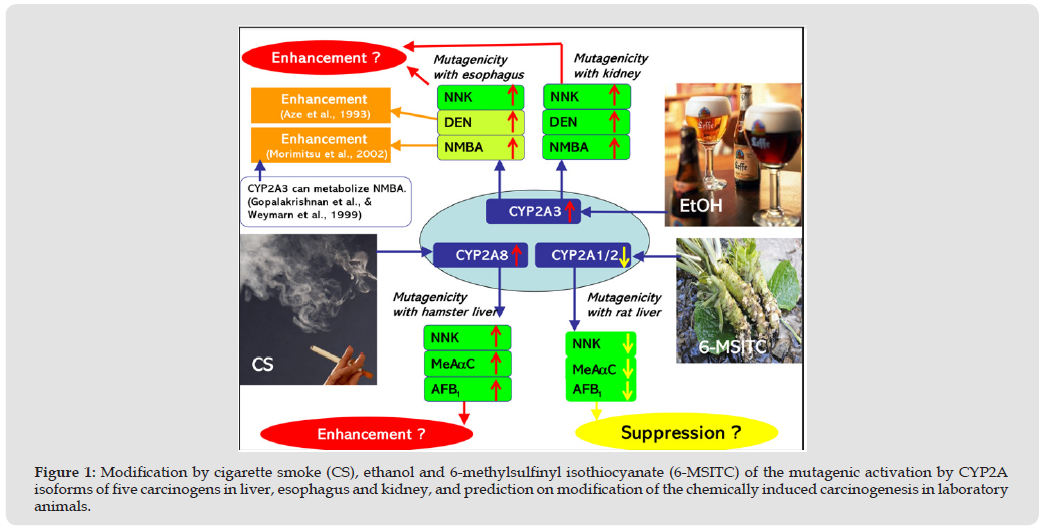
These lifestyle factors clearly modify the mutagenic activation of NOCs, HCAs, polyaromatic hydrocarbons or AFB1 by specific CYP isoform and/or detoxification by UDPGT, which are closely related with carcinogenesis initiated with environmental carcinogens in liver and other organs, including target organs. Finally, it suggests that modification by lifestyle factors of chemically-induced carcinogenesis could be predicted by evaluation with metabolic activation and detoxification of environmental carcinogens. For example, findings on modification by CS [1], ethanol [2] and 6-MSITC [5] of mutagenic activation of NOCs, 2-amino-3-methyl-9H-pyrifo[2,3-b]indole (MeAαC) and AFB1 by CYP2A subfamily are leading to predict for unknown modifications of the chemical carcinogenesis, as illustrated in Figure 1.
Figure 1

International Association of Landscape Archaeology, Czech Glass Society, Czech Republic

Department of Chemistry, Semenov Institute of Chemical Physics, USSR Academy of Sciences, Moscow, Russia

Department of Educational Sciences, Research Centre Qualities of Teachers, School of Education – HAN, Nijmegen, Netherlands

Associate Professor at Department of Breast and Thyorid Surgey, Chongqing General Hospital, China

Neurology, LA BioMed Research Institute, USA





 Abstract
 PDF
PDF



























