info@biomedres.us
+1 (502) 904-2126
One Westbrook Corporate Center, Suite 300, Westchester, IL 60154, USA
Site Map
 ISSN: 2574 -1241
ISSN: 2574 -1241
ISSN: 2574 -1241
Received: June 11, 2025; Published: July 07, 2025
*Corresponding author: Atsushi Imai, Department of Obstetrics and Gynecology, Matsunami General Hospital, 185-1 Dendai, Kasamatsu, Gifu 501-6062, Japan
DOI: 10.26717/BJSTR.2025.62.009756
Modern oral contraceptives not only offer highly effective pregnancy prevention but also ameliorate menstrual disorders, such as dysmenorrhea and menorrhagia. However, a significant adverse effect remains venous thromboembolism, largely attributed to the procoagulant activity of estradiol in combination formulations with synthetic progestins. Estetrol (E4) is the most recently described natural estrogen. A novel contraceptive containing E4 represents a further advancement, owing to its negligible impact on hemostasis and vascular function. E4-based therapeutics have also been introduced for hormone replacement therapy, aimed at mitigating menopausal symptoms and preventing postmenopausal osteoporosis. Given its minimal hepatic and mammary activity, E4 offers a promising safety profile, with reduced risk of thromboembolic events and hormone-related carcinogenesis.
Beyond their reproductive functions, estrogens exert multifaceted physiological effects, modulating the central nervous system and cognitive processes, cardiovascular health, lipid homeostasis (including cholesterol and triglyceride regulation), mammary gland biology, skin structure, bone density, and the overall continuum of women’s health. Endogenous estrogens encompass estrone (E1), estradiol (E2), and estriol (E3). More recently, estetrol (E4), a fourth natural estrogen, has attracted substantial scientific interest. These compounds are named according to the number of hydroxyl (OH) functional groups in their molecular structure, denoted by Greek numerical prefixes: di- (2), tri- (3), and tetra- (4) (Figure 1). To date, no estrogen beyond E4 (i.e., E5) has been identified. Estrogens share a steroidal core structure composed of four fused rings—three hexacyclic and one pentacyclic— exhibiting low aqueous solubility and a high affinity for plasma protein binding, particularly albumin. The incorporation of additional hydroxyl groups enhances hydrophilicity and subtly influences their pharmacodynamic and physiological profiles. With its four hydroxyl groups, E4 demonstrates rapid oral absorption, high bioavailability, and an extended half-life—characteristics that differentiate it from E2 and structurally similar compounds. E4 undergoes phase II metabolism via UDP-glucuronosyltransferases and sulfotransferases, resulting in inactive glucuronide and sulfate conjugates excreted renally. In contrast to E2, E4 is not metabolized by cytochrome P450 enzymes [1,2].
Figure 1
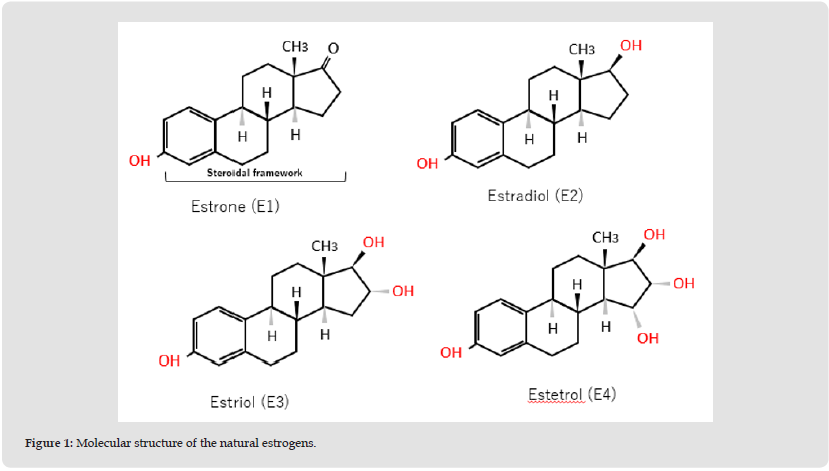
E1 is synthesized in the ovaries, adrenal cortex, and adipose tissue and is subsequently metabolized to E2, the most potent naturally occurring estrogen. E2 exhibits significantly higher estrogenic activity— approximately two to three times that of E1 and nearly tenfold that of E3. It plays a central role in female reproductive development and function, including the regulation of ovulatory and menstrual cycles. E3 is predominantly produced during gestation by the placenta and fetal adrenal glands and serves as a clinical indicator of fetal well-being. In non-pregnant individuals, circulating levels of E3 are generally undetectable. E4 is uniquely synthesized in the fetal liver through metabolic conversion from E2 or E3, appearing in maternal circulation around the ninth week of gestation and undergoing rapid clearance postpartum. Its synthesis ceases after birth due to the discontinuation of maternal estrogen supply, resulting in negligible endogenous production in neonates. Although its precise physiological role during fetal development remains to be fully elucidated, E4 demonstrates distinct tissue selectivity in adult females. It mimics classical estrogens in its effects on the uterus, vagina, ovaries, and skeletal system, while exerting minimal influence on hepatic function, coagulation pathways, and mammary tissue [3].
Modern oral contraceptives continue to offer robust pregnancy prevention and therapeutic benefits for menstrual irregularities. However, the associated risk of venous thromboembolism (VTE) remains a pertinent safety concern, predominantly due to the prothrombotic effects of E2-containing formulations with synthetic progestogens [4]. The liver, as the central organ in hemostasis, synthesizes the majority of coagulation factors, anticoagulant proteins, and components of the fibrinolytic system [5]. Despite enhancements in the safety profiles of existing contraceptives, the introduction of E4-based contraceptives constitutes a significant advancement, attributable to E4’s negligible impact on coagulative and vascular physiology [6-10]. Recently, E4-containing formulations have also been implemented in hormone replacement therapy (HRT) [11,12], designed to relieve menopausal symptoms and prevent osteoporosis in postmenopausal individuals. Due to its low hepatic and mammary activity, E4 is associated with a reduced risk of thromboembolic events [13,14] and hormone-related carcinogenesis, rendering it a promising candidate for long-term therapeutic use [15].
The authors declare no conflict of interest.


 Abstract
 PDF
PDF






























