info@biomedres.us
+1 (502) 904-2126
One Westbrook Corporate Center, Suite 300, Westchester, IL 60154, USA
Site Map
 ISSN: 2574 -1241
ISSN: 2574 -1241
ISSN: 2574 -1241
Received: June 20, 2025; Published: July 02, 2025
*Corresponding author: Karin Moser, Technische Hochschule Mittelhessen, Department of Health, Gießen, Germany
DOI: 10.26717/BJSTR.2025.62.009751
Purpose: The cross-sectoral project SERVE, which stands for “Support, Education, Resources, Vocational Employment,”
aims to enhance the collaboration in medical and occupational rehabilitation across the affected sectors.
The project’s main objectives are twofold: firstly, to facilitate cooperation between different sectors in the
field of rehabilitation, and secondly, to streamline the process of returning to work for individuals with health-related
participation difficulties, thereby reducing the incidence of early retirement among older individuals.
Methods: Study participants are recruited and supported by dedicated SERVE case and care managers via job
centres and employment agencies. A multidisciplinary social-medical colloquium (SMK) determines the range
of customized services, which are adapted to the requirements of the Participants and, when deemed necessary,
extend beyond the scope of statutory benefits. The members of the SMK—namely, social physicians, job centres,
employment agencies, general practitioners, and the German Pension Insurance—engage in virtual case conferences.
These novel methodological approaches are currently under development and being tested in SERVE. A
mixed-methods design is employed for the evaluation of the data collected quantitatively via questionnaires and
qualitatively via interviews.
Results: The SERVE project has achieved a substantial increase in the reintegration rate of older job seekers
with health-related challenges. A notable proportion of the participants, 51%, have secured employment, a development
attributable to the provision of tailored and personal support. These individuals are back at work,
have undergone training programs (LTA), or are currently engaged in active job-seeking endeavours. The SERVE
cross-sector collaboration has achieved a cultural transformation within the participating organizations.
Conclusion: The reintegration of older individuals into the labor market can be successful and has the potential
to reduce societal costs by preventing the premature disbursement of early retirement pensions to those with
health needs. The findings indicate that a more pronounced emphasis on health and a cultural transformation
within job centers and employment agencies are imperative. However, the implementation of SERVE requires
the establishment of a digital platform to facilitate effective communication between the sectors.
Keywords: Rehabilitation; Digital Platform; Return to Work; Jobseekers with Chronic Illnesses; Cross-Sectoral Virtual Case Management
Abbreviations: GPI: German Pension Insurance; EA: employment agencies; JC: Job Centers; SMK: Socio-Medical Colloquium; GDPR: General Data Protection Regulation; TMH: Technische Hochschule Mittelhessen; CBA: Cost-Benefit Analysis
In the German healthcare system, workers with health needs that could be a reason for reduced earning capacity or early retirement can apply for medical or occupational rehabilitation benefits through the German Pension Insurance (GPI). These are intended to help people cope with medical conditions [1]. Qualification for these benefits depends on a medical recommendation that indicates a “significant risk” to the person’s ability to work and is issued by a general practitioner or specialist. If approved, the vast majority (84%) of applicants receive inpatient rehabilitation [2]. Here, a treatment program, which usually lasts three to four weeks, is drawn up by doctors at the rehabilitation clinic [3]. These rehabilitation programs can include medical and psychological treatments, vocational rehabilitation measures or a combination of these approaches [4]. At the same time, local employment agencies (EA) and job centers (JC) offer supplementary programs for professional reintegration, skill improvement, retraining and workplace adjustments with a needs-specific focus [5]. Currently, shortcomings in intersectoral managed care represent significant barriers to timely rehabilitation measures. The prevailing system relies on paper-based documentation and non-transparent processes, and does not provide an integrated, individualized approach for either patients or their GPs [6]. This hinders effective communication between public health service doctors, GPs and specialists. New, more flexible models must therefore be found that can provide seamless care before and after rehabilitation across sectoral boundaries until the workers are reintegrated into employment [7]. Furthermore, a successful return-to-work (RTW) process is not based solely on the completion of a rehabilitation measure, but depends upon the personality of the individual [8]. Regional unemployment rates often have only a marginal influence on the RTW process [9]. Against this background, it becomes clear that job-seeking rehabilitants not only need medical care, but also personality-building measures, such as personalized case management and coaching. Learning self-care and coping mechanisms relevant to one’s own (illness) situation are prerequisites for successful reintegration into gainful employment [10].
Objective
The aim of the SERVE was to prevent cases of premature and illness- related loss of earning capacity. The intersectoral care management process was intended to support jobseekers aged between 40 and 60 with health impairments. One focus was on the early identification of affected individuals through a targeted approach by GPs and EA/JC. SERVE consisted of a randomized study component [11- 13], which tested the implementation of the intervention and access to rehabilitation services via GP practices, and an exploratory study component (ES) in which participants were recruited by EA/JC outside of established recruitment channels. The start of the study for both components was 01.04.2020 with a total planned duration until 31.03.2025. The randomized study component was terminated prematurely in March 2024, as recruitment (7 Participants (P) in 8 GP practices) fell far short of the planned numbers (171 P intervention group, 171 P control group in 57 GP practices) and thus no statistical evaluation was possible. This paper describes the results of the ES of rehapro SERVE.
Primary Hypothesis of SERVE: It should be possible to prevent a reduced earning capacity pension for jobseekers with health risk factors through the early use of screenings in EA and JC by means of personalized and innovative rehabilitation measures.
Secondary Question (ES): Can the use of a digital exchange platform improve the cross-sectoral collaboration between physicians, EA and JC, as well as rehabilitation and social medicine specialists?
Long-Term Objectives (ES): Professional and social participation despite health needs, promoting intersectoral cooperation, enabling self-determined disease management, enabling workers to play their anticipated role in society, improving the state of health and quality of life for those affected.
Study Design and Setting A mixed-methods study design with pre-post comparison at two measurement points was carried out in the ES. The central element of SERVE is the socio-medical colloquium (SMK), which took place as part of a digital multidisciplinary case conference and was conducted on a digital case management platform. While the randomized component of the SERVE study [11-13] carried out a comparative evaluation between participants with and without the SMK (control group), in the ES each study participant received personalized innovative and/ or conventional health/medical measures according to the individual’s needs after assessment by the SMK. In the ES, the participants (P) received personal support (case management) from specially trained employees of the EA/JC (called SERVE persons in the project), who were financed in part by project funds. Different care structures - urban/ rural - were taken into account. The Central Hesse region was selected due to its leading role in the implementation of the Hessian prevention plan. One job center in Central Hesse acted as a moderator in the project “Staying healthy in the middle of life” within the Hessian prevention plan and had specialist rehab consultants [14].
The Rhine-Main area was chosen as the urban comparison region. The ES covered the cooperation between EA and JC in the Rhine- Main area and in Central Hesse. A feasibility phase was carried out from 01.07.2021 to 15.08.2022. The aim was to examine the operational practicability of the SERVE process, implementation hurdles and acceptance. The main phase began thereafter and lasted until 31.03.2025, after adjustments based on the experiences of the feasibility phase were implemented. A GDPR-compliant (General Data Protection Regulation) concept was designed by the university, commissioned with the accompanying evaluation and an ethics vote was obtained.
Study Participants (P)
The target group definition was based on analyses [15], and empirical values of the GPI with regard to the indication and age structure of patients who generally apply for a reduced earning capacity pension in the target regions. These analyses showed an increase in these pension applications of 40 % in the age group > 50 years compared to the age group > 40 years.
1. Inclusion criteria were therefore: Age ≥ 40 years, at least 4 weeks of cumulative incapacity for work, a high risk of permanent reduced earning capacity and the likelihood of a pension due to mental, orthopaedic or oncological diseases and post-Covid 19.
2. Exclusion criteria were: Age > 60 years, a current rehabilitation application, receiving or applying for an old-age or disability pension, civil servants or persons equivalent to civil servants with pension entitlements, persons permanently retired from work, habitual residence abroad, insufficient knowledge of German and the presence of an acute illness that does not allow participation in rehabilitation measures.
3. Potential Ps were identified in two ways:
• Consecutive use of services in the counselling context in EA/ JC. The case manager of the EA/JC refers clients meeting the admission criteria.
• Comprehensive screening of the SERVE persons in the EA/ JC databases and subsequent contact with the potential P by the SERVE person in cooperation with the case managers.
SMK and Digital Case Management System CANKADO
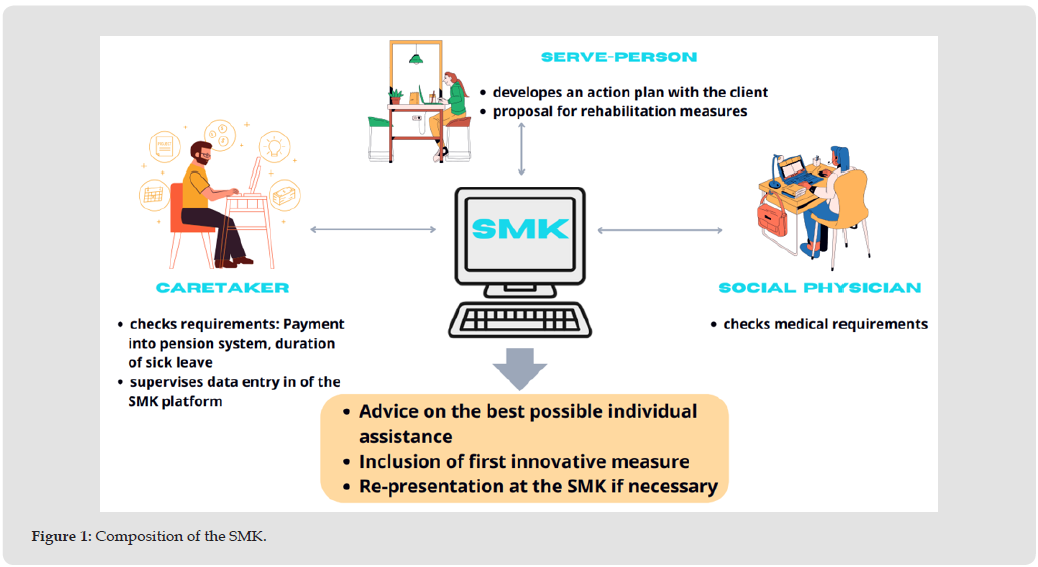
The SMK is a meeting platform for cross-sectoral experts who discuss and support the health/medical needs of the study participants digitally. The SMK consisted of the following groups of people, whose functions are described in Figure 1: “caretaker” (central coordinator of the SMK, GPI employee), SERVE person from the EA/JC and social medical physician from the GPI Hessen. The cloud-based CANKADO system accompanied the main study and served as the study center in which all data was stored. CANKADO [16], enabled time-delayed communication between the participants and facilitated intersectoral collaboration in the SMK. The SMK members were able to access the Participant’s medical history and discuss possible treatment options virtually on the central platform. After the SMK, if necessary, the general practitioner was informed to initiate the treatment program. The frequency of digital case discussions varied depending on the needs of the Participants and therapeutic progress. The Participant was accompanied and supported by their SERVE person at all stages of the reprocess.
Figure 1
Interventions
The interventions included innovative approaches as well as components of standard care. The coordination and definition of the rehabilitation program by an interdisciplinary team of the GPI Hessen and a SERVE person of the respective EA/JC within the framework of the SMK was innovative and an essential component of the project (Figure 1). Digital health applications (DiGA) could be prescribed exclusively (CASPAR Health) as an innovative measure or for aftercare (e.g. T-Rena, etc.). To support self-motivation and sustainably improve health knowledge (health literacy), the Participants were provided with POLAR smartwatches from the M430 series for one year on request. In addition, patients were able to receive a rehabilitation measure at the expense of the GPI even if the minimum qualifying insurance periods were not met. The rehabilitation program could include both regular treatments and a more flexible therapeutic sequence based on clinical findings (e.g. planning physiotherapy before a surgical procedure as part of a pre-rehab measure), which thus represented an offer that went beyond the current insurance guidelines. Both outpatient and inpatient medical and occupational rehabilitation measures were coordinated and prescribed in the SMK. The SERVE person acted as a personal coach for the Participant throughout the entire project. This ensured close and flexible support, if required, as part of case management.
Evaluation Procedure Mixed-Method Design - Sample Size and Systematic Errors
From the four institutions initially involved in the project, 25 Participants were to be recruited for the ES. Despite participating in the project, one employment agency did not participate in the recruitment, meaning that the target size for recruitment was subsequently reduced to 75 Participants. In December 2022, an additional job center was persuaded to participate through the initiative of the GPI, but without a defined target size for recruitment. The aim here was to test whether the recruitment of Participants would be successful even without dedicated SERVE case and care managers. A selection bias could not be ruled out when choosing the sample, as it is possible that only EA and JC customers who would like to return to work or who hoped that the interventions would improve their health situation registered for the project. This group was therefore already more motivated to participate. At the same time, the loss-to-follow-up bias came into play, as this particular group of people did not always reliably participate until the end of the project, meaning that data was lost and the effective sample size reduced (“drop-outs”).
Quantitative Data Collection and Analysis
The data collection took place in a pre-post comparison at two measurement points and consisted of the baseline data collection (T0) of demographic and health-related data (BMI, smoking behavior, alcohol consumption, sleep hygiene), employment status, reason for inability to work in the last 6 months, ability to work using the Work Ability Index (WAI), German version [17], and health-related quality of life using the Short Form 36 Health Survey (SF-36), German version [18]). The evaluation of the WAI enabled the Participants to provide a self-assessment of their ability to work; the SF-36 is equivalent to subjective health indicators and describes a multidimensional psychological construct that can be operationalized by at least four components: the respondent’s mental state, physical condition, social relationships and functional competence. The results were presented in a physical summated scale (KSK) and a psychological summated scale (PSK). The second measurement point (T1) was 6 months after T0. SPSS [19] software for Windows version 29.0.2.0(20) was used for the statistical analyses. Measures of central tendency and measures of dispersion were calculated. The KSK and PSK of the SF-36 questionnaire were calculated using the standardized and validated evaluation software of the Hogrefe publishing house (Hogrefe Verlag, Göttingen). As part of the analysis, the 36 items collected were coded in accordance with the specified coding guidelines and processed using the SPSS software program.
Qualitative Data Collection and Analysis
The reporting of this study follows the consolidated criteria for reporting qualitative research (COREQ, see supplementary material). Semi-structured interviews were conducted for the qualitative evaluation in order to gain insights into user experience and acceptance of the intervention. The collective of interviewees is shown in Table 1. The interviews were conducted by PS, AH and KM (all female), PS and KM each have an M.Sc. degree and are employed as research assistants at the Technische Hochschule Mittelhessen (THM), AH was an M.Sc. student as a research trainee. AH and KM had already worked on qualitative analyses in scientific papers. Before the start of data collection, the employees of THM were known to the employees of EA/ JC (weekly meetings) and GPI (meetings of the coordination group); there was no contact with the Participants before the interviews. The interviewees knew before the interviews that the experiences and outcomes of SERVE were to be evaluated in order to answer the research questions. The evaluation was carried out using a structuring qualitative content analysis according to Kuckartz with the MAXQDA (VERBI) software [20]. This is a multi-stage procedure in which topics relevant to the research question are systematically evaluated. The aim was to conduct a full survey of EA/JC and GPI employees. The Participants were surveyed using convenience sampling. The invitations to the interviews with the employees of the participating institutions were sent by e-mail; the Participants were contacted by the SERVE staff in person or by telephone.
Table 1: Overview of the qualifications of the persons (groups) interviewed.

Of the 37 Participants recruited, 25 could not be invited for an interview, either because they were no longer in contact or because they were not interested in an interview. The interviews took place in different settings following written consent to the interview. The JC project managers and the GPI employees were interviewed individually via video call with Webex [21] at their workplace and recorded using a dictaphone (Philips DVT2050). The MP3 files were transcribed using the automatic transcription function of Microsoft Word [22] and imported into the MAXQDA (VERBI) software according to Kuckartz. The transcripts were used exclusively for analysis and were not given to the interviewees. In the course of the project, a lively exchange and a close relationship of trust developed during the weekly exchange meetings between the participating SERVE persons from the EA/JC and the accompanying research team, so that conducting individual interviews did not appear to make sense. New aspects were to be discovered through the group dynamics [23]. Nine Participants were interviewed in the EA/JC, whereby only the interviewers were in the room with the Participants; three Participants were interviewed by telephone at their request. During the feasibility phase, interview guidelines were drawn up by the employees at the time and pretested with the SERVE people and two Participants. After the initial evaluations by the authors listed, it was clear that these needed to be fundamentally revised. This adjustment was made for the main phase.
It can be assumed that data saturation was reached in the interviews with the employees of the participating institutions. In the case of the Participants, additional findings could have been expected from further interviews. However, no further Participants were willing to be interviewed. The analysis summarizing the content was carried out after an initial review of the data. The key questions were categorized according to the Donabedian quality dimensions. In this way, process flows can be examined, the structural conditions in care can be recorded and the result or outcome for the Participants can be evaluated [24]. The categories were formed in MAXQDA using the guidelines by taking the deductive categories from the key questions in the questionnaires. In addition, inductive categories were formed from the data material during processing. The initial coding was carried out by AH and KM. The further coding of the transcripts was carried out using the intrarater method due to personnel constraints, i.e. the entire coding was carried out at three points in time at intervals of several weeks by the same person (KM) and in close dialog with the research team. The list of codes can be found in the supplementary materials.
Structure and Number of Study Participants Recruited for the Quantitative Analysis
During the study period, a total of 244 customers of the participating job centers and employment agencies were identified as potential participants and asked to participate. Of these, 35 Participants were included in the study. Of these, 6 were recruited during the feasibility phase and 29 Participants in the main study. This corresponded to a target achievement rate of 46.7 % for recruitment based on the original target of 75 participants. In the subsequently acquired JC, an additional 8 customers were approached and 2 of these were recruited. These were not included in the target achievement rate due to the lack of targets for the number of Participants. In summary, n = 37 Participants were recruited into SERVE. Complete data sets for evaluation were available from 21 Participants (P). 5 Ps dropped out of the study and 11 Ps did not take part in the final survey T1. Table 1 summarizes the demographic, health-related data and social characteristics of the 26 Participants with complete data sets after completion of the SERVE intervention. It shows the results of the screening questionnaire, the needs assessment, the baseline survey and the final survey. The BMI was calculated at the beginning of the data collection (T0). Due to incomplete data sets for many Participants, it was not possible to calculate the BMI for all Participants at the end (T1). The evaluation of the collected data showed an average weight reduction for 8 P. In 4 other Ps, however, there was no change in this parameter. An improvement in smoking behavior and a reduction in alcohol consumption were observed (see SERVE interventions).
In 4 cases, smoking was stopped and in 6 cases a reduction in alcohol consumption was observed until it was completely eliminated. Another positive effect is the improved sleep quality (in terms of sleep duration, satisfaction and sleepiness/regeneration) of the Participants. The analysis of the data revealed that 12 Participants showed an improvement in sleep duration. (Table 2) 9 P showed an improvement in the continuous variables were tested for normal distribution using the Shapiro-Wilk test. The variables tested were predominantly normally distributed (Shapiro-Wilk test: p<0.807). A paired t-test was used to analyze the extent to which an intervention to improve KSK and PSK was successful. The comparison of the results of the SF- 36 showed an improvement in the physical area of the KSK for 12 Ps (=32 %), the KSK value deteriorated for 5 Participants (=14 %) and no evaluation of the data was possible for 20 Ps (=54 %). No participant recorded any pre-post difference. The PSC data showed an improvement in the mental constitution of 10 Ps (=27 %), 7 Ps (=19 %) showed a deterioration and no evaluation was possible for 20 Ps (=54 %). Here too, the results showed that no participant noticed a difference in their mental state. The evaluation of the pre-post comparisons of the WAI questionnaires revealed a significant improvement in self-assessed work ability of 1 to 19 points for 12 Participants (= 32 %). In contrast, an average deterioration of 4 points was found for 6 P (16 %). Three participants (=8 %) saw no difference in their ability to work.
Table 2: Characteristics of the participants in SERVE at the beginning of data collection T0.

Note: WAI: scores from 7 to 49.
SF-36 Short Form 36 Health Survey: scores from 0 to 100, KSK physical sum
scale, PSK psychological sum scale.
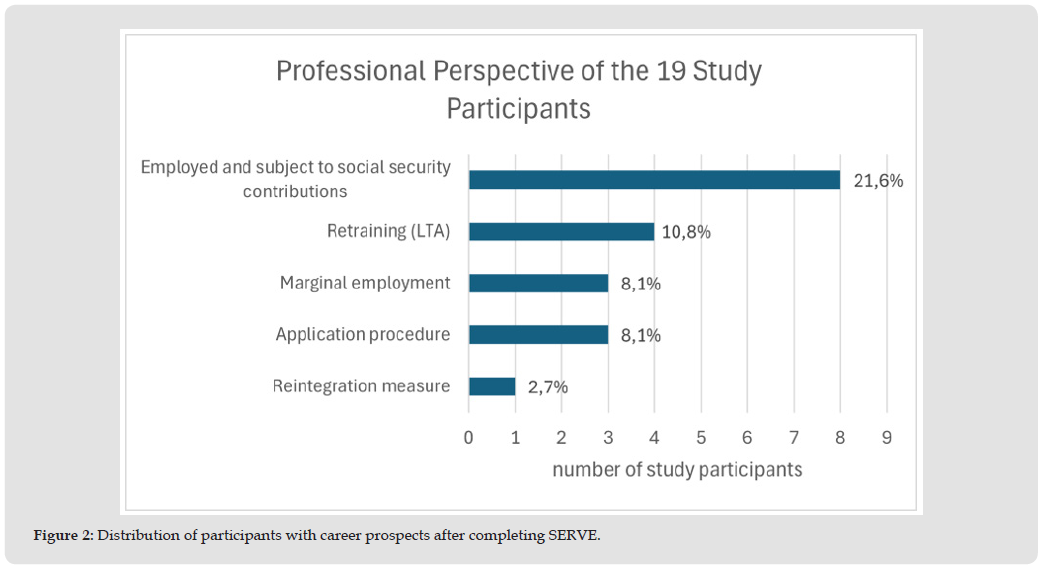
The data of 16 Ps (=44 %) could not be analyzed. The evaluation of the career prospects of the 37 Ps showed that 19 Ps (=51 %) were already back in work or were actively seeking employment. Figure 2 illustrates the distribution of the work structure. At the time of the exit survey (March 2025), 18 Ps (=49 %) were not currently planning to return to the labor market. The integration rate, defined as the proportion of employment subject to social security contributions, fully qualifying vocational training or self-employment, amounted to 32.4 % (= 12 Ps) for the ES. The rate of marginal employment was 8.1 % (= 3 Ps). Compared to SERVE, Hesse has an average integration rate of 19.63 % for 2024. The rate of marginal employment in Hesse in 2024 amounted to 6.81 % [15] (Figure 2).
Figure 2
Qualitative Results of the Professional Project Participants
With regard to the question of whether a reduced earning capacity pension could be avoided, all groups agreed that SERVE could make this possible: The intensive case and care management support provided by SERVE staff enabled new, constructive solutions and perspectives to be developed for the Participants. In addition, the P benefited from support with administrative processes. However, the rehabilitation period was observed to be too short for a comprehensive convalescence after years of unemployment/illness. Earlier intervention would be beneficial.
Quotes from the interviews: It’s actually crazy that this doesn’t even exist yet, because it would help patients. If the payers exchange information with each other...one does the measures and the other does other measures, but that we look at how we complement our measures and carry them out together, so to speak. (Interview with professional project participant). There was also agreement on the need for a digital exchange platform. Asynchronous communication was rated positively. This would make processes more effective and less time-consuming in the future. And when I think about the masses that would theoretically have to be channelled through there, then of course, then it can no longer be done in one-to-one meetings, then it is certainly a specialized software where you can perhaps communicate with each other asynchronously. I have no illusions about the timetable of a social medicine specialist at the German Pension Insurance. Then perhaps it’s also possible to work through a certain amount of time economically without constantly having to search for appointments. So, I can still see prospects and potential there that could become very fruitful. (Interview with professional project participant). The intersectoral cooperation within the ES of rehapro SERVE was greatly appreciated. The direct exchange enabled problems to be resolved quickly. The changes were perceived as a cultural change in the organizations and the contacting of Participants by GPI employees was described as an improvement in the image of the GPI vis-à-vis the insured.
What has always been important to me as a job center is that we have an interface in the first place and that we test it, and that has worked quite well so far. Yes, and we should continue to do that. (Interview with professional project participant)
Qualitative Results of the Participants
When the Participants were interviewed about their ability to manage their illness(es) independently, they reported that they were no longer afraid of the authorities or application procedures thanks to the support provided by the SERVE person. They said they were lucky to have been accepted into SERVE, as individual support is very important for people with health problems. So, I got to where I wanted to be, faster and easier with the help, namely retraining. And I believe that there are a lot of people who want to, but don’t get anywhere because they’re stuck in this disgusting system and don’t receive any support. You just don’t see them. (Interview Participant). On the question of improved quality of life and the subjective perception of their state of health after the end of the project, most respondents said that they would rate their health as rather poor. Only 3 Participants reported that they were not completely healthy, but that their situation had improved and that they would like to do more for themselves in terms of health. More than half of the Participants stated that there were living conditions that had a negative impact on their health and therefore quality of life. These were often to be found in the private environment of the family or relatives or were caused by a new illness.
So, I can now move around with a cane, no longer with crutches, which has improved things a bit. But I still need my aids. But, yes, I would say it has improved a bit... (Interview P). Nevertheless, 5 Participants stated that their overall state of health had improved or stabilized, 4 P would have needed further rehabilitation treatments to improve, and only 3 of the 12 respondents reported a deterioration in their state of health. In response to the question of professional and social participation despite health needs and thus the ability to perform their social role, 8 of the 12 Participants stated that they had already found work again or were preparing to do so. 4 P felt that they were not yet ready to return to work. Otherwise, of course, I want to get a job again and I hope that something will come of it, because I’ve also changed my strategy a bit and improved my documents and let’s hope that something will come of it. (Interview P)
The majority of Participants achieved an improvement in both their subjective ability to work and their health-related quality of life according to the evaluated data sets. However, due to the small number of cases, the study is indicative but not representative and the effect size may therefore be overestimated [25]. Nevertheless, initial trends were identified, which would need to be substantiated on a larger scale in a continuation of the project. A follow-up survey should be conducted; however, it was not possible to contact the majority of Participants again after the end of the project. More than half of the Participants are back in work or on their way there. In comparison to the average integration rate of 19.63 % in Hesse in 2024, the integration rate achieved is 29.7 % in the ES as defined by the Federal Ministry of Labor and Social Affairs (BMAS). Here, employees subject to social insurance contributions and marginally employed persons are considered together [26,27] The significant increase in SERVE may partly be affected by the aforementioned selection bias, but should mostly be based on the ins SERVE established networking between the legal areas of Social Security Code II and Social Security Code VI. The SMK and the newly established procedures enabled this for the first time. The digital communication platform provided stakeholders with a framework for exchanging relevant health and social context information and to jointly develop a personalized and integrated treatment strategy in a timely manner.
The innovation and thus success factors of SERVE-ES were also the early approach (preventive screening) and especially the personal contact persons (SERVE case and care managers) in the EA/JC for the social support of jobseekers with health-related participation difficulties. The support provided by SERVE staff in the EA/JC thus fulfilled the requirements of §16k Social Security Code II for holistic and, if necessary, outreach support for sustainable integration into the labour market. SERVE also showed that this can even be successful for older worker cohorts’ people [28]. For this group, however, it was challenging to initiate the necessary steps to improve their own (health) situation without support. Strassen et al. show that although these cohorts can find health information, they have problems assessing and understanding it. They therefore need a competent partner, in this case the SERVE person, who can guide them and thus improve their health literacy on an equal footing [29]. This is reflected in the results of the SERVE Participant surveys. The participants surveyed indicated the great importance of participating in the project for their personal health and social development. However, the answers also show that without further help and support, the newly established behavioral patterns learned during rehabilitation may not be sustainable in everyday life. An example is the continuation of sporting activity is not possible due to inflexible aftercare programs or a lack of self-motivation. In retrospect, the target number of 75 participants from the three active recruiting EA/JC institutions would have required a better filtering option for the required selection items, such as illness and state of health from the jobcentre databases.
As a result, the SERVE staff needed a lot of time to develop their own strategies for identifying suitable customers. Recruitment would also have been facilitated by broader inclusion and exclusion criteria. Many clients had to be excluded because they were too young (below 40 years) but met all other criteria and would have benefited from the project. SERVE established that cross-sector, digitally provided individual support and the use of tailored rehabilitation measures can facilitate the return-to-work process for EA/JC customers and possibly prevent premature loss of earning capacity [30]. In order to ensure the sustainability of work integration, further support in accordance with §16i Social Security Code II by the SERVE case and care managers in cooperation with the employer service of the EA/JC would be important in order to Return to Work quotas. This topic should be investigated by further research projects. Based on the results achieved in the reintegration of Participants into gainful employment or Benefits for participation in working life programs (Benefits for participation in working life=LTA), the question was raised as to what extent the financial investment for reintegration within the framework of SERVE can be compensated by added value through gainful employment. The cost-benefit analysis (CBA) carried out as part of the ES is based on a comparative scenario evaluation and will be published in parallel.
Limitations
The SERVE study began at the time of the Covid-19 pandemic. This led to a delay in the implementation of the SERVE processes in the JCs and EAs and hindered recruitment. Face-to-face meetings and conferences had to be moved to an online format. Only a reduced number of Participants could be admitted as patients to rehabilitation clinics. Outpatient rehabilitation measures could generally not be carried out. Participants who were not vaccinated against CoV-19 were refused hospitalization. As a result, there were significant postponements and delays within the project processes.
• Intensive case management and coaching of older, employable but comorbid benefit recipients allows for their reintegration into the labor market.
• A cultural change in institutions such as EA/JC and GPI has been achieved, but required time and commitment from the individual participants and organizations.
• Processes can be designed to more efficiently and effectively coordinate in a patient- centric manner across all sectors using a digital platform.


 Abstract
 PDF
PDF






























