info@biomedres.us
+1 (502) 904-2126
One Westbrook Corporate Center, Suite 300, Westchester, IL 60154, USA
Site Map
 ISSN: 2574 -1241
ISSN: 2574 -1241
ISSN: 2574 -1241
Received: June 19, 2025; Published: June 24, 2025
*Corresponding author: Jing Zhao, Doctoral Degree, Associate Chief Physician, Department of Nephrology at Nanjing University of Chinese Medicine, China
DOI: 10.26717/BJSTR.2025.62.009742
We report a case of a patient with end-stage renal disease due to hypertensive nephropathy, who underwent hematodialysis and peritoneal dialysis for 17 months. After receiving a combined treatment plan of traditional Chinese and Western medicine, the patient successfully weaned off the dialysis, and his renal function remained stable. We report this case in the hope that it will provide some enlightenment for the clinical treatment of this disease.
Keywords: Hypertension; Chronic Kidney Disease; Peritoneal Dialysis; Traditional Chinese Medicine
Abbreviations: BNP: B-Type Natriuretic Peptide; SCR: Serum Creatinine; eGFR: Glomerular Filtration Rate; AKI: Acute Kidney Injury; CKD: Chronic Kidney Disease; CRRT: Continuous Renal Replacement Therapy; TCM: Traditional Chinese Medicine; NUTMC: Nanjing University of Traditional Chinese Medicine
Hypertension affects nearly 1.3 billion people worldwide, with only 20% of these individuals receiving appropriate management [1]. The kidneys are the primary target organ affected by hypertension. poor blood pressure control can lead to kidney damage, which gradually progresses to chronic kidney disease, and eventually to end-stage renal disease [2]. The prevalence and mortality rate of hypertensive kidney damage have been increasing annually [3], and in the United States, it is the second leading cause of end-stage renal disease, accounting for about 27.5% of new dialysis patients each year [4]. Usually, patients with chronic kidney disease who had been on dialysis for over three months rarely recovered their renal function and were able to stop dialysis. Here, we report a case of a patient with end-stage renal disease due to hypertensive nephropathy, who underwent hematodialysis and peritoneal dialysis for 17 months. After receiving a combined treatment plan of traditional Chinese and Western medicine, the patient successfully weaned off the dialysis, and his renal function remained stable.
Patient Information
The patient is a 38-year-old male, 178cm tall, and has a body weight of 98.1kg. On February 26th,2022, he experienced gross hematuria, accompanied by lower back pain, chest tightness, shortness of breath, severe edema in both legs, and frequent nocturia. His blood pressure was 200/100 mmHg, and urine red blood cell count of 20,241/uL. The 24-hour urine protein was 2,191mg. White blood cells in the blood was 12.05 * 10^9/L, B-type natriuretic peptide (BNP) 709 pg/ml, serum urea 28.02mmol/L, serum creatinine (Scr) 863.9umol/L, and glomerular filtration rate (eGFR)6.0mL/ min/1.73m2. A renal ultrasound revealed that the left kidney measured 11.2*4.8cm, and the right kidney was 11.7* 4.8 cm. The renal cortex showed enhanced echogenicity, with unclear boundaries between the cortex and medulla, no separation of the renal sinus, and substantial damage to both kidneys. The patient denied any medical history or family history of genetic diseases. On March 1th, 2022, a renal biopsy was performed. The results indicated: hypertensive kidney damage and acute tubular injury. The characteristics of the kidney lesions were as follows: mild segmental hyperplasia in the glomerular mesangial area, with glomerulosclerosis (11/20). Multiple capillary loops showed significant atrophy, and the glomerular capillary loops were poorly open. There were mild chronic interstitial changes (20%), interstitial fibrosis (20%), and mild acute tubular injury (10%). The interlobar arteries showed thickened intima, stratified internal elastic lamina, and localized lumen stenosis. Electron microscopy ultrastructure observations confirmed the histological changes associated with hypertensive kidney damage.
Final Diagnosis
Chronic kidney disease stage 5, hypertensive renal damage. Heart failure, malignant hypertension.
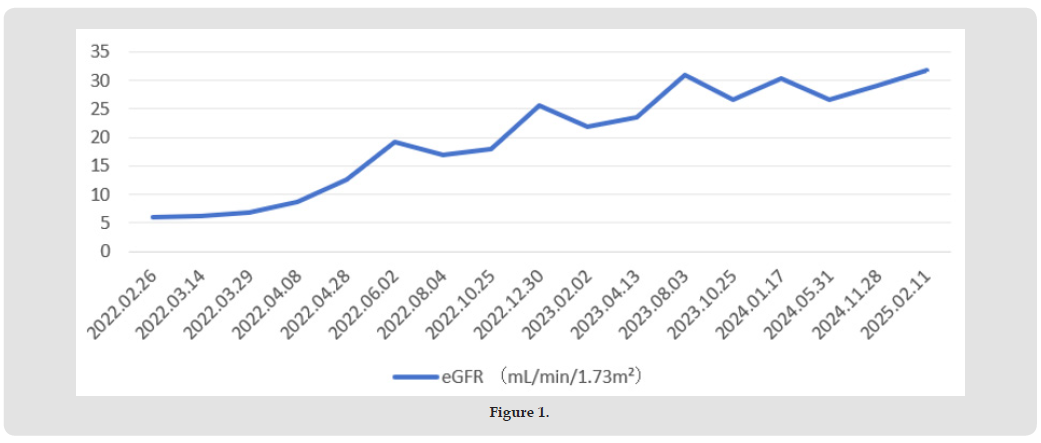
Considering the patient’s critical condition, hemodialysis treatment began on March 1st, 2022. For preserve residual renal function and in line with the patient’s wishes, a peritoneal dialysis catheter implantation was performed on March 22th,2022. On March 28th, hemodialysis was discontinued, and the patient began regular peritoneal dialysis treatment. Throughout the course of the disease, the patient received comprehensive treatments to lower blood pressure, reduce uric acid levels, and decrease proteinuria. The antihypertensive regimen included: Sacubitril/Valsartan Sodium Tablets 200mg twice daily, Metoprolol Succinate Extended-Release Tablets 47.5mg once daily, Amlodipine Besylate Tablets 5.0mg twice daily, and Terazosin Hydrochloride Tablets 2.0mg once daily. After treatment, the patient’s blood pressure remained normal. To protect kidney function and increase the glomerular filtration rate, the patient has been taking a traditional Chinese medicine formula since March 2022. The formula consists of 16 to 24 herbs and is designed to supplementing the essence of the kidneys, remove dampness and heat, and promote blood circulation and resolve stasis. Additionally, the patient has been taking other Chinese patent medicine, such as Shenwu Yishen Tablets and Zhiling Fungus Capsules, which are widely used in China to enhance glomerular filtration rate. After 17 months of regular outpatient treatment combining traditional Chinese and Western medicine, the patient’s serum creatinine gradually decreased, eGFR gradually increased, and hematuria and proteinuria were controlled. The urine output was maintained at 1000-1500 ml/day. Regular follow-ups on renal function and electrolytes, showed that eGFR fluctuated between 15-30mL/min/1.73m2. On August 3rd, 2023, a follow-up examination of renal function revealed that serum creatinine was 221.2umol/L, eGFR30.9mL/min/1.73m2, and the electrolyte levels were normal.
The patient was advised to stop peritoneal dialysis and continue the combined treatment of traditional Chinese and Western medicine, with an additional 40mg of febuxostat daily to control uric acid levels. On October 25th,2022, a follow-up examination of serum creatinine 250.0umol/L, eGFR26.7mL/min/1.73m2 was conducted. On October 31,2023, the peritoneal dialysis catheter was removed, marking the end of the patient’s peritoneal dialysis treatment. Since October 2023, the patient has been receiving combined Chinese and western medicine treatment in outpatient clinics. The renal function level is reviewed every 6 months, eGFR remains at 26.6-31.7mL/min/1.73m2, the electrolyte level remains normal, and the condition is stable (Table 1).
Table 1: Changes of renal function, routine urine and hemoglobin during diagnosis and treatment.
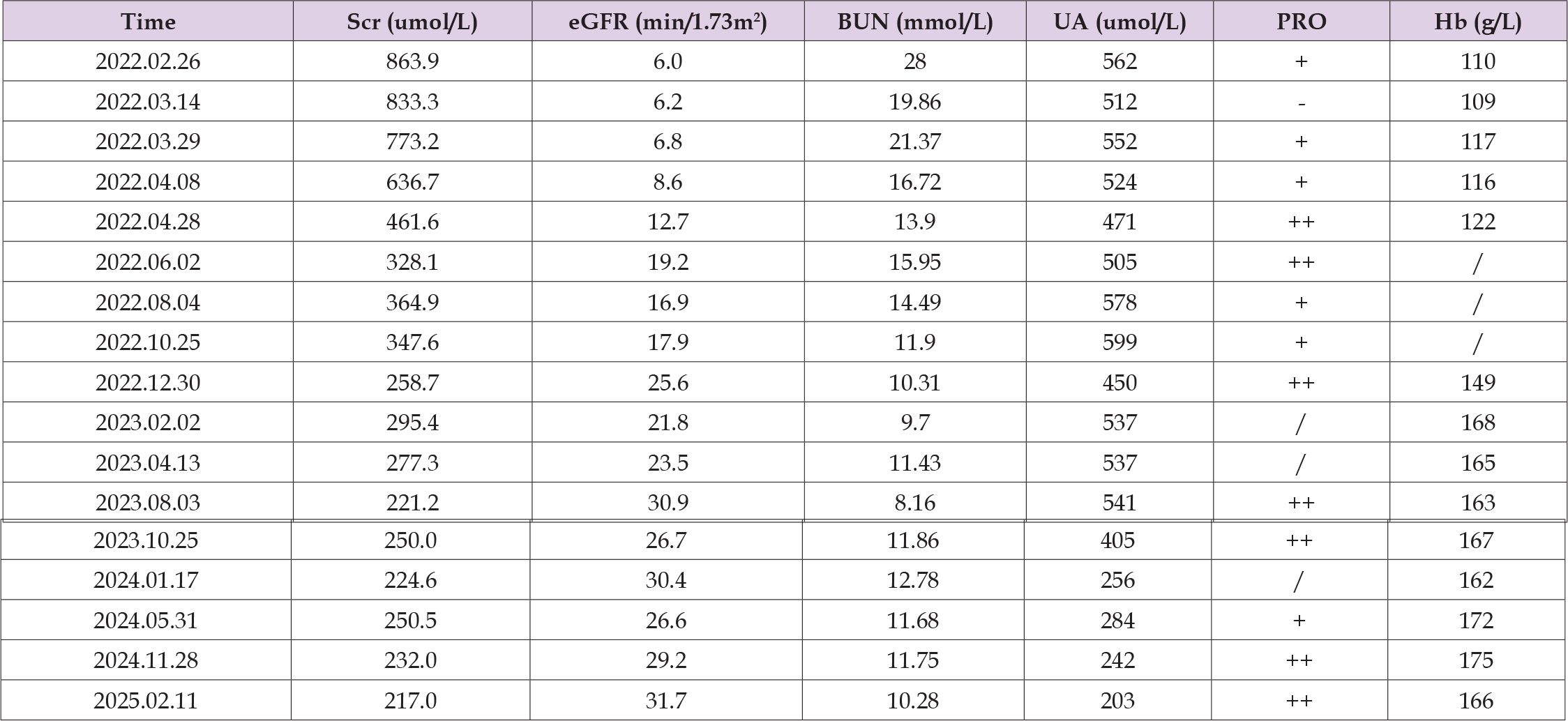
Figure 1
The prognosis of chronic kidney disease is often poor, and there are few reports about the reversal of the condition and the successful removal of the catheter after peritoneal dialysis for such patients. The success of this patient’s treatment is mainly due to the following two reasons:
Acute Kidney Injury is a Reversible Factor
The patient in this case has acute kidney injury (AKI). AKI is the most common and life-threatening condition among hospitalized patients, with a high risk of death. Studies show that AKI patients are 2.67 times more likely to develop chronic kidney disease (CKD), 4.81 times more likely to progress to uremia, and 1.80 times more likely to die [5]. However, early initiation of hemodialysis in AKI patients can reduce mortality and promote renal function recovery [6]. In this patient’s case, the condition progressed from acute to chronic kidney injury, rather than from chronic to end-stage renal disease. The former has the potential for reversal, whereas the latter almost always requires continuous renal replacement therapy (CRRT). Research indicates that acute tubular injury (such as brush border shedding and tubular epithelial cell flattening) is the sole predictor of renal function improvement within one year in patients with hypertensive nephrosclerosis [7]. The patient’s pathological diagnosis was hypertensive nephrosclerosis combined with acute tubular injury, and the light microscopic pathology predicted the likelihood of successful treatment, offering hope and confidence for both the patient and doctor’s providers.
The Combination of Chinese and Western Medicine Has Been Effective
In China, many patients with kidney diseases are treated using a combination of traditional Chinese and Western medicine. Studies have shown that traditional Chinese medicine (TCM) is effective in delaying the progression of kidney disease and reducing proteinuria levels [8,9]. This patient has been regularly followed up at the nephrology outpatient clinic of Nanjing University of Traditional Chinese Medicine (NUTMC). The treatment involves adequate blood pressure control and a combination of TCM and Western medicine to protect kidney function and slow the progression of kidney disease. According to TCM, kidney disease is caused by spleen and kidney deficiency, internal retention of water and dampness, and blood stasis. Treatment involves protecting the kidneys, clearing damp-heat, and promoting blood circulation to remove stasis, using appropriate Chinese herbal decoctions. The prescription is typically adjusted every 1-2 months, based on changes in the patient’s condition and any additional symptoms. Liver and kidney function and electrolyte levels are regularly monitored.
This case exemplifies the routine TCM treatment for kidney disease, where some patients have seen significant improvement and control. The patient initially developed renal failure due to hypertension- induced kidney damage and acute tubular injury. After discontinuing dialysis, the condition progressed to stage 3-4 chronic kidney disease. Chronic kidney disease is a progressive condition that requires long-term follow-up and treatment, including lifestyle adjustments, health management, and medication [10]. The patient’s renal function, as checked every six months, has remained stable. With ongoing treatment and monitoring, there is hope for achieving satisfactory results. In this case, a patient with hypertensive renal damage combined with acute tubular injury was treated with a combination of Chinese and western medicine during the 17-month peritoneal dialysis treatment, and the glomerular filtration rate was improved and he was discharged from dialysis treatment. We report this phenomenon in the hope that it will provide some enlightenment for the clinical treatment of this disease.
Jiangsu Provincial Health Care Research Project (BJ23011); Jiangsu Provincial Hospital of Chinese Medicine Innovation and Development Fund (Y2023CX05); Key Project of Jiangsu Province Traditional Chinese Medicine Science and Technology Development Plan (ZD202209).


 Abstract
 PDF
PDF