info@biomedres.us
+1 (502) 904-2126
One Westbrook Corporate Center, Suite 300, Westchester, IL 60154, USA
Site Map
 ISSN: 2574 -1241
ISSN: 2574 -1241
ISSN: 2574 -1241
Received: June 02, 2025; Published: June 19, 2025
*Corresponding author: Megersa Bayisa, Ethiopian Institute of Agricultural Research, Kulumsa center, source technology multiplication& seed research, Asela, Ethiopia
DOI: 10.26717/BJSTR.2025.62.009736
Food safety and quality are critical global concerns, driving the need for innovative approaches in food processing and preservation. Enzymes, as highly specific biocatalysts, are widely utilized in food processing for their potential to enhance food safety and quality by catalyzing targeted biochemical reactions under controlled and mild conditions. However, their effectiveness and safety depend on appropriate selection, application methods, and process parameters.” This literature review synthesizes recent advances in the application of key enzyme types proteases, lipases, oxidases, amylases, and laccases in improving food texture, flavor, nutritional value, shelf life, and contaminant detoxification. Comparative analyses reveal that enzymes effectively reduce allergens, lipid oxidation, microbial contamination, and enzymatic browning, contributing to safer and higher-quality foods. Despite challenges such as enzyme stability, production cost, allergenicity, and regulatory barriers, emerging technologies including enzyme immobilization and protein engineering show promise in overcoming these limitations. Future research should focus on developing robust, cost-effective enzymes and integrating enzymatic treatments with novel preservation methods. Overall, enzymes represent versatile and sustainable tools essential for meeting evolving food safety standards and consumer demands for fresh, nutritious, and high-quality foods.
Keywords: Enzymes in Food Processing; Food Safety Enhancement; Food Quality Improvement Enzymatic Biocatalysts and Enzyme Biotechnology
Ensuring food safety and maintaining food quality are critical global concerns, especially amid increasing consumer demand for minimally processed, nutritious, and microbiologically safe food products. In response to these evolving expectations, enzymes have gained prominence in the food industry as essential biocatalysts. Their ability to catalyze specific biochemical reactions under mild processing conditions offers a sustainable alternative to traditional chemical additives (Ahmed, et al. [1,2]). By improving food texture, flavor, nutritional content, and shelf life, enzymes contribute significantly to product enhancement. Advances in enzyme technology have further expanded their utility across diverse food matrices, supporting the development of safer, high-quality foods (Fernandez, et al. [3,4]). This review critically explores the multifunctional roles of enzymes in enhancing food safety and quality, highlights the current technological and application-related challenges, and outlines promising directions for future research and innovation in enzyme-assisted food processing.
Background
Enzymes are predominantly protein-based molecules that catalyze biochemical reactions by accelerating reaction rates without being consumed in the process. In food systems, they may occur naturally or be introduced exogenously to trigger beneficial transformations such as starch hydrolysis, protein denaturation, lipid emulsification, and microbial inhibition (Zhao, et al. [5,6]). These enzymatic processes not only enhance food digestibility and eliminate anti-nutritional factors but also play a vital role in reducing spoilage by neutralizing microbial toxins and residues (Bhushan, et al. [7]). Specific enzymes serve distinct functional purposes—proteases improve meat tenderness and facilitate milk coagulation, while oxidases help detoxify pesticide residues and reduce microbial contamination in fresh produce (Li, et al. [4,8]). Due to their high specificity, environmental compatibility, and minimal adverse effects on sensory properties, enzymatic treatments are increasingly being favored over conventional chemical- based methods in modern food processing (Singh, et al. [6,9,10]).
Objectives
• To review the types of enzymes used in food safety and quality improvement.
• To compare different enzymatic approaches and their effectiveness in enhancing food safety and quality.
• To identify challenges and limitations in enzyme applications in the food industry.
• To propose future directions for research and industrial application.
A systematic literature search was conducted using databases such as PubMed, ScienceDirect, and Google Scholar for peer-reviewed articles published from 2018 to 2024. Keywords included “enzymes in food safety,” “enzymes for food quality,” “enzyme applications in food industry,” and “biocatalysts in food processing.” Studies involving experimental and review articles focusing on enzyme types, mechanisms, outcomes, challenges, and advancements were included. Data from selected articles were extracted and compared in tabular and graphical forms.
Types of Enzymes and their Roles in Food Safety and Quality
Different food categories often require specific enzymes to improve processing, enhance texture, increase shelf life, or modify nutritional properties. Below is an overview of common food categories and the enzymes that are typically targeted or applied in their processing (Table 1).
Table 1: Food Categories and Corresponding Enzymes.

Comparative Analysis of Enzymatic Applications
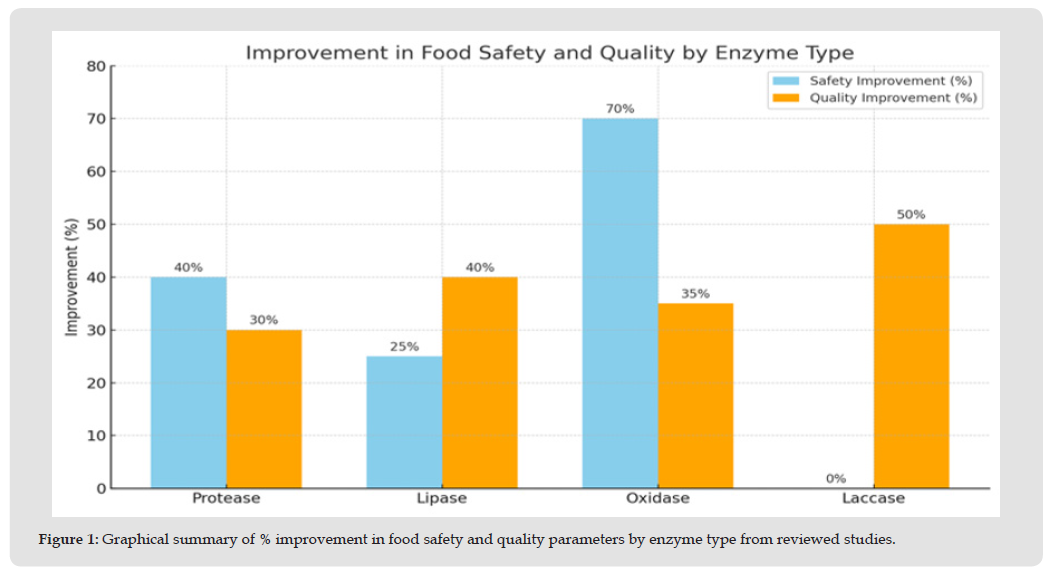
Protease shows significant improvements in both safety (allergen reduction) and quality (tenderness). Lipase enhances flavor (quality) and reduces lipid oxidation (safety) (Figure 1). Oxidase is most effective in detoxifying pesticides (safety) and reducing microbial spoilage. And Laccase mainly improves quality aspects such as browning reduction and color retention (Table 2).
Table 2: Comparative Analysis of different Enzymatic.
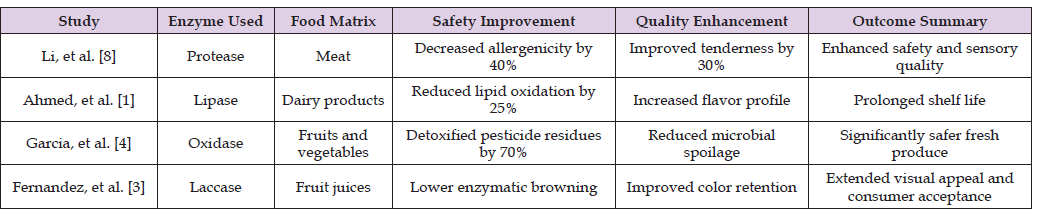
Figure 1
Mechanisms Underlying Safety and Quality Improvement
Enzymes play multifaceted roles in improving both the safety and quality of food products by inducing biochemical transformations that are specific, efficient, and environmentally friendly.
1) Detoxification of Contaminants: Oxidative enzymes such as oxidases and laccases are effective in degrading harmful chemical residues, including mycotoxins and pesticide residues that may be present in raw agricultural produce. These enzymes catalyze redox reactions that break down toxic molecules into less harmful or inert compounds, thereby reducing public health risks associated with foodborne toxins (Garcia, et al. [3,4]).
2) Antimicrobial Activity: Enzymatic interventions can also exert antimicrobial effects either by degrading the structural components of microbial cells or through the production of antimicrobial peptides. For instance, lysozymes and certain proteases disrupt microbial cell walls, while engineered enzymes can generate peptides with bacteriostatic properties (Bhushan, et al. [2,7]).
3) Texture Modification: Proteolytic enzymes such as papain, bromelain, and trypsin hydrolyze protein structures, enhancing the tenderness and texture of meat and dairy products. This enzymatic tenderization is particularly valuable in the meat industry to improve palatability and reduce processing time (Li, et al. [8]).
4) Flavor Enhancement: Lipases contribute significantly to flavor development by catalyzing the release of free fatty acids, which serve as flavor precursors in dairy, baked goods, and fermented products. These enzymes help create complex and desirable flavor profiles without the need for artificial additives (Ahmed, et al. [1]).
5) Shelf Life Extension: By reducing lipid oxidation and microbial proliferation, enzymes such as catalases and peroxidases contribute to prolonged shelf life. Their ability to degrade reactive oxygen species and suppress spoilage microorganisms enhances product stability and safety (Kumar, et al. [6,9]).
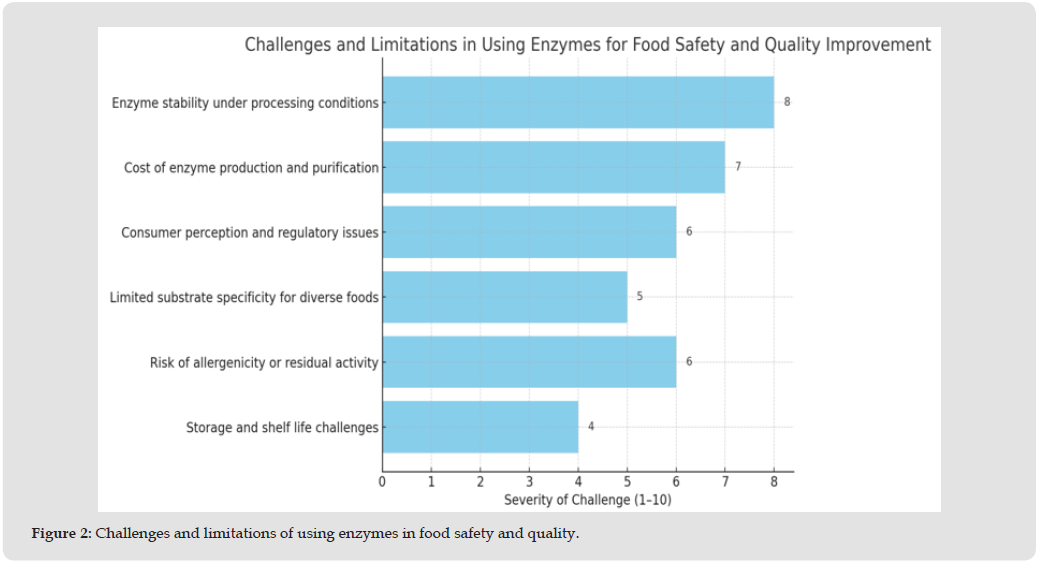
• Enzyme Stability: Many enzymes are sensitive to temperature,
pH, and food matrix conditions, limiting industrial use
(Singh, et al. [9]).
• Cost: High production and purification costs can be a barrier
for widespread application.
• Allergenicity: Some enzyme sources may induce allergic reactions.
• Regulatory Hurdles: Approval processes for enzyme use
vary globally and can delay commercialization [11-16].
• Interaction with Food Components: Enzymes may produce
unwanted by-products or affect sensory qualities negatively
if not carefully controlled (Figure 2).
Figure 2
Future efforts should prioritize the development of robust, pH-tolerant, and thermostable enzymes through microbial engineering and protein editing. These enzymes should be designed to function under extreme processing conditions and be compatible with emerging food preservation technologies such as high-pressure processing (HPP), cold plasma, and pulsed electric fields (PEF). Combining these novel techniques with enzymatic treatments can significantly enhance food safety and quality while maintaining sensory integrity. To improve cost-efficiency and reusability, the adoption of immobilized enzyme systems and advanced delivery methods such as encapsulation is essential. Exploring synergistic enzyme combinations can further optimize food processing outcomes. Additionally, integrating artificial intelligence and big data analytics will accelerate enzyme discovery, process optimization, and quality prediction. Equally important are comprehensive safety assessments, including allergenicity and toxicity profiling, to ensure consumer protection. Public education and the harmonization of global regulatory standards are crucial to building trust and facilitating market adoption. Tailoring enzyme solutions for traditional and local foods, especially in developing regions, can support nutrition and food security. Finally, sustainability should underpin all enzyme-related innovations, with life cycle assessments guiding environmentally responsible applications in food systems.
Enzymes play a vital role in improving food safety and quality by enabling natural, precise, and efficient changes to food components. As natural biocatalysts, they enhance texture, flavor, nutrition, and shelf life while offering a sustainable alternative to chemical additives. Advances in enzyme biotechnology have expanded their use across various foods dairy, cereals, fruits, vegetables, meat, and seafood with enzymes like proteases, amylases, lipases, oxidases, and lactases driving key benefits such as detoxification, antimicrobial action, and quality enhancement. Despite these advantages, challenges like enzyme stability, cost, allergenicity, regulatory issues, and interactions with food limit broader adoption. Yet, innovations in enzyme engineering, immobilization, and integration with novel processing methods, alongside AI and big data tools, promise to overcome these barriers and improve efficiency. With growing consumer demand for safe, nutritious, minimally processed foods, enzymes are an essential, eco-friendly solution. Future efforts should focus on developing robust, multifunctional enzymes suited to diverse conditions, supported by advanced delivery systems and process optimization. Aligning global regulations and increasing public awareness will further boost acceptance and market growth. Ultimately, sustainable enzyme technologies hold great potential to enhance food safety, quality, and security worldwide, particularly in developing regions.

International Association of Landscape Archaeology, Czech Glass Society, Czech Republic

Department of Chemistry, Semenov Institute of Chemical Physics, USSR Academy of Sciences, Moscow, Russia

Neurology, LA BioMed Research Institute, USA

Associate Professor at Department of Breast and Thyorid Surgey, Chongqing General Hospital, China

Professor of Nuclear Medicine, Faculty of Medicine and Surgery, University of Milan, Milan, Italy





 Abstract
 PDF
PDF



























